From the Top of V-League: The Interplay of Personality, Choice, and Timing in BaZi
After the first round of the 2026-2027 V-League season, Nam Định Steel sits atop the table, and their clash with HAGL has sparked widespread discussion. This article uses this hotspot to rationally explore the deep connections among personali
Opening Introduction
After the first round of the 2026-2027 V-League season, Nam Định Steel sits atop the table, and their clash with HAGL has become a focal point of public attention.
This article uses this hotspot to rationally explore the deep connections among personality, choice, and timing from the unique perspective of BaZi culture.
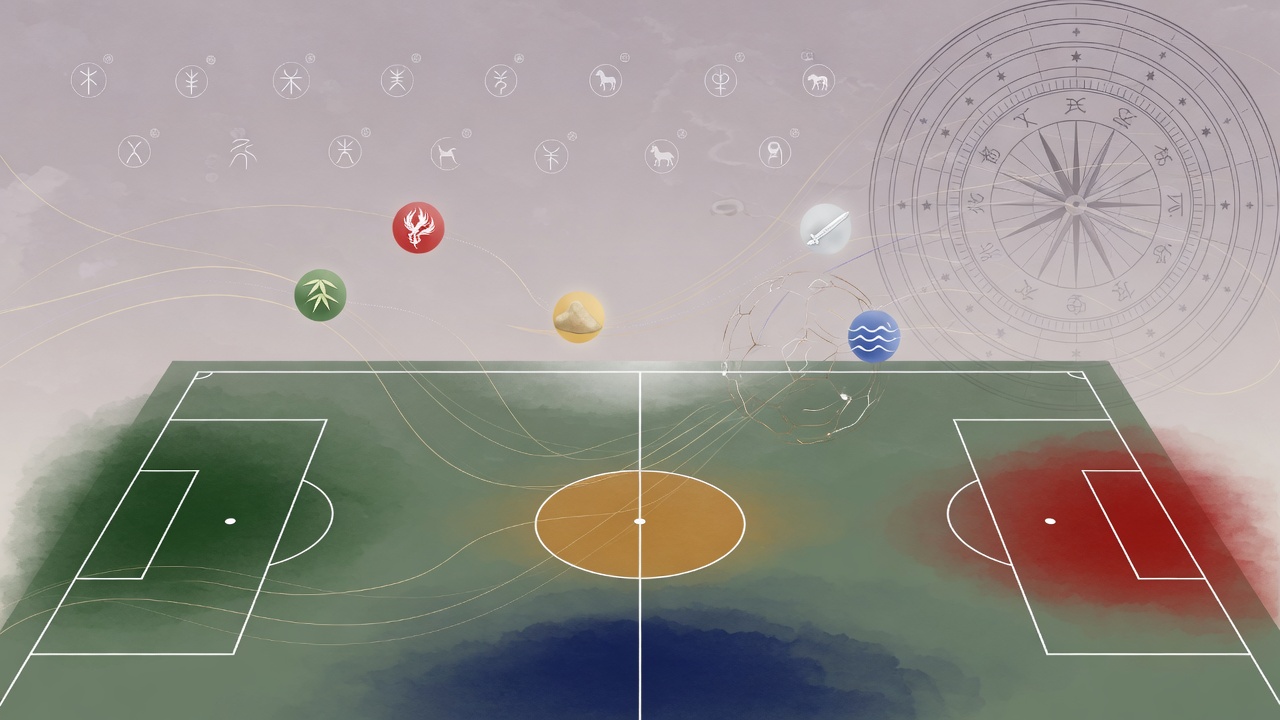
Basic Clarifications
A Quick Overview of Core BaZi Concepts
BaZi consists of four pillars — Year, Month, Day, and Hour — each made of a Heavenly Stem and an Earthly Branch, totaling eight characters, hence the name.
Among them, the Day Master represents the self, while the other seven characters interact with the Day Master through generating and overcoming relationships, forming the Ten Gods system.
Luck Cycles and Annual Cycles represent the external temporal environment, jointly influencing the course of life.
Common Misconceptions
- Misconception 1: BaZi is fatalistic and can predict match outcomes. Fact: BaZi only describes trends and tendencies, not specific events.
- Misconception 2: A team's ranking directly reflects the quality of its players' BaZi charts. Fact: Rankings are influenced by many factors; BaZi cannot be directly applied.
- Misconception 3: Using BaZi to name a team or choose numbers can change its fortune. Fact: This is a commercialized distortion of traditional culture.
- Misconception 4: BaZi can pinpoint the result of a single match. Fact: BaZi operates on a relatively coarse time granularity and cannot correspond to micro-level single-match events.
Core Insights
BaZi Personality Model: An Alternative Interpretation of Team Styles
The Ten Gods system in BaZi can be analogized to the role distribution within a team. Peer represents collaboration and competition, Expression represents creativity and performance, and Authority represents discipline and rules.
Every team can be seen as a 'chart,' where the combination of players and tactical style corresponds to the configuration of the Ten Gods, determining its performance tendencies.
- Peer and Team Cohesion: A team with strong Peer energy has strong internal collaboration but may suffer from internal friction. Nam Định Steel's stability could be seen as a result of well-balanced Peer support.
- Expression and Offensive Creativity: Strong Expression energy leads to versatile tactics and flexible attacking, but one must guard against excessive risk-taking.
- Authority and Defensive Discipline: When Authority is effective, the defense is solid and execution is strong — a common trait among title contenders.
- Day Master Strength and Pressure Resistance: A team with a strong Day Master is more resilient in adversity; a weak Day Master team needs to leverage its strengths and avoid weaknesses, choosing suitable tactics.
- Resource and Learning Adjustment: The Resource star represents learning and absorption; the coaching staff's tactical adjustment ability can correspond to the role of the Resource star.
- Wealth and Resource Management: The Wealth star symbolizes resource integration and commercial operations; a club's management capability is often related to this, but one should not over-extrapolate.
Choice and Timing: Decision Windows in Luck Cycles and Annual Cycles
In BaZi theory, Luck Cycles change every ten years, representing the broader background of a life stage; Annual Cycles change every year, representing specific opportunities of that year.
A team's season journey has a similar rhythm. Every choice a coach makes is a trade-off under specific timing.
- Luck Cycles and Season Cycles: A season is like a Luck Cycle — preseason preparation is the start, mid-season is the adjustment within the cycle, and the season's end is the closing of the cycle.
- Annual Cycles and Key Matches: The opening round, derbies, and title-deciding clashes are like different Annual Cycles; with different timing and circumstances, tactical choices must be adjusted accordingly.
- The Weight of Choice: Given the same chart, choosing to attack proactively or defend solidly can lead to completely different outcomes. A coach's decision is akin to choosing the Useful God.
- Timing and Windows of Opportunity: BaZi emphasizes 'response periods' — whether the timing is ripe. A team's peak form often erupts within a certain time window; missing it means waiting for the next.
- Dynamic Balance: Good choices are not static; they adjust flexibly with changing Annual Cycles, just as the Useful God in BaZi changes with the Luck Cycle.
- Cognitive Upgrade: From a BaZi perspective, every choice is a dialogue between personality and timing. Rational analysis is more important than blindly following the herd.
Timing Creates Heroes: The Cyclical Rhythm Behind the V-League Top Spot
From a Five Elements perspective, the start of a season is like spring when Wood flourishes, when all things grow — a time suitable for proactive progress. Topping the table in the first round fits this timing, but the law of cycles reminds us: no one stays on top forever.
BaZi thinking emphasizes dynamic balance; any advantage can transform as time passes.
- Five Elements Cycles and Season Phases: Wood governs growth, Fire governs peak, Metal governs consolidation, Water governs dormancy. Teams' form fluctuates with different phases of the season.
- The Influence of Month and Day Cycles: The specific date of the first round might subtly align with some teams' Favorable Gods, but this is only a cultural interpretation and should not be mechanically applied.
- The Inevitability of Ranking Fluctuations: BaZi thinking emphasizes dynamic balance; the top spot is only a temporary position. The remaining schedule is like subsequent Annual Cycles — change is the norm.
- Returning to Rationality from the Hotspot: The clash between Nam Định Steel and HAGL is a display of competitive strength. BaZi culture only offers a perspective for observation, not a substitute for match analysis.
- Insights from the Law of Cycles: Whether a team or an individual, one must understand the cycle of peaks and valleys, go with the flow, and not fixate on temporary gains or losses.
- Historical Perspective: The change of champions in V-League history is like the shift of Luck Cycles in BaZi; the alternation of strength and weakness is the norm in competitive sports.
Pitfall Avoidance Guide
Points to Note
- Reminder 1: Do not use BaZi to directly predict match results or scores. This is a misuse of traditional culture and goes against rational spirit.
- Reminder 2: Do not publicly analyze the private birth charts of players or coaches. Respecting privacy is a fundamental bottom line.
- Reminder 3: BaZi analysis focuses on trends and probabilities, not definitive outcomes. Any interpretation should remain open-ended.
- Reminder 4: Football is a team sport. Collective performance is influenced by tactics, fitness, psychology, and many other factors; individual destiny cannot fully explain it.
- Reminder 5: Focus on the competitive charm of the game itself and avoid excessive mystification. Rational entertainment is the right attitude.
- Reminder 6: Do not confuse BaZi culture with superstition. Learning its systems thinking is the core value.
- Reminder 7: Many online 'master' interpretations have commercial motives. Maintain critical thinking and do not easily believe unverified conclusions.
- Reminder 8: Treat BaZi as a mirror reflecting tendencies in personality and choice, not as a tool for determinism.
Summary and Recap
Key Conclusion: BaZi culture is a systemic way of observing the relationships among personality, choice, and timing.
V-League rankings, like the ebb and flow of Annual Cycles, remind us to view short-term fluctuations rationally and grasp long-term trends.