The 24 Solar Terms: Agricultural Wisdom and Astronomical Codes of the Yellow River Basin
The 24 Solar Terms are not mystical superstition, but a scientific crystallization of ancient sky-watching and earth-measuring. Originating in the Yellow River Basin, they use the solar ecliptic longitude as a precise ruler, integrating **ste
Introduction
The 24 Solar Terms are a product of ancient agricultural civilization, rooted in the soil and starry skies of the Yellow River Basin. They are not superstition, but a precise dissection of the sun's annual motion.
From budding in the Spring and Autumn period to finalization in the Qin-Han dynasties, this time-recognition system was engraved into the Taichu Calendar, becoming a living clock for farming. Understanding it is to decode the celestial-human genetic code of Chinese civilization.
Clarification: Breaking Cognitive Misconceptions
Common Misconceptions
- Misconception 1: The 24 Solar Terms are a lunar calendar. In fact, they are strictly a solar calendar, based on the Earth's orbit around the sun (the ecliptic), with one term every 15°, independent of moon phases.
- Misconception 2: The 24 Solar Terms originated in Jiangnan or the northern grasslands. The core birthplace is the Yellow River Basin, where distinct four seasons and strong agricultural needs first gave rise to concepts like Mid-Spring and Mid-Summer.
- Misconception 3: The terms simply divide seasons. They form a multi-dimensional system, covering cold-heat shifts, temperature changes, precipitation amounts, and phenological farming activities—far more than just 'Start of Spring' or 'Start of Autumn'.
Core Points: A Millennium of Evolution from Star-Watching to Calendar Fixation
Origin and Establishment: From the Spring and Autumn Period to the Taichu Calendar
During the Spring and Autumn period, ancient people could already pinpoint four key nodes: Mid-Spring, Mid-Summer, Mid-Autumn, and Mid-Winter. Observation methods were continuously refined, and by the Qin-Han period, the 24 Solar Terms system was fully established.
In 104 BC, during Emperor Wu of Han's reign, astronomers like Deng Ping and Luo Xiahong created the Taichu Calendar, officially incorporating the 24 Solar Terms into the national calendar as an official supplement for guiding agriculture in the Yellow River Basin.
- Key Turning Point: The Taichu Calendar achieved a seamless connection between solar terms and calendar, directly serving agricultural production with astronomical observations.
- Core Logic: Taking one Earth revolution around the sun as a year, the 360° orbit is equally divided, with Spring Equinox at 0° and one term every 15°, precisely corresponding to cold-heat transitions.
Dividing Basis: Fusion of Three Observation Systems
These three methods are not replacements, but a progressive fusion. Stellar shifts provided a macro framework, gnomon shadow measurement offered empirical data, and solar ecliptic longitude delivered a mathematically precise model.
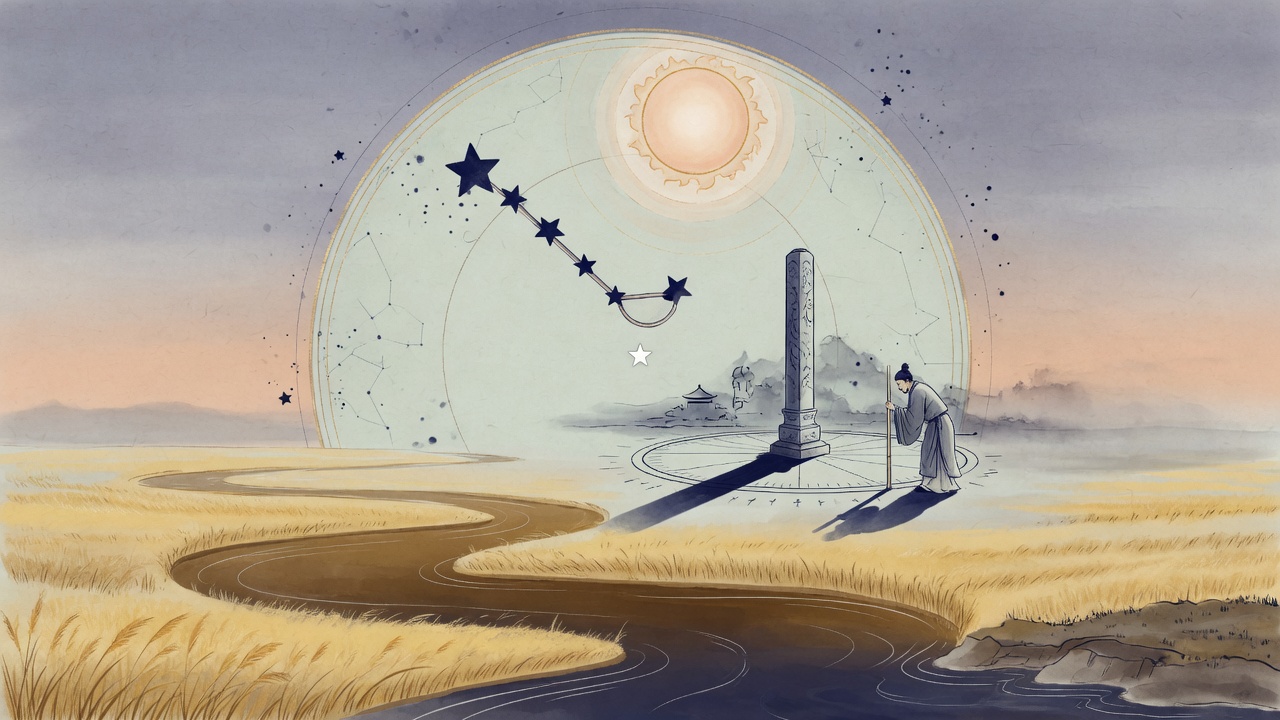
- Stellar Shifts (Dou Zhuan Xing Yi): The Big Dipper's handle direction served as an ancient 'celestial clock'. Pointing east means spring, south means summer, west means autumn, north means winter, forming the earliest seasonal cognition.
- Gnomon Shadow Measurement (Gui Biao Ce Ying): An eight-foot gnomon was erected to measure noon shadow length. Summer Solstice has the shortest shadow, Winter Solstice the longest, determining the tropical year length and calibrating term points.
- Solar Ecliptic Longitude (Tai Yang Huang Jing): Finally fixed as the ecliptic coordinate system. The sun's apparent position on the ecliptic is precisely divided into 360°, one term every 15°, completely free from geographical limits, achieving universality.
Four Categories of Solar Terms: A Complete Spectrum from Cold-Heat to Phenology
The 24 Solar Terms are not a scattered list, but a structured system by function. The ancients grouped them into four categories, covering all dimensions of nature and farming.
- Cold and Heat Shifts: Start of Spring, Spring Equinox, Start of Summer, Summer Solstice, Start of Autumn, Autumn Equinox, Start of Winter, Winter Solstice – marking seasonal beginnings and midpoints, reflecting drastic solar altitude changes.
- Temperature Changes: Minor Heat, Major Heat, End of Heat, Minor Cold, Major Cold – describing heat and cold ladders, where End of Heat means 'exiting heat', with heat fading away.
- Precipitation Reflection: Rain Water, Grain Rain, White Dew, Cold Dew, Frost Descent, Minor Snow, Major Snow – from liquid to solid precipitation, outlining wet-dry and cold-warm transitions.
- Phenology and Farming: Awakening of Insects (spring thunder wakes hibernating insects), Pure Brightness (clear and bright, all things visible), Grain Buds (wheat grains plump but not full), Grain in Ear (wheat harvest, rice sowing) – directly linked to field activities.
Practical Guide: Solar Term Pitfalls to Avoid
Important Notes
- Don't confuse solar terms with festivals: Pure Brightness (Qingming) is a solar term; tomb-sweeping and ancestor worship are later added folk customs, not the term's original meaning. Terms are astronomical points; festivals are human activities.
- Avoid rote memorization: Understand that 'Four Starts' mark season beginnings, 'Two Equinoxes and Two Solstices' mark solar direct-point turning points. Grain Buds is not 'Grain Full'—it reflects the ancient philosophy of 'modesty prevents loss'.
- Mind the North-South differences: Originating in the Yellow River Basin, phenological descriptions like 'Frost Descent' or 'Minor Snow' may lag or mismatch in South China. Adjust usage to local climate.
- Don't overlook the distinction between 'Jie' and 'Qi': Each month's first term is a 'Jie' (node), the second a 'Qi' (phase); e.g., Start of Spring is Jie, Rain Water is Qi. This yin-yang alternation structure still influences date selection and destiny analysis.
- Modern application: Solar-term health practices should follow nature but not rigidly. For example, Major Heat calls for light tonification, not heavy supplementation, adapted to individual constitution—never apply dogmatically.
Summary and Review
The 24 Solar Terms are a great invention by ancient Yellow River Basin people, centering on solar ecliptic longitude, aided by the Big Dipper and gnomon, transforming astronomical cycles into agricultural rhythms. Budding in the Spring and Autumn period and enshrined in the Han calendar, they form a four-category system of cold-heat, temperature, precipitation, and phenology, remaining a living heritage for decoding the human-nature relationship.