The BaZi Code of Penalty Redemption: Character, Choice, and Timing in Sunderland vs AZ Alkmaar
In September 2026, Sunderland faced AZ Alkmaar and Enzo Le Fée redeemed himself from the spot, turning the game around. This clash sparked heated discussion among Singaporean fans about players' psychological resilience. From a BaZi perspective, this
Introduction
One penalty kick, two possible outcomes. Enzo Le Fée's self-redemption after his initial miss led Sunderland to victory over AZ Alkmaar. This is not just dramatic sports theater—it also reflects the deep connection between BaZi (Chinese destiny analysis), personality, choice, and timing.
As global attention focused on the twelve-yard mark, let us re-examine with Eastern wisdom: Why do some people crumble under pressure while others turn crisis into opportunity? The answer may lie in the codes of Day Master strength and Five Elements flow.
This article uses the traditional culture familiar to Singaporean readers to decode the energy laws behind decision-making. It makes no predictions about match results—only rational cultural education.
Basic Clarifications
Common Misconceptions
BaZi is not fatalism; it is a tool for analyzing innate energy configurations. Many people mistakenly believe it predicts specific events, when in fact it only reveals personality tendencies and timing patterns.
- Misconception 1: BaZi is superstition. Correct view: BaZi is based on Yin-Yang and Five Elements—a traditional philosophical system, not involving spirits or gods.
- Misconception 2: BaZi can predict match outcomes. Correct view: Destiny analysis does not predict specific events; it only assesses the waxing and waning of energy fields.
- Misconception 3: A penalty miss means bad destiny. Correct view: A miss is a temporary imbalance of timing and personal state, fully adjustable through post-natal effort.
BaZi Basics: Day Master, Five Elements, and Luck Cycles
A BaZi chart consists of Heavenly Stems and Earthly Branches for year, month, day, and hour—eight characters in four pillars. The core is the Day Master, representing the self. The strength and generating/controlling relationships of the Five Elements (Wood, Fire, Earth, Metal, Water) form the basic structure of the destiny chart.
- Day Master: The Heavenly Stem of the birth day, such as Jia Wood or Bing Fire, determines basic personality and decision-making style.
- Five Elements Strength: Analyzed via the month branch and hidden stems—those commanding the season are strong, those out of season weak, influencing stress tolerance.
- Luck Cycle: A ten-year cycle that shifts every decade, guiding the overall direction at each major life stage.
- Annual Luck: The Heavenly Stem and Earthly Branch of the current year, bringing short-term energy influences that affect key performance moments.
Core Insights
Five Elements Personality Mapping: Innate Decision-Making Patterns of Penalty Takers
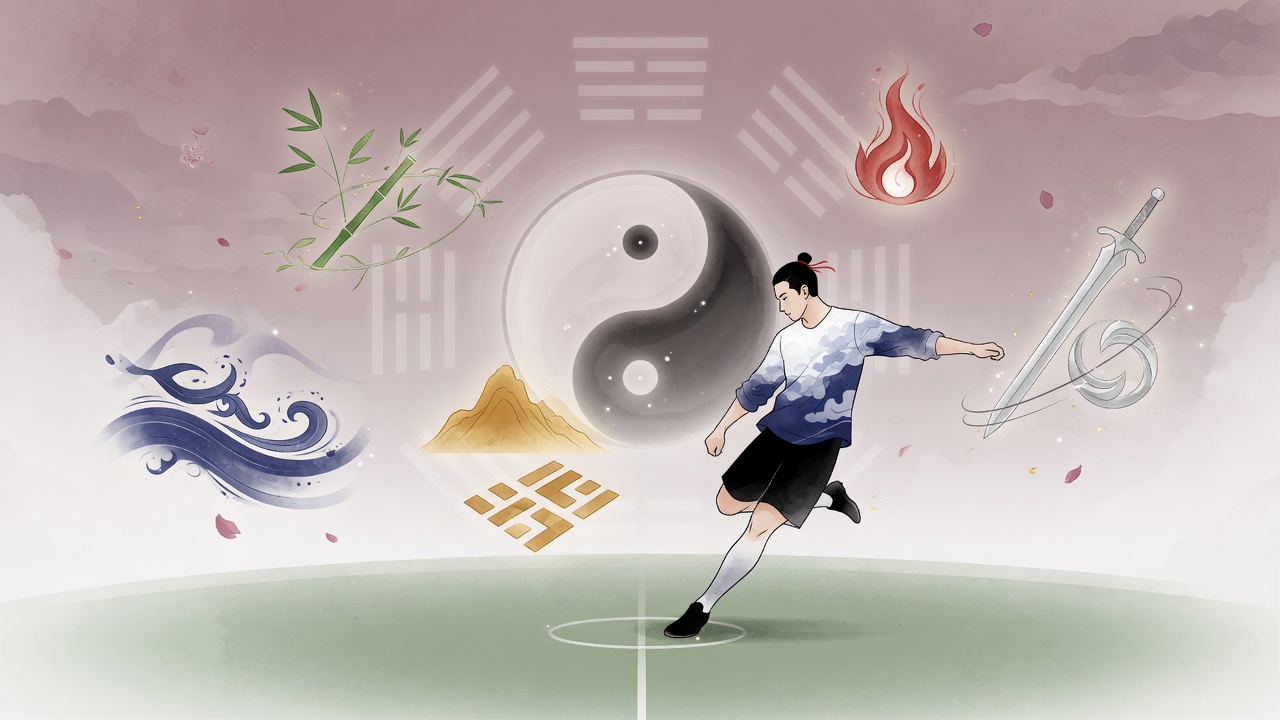
BaZi takes the Day Master as the self core, whose Five Element nature determines basic behavioral patterns. Metal stands for resolution, Water for adaptive intelligence, Wood for resilient benevolence, Fire for passionate propriety, Earth for steadfast reliability. In the moment of a penalty, a player's choice often aligns with their Five Element tendencies.
Enzo Le Fée's redemption demonstrates the adjustment ability of Wood or Water types: after initial miss, he quickly cooled down and calmly scored on the second chance. This stress-handling trait, in destiny analysis, relates to the protection of Resource Star and the release of Output Star.
Those with strong Resource Stars have solid inner spiritual support, not easily defeated by setbacks; those with flourishing Output Stars are adept at flexible adaptation and can quickly find solutions. The combination of both is precisely the destiny template for penalty redemption.
Players of different Five Element types display distinct styles on the twelve-yard line. Metal types pursue a single lethal strike; Fire types play with passionate intensity but may fluctuate; Earth types are steady yet may become rigid. Understanding one's own Five Elements can help target psychological training.
It's worth noting that BaZi is never determined by a single element, but by the entire chart's configuration. A player may possess multiple traits; the key lies in the Favorable Element—the Five Element most beneficial to the chart.
Thus, if coaching staff can grasp players' Five Element tendencies, they can select the most suitable penalty taker at critical moments, rather than relying solely on past data.
- Metal-type players: Goal-oriented, pursuing power and angle, rarely hesitating. Representative example: Roberto Carlos, with Geng Metal-like sharpness.
- Water-type players: Good at observing the goalkeeper's movement, flexibly changing direction, winning with intelligence. Neymar's trick penalties reflect Ren Water's fluid wisdom.
- Wood-type players: Internally resilient, able to quickly recover even after setbacks, like Enzo Le Fée, embodying Jia Wood's upward growth force.
- Fire-type players: Fiery passion, but easily affected by emotional fluctuations, inconsistent performance, needing stronger psychological building.
- Earth-type players: Steady and reliable, but may lack flexibility, habitually using fixed routines, easily studied by opponents.
- Favorable Element is Resource: Strong stress resistance, suitable for taking penalties when trailing; Favorable Element is Output: full of creativity, able to produce unexpected angles.
- Five Elements balanced: When the chart flows harmoniously, penalty performance is most stable—like Zinedine Zidane, who rarely took penalties but remained exceptionally calm in crucial moments.
- Post-natal cultivation: Deficiencies in Five Elements can be compensated through specialized training—Metal-weak players train power, Water-weak players train observation—this is "acquired nature supplementing innate nature."
The Pull of Timing: How Luck Cycles and Annual Luck Affect Key Performance
In BaZi, the Luck Cycle shifts every ten years and the Annual Luck changes yearly, forming the energy field of external circumstances. 2026 is a Bing Wu (丙午) year—Heavenly Stem Bing Fire, Earthly Branch Wu Fire, a blazing Fire element. For different destiny charts, this Fire energy may be a boost or a pressure.
On match day, timed with a Fire-abundant period, players' physical and mental states are influenced by timing. Those who favor Fire are energetic and sharp in judgment; those who dread Fire tend to become agitated and technically deformed. Yet this is not absolute—post-natal training can adjust innate weaknesses.
Enzo Le Fée's redemption may have benefited from the alignment of his chart's Favorable Element with the Luck Cycle and Annual Luck. When he stepped up the second time, the timing energy field had shifted to support him, helping him overcome his inner demon. Such "timing turning favorable" is quite common in BaZi.
The Luck Cycle is like the background music at each life stage, while Annual Luck is the annual interlude. If a player is undergoing a favored Luck Cycle, their overall performance tends to peak; if in an unfavorable Luck Cycle, they must redouble efforts. The 2026 Fire year presents opportunity for Fire-favorers and trial for Fire-dreaders.
Annual Luck Fire strength also means body parts related to the Fire element (e.g., heart, eyes) are more susceptible. Players need to manage energy allocation to avoid technical distortion from over-excitement. This is a cross-section of BaZi and sports science.
On a deeper level, the Five Element overlay of the specific match hour can subtly influence on-field decisions. But ordinary people need not delve into this; just understand: timing is a variable, not a fix—human agency always takes the lead.
- Fire-favorers: In the Fire-strong 2026 Annual Luck, such players often deliver supernormal performances, with quicker reaction speeds.
- Fire-dreaders: Must particularly guard emotional management against rash errors. They can balance through Water-element methods like meditation or deep breathing.
- Luck Cycle transition: If a player is around the switch of cycles, their form may fluctuate more, requiring greater team support and self-adjustment.
- Day-specific influence: The Stem-Branch combination of match day might intensify or weaken the year's Fire trend, but the effect is limited—no need for over-interpretation.
- Favorable Element is Water: Fire-strong year may suppress them; they should pre-plan psychological strategies, such as setting a breathing rhythm for penalty kicks.
- Favorable Element is Wood: Wood fuels Fire, so strong Fire may drain Wood, leading to depleted energy—boost physical reserves.
- Timing is not fatalism: History shows many superstars winning championships in unfavorable years, proving that post-natal effort and teamwork can reverse energy fields.
- Practical suggestion: Teams could apply BaZi principles to create personalized psychological adjustment plans before the season, not for superstition but for rational preparation.
Team Five Element Dynamics: The Collective Energy Field of Sunderland and AZ Alkmaar
A football team resembles a small ecosystem, where players' BaZi charts form a unique Five Element energy field. The coach's tactics and player coordination are essentially a dynamic balance of Five Element generating and controlling. Sunderland's comeback may well reflect team Five Element complementarity.
Midfield organizer belongs to Water, striker to Wood—Water generating Wood makes attack flow smooth; defensive warriors belong to Metal, the opponent's core to Wood—Metal controlling Wood effectively restricts. An ideal lineup needs all Five Elements present, flowing harmoniously, avoiding biased extremes.
From a BaZi perspective, Enzo Le Fée's redemption is not only a personal victory, but also the result of team Five Element energy blending. When an individual is under controlling pressure, teammates' mutual generation can help them through—for example, a goalkeeper belonging to Water can generate a Wood-type penalty taker.
Sunderland's turnaround may stem from the team Five Elements forming a pass-through dynamic in the second half. That is, originally conflicting elements were mediated by an intermediary (e.g., Earth), resolving conflict and allowing smooth energy flow to reverse the situation.
Although AZ Alkmaar once led, if their team Five Elements encountered mutual clash (e.g., Metal vs Wood without Water rescue), they would easily crumble under pressure. This is not hindsight rationalization, but the objective reflection of Five Element generating-controlling laws in a collective.
The coach's role is akin to the Favorable Element in BaZi. A good coach can rebalance on-field Five Elements through substitutions and formation changes, unleashing team potential. This requires acute observation and profound Five Element understanding.
- Generating combinations: Defensive midfielder (Earth) generates midfielder (Metal), midfielder generates winger (Water), forming fluid transitions.
- Controlling constraints: Center-back (Metal) controls opponent center-forward (Wood), limiting their threat; but over-controlling may lead to deadlock.
- Biased Five Elements: If one element overwhelmingly dominates (e.g., team full of Fire-type players), tactics may become monotonous and easily countered.
- Pass-through role: When Metal and Wood clash, introducing Water-type players (Metal generates Water, Water generates Wood) can dissolve conflict and activate the whole team.
- Coach as balancer: Like the Favorable Element in a chart, the coach adjusts the Five Element mix through personnel decisions—the team's "living Favorable Element."
- Substitute as surprise weapon: A substitute whose Five Element is exactly what the pitch lacks often instantly shifts momentum upon entering.
- Team Luck Cycle: A team overall can also map a Luck Cycle; if the timing favors them, they ride an unstoppable wave; otherwise, they stutter.
- Cultural revelation: The Five Element generating-controlling cycle reminds us that teamwork is not simple addition of individuals, but a dynamic balance of energies.
Pitfall Avoidance Guide
Important Notes
BaZi is a self-awareness tool, not a shackle of destiny. When enjoying football matches, we should view traditional culture rationally and avoid the following pitfalls.
Especially for Singaporean readers, this destiny education aims to inspire thought; it must never be used for gambling, discrimination, or personal attacks on players.
- Do not equate BaZi with fatalism: Destiny analysis reveals trends, not fixed outcomes. Post-natal effort and training can change the trajectory.
- Avoid judging others' success or failure through BaZi: Every person's chart is unique. A penalty miss does not mean bad destiny—merely timing not yet aligned.
- Treat Annual Luck trends rationally: Annual Luck trends are merely energy field signals; do not follow blindly, nor use as basis for investment or gambling.
- Cultural education, not prediction tool: This article uses a football hotspot to spread traditional wisdom; it makes absolutely no assertions about match results or player futures.
- Respect privacy: Never reverse-engineer a player's birth time from public data. BaZi analysis requires the person's consent; otherwise it breaches ethics.
- View Five Elements dynamically: Five Element strengths shift with Luck Cycles and Annual Luck; one miss does not define an entire career.
- Team surpasses individual: Football is a collective sport; even the best personal BaZi cannot win without teamwork.
- Maintain an open mind: Destiny study and science are not opposed. Many elite coaches are already applying similar thinking to optimize team management.
Summary & Recap
Success and failure on the penalty spot are both technical battles and resonances of character and timing. Enzo Le Fée's redemption mirrors the BaZi principle of Favorable Element gaining strength, telling us: at pivotal moments, understanding ourselves and aligning with timing allows the best choice.
BaZi culture offers a framework for observing human nature; it predicts no outcome, yet illuminates the path of choice. Next time a twelve-yard showdown unfolds, we might read more Eastern wisdom within it.