The Epochal Choices of the Naval Academy and the Four Pillars of Destiny: An Eastern Understanding of Character, Timing, and Resolve
When the site of the 해군사관학교 (Naval Academy) is discussed as a potential strategic base, the currents of the era once again push individual and collective choices to the forefront. Amid South Korea’s heightened focus on security and the future, we exp
Opening Guide
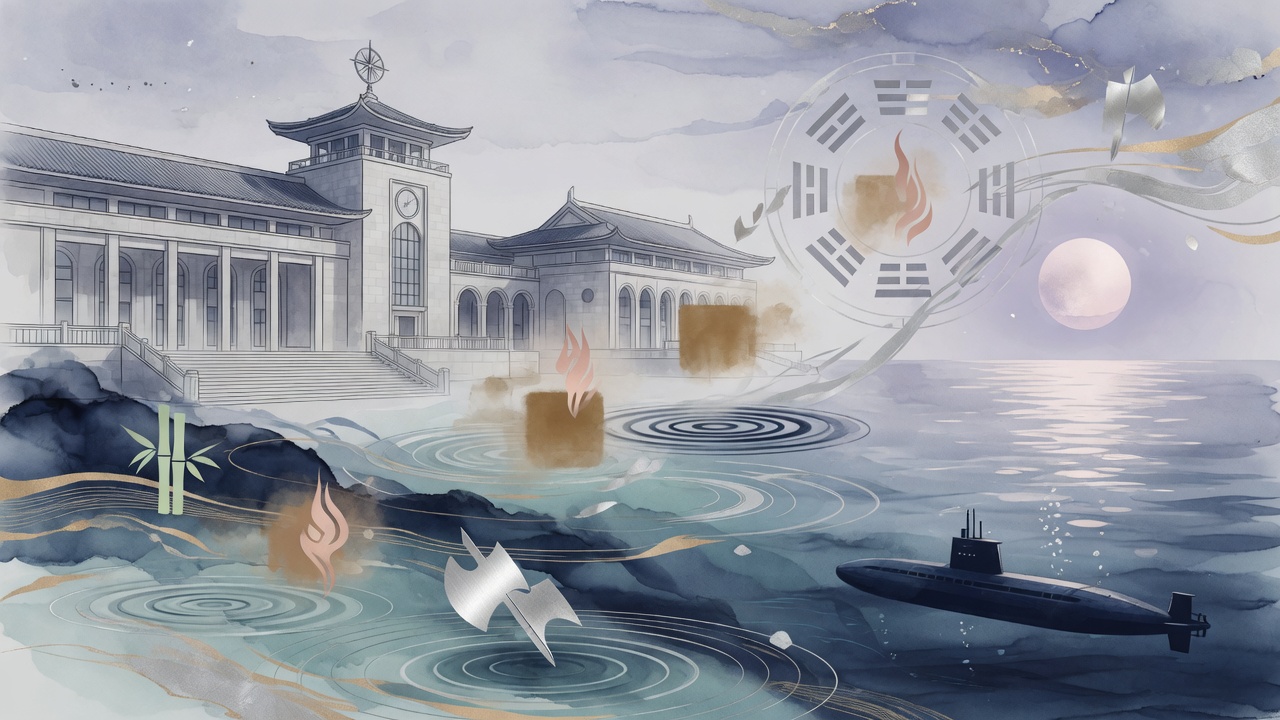
The Republic of Korea Naval Academy (해군사관학교) is not only a cradle for training commanders, but has recently entered the public eye due to discussions over its selection as a site for a nuclear-powered submarine base (핵추진잠수함 기지). This macro-level layout subtly echoes the mental structure in Bazi culture where individual destiny intertwines with the fortunes of the era.
This article treats Bazi as an analytical framework for character and timing, rationally popularizing its core principles. It does not presuppose the natal chart of any real person, nor does it make any auspicious or inauspicious assertions about military decisions or geopolitics.
Basic Clarification: Bazi Is Not Fatalism, but a Map of Endowment
Three Misunderstandings of Bazi Theory
Many people’s first impression of Bazi stops at fortune-telling or determining good or bad luck. Especially in South Korea, Saju (사주) is often associated with New Year’s fortune or daily divination, but its underlying logic is far more complex than mere prediction.
- Misunderstanding 1: Bazi determines everything — Bazi provides the innate Five Element qi endowment and the Ten Gods configuration, akin to a person’s factory settings. Acquired choices, education, environment, and the opportunities of the era equally determine the final path.
- Misunderstanding 2: Bazi is equivalent to divination — Genuine Bazi analysis emphasizes character traits, aptitude tendencies, and cyclical rhythms, not simplistic one-off divination.
- Misunderstanding 3: It has nothing to do with timing — Luck Cycles and Annual Luck reflect the resonance bands between the individual and the macro environment. The changing role of the Naval Academy through the times is a typical example of how timing influences collective trajectories.
Differences in Bazi Perception within the Korean Context
In South Korea, Saju Palja permeates almost all major life decision consultations. However, public perception still mainly revolves around the simplified assessment of the Month Branch (월지) corresponding zodiac animal and Five Element, with less in-depth structured analysis of the Ten Gods and Chart Patterns.
This article aims to introduce a more systematic perspective: Bazi is not about judging good or bad, but about understanding what kind of environment and which timing is more conducive to the exercise of specific character traits and abilities.
- Simplified Korean Saju: Emphasizes the generating and overcoming cycles and Five Element surface representations, suitable for quick reference but prone to fragmentation.
- Pattern-based Bazi: Anchored in the strength of the Day Master and the combination of Ten Gods, it more closely approximates a complete model for character and decision analysis.
Core Points: Character, Choice, and the Metaphors of Military-Political Decision-Making in Bazi
Day Master and Five Element Portraits: Bazi Archetypes of Officer Character
In a Bazi chart, the Heavenly Stem of the Day Pillar is called the Day Master, representing one’s innate nature and core drive. In the temperament imagery of naval officer cohorts, two types of Five Elements are particularly relevant:
Geng Metal and Ren Water. Geng Metal is Yang Metal, symbolizing axes, swords, and blades, embodying decisiveness, discipline, and assault traits; Ren Water is Yang Water, symbolizing rivers, lakes, and seas, carrying strategic vision, fluid adaptability, and inclusiveness.
Of course, the natal charts of actual officers cannot be uniform, but these two elemental energies are often symbolically projected in maritime military thinking.
- Geng Metal Day Master: Sharp and resolute, suited for rapid decision-making and high-pressure command, but must be cautious that excessive rigidity may lead to coordination weaknesses.
- Ren Water Day Master: Flexible and embracing, skilled in strategic layout and cross-domain synergy, but without Earth to regulate, may fall into over-dispersion.
- Five Element complementarity: Submarine bases emphasize concealment, endurance, and depth, which hold particular symbolic significance in the cycle of Gui Water (Yin Water) and Geng Metal generating Water.
Ten Gods Configuration: Bazi Reflections of Power, Responsibility, and Hidden Pressure
The Ten Gods are labels for the generating and overcoming relationships between other Heavenly Stems and Earthly Branches and the Day Master, delineating a person’s social capabilities and inner tension structure. At the level of military organization and national strategy, several groups of Ten Gods are especially critical:
Direct Officer represents rules, discipline, and public responsibility, forming the core of institutional leadership; Seven Killings represents decisiveness, crisis management, and breakthrough power, underpinning wartime response and unconventional operations; Indirect Resource brings meticulous strategy and technological comprehension.
Nuclear-powered submarines, as cutting-edge technological weapons, require the combined action of Seven Killings' boldness and Indirect Resource's precise thinking behind the scenes. This is not to assert the natal charts of specific individuals, but to illustrate the implicit demands that particular missions impose on mental configurations.
- Strong Direct Officer: Suitable for institution-building and routine fleet management during stable periods, emphasizing legal frameworks and hierarchy.
- Seven Killings properly controlled: A breakthrough leader in times of crisis, capable of bearing high-risk decisions, but if uncontrolled, easily becomes impulsive.
- Indirect Resource revealed: A think-tank type talent in the era of technological weaponry, especially needed in high-precision fields like submarines and cyber warfare.
- Mixed Direct Officer and Seven Killings: Those with a strong Day Master can balance daily governance and emergency leadership; those with a weak Day Master easily fall into anxiety and dual pressures.
Luck Cycles, Annual Luck, and Resonance with the Times: Why the Submarine Base Is Proposed Now
The core dynamic timeline of Bazi consists of Luck Cycles (ten-year steps) and Annual Luck (yearly rotations). They do not predestine events but describe the energetic bias of a certain period for the individual and social environment.
Suppose a symbolic ‘naval institution’ Bazi chart (entirely hypothetical, for logical demonstration only). If its current Luck Cycle enters a prosperous Metal and Water phase, and encounters Geng Shen, Gui Hai and similar Metal-Water Annual Luck pillars, this reinforces themes of maritime, mobility, and deep defense.
In reality, the emergence of related reports in 2026 reflects the macro timing of geopolitical-technological evolution and upgraded security demands. This can serve as a cultural parallel to the rhythm in Bazi where a cycle transitions from Wood, Fire, Earth to Metal, Water.
- Luck Cycle transition periods: The shift of Luck Cycles every ten years often serves as a window for personal or organizational strategic reshaping.
- Annual Luck triggers: For example, Metal-Water years favor maritime affairs and the advancement of concealed systems, a Bazi expression of ‘the trend of the times makes it so.’
- Correspondence between Heaven and humanity thinking: The generational mission shift of the ROK Naval Academy can be viewed, within the Bazi framework, as a synchronization of collective Luck Cycles and environmental hexagrams.
- Non-predictive principle: Bazi absolutely does not predict whether a nuclear submarine base will be approved or when it will be built; it only analyzes why this type of strategy is more likely to be placed on the agenda during specific periods.
From ROK-U.S. Cooperation to Independent Armaments: The Metaphor of Heavenly Stem Combinations
In Bazi, there is the theory of Five Combinations of Heavenly Stems, such as Jia-Ji combining into Earth, Yi-Geng combining into Metal, etc., often used to analyze cooperative relationships and resource integration. Structurally mapping this onto international military cooperation yields a non-divinatory cultural interpretation.
Taking nuclear submarines as an example, their propulsion systems involve high-level technological integration and multi-tiered transnational collaboration. In the Bazi framework, the mutual generation and combination of Geng-Xin Metal and Ren-Gui Water hint at the deep compatibility between technological breakthroughs and maritime strategy.
This does not imply any specific combination relationship between particular nations, but offers a thinking template: Bazi Five Element combination thinking can help understand the abstract structures of resource complementarity, technology transfer, and timing alignment.
- Jia-Ji combining into Earth: May correspond to joint infrastructure construction, such as base building and logistics integration.
- Yi-Geng combining into Metal: Often involves joint R&D of core technology and hard equipment, emphasizing precision and discipline.
- Bing-Xin combining into Water: The formation of strategic assets brought by water domains and cooperation; submarines belong to Water, so this combination metaphorically suggests maritime security collaboration.
- Ding-Ren combining into Wood: Involves the generation of emerging systems and innovative alliances, such as next-generation tactical networks and alliance expansion.
Pitfall Avoidance Guide: Rational View of Destiny, Not Superstitious Rigid Application
Precautions: Common Misuses in Bazi Analysis
- Never match specific individuals by assumption: All Bazi descriptions in this article are abstract character patterns. Before publication, no real officer’s or political figure’s birth data was consulted. Readers should not use this as a basis to speculate on the fate of any person or institution.
- Avoid labeling by Five Elements: The strength of Five Elements is merely a reference framework. Geng Metal does not necessarily represent combat prowess, nor does Ren Water necessarily equal wisdom; comprehensive judgment must integrate the Chart Pattern and Ten Gods.
- Luck Cycles are not set in stone: Luck Cycles and Annual Luck provide energetic tendencies; the final outcome is jointly constituted by decisions, environment, and collective action, and absolutely cannot be determined by Bazi alone.
- Beware of Bazi distortions in news headlines: Hot events are often exploited to attract attention with divinatory predictions. This article firmly refuses to predict whether the submarine base will be approved or when it will be built, using the news background only as a lead-in for cultural education.
- Distinguish individual from collective destiny: The Naval Academy as an institution does not possess a unified ‘Bazi chart.’ The symbolic collective discussion here is only for pedagogical convenience and must not be equated with deterministic institutional destiny.
- Never ignore real-world variables: Budget, technological bottlenecks, international treaties, domestic politics are all real variables; Bazi cannot bypass them to directly pronounce success or failure.
- Awareness of Korean traditional cultural differences: The cultural practice of 한국 사주 has its unique lineage. This article integrates the traditional Bazi system for rational exposition, but one should still note the differences in terminology and interpretive habits between the two countries.
How to Healthily Use Bazi Thinking to Observe Current Events
- Learn Five Element dialectical thinking: Treat Bazi as an exercise in evolutionary thinking, observing the driving and constraining relationships among things through the generating and overcoming cycles of the Five Elements.
- Focus on cyclicality rather than certainty: Repeatedly read the descriptions of Luck Cycles and Annual Luck to appreciate the sense of cyclical rhythm, rather than pursuing definitive answers.
- Integrate modern analytical tools: Strategic analysis, organizational behavior, geopolitical models, and the Bazi framework can complement each other, moving step by step toward multi-dimensional cognition.
- Do not be hijacked by panic emotions: No military-related term should cause self-induced panic or euphoria simply because a certain Five Element appears in a Bazi chart. Beyond emotional stress, please return to rational reading.
Summary and Recap: The Bazi Framework Aids Understanding of Choices, Not Predicting Outcomes
There is no necessary predictive relationship between the changing fortunes of the 해군사관학교 and Bazi theory, but it can serve as a cultural key for understanding character tendencies, decision windows, and the rhythm of the times.
Key conclusion: Bazi is a structured language of endowment and temporal dynamics, not a verdict of fatalism. Behind real-world events such as military strategy and base site selection, multiple factors—political, technological, diplomatic, budgetary—are interwoven; Bazi can only offer a mode of thinking.
Using Bazi as an observational tool rather than the sole basis for decisions; maintaining rational discernment and not being misled by cultural concepts into treating them as absolute truth, is an attitude worth upholding in this complex era.