From MotoGP Mandalika to Ba Zi Wisdom: The Competitive Spirit of Bi Jie and the Technical Brilliance of Shi Shang
At the 2026 MotoGP Mandalika, Aprilia Racing's Marco Bezzecchi took victory, intensifying the championship standings. Behind this spectacle of speed, the Ba Zi concepts of Bi Jie and Shi Shang offer a unique lens to interpret the fierce r
Opening Introduction
As MotoGP arrived at Indonesia's Mandalika, Aprilia's Marco Bezzecchi emerged victorious in the 2026 season, reflecting a fierce, multi-rider championship chase. This intense competition serves as a perfect entry point for understanding the core Ba Zi concepts of Bi Jie and Shi Shang.
Ba Zi is not fatalism. It is a symbolic system for analyzing personality traits and energy trends. Through it, we can more rationally understand a racer's behavioral patterns and state changes under high-stakes pressure.
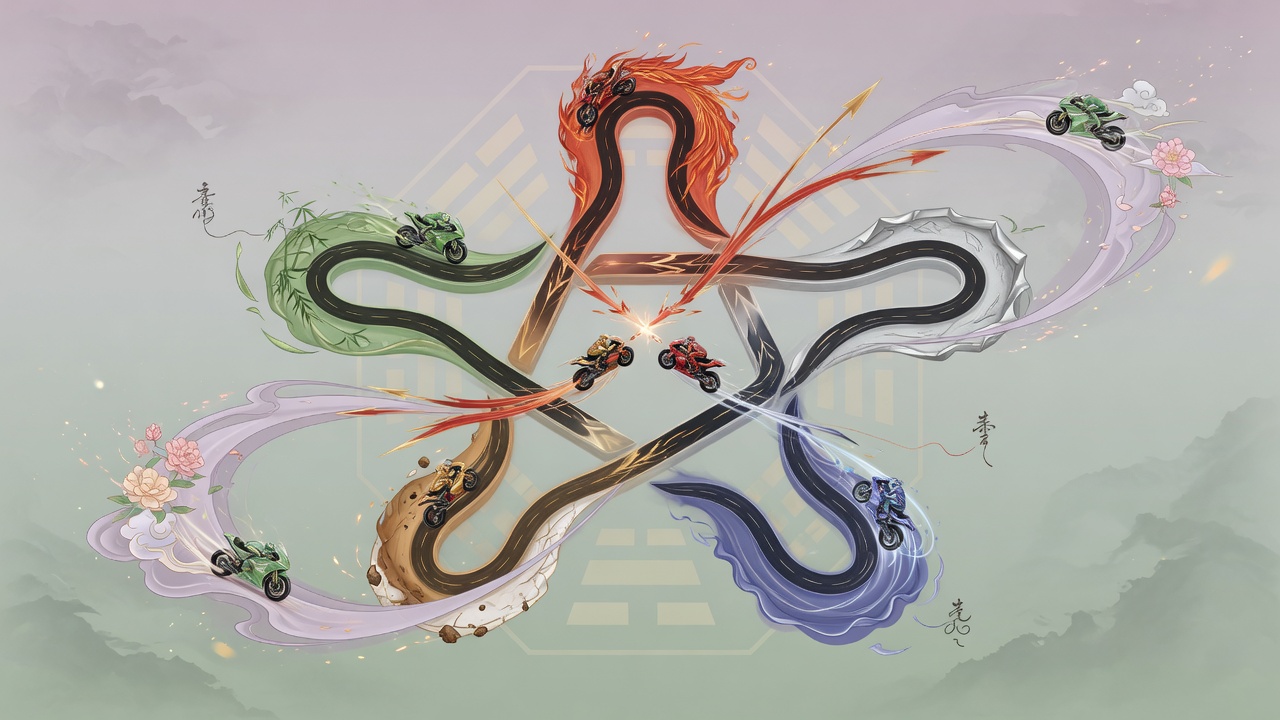
Basic Clarification: Ba Zi is Not Superstition
Common Misconceptions
- Misconception 1: Ba Zi can precisely predict race results. In reality, it only reveals personality tendencies and energy cycles, not specific event outcomes.
- Misconception 2: A strong Bi Jie always means a combative nature. Bi Jie represents peer relations and competitive awareness; its strength must be assessed within the total chart configuration, not through simple labels.
- Misconception 3: Shi Shang is purely artistic talent. While it governs technical expression, in competition it more accurately relates to on-the-spot creativity, reaction speed, and tactical flexibility.
- Misconception 4: A champion can be identified by the Day Master's strength alone. Ba Zi requires a synthesis of Five Element flow, Ten God combinations, and Luck Cycles. Isolated judgments are highly misleading.
Core Insights: The Competitive Code from a Ba Zi Perspective
Bi Jie: Peer Competition and Energy Resonance on the Track
In Ba Zi, Bi Jian and Jie Cai are collectively known as Bi Jie. They represent elements of the same kind as the Day Master. On the track, Bi Jie directly corresponds to rivals, teammates, and the entire group of competitors.
When annual or decade luck cycles enter a strong Bi Jie phase, a racer keenly feels increased peer pressure as rivals collectively find top form. Yet, this also means competition ignites potential, often leading to limit-breaking performances during close battles.
- Bi Jian symbolizes healthy competition, like technical sparring within a team that promotes mutual improvement without damaging harmony.
- Jie Cai carries a stronger confrontational edge, often manifesting as aggressive overtakes and direct duels for position.
- If Bi Jie is overly strong and the Day Master is weak, a sense of being overwhelmed is common. If Bi Jie is favorable and flourishes, the racer becomes more battle-hardened.
- In team dynamics, Bi Jie also governs crew coordination. Though racing is individual, factory support and mechanic synergy are influenced by this energy.
Shi Shang: Technical Showcase and On-the-Fly Creativity
Shi Shen and Shang Guan, collectively termed Shi Shang, are produced by the Day Master. They represent talent, expression, skill, and enjoyment. A racer's delicate control, cornering lines, and instinctive braking judgment all fall into the Shi Shang category.
Shi Shen governs consistent performance with a smooth rhythm, excelling in tire and fuel management with an elegant, efficient style. Shang Guan fuels audacious overtaking and unconventional line choices, adding spectacular flair but with a tendency towards fluctuating stability.
- Charts with strong Shi Shang typically feature high coordination and rapid reflexes, a common configuration among elite racers.
- Shi Shen Controlling Sha: Shi Shen can restrain the pressure from Qi Sha, transforming crisis into precise maneuvers and calm danger avoidance in critical moments.
- Shang Guan Opposing Guan: A clash between Shang Guan and Zheng Guan can trigger rule disputes or penalized risk-taking, requiring a harmonizing luck cycle to turn peril into safety.
- If Shi Shang is too weak, on-track performance becomes rigid and lacks adaptability. If too strong and unchecked, overconfidence can lead to critical mistakes.
Chart Structure and Luck Cycles: The Time Windows of Competitive Form
Ba Zi emphasizes dynamic balance. The natal chart determines foundational talent, while Luck Cycles and Annual Stars map the curves of form. A racer's peak performance often aligns closely with periods where the favorable gods are supported.
For instance, a strong Day Master with a Qi Sha structure favors Shi Shang to control the Sha or Wealth stars to produce it. When a luck cycle enters a strong Shi Shang phase, their skills are fully unleashed, sharply boosting competitiveness. If a Bi Jie cycle steals the Wealth star, sponsorship may shrink or team friction increase.
- A Strong Day Master favors draining: Shi Shang, Wealth, and Officer/Sha are favorable; encountering them benefits technical output and ranking breakthroughs.
- A Weak Day Master favors support: Resource and Bi Jie stars are favorable; encountering them aids physical recovery, strong team backing, and enhanced stress resistance.
- An annual clash with the Day Pillar or favorable god often corresponds to major seasonal turning points or unexpected incidents, demanding a calm response.
- Competitive destiny analysis emphasizes active stars—Qi Sha, Shang Guan, Jie Cai, and Pian Cai. Years where these Ten Gods are active often produce dramatic highs and lows in performance.
Pitfall Avoidance: A Rational View on Competitive Destiny Analysis
Key Precautions
- Never judge by a single pillar: Don't focus solely on the Day Stem. You must synthesize the entire chart structure, Five Element flow, and Ten God configurations.
- Avoid absolute pronouncements: Destiny analysis provides a probability range and energy tendency, not a definitive ranking prediction.
- Don't ignore real-world variables: Machine performance, team strategy, weather, and track characteristics carry far more weight than symbolic representations.
- Don't be superstitious about a 'champion's chart': No Ba Zi chart dooms one to be a world champion. Acquired training and timing mastery are the ultimate keys.
- Use symbolic stars cautiously: Stars like 'General Star' or 'Traveling Horse' serve as auxiliary references but should never be used independently from the Five Element framework.
- Respect privacy: When publicly discussing riders' charts, never fabricate specific birth times. Conduct only theoretical deductions to avoid creating misinformation.
Final Recap
The wisdom of destiny analysis in competitive sports lies in understanding the symbiotic rivalry of Bi Jie and the technical breakthroughs of Shi Shang. Ba Zi offers a lens to observe personality traits and energy cycles—a mirror reflecting a racer's behavioral patterns under pressure, not shackles that dictate their fate.
Applying this rational mindset allows us to appreciate a race with greater depth, but the true victory is always decided between every brake application and twist of the throttle on the asphalt.