From Indonesian Hijri Date Searches to the Time Wisdom in BaZi GanZhi Timekeeping
When Indonesian netizens search “Hari Ini 19 Oktober 2026 Tanggal Berapa Hijriah,” behind it lies a need to confirm temporal coordinates. This need crosses cultures: in Chinese tradition, BaZi destiny analysis likewise relies on a precise tim
Introduction
On October 19, 2026, Indonesian netizens searched Google for “what is the Hijri date today,” a behavior that reflects humanity’s instinctive need for temporal orientation. In Chinese cultural circles, BaZi destiny analysis likewise depends on a unique time-marking system that converts year, month, day, and hour into combinations of Heavenly Stems and Earthly Branches, forming a personal time archive.
One calendar is based on lunar phases, the other on the solar return and solar terms; they seem very different, yet both share reverence for natural cycles. Starting from this trending topic, this article takes you into the world of BaZi GanZhi timekeeping, to understand how traditional destiny analysis interprets the relationship between the flow of time and personal choices.
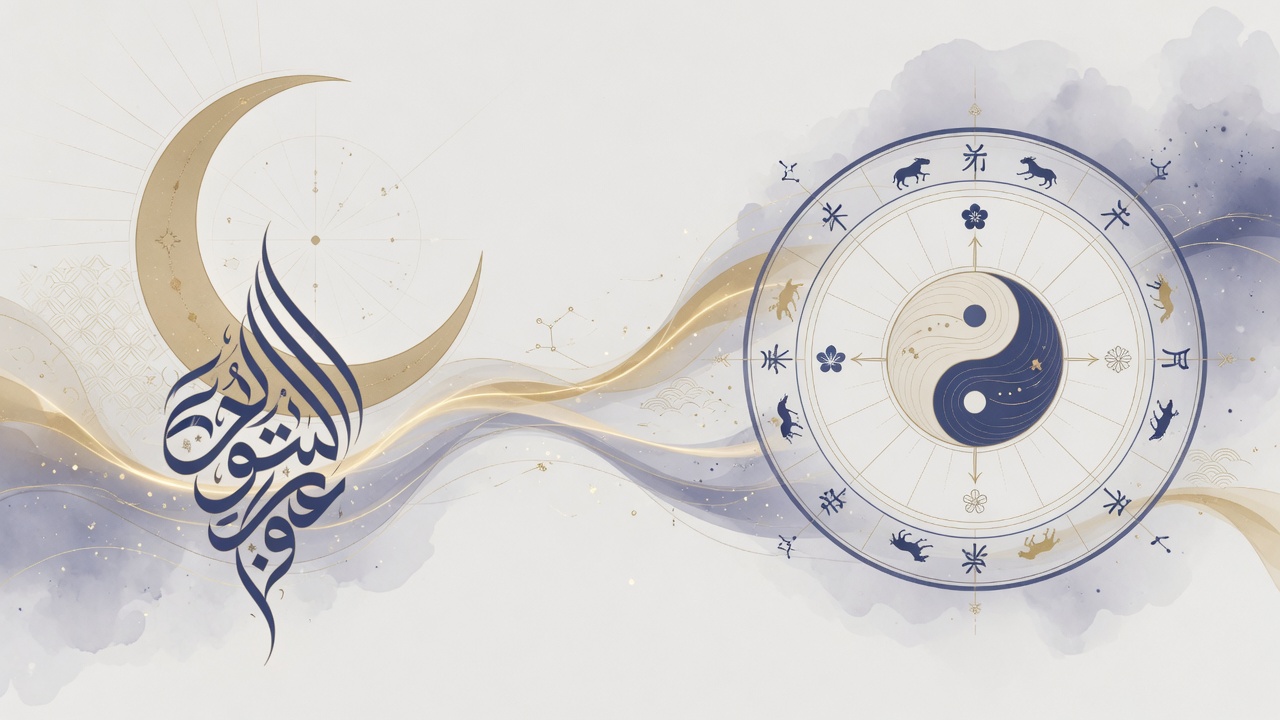
Basic Clarification: The BaZi View of Time Is Not Fortune-Telling Superstition
Common Misconceptions
Many people’s first impression of BaZi is “fortune-telling,” which actually narrows its cultural meaning. BaZi is first and foremost a time-recording system that symbolically marks the cosmic rhythm at the moment an individual arrives.
- Misconception 1: BaZi can precisely predict future events. In reality, traditional destiny analysis emphasizes trend and temperament analysis rather than predictions of specific events. It is like a time map that marks possible terrain undulations, not the exact coordinates of every step.
- Misconception 2: BaZi time is simply the lunar or Gregorian date. BaZi charting is based on solar terms, not lunar months. For example, Li Chun (Beginning of Spring) is always the dividing point for the year pillar, regardless of whether the first day of the lunar new year has passed.
- Misconception 3: Different calendrical systems are mutually exclusive. The Islamic calendar, Gregorian calendar, and GanZhi calendar each have their own applicable contexts; they are different languages for understanding time and can coexist and cross-reference.
Core Points: Three Time Codes of BaZi GanZhi Timekeeping
Code 1: Heavenly Stems and Earthly Branches—The Six-Dimensional Coordinates of Time
BaZi is composed of four pairs of GanZhi—year pillar, month pillar, day pillar, and hour pillar—each pillar containing one Heavenly Stem and one Earthly Branch, making eight characters in total. The Heavenly Stems are the ten stems Jia, Yi, Bing, Ding, etc.; the Earthly Branches are the twelve branches Zi, Chou, Yin, Mao, etc. Their combinations form the sixty-JiaZi cycle.
These four pillars correspond respectively to the four time dimensions of year, month, day, and hour; together with Da Yun (the ten-year luck cycle) and Liu Nian (the current year’s GanZhi), they form a six-dimensional time framework. Unlike the linear time of the Gregorian calendar, BaZi time is cyclically nested, with every moment carrying multiple layers of cyclical information.
- Year pillar: divided by Li Chun, not the first day of the lunar new year. Those born after Li Chun in 2026 have a year pillar of Bing Wu.
- Month pillar: divided according to solar terms; for example, from Jing Zhe to Qing Ming is the Mao month, and the Heavenly Stem is derived from the year stem.
- Day pillar: converted from the Gregorian date using a formula; the daily GanZhi cycles continuously and is not affected by solar terms.
- Hour pillar: the Earthly Branch is determined by the birth hour; 23:00–1:00 is the Zi hour, and the Heavenly Stem is derived from the day stem.
Code 2: Solar Terms—The Soul of the BaZi Time System
The core of the BaZi view of time is not the numerical calendar, but changes in the sun’s ecliptic longitude. The twenty-four solar terms precisely mark the sun’s position on the ecliptic, with one solar term every 15 degrees, directly determining the start of the month pillar.
This design deeply binds BaZi time to natural rhythms. For example, when Jing Zhe arrives, all things revive, corresponding to the rising Wood energy of the Mao month; when Bai Lu descends, Metal energy gradually strengthens, corresponding to the You month. The strength of the Five Elements in a BaZi chart largely depends on the solar-term interval of the birth month.
- Difference between “Jie” and “Qi”: Li Chun, Jing Zhe, etc., are “Jie” (nodes) and mark the start of month pillars; Yu Shui, Chun Fen, etc., are “Qi” (midpoints) and mark mid-month. Only “Jie” is used to set the month pillar.
- Solar terms and Five Elements: In spring, the Yin, Mao, and Chen months have strong Wood; in summer, the Si, Wu, and Wei months have strong Fire; in autumn, the Shen, You, and Xu months have strong Metal; in winter, the Hai, Zi, and Chou months have strong Water; in the last eighteen days of each season, Earth is strong.
- Differences in time quality: Even on the same day, the energy characteristics before and after a solar term differ. For example, around Li Chun, although the Gregorian dates are adjacent, the year pillar may have already changed, resulting in a completely different Five Elements configuration.
Code 3: Date Selection Tradition—Actively Choosing Time Nodes
In the Islamic calendar, Muslims may refer to Jumu’ah or specific months to arrange important matters. In BaZi culture, date selection is likewise an important application; it chooses suitable time windows based on the interaction between GanZhi combinations and an individual’s BaZi chart.
Date selection is not superstition; it is a practice of the unity of heaven and humanity in traditional society. It holds that the energy combinations at certain time nodes are more favorable for specific activities, such as marriage, business opening, or relocation. Its underlying logic is a comprehensive judgment based on Five Elements generation and control and the deity-and-killing system.
- Personalized date selection: centering on the Heavenly Stem of the person’s BaZi day pillar, avoid dates that seriously clash with or control one’s own chart. For example, if the day stem is Jia Wood, one should avoid Geng Shen days (Heavenly Stem control and Earthly Branch clash).
- General auspicious days: based on the day’s GanZhi combination, with reference to the twelve Jian-Chu deities, the twenty-eight lunar mansions, etc., to judge whether the day is favorable for major matters.
- Solar-term timing: major decisions are often made at solar-term transition points, such as Li Chun or Dong Zhi, because it is believed that the cosmic energy field shifts at these moments, making them suitable for starting new plans.
- Cultural comparison: Islamic date selection emphasizes lunar phases (such as new moon and full moon), while BaZi date selection emphasizes GanZhi and solar terms; both reflect humanity’s reliance on natural time markers.
In-Depth Analysis: Comparing Time Wisdom Across Two Calendrical Systems
Underlying Logical Differences Between the Islamic Calendar and the GanZhi Calendar
The Islamic calendar is a purely lunar calendar, taking the waxing and waning of the moon as its cycle, with about 354 days in a year; festivals such as Ramadan and the Hajj month drift with the lunar phases. This design directly ties religious rituals to natural lunar phases, so dates can be determined by moon sighting.
The BaZi GanZhi calendar is a derived system of the lunisolar calendar, using the solar return year as its benchmark, correcting the month pillar through solar terms while retaining the traditional association between Earthly Branches and lunar phases. It accommodates both solar seasons and lunar cycles, but is dominated by solar rhythm.
- Different time reference frames: The Islamic calendar takes the Hijrah (622 CE) as its epoch starting point, making it linear historical time; the GanZhi calendar cycles through the sixty JiaZi, making it cyclical time with no fixed first year.
- Different definitions of months: In the Islamic calendar, the month begins at the new moon, and months are 29 or 30 days long; the BaZi month pillar begins at a solar term, is about 30.4 days long, and is bound to the sun’s ecliptic longitude.
- Different cultural functions: The Islamic calendar mainly serves religious festivals and community rhythms; the BaZi GanZhi calendar emphasizes the correspondence between individual life rhythms and natural energies.
Shared Time Philosophy: Aligning with Natural Rhythms
Despite different calendrical systems, both cultures emphasize aligning with the timing of heaven. Islam encourages prayer and fasting at specific times, while BaZi destiny analysis suggests acting or resting at appropriate times.
This consensus stems from pre-industrial societies’ deep dependence on natural cycles. Whether observing lunar phases in Mecca or measuring the sun’s shadow in the Central Plains, both are human efforts to synchronize with cosmic rhythms.
- Cyclical return: The Islamic calendar’s annual Ramadan allows believers to experience hunger and self-reflection, while BaZi Da Yun switches every ten years to allow natural transitions between life stages; both provide opportunities for cyclical renewal.
- Node awareness: The Islamic calendar’s Jumu’ah congregational prayer and the solar-term transitions in BaZi both emphasize ritual activities at specific time nodes, strengthening the community’s or individual’s perception of time.
- Practical orientation: Both systems developed timing traditions—Islamic culture has the selection of blessed periods, and BaZi has the calculation of auspicious days—both aiming to optimize the match between actions and time.
Applying Time Wisdom in Modern Life
In the digital age, we seem to have freed ourselves from natural time constraints, yet time anxiety is growing. Recovering the time wisdom of traditional calendars is not a retreat to the past, but a way to regain sensitivity to life rhythms.
BaZi GanZhi timekeeping reminds us that time is not an abstract number flowing uniformly, but has qualitative differences. Some periods are suitable for sprinting, others for settling, which aligns with modern biological clock research.
- Personal rhythm management: Refer to one’s BaZi Five Elements preferences and avoidances, and schedule important matters during favorable months and days, similar to energy cycle planning in modern time management.
- Solar-term health preservation: The Five Elements balance in BaZi is connected to traditional Chinese medicine health practices; different solar terms correspond to nourishing different organs, such as nourishing the liver (Wood) in spring and the heart (Fire) in summer.
- Culturally inclusive perspective: Understand the value of different calendrical systems and avoid a single view of time. The Islamic calendar reminds us to pay attention to lunar phases and community rhythms, while the GanZhi calendar reminds us to pay attention to solar rhythms and personal cycles.
Pitfall Guide: Common Traps in Understanding the BaZi View of Time
Points to Note
When engaging with BaZi GanZhi timekeeping and date selection culture, maintain a rational attitude and avoid the following pitfalls. These reminders help correctly absorb traditional wisdom rather than being misled by commercial hype.
- Reminder 1: Do not confuse the lunar calendar with the GanZhi calendar. BaZi charting must check solar terms, not the lunar calendar. Many online charting tools default to lunar conversion; if you do not understand solar-term rules, you may produce an incorrect BaZi chart.
- Reminder 2: Date selection is not a universal insurance. Traditional date selection emphasizes “first destiny, second luck, third feng shui, fourth virtue, fifth study”; time choice is only an auxiliary factor and cannot replace real effort and rational decision-making.
- Reminder 3: Beware of over-commercialization. Market products such as “daily fortune” or “auspicious day quick check” often oversimplify complex GanZhi relationships and ignore individual BaZi differences, so their reference value is limited.
- Reminder 4: Respect cultural differences. The BaZi system originated from Chinese agrarian civilization and differs from the religious sanctity of the Islamic calendar. When making cultural comparisons, avoid judging superiority or inferiority; focus on understanding each system’s logic.
- Reminder 5: Solar-term times are precise to the minute. The switching point of the year pillar and month pillar is not midnight, but the exact solar-term transition moment. For example, Li Chun in 2026 occurs at 04:02 on February 4; before that moment, it still belongs to the previous year, Yi Si.
- Reminder 6: Do not use BaZi to predict specific events. Traditional destiny analysis is good at analyzing personality tendencies and stage trends, not predicting specific details such as exam scores or marriage partners. Keep reasonable expectations.
- Reminder 7: GanZhi timekeeping is a symbolic system. Heavenly Stems and Earthly Branches themselves have no inherent auspiciousness or inauspiciousness; fortune or misfortune arises from their combinations and Five Elements balance. Beginners should first understand basic principles rather than memorize deity-and-killing rules by rote.
Summary and Review
From Indonesian netizens checking the Hijri date to the cultural introduction to BaZi GanZhi timekeeping, we see that different civilizations are answering the eternal question “what day is today” in their own ways. The GanZhi calendar weaves a time network with Heavenly Stems, Earthly Branches, and solar terms, while the Islamic calendar marks religious rhythms with lunar phases; both are crystallizations of humanity’s dialogue with nature.
Key conclusion: The core of the BaZi view of time is not prediction, but perceiving rhythms. Solar terms are the breathing of the sun, GanZhi are the code of time, and date selection is an attempt to actively synchronize with nature. In the era of globalization, understanding diverse calendrical systems helps us break free from the constraints of a single clock and rediscover the humanistic depth of time.