Viewing Timely Circumstances and Choices in Bazi through Hanoi's Heavy Rain: How Personality Responds to External Changes
Hanoi's recent heavy rain peak has become a hot topic; weather changes are like the rise and fall of timely circumstances in life. This article uses the weather topic to rationally popularize the interactive relationship between personality,
Introduction
Hanoi's heavy rain peak has become a recent hot topic; sudden weather changes are like the ups and downs of life's timely circumstances.
This article uses the weather topic to rationally popularize the relationship between personality, choices, and timely circumstances in Bazi culture, without making assertions of fortune or misfortune.
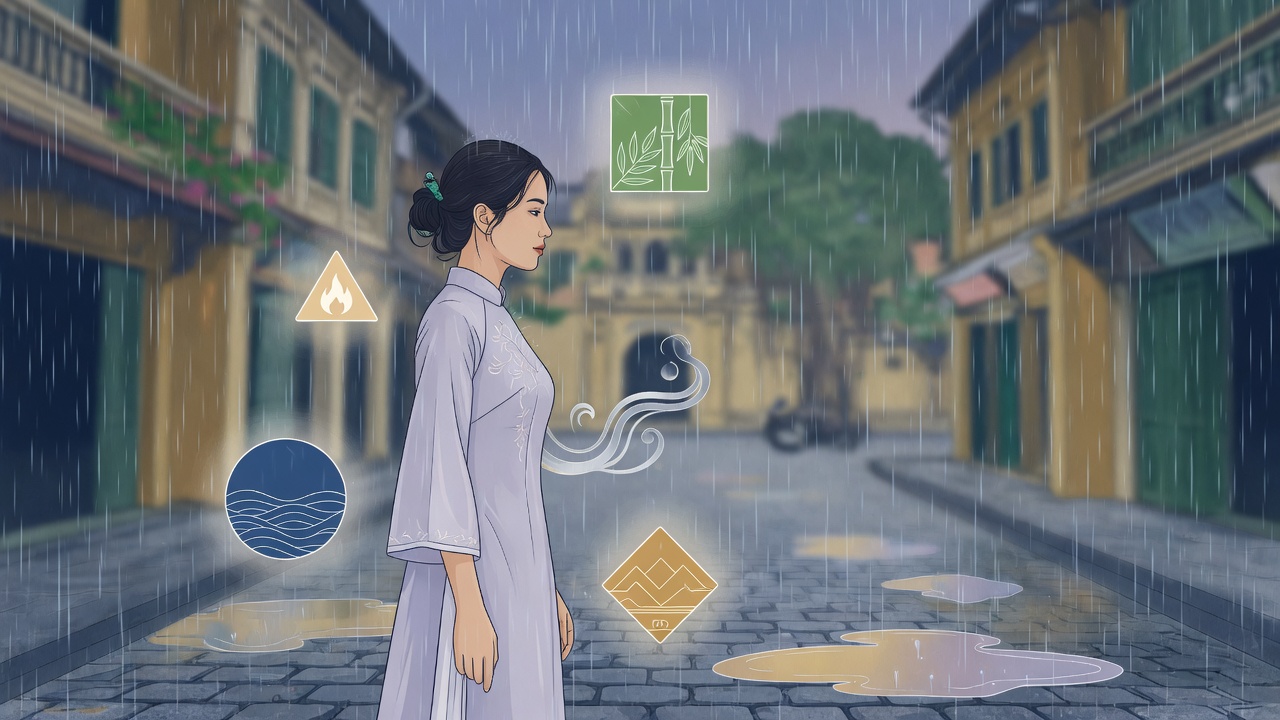
Basic Clarification
Common Misconceptions
Bazi is not a mystical prophecy, but an experiential model from ancient times observing the time dimension and personal traits.
It does not directly determine weather, events, or destiny, but helps understand innate tendencies and possible behavior patterns.
Learning Bazi should return to cultural cognition, avoiding being misled by overly mystified claims.
- Misconception 1: Bazi can predict specific weather or events. In reality, Bazi only describes personal innate tendencies and does not determine external changes.
- Misconception 2: Good or bad timely circumstances directly equal personal fortune or misfortune. Traditional fate analysis emphasizes adaptation and adjustment rather than passive acceptance.
- Misconception 3: Personality is completely locked in by Bazi. Bazi reveals potential tendencies, but postnatal environment and choices still have enormous shaping space.
- Misconception 4: A year with strong Water will definitely bring bad luck. The annual luck is only a time variable and must be analyzed in combination with the individual's full Bazi chart.
- Misconception 5: Consulting Bazi can replace real-life decision-making. Weather changes still require attention to official warnings; traditional culture cannot replace disaster prevention.
Core Points
Personality Foundation: Day Master and Five Element Inclinations
Bazi takes the Day Master as the core of self, depicting the personality outline through the generating and overcoming relationships of the five elements.
For example, a Wood Day Master often has traits of growth and expansion, while a Fire Day Master often shows enthusiasm and extroversion.
The humid environment brought by Hanoi's heavy rain corresponds to a relative abundance of Water in the five elements, which can be used as a metaphor for the external soaking into the internal.
The differences in how different Day Masters feel in humid weather precisely reflect the subtle connection between the five elements and body-mind.
Understanding one's own Day Master attribute helps comprehend one's emotional and reactive patterns in specific environments.
- Five Element Personalities: Metal governs righteousness, Wood governs benevolence, Water governs wisdom, Fire governs propriety, Earth governs trustworthiness—each has its bias.
- Day Master Strength: Those with a strong Day Master often withstand pressure better, while those with a weak Day Master need to leverage support or adjust their pace.
- Dampness Influence: Traditional folk beliefs hold that when dampness is heavy, the Wood and Fire energies are suppressed, making people feel gloomy—similar to the Bazi image of Water flooding Wood.
- Metal Generating Water: If a Metal Day Master has a chart with strong Water, rainy days might actually stimulate active thinking and adeptness in responding to external changes.
- Fire and Earth Tend to Dryness: For Fire or Earth Day Masters with a chart tending toward dryness, rainy days may bring emotional relief and balance.
Choice Logic: Ten Gods and Decision-Making Tendencies
In Bazi, the Ten Gods represent different social relationships and behavior patterns, influencing an individual's preferences when making choices.
Facing sudden weather, some plan ahead while others react on the spot—much like the difference between Direct Officer and Seven Killings.
Direct Officer values rules and order; Seven Killings values efficiency and breakthrough—there is no superiority, only different paths of choice.
Whether to go out during heavy rain or how to adjust one's schedule often reflects a person's inner decision-making style.
Traditional fate analysis does not judge which choice is better, but reminds us to be aware of our habitual thinking.
- Direct Officer Type: Tends to arrange schedules reasonably according to weather forecasts, follow established rules, and reduce accidents.
- Seven Killings Type: Tends to respond quickly to changes, even using rainy days to adjust pace and pursue efficiency.
- Eating God Type: Focuses on experience and comfort, may choose to stay home or find joy in the rain, enjoying the present.
- Wealth Star Type: Pays attention to time and resource costs, acts after weighing pros and cons, considering economic impact.
- Resource Star Type: Tends to observe and think first, gather information before deciding, emphasizing stability.
- Friends Star Type: Values companionship and socializing, may invite others to cope with the weather together or share experiences with friends.
- Hurting Officer Type: Likes to break norms, may deliberately go against the grain and seek unique experiences.
Interaction with Timely Circumstances: Luck Pillars, Annual Luck, and Environmental Rhythms
In Bazi culture, Luck Pillars and Annual Luck are analogous to seasons and weather systems in meteorology.
Luck Pillars represent long-term trends; Annual Luck represents short-term fluctuations—individual choices need to consider the overlay of both.
Hanoi's heavy rain peak is a short-term meteorological event, corresponding to the relatively strong Water energy in the annual luck, which need not be over-amplified.
Traditional wisdom emphasizes correspondence between heaven and human; weather changes remind us to examine our current rhythm and adjust our actions.
Understanding timely circumstances is not about predicting fortune or misfortune, but about cultivating sensitivity to cycles of change, thus enabling more composed responses.
- Long-term Trends: Luck Pillars determine a ten-year theme, such as a Wood luck governing growth, Metal luck governing contraction.
- Short-term Fluctuations: Annual Luck brings yearly energy changes; heavy rain can be seen as a concentrated manifestation of Water momentum.
- Response Principle: Understand one's own five-element likes and dislikes, adjust behavior accordingly rather than clashing head-on.
- Environmental Rhythms: Traditional wisdom emphasizes heaven-human correspondence; weather changes remind us to examine our current rhythm.
- Annual Luck with Strong Water: If one's Bazi likes Water, rainy days may bring inspiration and opportunities; if it dislikes Water, it is better to stay quiet than to act.
- Luck Pillar Background: The same heavy rain may carry completely different meanings and impacts for people in different Luck Pillar stages.
- Dynamic Balance: Fate analysis is not a static label, but helps us see the changing trends of interaction between ourselves and the environment.
Avoidance Guide
Precautions
- Reminder 1: Do not use Bazi to predict specific weather; please refer to official meteorological information for weather forecasts.
- Reminder 2: Do not assert personal fortune or misfortune based on weather changes; the strong Water in Bazi is only a symbolic hint.
- Reminder 3: Do not simplistically label personality differences as good or bad; different Day Masters have their own advantageous scenarios.
- Reminder 4: Learning Bazi should focus on self-awareness, not seeking fatalistic conclusions.
- Reminder 5: Pay attention to safety during heavy rain; traditional culture cannot replace practical disaster prevention measures.
- Reminder 6: Annual Luck and Luck Pillars need to be viewed comprehensively; looking at a single event easily leads to taking things out of context.
- Reminder 7: Do not blindly apply five-element likes and dislikes; analysis must be based on the specific Bazi structure.
- Reminder 8: Weather changes are natural phenomena; do not over-associate them with personal fortune, and remain rational.
- Reminder 9: If interested in Bazi, it is recommended to study systematically or consult professionals to avoid fragmented misunderstandings.
- Reminder 10: The power of choice lies in everyone's own hands; fate analysis is only a reference tool, not a decisive force.
Summary and Review
Hanoi's heavy rain is a manifestation of timely circumstances; Bazi culture allows us to understand the choice logic of different personalities when facing changes.
The core is not predicting outcomes, but enhancing self-awareness and adaptability through traditional wisdom.
May everyone see their own rhythm in the storm and make more suitable choices.