From Elche 0-5 Barcelona: A Rational Look at Bazi, Character, Choices, and Timing
On August 23, 2026, Barcelona trounced Elche 5-0 in the La Liga opener, a result that sparked discussion in Hong Kong: can Bazi analyze a match? This article does not predict events, but uses this game as a springboard to rationally explore how Bazi'
Opening Guide
On August 23, 2026, Barcelona easily defeated Elche 5-0 in the La Liga opener. This seemingly one-sided match ignited lively discussions among Hong Kong football fans.
Some marveled at Barca's dominance, while others drew parallels to the concept of timing in traditional metaphysics. This article does not predict any match outcomes, but uses the event as a starting point to rationally explore the interplay between character, choice, and timing through Bazi culture.
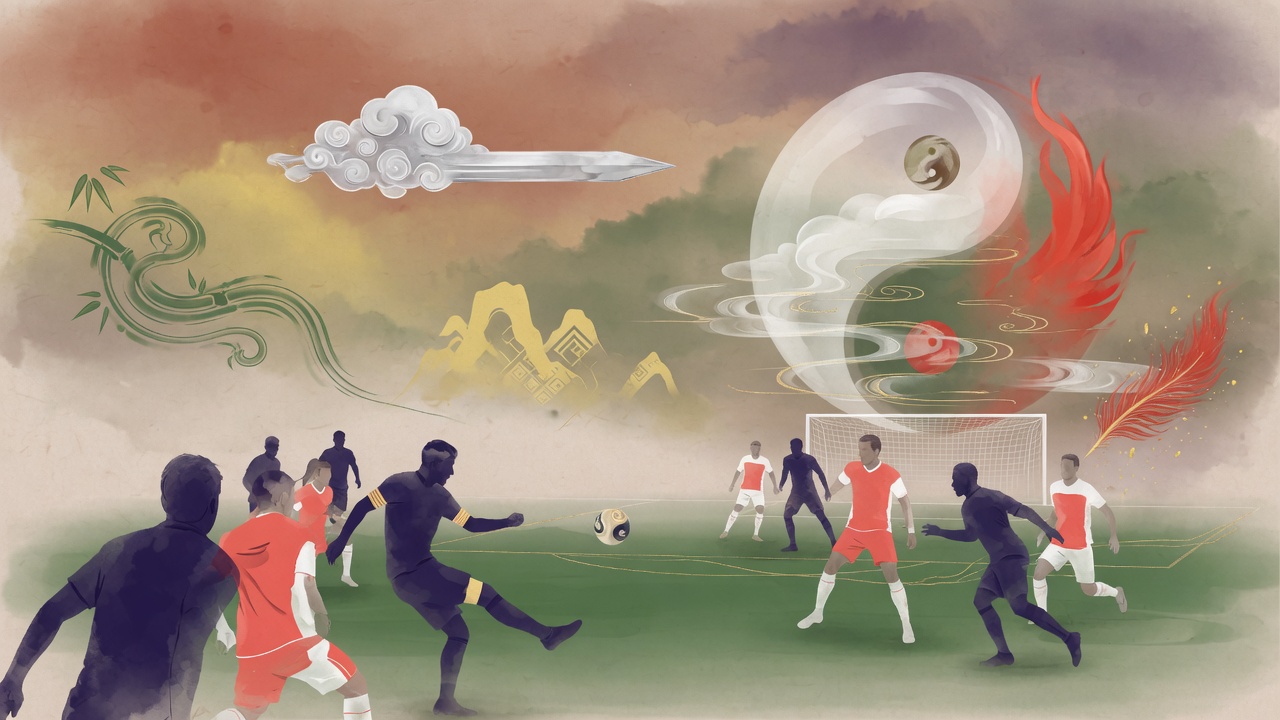
Foundational Clarifications
Bazi is not a tool for predicting sports events, nor is it a fatalistic verdict. It is a traditional analytical framework based on the Heavenly Stems and Earthly Branches of one's birth time, used to observe personality tendencies and life rhythms.
Before using a football match to discuss Bazi, it's helpful to understand some basic concepts and clear up common misconceptions.
Basic Bazi Concepts
Bazi is composed of the Heavenly Stems and Earthly Branches for the year, month, day, and hour of birth, forming eight characters across four pillars: the Year, Month, Day, and Hour Pillars.
Among them, the Day Master (the Heavenly Stem of the Day Pillar) represents the self, while the other seven characters reflect one's environment and interactions through the cycles of the Five Elements and the Ten Gods.
The Five Elements—Metal, Wood, Water, Fire, and Earth—nourish and control each other, forming the basic language of Bazi analysis.
The Ten Gods are ten abstracted roles, such as Direct Officer and Direct Resource, derived from the relationship between the Day Master and other stems and branches.
These concepts constitute a dynamic, balanced system, not used to predict specific events but to offer a perspective for observing the relationship between a person and their environment.
It is important to note that Bazi analysis relies on an accurate birth time. Teams or organizations do not have Bazi charts, so the following discussions are cultural analogies and do not point to any real individuals.
Common Misconceptions
- Misconception 1: Bazi can predict match results. Bazi studies long-term human trends, not the random outcomes of single events. Any claim to predict a score deviates from Bazi's true purpose.
- Misconception 2: Bazi determines character, and character determines destiny. The personality inclinations in Bazi are just a base layer. Postnatal environment, personal choices, and effort are equally, if not more, critical.
- Misconception 3: You can't discuss Bazi without an exact birth time. A full chart requires the year, month, day, and hour. But in this general discussion, we use cultural concepts only as analogies for team styles, not to analyze any specific chart.
- Misconception 4: Five Element personality labels can be applied simplistically. Wood, Fire, Earth, Metal, and Water form a symbolic system, not to be used as fixed labels for people, much less to pass final judgment on a sports team.
- Misconception 5: Bazi analysis is synonymous with superstition. Viewed rationally, Bazi is an ancient system of classification and decision-making that has parallels with modern psychology and management.
- Misconception 6: A team or player's Bazi chart can be publicly analyzed. This involves privacy and has no scientific basis, and must be strictly avoided.
Core Points
In Bazi culture, human behavioral patterns can be observed from three levels: innate character, choice strategy, and the rhythm of timing. Using this match as a lens, we will explore each one.
Reading Character Through the 'Day Master's Five Element' — A Cultural Analogy for Team Style
In Bazi, the self is represented by the Day Master, whose corresponding Five Element suggests different personality tendencies. For instance, Wood represents benevolence, growing and flexible; Fire represents propriety, passionate and upward-striving; Earth represents trustworthiness, stable and sustaining; Metal represents righteousness, resolute and bold; Water represents wisdom, adaptable and fluid.
This classification is an abstract summary of human nature by ancient thinkers. It does not definitively claim a person or team is a certain element, but rather provides a framework for understanding style.
Taking this match as an example, Barcelona's traditional football style emphasizes possession, patient organization, and collective progression, which bears a resemblance to the Earth element's qualities of 'bearing, stability, and unhurried determination'.
Elche, as a smaller club, likely adopts a strategy of deep defense and counter-attacks against a stronger opponent, akin to Water's nature of 'going with the flow, adapting, and avoiding strength to strike weakness'.
Please note, this is purely a cultural metaphor. It does not mean Barcelona's Bazi is of Earth or Elche's is of Water. True Bazi analysis requires specific birth data. Teams do not have Bazi, and the privacy of individual players should not be violated.
Using the Five Elements to look at style only helps us understand different tactical tendencies, not to tell anyone's fortune. In the Five Elements' cycle, Earth controls Water, but too much Water can wash Earth away. This suggests that a strong-weak dynamic is not absolute, and tactical counters also have variables.
Furthermore, a team's style cannot be summed up by a single element. It is often a blend of multiple elements; for example, Barca has Earth's stability, Fire's passion, and Water's fluidity. This complexity is the charm of Bazi analysis—it refuses simple labeling.
- Day Master: The core self in a Bazi chart, used to observe a person's fundamental disposition.
- Five Element Personalities: Wood=benevolence, Fire=propriety, Earth=trustworthiness, Metal=righteousness, Water=wisdom. These are abstract diagrams, not precision scales.
- Team Analogy: A strong team controlling the game is like the solidity of Earth; a weaker team's guerrilla tactics are like the nimbleness of Water.
- Rational Boundary: Any forced correlation between a team's style and a Five Element is merely food for thought, not to be taken literally.
- Extended Thinking: If a team is viewed as a whole, its 'character' is shaped by club culture, coaching philosophy, and player composition—echoing Bazi's emphasis on the interplay between 'innate nature and environment'.
- Insight from the Control Cycle: Earth controlling Water is the norm, but Water making Earth flow is the exception-alert, just as a strong team is not guaranteed to beat a weaker one.
Seeing Choice Strategy from the 'Ten Gods' Configuration — the Mindset of the Useful God and Team Trade-offs
The Ten Gods in Bazi, such as Direct Officer, Seven Killings, Direct Resource, and Indirect Wealth, describe a person's role and strategy when interacting with the outside world. Everyone's combination of gods is different, creating a unique 'Useful God'.
The 'Useful God' is the key element that can balance the entire chart and bring out one's strengths. The right choice multiplies effort; the wrong one divides it.
This idea can be extended to football tactics. Barcelona's tactical tradition is to amplify its technical advantage and break through defenses with passing, similar to the Direct Resource's approach of winning through intelligence and softness.
Elche, facing a formidable opponent, might employ a dense defense and rapid counter-attacks, more akin to the unconventional thinking of the Indirect Resource or the desperate posture of the Seven Killings.
However, Bazi culture strongly advises against using this to predict winners, as choices on the pitch are infinitely variable and cannot be captured by a few symbols.
From another angle, choice strategies are also influenced by timing. The same team should dynamically adjust their 'Useful God' thinking against different opponents and in different seasons.
For example, Barcelona's rhythm and focus will certainly differ between a Champions League knockout game and a league match against a weaker side. Elche might take different levels of risk in a relegation battle versus a cup competition.
Relationships of generation and control also exist among the Ten Gods. For example, the Direct Officer can control the Seven Killings, and the Direct Resource can neutralize the Seven Killings. This is similar to the checks, balances, and coordination between different roles in a team. A mature team often needs the synergy of multiple gods, not the extreme application of a single mode.
- Ten Gods: A symbolic system in Bazi representing social relationships and behavioral patterns.
- Useful God: The key element that balances a chart, requiring dynamic adjustment based on one's Luck Pillars and the current year.
- Choice Analogy: Barca's patient possession play mirrors Direct Resource thinking; Elche's defensive counter-attacks mirror Indirect Resource or Seven Killings.
- Decision-Making Insight: Understanding your own traits and choosing a fitting strategy is more important than blindly imitating others.
- Dynamic Adjustment: The Useful God is not static, just as tactics must change according to the opponent and the situation.
- Avoid Rigidity: Thinking a specific god always means victory is to completely misunderstand how Bazi operates.
- Team Balance: The controlling cycle among the Ten Gods reminds us that a team needs a mix of complementary roles, not a single, uniform style.
Viewing the Shifts of Timing from 'Luck Pillars and Annual Cycles' — Rhythmic Cycles and a Rational View of Single Results
Bazi suggests that a person's fortune ebbs and flows with the alternation of Luck Pillars (ten-year cycles) and Annual Cycles, but it would never be used to predict a single day's events, as the chain of causality is too complex.
A football match is like a single day within an annual cycle, influenced by too many temporary variables: player form, injuries, refereeing, weather, and psychological fluctuations.
What Bazi thinking truly reminds us is this: everything is in flux. There is no permanent high, nor an everlasting low.
Barcelona's 5-0 victory showcases their excellent form at the start of a new season, but it is just one node in a long campaign, with turbulence likely ahead.
Elche's loss does not signify a failed season. By adjusting strategy and leveraging timing, they still have opportunities.
This is the view of timing in Bazi culture: not fixating on a single battle or piece of land, but observing the long-term rhythm.
Furthermore, timing includes the larger environment: the competitive landscape of the league, the club's financial health, coaching changes, etc. These can all be analogized to the Luck Pillars background in Bazi.
A single match's outcome is analogous to a specific day or even hour in a Bazi reading, which is highly random. Therefore, Bazi practitioners never use it as a prediction target.
The ancients said, 'The times produce heroes,' and also, 'Heroes create the times.' This shows the interactive relationship between people and their environment. A team's rise requires both its own strength and the right moment.
A rational view of a single result prevents us from being swayed by momentary gains and losses. This aligns perfectly with the Bazi cultural principle of 'judging not by a moment's fortune, but by a long-term trend.'
- Luck Pillars: Ten-year phase-based cycles that emphasize long-term trends.
- Annual Cycle: The yearly shift, similar to a short-term rhythm.
- Match Analogy: A single match result is like one day within an annual cycle and cannot represent the whole.
- Trend Thinking: Observing phases and trends is far more meaningful than obsessing over a single win or loss.
- A Rational Reminder: Bazi will not provide answers about match results, but it can teach us how to view the inevitability of ups and downs.
- Case Reference: Many historically strong teams have had low seasons, and underdogs have had moments of triumph—this is exactly the work of timing.
- Interplay: Timing influences choices, and choices also shape timing; it is not a one-way determination.
Pitfall Avoidance Guide
When using Bazi culture to interpret a game, it's easy to slip into superstition or over-interpretation. Please be sure to note the following core points to avoid traps.
Important Notes
- Do not use Bazi to predict sports events: Bazi is not a lottery ticket. Any technique claiming to calculate a score is pseudoscience.
- Do not draw forced parallels: Linking a team's style to a specific Five Element is a cultural metaphor, not a factual statement.
- Do not obsess over a single result: One big win does not dictate the fortune of an entire season. Avoid generalizing from a single instance.
- Do not ignore subjective human initiative: Bazi speaks of trends, but coaching tactics and player effort are equally crucial.
- Do not violate others' privacy: Never create and analyze a chart using a player's birth time. It is both unethical and non-compliant.
- Do not stigmatize traditional culture: Promote rational discussion of Bazi thinking; oppose feudal superstition.
- Do not use Bazi as a reference for investing or gambling: Bazi cannot guide sports betting. Please stay away from gambling.
- Do not disregard modern science: Football has professional statistics and analysis. Traditional culture is only a supplementary perspective.
- Do not equate Bazi with fatalism: Bazi values trends, but it emphasizes human choice and effort even more.
- Do not be deceived by commercial fortune-tellers: Anyone promising to 'accurately predict scores' or 'change your luck for a win' is likely a fraud.
- Do not spread anxiety on social media: Discuss rationally, don't create panic or division.
- Do not use traditional culture as clickbait: Educational outreach should have a bottom line and must not fabricate stories for traffic.
Summary and Review
From Elche vs Barcelona's 5-0 result, we see a gap in strength and form. But Bazi culture reminds us: character is the foundation, choice is the key, and timing is the variable.
A rational approach to Bazi—one that neither predicts nor falls into superstition—is the only way to truly draw from traditional wisdom and understand the rhythms of life's ups and downs.
Whether for teams or individuals, grasping one's own traits amidst dynamic change, making sound choices, and aligning with the rhythm of the times—this is the greatest insight Bazi thinking can offer.