A Look at BaZi Wisdom from Zverev's US Open Victory: The Game of Character, Choices, and Timing
In September 2026, Alexander Zverev defeated Ben Shelton at the US Open to claim his second Grand Slam title. This headline event is not just a sporting spectacle; it is a perfect cultural lens through which to explore the deep relationship between *
Opening Guide
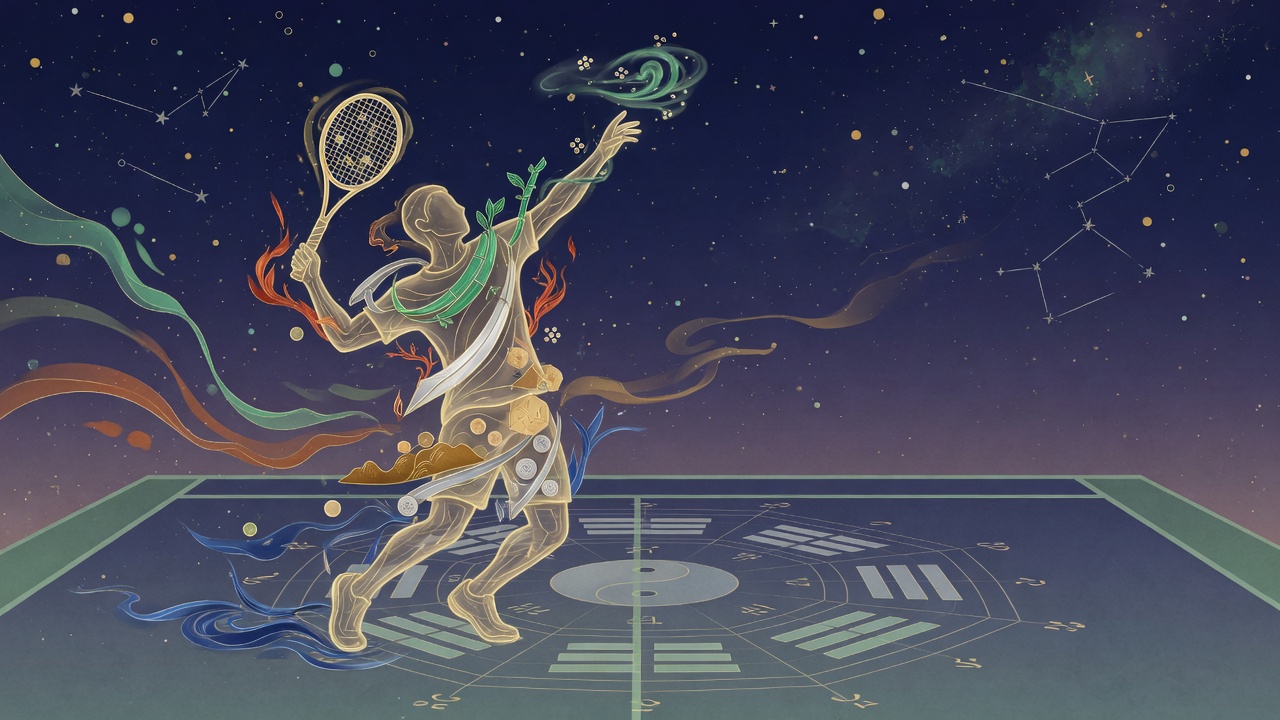
The 2026 US Open final, marked by Alexander Zverev's championship run, vividly tells a story of perseverance and breakthrough. From the perspective of BaZi culture, this is not merely a triumph of technique or physical strength, but rather a diagram showing how individual character and external timing interlock with precision.
We approach this from a destiny analysis angle not to deify success, but to use this highlight moment to understand how traditional culture views the idea that character determines choice and the times make the hero.
Basic Clarification: What BaZi Looks At and Does Not Look At
Common Myths and Correct Understanding
- Myth 1: BaZi is fatalism, making absolute good-or-bad predictions. Correct understanding: BaZi reveals an innate energy map that indicates character inclinations, potential, and challenges, but it is by no means an unchangeable script. The power of choice and post-natal effort are equally crucial.
- Myth 2: BaZi can accurately predict match outcomes. Correct understanding: Destiny analysis examines trends and cycles. It can show whether a person is in a period of “building reserves” or “breaking out,” and whether they are more likely to meet favorable or adverse circumstances, but it cannot, and should not, be used to forecast gambling-style concrete results.
- Myth 3: Successful people must have a flawlessly perfect BaZi chart. Correct understanding: Every chart has its imbalances. True wisdom lies in discovering the driving force within the flaws. For many top achievers, it is precisely the “illness” in their chart that forges their extraordinary persistence and focus.
Core Insights: Decoding the Three Elements of Destiny from Competitive Sports
1. Character Manifestation: Ten Gods Combinations and Competitive Personality
In BaZi, the Ten Gods are core symbols describing personality and behavioral patterns. We can look at a top athlete's public performances and deduce the possible corresponding destiny traits; this is a cultural psychological reading, not an empirical chart fixing.
Zverev's powerful serve and ability to grind out baseline rallies on court reflect a composite character of explosiveness and tenacity, which in destiny study often relates to specific Ten Gods combinations.
- The enterprising and commanding nature of the Seven Killings (Qi Sha): The Seven Killings represents decisiveness, competitiveness, and authority. Those with a strong Seven Killings are, counter-intuitively, fired up by intense pressure, eager to conquer opponents in direct confrontation. This “I am the one” kingly aura is an important psychological foundation for becoming a champion.
- The calmness and wisdom of the Direct Resource (Zheng Yin) and the Eating God (Shi Shen): Fierceness from the Seven Killings alone can easily lead to recklessness. The Direct Resource provides strategic composure and the ability to dissolve pressure, enabling one to think clearly in adversity. The Eating God represents technical talent and smooth performance, transforming strength into exquisite placement and tactics, making the game both powerful and aesthetically pleasing.
- The competition and persistence of the Peer (Bi Jie): The Peer star symbolizes peer competition and physical power. It endows an athlete with an indefatigable fighting spirit and strong rally endurance. In long exchanges, this “grind-the-opponent-down” tenacity is a direct embodiment of the Peer mindset.
2. The Times Make the Hero: How Luck Cycles and Annual Decrees Shape Career Trajectories
In BaZi theory, Luck Cycles (Da Yun) govern energy shifts in ten-year phases, while Annual Decrees (Liu Nian) determine the specific auspicious or inauspicious feel of a given year. The ups and downs of a person's career often resonate strongly with this rhythm of changing fortune.
We can place an athlete's career phases into this abstract time frame of destiny to understand why peaks and valleys alternate.
- Favorable Deity cycles as “sailing with the current”: When a Luck Cycle or Annual Decree travels into the Favorable Element (Yong Shen) your chart needs, everything seems to go smoothly, and opportunities emerge spontaneously. For an athlete, this may manifest as luck on key points, absence of injuries, and flawless tactical execution, all converging into a championship trophy.
- Unfavorable Deity cycles as “sailing against the current”: Conversely, when encountering an Unfavorable Deity (Ji Shen) cycle, even equal effort often yields meager results. Form slumps, unexpected injuries, or mental collapses at crucial moments are more likely. This does not mean ability has declined, but that the cosmic energy field's support for the individual has weakened, requiring greater wisdom to lie low and adjust.
- Critical Annual Decree as the tipping point: An Annual Decree like 2026 might just be the nexus where Luck Cycle and Natal Chart form a three-way interaction. Through combinations, clashes, or other mechanisms, it may resolve a pre-existing contradiction in the chart, allowing long-pent-up energy to burst forth, or remedy a character flaw, enabling the person to make the most correct decision at the critical moment.
3. Choice and Balance: Long-Termism from a Destiny Perspective
Zverev's road to the championship was never smooth, having experienced serious injury and form fluctuations. From the viewpoint of BaZi culture, this exactly reflects the profound philosophy of Five Element balance and life choices.
Destiny study never encourages blindly persisting on one path; it emphasizes adopting strategies that match the energy of different fortune phases.
- The 'Officer/Killing' message during injury layoffs: In destiny, when Officer/Killing (Guan Sha) is overly strong and uncontrolled, it represents not only pressure but also potential for physical harm. An athlete suffering a severe injury can be symbolically interpreted as the universe forcing a halt, compelling them to undergo internal “controlling the Killing” and “reinforcing the Resource” — that is, through rest, learning, and mental adjustment, rebuilding mind-body equilibrium.
- The 'Resource' strategy in low valleys: When in an athletic trough, that is, a waning phase of fortune, the best choice is not blind over-training (which further depletes already weakened Peer energy), but returning to the Direct Resource-type activities of study and introspection. Analyzing strategy, fine-tuning technical details, and strengthening mental fortification are all ways of “reinforcing the Resource,” accumulating true energy for the next peak.
- The 'Eating/Output' play at the peak: When fortune arrives, one should boldly unleash the creativity and expressiveness of the Eating/Output (Shi Shang) gods. On the court, dare to hit extreme shots, display your true style, and refuse to be shackled by conservative thinking. This is the moment to most efficiently convert long-term accumulated energy into victory.
Pitfall Guide: Common Traps in Destiny Perception
Rational Views on Destiny: Avoid the Following Misconceptions
- Demonizing Unfavorable Deities: Becoming anxious and abandoning effort upon learning you are in an “Unfavorable Deity” cycle. Remember, in destiny, “unfavorable” represents a challenge and a lesson; it forces you to learn new coping models, thereby growing stronger. Had Zverev given up during his injury period, he would not be champion today.
- Single-Symbol Determinism: Seeing a “Seven Killings” and labeling someone a brute, or seeing an “Eating God” and calling them a genius. BaZi is a sophisticated system; the success or failure of a chart pattern depends on the combination of the Ten Gods, the flow of the Five Elements, and the checks-and-balances. Any isolated judgment detached from the overall picture is one-sided.
- Calcified Fortune-Telling: Believing you must get rich in a certain year or marry in another is a massive misunderstanding of destiny. The same fortune energy works completely differently for people making different choices. When fortune is good, expansion might succeed, but it might also fail due to rashness; when fortune is bad, conservatism might be safe, but it might also miss a golden chance. Destiny is a map, not a set of navigation orders.
- Neglecting Personal Agency: Attributing all success and failure to the BaZi chart is the biggest “destiny superstition.” No matter how good the chart, without post-natal effort and moral cultivation, it remains a castle in the air. As Heaven’s movement is ever vigorous, so must a gentleman ceaselessly strive along. This is the core spirit of traditional culture.
Summary and Reflection
Zverev's 2026 US Open victory is a superb allegory. It tells us that both the sharp edges and the shortcomings of character must be tempered in the crucible of time. The ultimate wisdom of BaZi destiny study lies not in predicting a single outcome, but in recognizing the map of our own energy, quietly reinforcing the Resource in adverse times and boldly expressing the Eating/Output in favorable times. The true champion is always the one who, having understood destiny, still chooses to give their all.