From Sabalenka’s US Open Battle: Decoding Character, Choice, and Timing Through the Lens of BaZi
The intense 2026 US Open semi-final clash between Aryna Sabalenka and Jessica Pegula captured global attention. In Indonesia, BaZi enthusiasts are using this moment to explore a rational question: how do a top athlete’s **instinctive reaction
Opening Introduction
When Aryna Sabalenka faced a break point against Jessica Pegula in the US Open semi-finals, her instantaneous burst of power and adjustment was both muscle memory forged through countless hours of training and a flash of her deep-seated psychological pattern. In Indonesia, many people's interest in BaZi is shifting from fatalism to a character analysis tool. BaZi does not predict victory or defeat; it is more like an ancient personality model, helping us understand why some thrive under pressure while others need more time to find their rhythm. Using this trending event, we rationally dissect personality tendencies, decision-making logic, and timing perception from a BaZi perspective.
Basic Clarification: BaZi Does Not Predict Matches
Common Misconceptions and Rational Boundaries
Many first-time learners easily equate BaZi with crystal-ball gazing, believing it can precisely predict a match's outcome or specific events. This is a fundamental misunderstanding.
- Misconception 1: BaZi can calculate exact match results. BaZi reflects an innate energy field and character foundation, not a deterministic script of specific events. In the same match, both top athletes face their own internal challenges; there are no absolute labels of good or bad fortune.
- Misconception 2: Without an exact birth time, analysis is impossible. Professional BaZi analysis requires an accurate birth date and time. We cannot access Sabalenka's private information, so any BaZi chart constructed for her personally would be fictional. This article only uses her on-court performance to explain general principles like the Ten Gods character types and Five Elements dynamics.
- Misconception 3: BaZi is a passive fatalism. On the contrary, BaZi emphasizes knowing your destiny to then strategize. Understanding your energy tendencies allows for clearer choices at critical moments, much like how athletes use psychological training to strengthen their advantages.
Core Insights: How BaZi Interprets Character and Choice on the Court
1. The Ten Gods: The Inner Code of Aggression and Stress Resistance
In the BaZi system, the Ten Gods are the core symbols for analyzing personality. Defined by the interaction between the Day Master (representing the self) and other stems and branches, they depict different behavioral tendencies and emotional response patterns. Observing Sabalenka's aggressive baseline hitting evokes a strong combination of certain Ten Gods.
- A Forest of Peers: Strong self-assertion and competitive desire. People with strong Friend and Rob Wealth energies typically possess intense competitiveness and resilience against setbacks. Facing a break point, such a configuration doesn't shrink back but ignites a 'bring it on' fighting spirit, transforming pressure into fiercer attacks. Sabalenka's signature roar and assertive body language are an outward manifestation of this Friend/Rob Wealth energy.
- Aggressive Power Under Control: Instinct to turn crisis into opportunity. The Seven Killings star represents pressure, challenge, and sudden trouble. Those who can harness Seven Killings in their chart often become exceptionally calm in desperate situations, bursting with astonishing energy. This is known as Hurting Officer Controlling Seven Killings or Resource Star Transforming Seven Killings. Pegula's tenacity in saving break points can similarly be seen as an image of Seven Killings transformed by Resource, turning pressure into meticulous defense and patience for a grinding rally.
- Expressive Talent: The source of creativity and improvisation. The Hurting Officer and Eating God stars represent the display of talent and unconventional thinking. Players who hit unthinkable shots on crucial points are experiencing a momentary burst of Eating God/Hurting Officer energy. However, if this is excessive and uncontrolled, it can lead to emotional swings and unforced errors. A top player's ability to regulate is essentially the art of balancing Ten God energies.
2. The Five Elements Dynamic: A Metaphor for Playing Style and Physical Rhythm
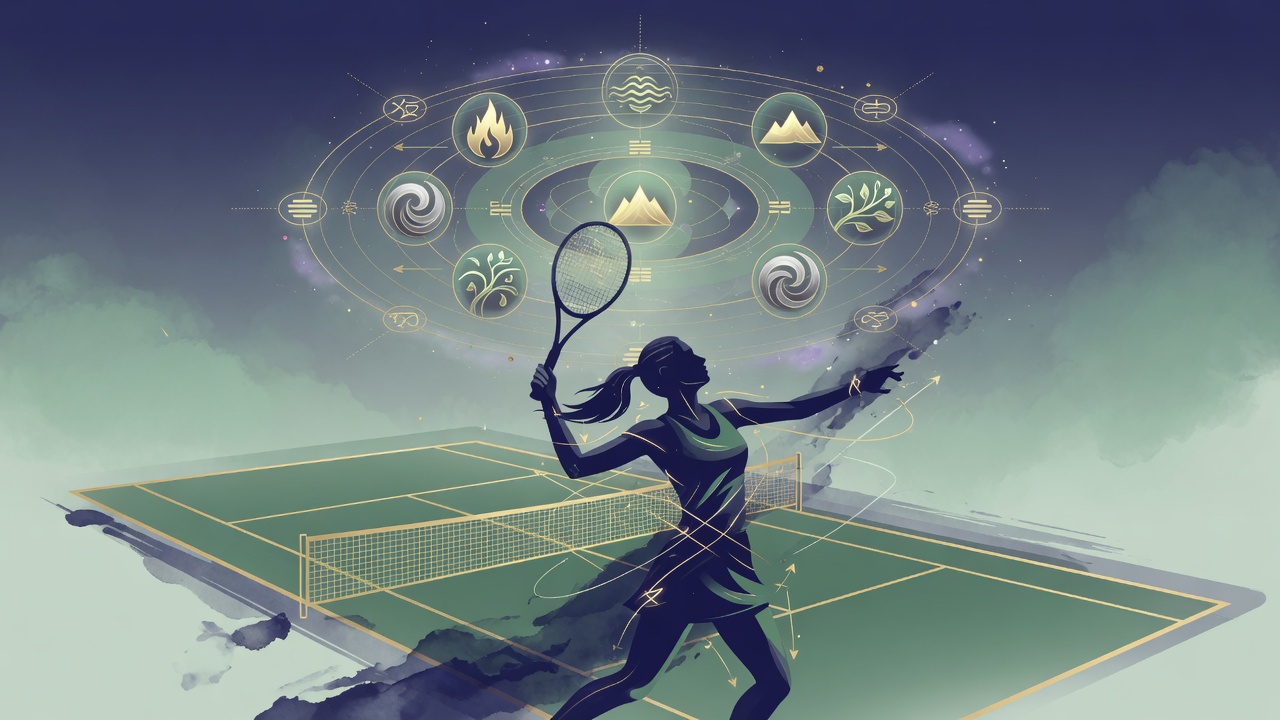
The Five Elements (Metal, Wood, Water, Fire, Earth) are not literal substances but abstract summaries of energy movement states. They have deep metaphorical connections to an athlete's technical style and physical cycles. Indonesian BaZi enthusiasts often map elemental characteristics onto personal traits, a perspective that is both intriguing and insightful.
- Metal Governs Righteousness: Sharpness, decisiveness, and penetrating power. Metal energy symbolizes resolution and discipline. A person with strong Metal influence tends to have a clean, efficient style, pursuing winner efficiency, with serves and flat groundstrokes like a blade's edge. Sabalenka's power-based game carries a strong Metal killing aura, striving for a direct, one-shot conclusion.
- Water Governs Wisdom: Flexibility, flow, and adaptability. Water energy represents adaptability and calmness. Counter-punching players who excel at using an opponent's pace often possess Water qualities. Pegula's excellent court coverage and defensive resilience dissolve attacks like water, seeking counter-attack opportunities within the flow, embodying Water's wisdom.
- Wood-Fire Brightness and Earth's Stability. Wood represents growth and explosive power, Fire is passion and visual impact, and Earth is stability and endurance. A match is a dynamic clash of Five Element energies. A player's fluctuating form can also be understood through the lens of Luck Pillars and Annual Cycles, such as a period of strong Fire potentially bringing greater expressive desire and physical peaks, but possibly accompanied by restlessness.
- Annual Cycle Influence: The invisible variable of timing. BaZi theory holds that each year, a person interacts with the year's Heavenly Stems and Earthly Branches. For instance, a year that combines with one's Day Master might bring a calmer mindset and smoother teamwork; a year of clashes might present more changes and tests. This isn't fate, but a reminder that certain years require more self-awareness and strategic adjustment.
3. Chart Structures: The Decision-Making Model at Critical Moments
A BaZi Structure is a model for analyzing which internal program a person will prioritize when facing major decisions. Determined by the month's energy and the Ten Gods combination, it reveals deep value hierarchies and behavioral logic. Every shot choice on the court is a microcosm of a life decision.
- Hurting Officer with Resource: The battle between bold risk and rational restraint. Hurting Officer represents a rule-breaking, adventurous spirit, fond of high-risk, high-reward shots. Direct Resource represents deliberation and safety-first. A Hurting Officer with Resource structure involves a constant internal tug-of-war between daring and caution. Whether to follow instinct on a critical point or stick to a tactical plan is an externalization of this inner structure.
- Eating God Generating Wealth: The rhythm master who goes with the flow. An Eating God generating Wealth Star structure excels at leveraging strengths and capturing environmental opportunities. These players have an excellent sense of rhythm, keenly detecting opponents' physical or psychological fluctuations and adjusting tactics to convert advantages into points. This is the wisdom of going with the flow, not forcing change but cleverly utilizing it.
- Strong Root and Blade Edge Structures: The warrior gene that rises to the challenge. People with Strong Root or Blade Edge structures are born with genes for competition and pioneering. They do not fear confrontation and often only reach their peak performance when inspired by a powerful opponent. Sabalenka's performances in the deep rounds of Grand Slams often display this 'born for the big stage' quality, a result of her inherent structure.
Pitfall Avoidance Guide: Rationally Viewing the Link Between BaZi and Life
Important Notes
When applying BaZi thinking to understand sports or life, several common traps must be avoided to prevent falling into irrational cognition.
- Avoid forced matching and rigid thinking. Never assert someone has a specific BaZi configuration based on one or two on-court behaviors. Personality expression is influenced by training, tactics, and situational factors. BaZi is just one perspective, and it must be based on an accurate birth time.
- Beware of hindsight bias and confirmation bias. Whether a match is won or lost, a 'reasonable' explanation can always be found in BaZi theory, which is precisely what we must guard against in educational content. We should use it as a framework for understanding character beforehand, not a game of proving correctness afterward.
- BaZi analysis cannot replace professional sports psychology. The achievements of top athletes are rooted in scientific training, team support, and personal will. BaZi culture offers a philosophical self-cognition tool to help ordinary people understand their tendencies. It must never overstep to replace professional judgment.
- Respect privacy, reject myth-making and voyeurism. Fabricating a public figure's birth information for analysis is strictly prohibited as a basic respect for privacy. We discuss cultural archetypes and universal principles, not a personal destiny reading of a specific individual.
- Understand cultural differences to avoid stereotypes. In regions like Indonesia, BaZi has integrated with local culture, forming unique interpretations. When educating, it's essential to clarify that this is a traditional analytical system originating from China, possessing both explanatory power and limitations, and should be approached with an open yet cautious attitude.
Recap and Conclusion
From Aryna Sabalenka's commanding court presence to the Ten Gods, Five Elements, and Structures in BaZi culture, what we see is not a script of fate, but a deep insight into character energy. The core conclusion is this: BaZi provides a symbolic system for understanding human tendencies, reminding us that everyone's innate nature reveals itself under pressure. True wisdom lies in recognizing your own patterns and, at every critical moment, making a conscious choice that transcends instinctive habit. This is both the allure of sport and the inspiration BaZi philosophy offers for modern life.