Timeless Wisdom: How Heavy Rainfall and Singapore’s Fire Land Reveal the Deep Dialogue Between BaZi Personality, Choice, and Circumstance
Recent short-duration heavy rainfall in multiple regions has raised concern, while Singapore’s equatorial climate also shows its unpredictable side. When weather becomes the backdrop of our era, how does BaZi culture rationally interpret the relation
Opening Introduction
The Central Meteorological Observatory forecasts short-duration heavy rainfall in Jilin, Liaoning, Shaanxi, Henan, and other areas, warning of flash floods and mudslides. Far away on the equator, Singapore may not face typhoons, but seasonal thunderstorms still catch people off guard. Weather seems to constantly remind us that the world has rhythms beyond our control.
In traditional BaZi culture, weather is not an isolated meteorological event but a manifestation of Heavenly Timing. The ancients used the Five Element cycles and the Ten Gods configuration to deduce a person’s innate personality foundation, then combined this with Luck Pillars and Annual Cycles to observe how an individual interacts with external circumstances. This is not about predicting sunshine or rain, but about understanding the breath between “self” and “environment.”
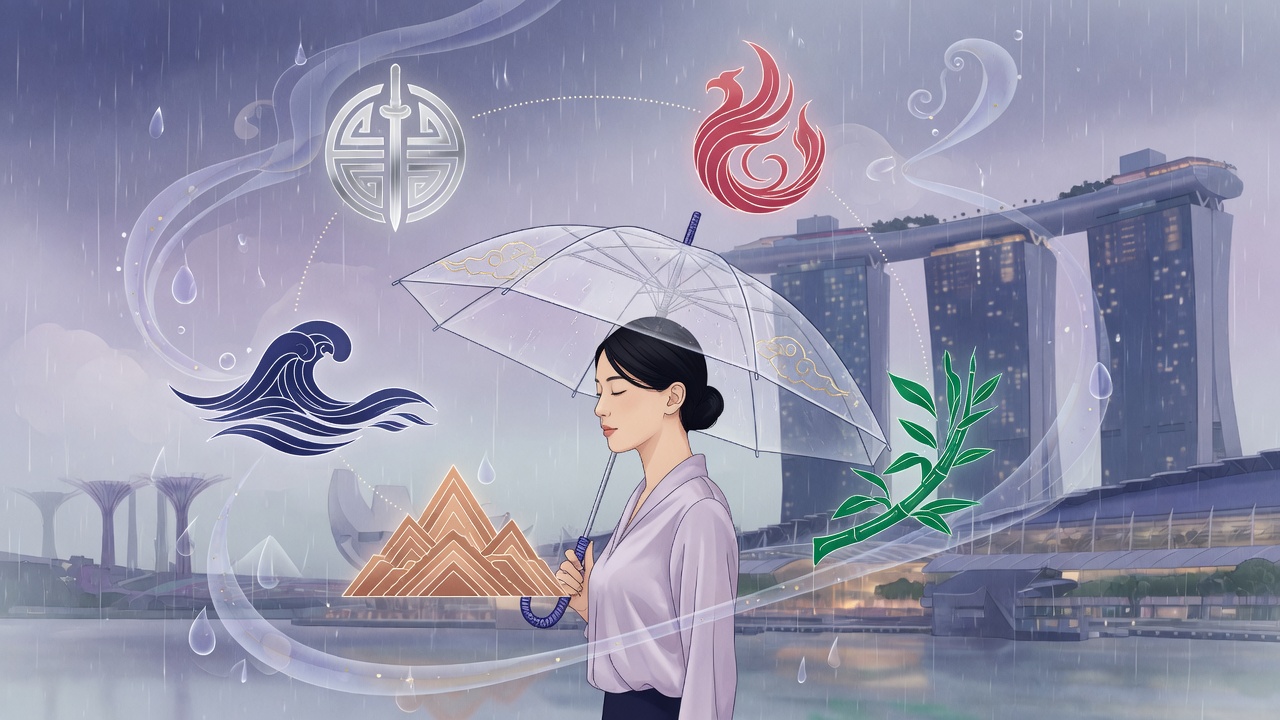
Basic Clarification: BaZi Is Neither a Weather Forecast Nor a Script of Fate
Common Misconceptions
- Misconception 1: BaZi can predict whether it will rain on a certain day in a certain place. BaZi studies a person’s innate energy configuration, and its time scales are the ten-year Luck Pillar and the annual cycle, not short-term meteorological forecasts. It is concerned with what state a person is more likely to exhibit under a certain Five Element atmosphere, not with predicting the weather itself.
- Misconception 2: A good BaZi chart means smooth sailing, and a bad one means constant misfortune. A so-called “good chart” usually indicates smooth Five Element flow and a balanced temperature and moisture level, which implies greater personality flexibility and more room for choice. But even if the natal chart has deficiencies, through cognitive adjustment and environmental choices later in life, one can still seek fortune and avoid misfortune. BaZi is an instruction manual, not a verdict.
- Misconception 3: Singapore is full of Fire, so everyone living there needs to supplement Water in their BaZi. The Five Element nature of a geographical environment does influence people, but BaZi analysis prioritizes the Day Master and the overall chart configuration. A person with an inherently strong Water chart might actually achieve a certain balance by living in a Fire-dominant place. It is never a one-size-fits-all prescription to simply add Water.
Core Insights: From “Weather” to “Heavenly Timing” — How BaZi Builds the Bridge Between Personality and Choice
1. The “Climate” in BaZi: Temperature Adjustment as Priority, the Deep Thermostat of Personality
The BaZi classic *Qiong Tong Bao Jian* places Temperature Adjustment in an extremely important position. Temperature Adjustment is about judging whether a chart is too cold, too warm, too dry, or too damp. This is very similar to how we physically experience weather—some people are born in the Hai, Zi, or Chou months with a chart frozen by Metal and Water, making them prone to introversion, overthinking, and sluggish action; those born in Si, Wu, or Wei months with scorching Fire and Earth tend to be extroverted, impatient, and lacking in sustained endurance.
The Useful God for Temperature Adjustment is the energy that “regulates the climate.” A cold chart needs Fire to warm it; a dry chart needs Water to moisten it. This adjustment often corresponds to personality traits a person needs to consciously develop.
- Cold Chart (born in winter with strong Metal/Water): Needs “Fire” to warm it, corresponding to cultivating initiative, passion, and outward expression. If the Luck Pillar brings Fire, it is like a warm current sent by heavenly timing, suitable for breaking out of the comfort zone.
- Dry Chart (born in summer with strong Fire/Earth): Needs “Water” to moisten it, corresponding to developing calmness, patience, and empathy. When the annual cycle brings Water energy, it is a good time for introspection and repairing relationships.
- The Singapore Metaphor: The Lion City is summer-like all year round, with Fire and Earth in command. People living here, regardless of their natal chart, are easily affected by dryness, manifesting as fast pace, high stress, and a tendency to “overheat.” Therefore, in local BaZi consultations, there is a very high proportion of attention paid to Metal and Water for Temperature Adjustment, but this must be combined with the individual’s natal chart and cannot be generalized.
2. Annual Cycles and Luck Pillars: How the “Heavy Rainfall” of Heavenly Timing Sculpts Personal Choices
The recent heavy rainfall in many parts of China, from a Five Element perspective, is a manifestation of a sudden surge in Water energy. In the BaZi system, the Heavenly Stems and Earthly Branches of the annual cycle change every year, and the ruling Water stars (Ren, Gui, Hai, Zi) interact with each person’s natal chart. This interaction is not simply good or bad fortune, but a “trigger”—it may activate your Wealth Star, your Officer Star, or your Hurting Officer and Seven Killings.
The key is that this triggering, through the imagery of the Ten Gods, influences your thinking tendencies and decision-making patterns. For example, if Water is your Wealth Star and gets activated, it may bring new financial opportunities or fluctuations; if Water is your Officer or Killing, you may feel increased external pressure or heavier responsibilities.
- Common Themes in Water-heavy Years: Water governs wisdom but also fear. For those with weak Earth in their chart, strong Water may breach their embankments, manifesting as decreased security and overthinking. At such times, choices should favor “stability,” avoiding rash investments or major life transitions.
- Annual Cycle Interaction for Singapore’s Fire-Earth People: Suppose a person’s chart has excessive Fire and Earth; a Water year is actually the arrival of a Temperature Adjustment favorable god. They may feel clearer thinking and calmer emotions—this is precisely a “cooling-off period” granted by heavenly timing, suitable for studying, planning, and mending relationships.
- Personality Determines Choice, but Circumstance Amplifies Personality: A person with a heavy Indirect Resource star who tends to overthink can easily fall into mental rumination during a Water-heavy year. But if they realize this is the influence of the annual energy field, they can proactively increase social interaction and exercise (supplementing Fire and Earth), using action to interrupt the thought loop. This is the initiative that BaZi grants.
3. Choosing Where to Live and When to Act: The Dialectic of Time and Space Through the Singapore Case
Within BaZi culture, there is a branch called “Geographical Destiny” that explores how the Five Element nature of a geographical environment can supplement a person. Singapore sits on the equator with thick Fire and Earth, but as an island nation surrounded by sea, its Water energy is not weak. This special configuration often creates an inner drama of Fire-Water clash for those living here: on one side, the urban drive and restlessness; on the other, the openness and calm between sea and sky.
If you find yourself often feeling anxious or suffering from insomnia in Singapore, from a BaZi perspective, you don’t necessarily need to move immediately. Instead, you can make adjustments in your micro-environment—such as choosing to work near water, swimming more, or wearing blue clothing. These behaviors essentially use Water energy to balance the excessive Fire and Earth.
- Career Choice and Five Element Resonance: Those whose BaZi favors Water can engage more in industries with flowing attributes in Singapore, such as logistics, trade, tourism, and communications; those who favor Fire are suited to fields that shine and radiate, like food and beverage, energy, technology, and creativity. This is not fate, but using environmental Five Elements to make things easier for oneself.
- Timing Choices: For major decisions like signing contracts or changing jobs, doing so during a month or day that matches your personal favorable god often yields twice the result with half the effort. For example, someone who favors Water can choose the Hai or Zi month, or a Ren or Gui day. This is not superstition, but allowing yourself to make clearer decisions at the moment when your energy field is best aligned.
- Lessons from Heavy Rainfall Days: When external weather is severe and Water energy is extremely heavy, people with weak Earth in their chart may be more prone to hesitation and pessimism that day. It is better not to force decisions at such times; postpone important communications and handle simple matters first. This wisdom of “pausing with the flow” is exactly how BaZi culture’s principle of “knowing the Mandate of Heaven and doing one’s human best” is put into practice.
Avoidance Guide: What Not to Do When Using BaZi to Observe Heavenly Timing
Points to Note
- Do not directly link weather disasters to personal destiny: A flood in a certain place does not mean all locals with strong Water in their BaZi will suffer misfortune. BaZi analysis must always return to the individual natal chart; public events cannot be used to retroactively deduce personal fortune. This is neither scientific nor in line with destiny logic.
- Do not blindly supplement Water just because the annual cycle is Water-heavy: If the natal chart already has an excess of Water, adding more will only worsen the imbalance. All adjustments must be based on the Useful God judgment. It is recommended to seek analysis from a professional BaZi practitioner rather than self-diagnosing.
- Do not use BaZi to find “divine will” explanations for extreme weather: Flash floods and mudslides are results of natural phenomena combined with geological conditions. BaZi culture should not be used to explain the causes of disasters, much less to spread superstitious talk of “heavenly punishment.”
- Do not neglect practical action: BaZi provides trend reminders akin to a “weather forecast,” but true safety still depends on heeding warnings, preparing supplies, and following evacuation guidance. No matter how strong the heavenly timing, it cannot replace human agency.
Summary and Recap
The weather is unpredictable, but people can be orderly. The concepts of Temperature Adjustment, Ten Gods, and Luck Pillars and Annual Cycles in BaZi culture are essentially a language for observing the interaction between self and environment. They tell us: personality is the innate base color, choice is the acquired brushstroke, and circumstance is the light and shadow on the canvas.
Facing heavy rainfall and Singapore’s scorching heat, there is no need to be anxious about “heaven’s will.” Instead, we should read our own energy configuration, do the right things at the right time, and hold the line when the energy field is unfavorable. Knowing fate without resigning to it, flowing with the current without being swept away—this is the most practical wisdom BaZi leaves for modern people.