When Korean Death Studies Meets the Twelve Stages of Life: How Ancient Wisdom Uses Lifecycle Metaphors to Understand Endings and Transformation
In the autumn of 2026, a Korean media column on death studies sparked deep public reflection on how to face farewells. This resonates remarkably with the Eastern destiny concept of the Twelve Stages of Life. This article explores the twelve stage
Opening Introduction
The Korean column 'Notes on Death Studies' poses a sharp question: Has modern society forgotten how to accompany and stay? This wave of reflection aligns remarkably with the ancient wisdom of the Twelve Stages of Life in Bazi destiny analysis.
The Twelve Stages are not a predictive tool but an exquisite lifecycle metaphor. Using twelve phases, it depicts the entire process of all things from gestation to returning to the root, viewing 'ending' as a starting point for transformation, not a final destination.
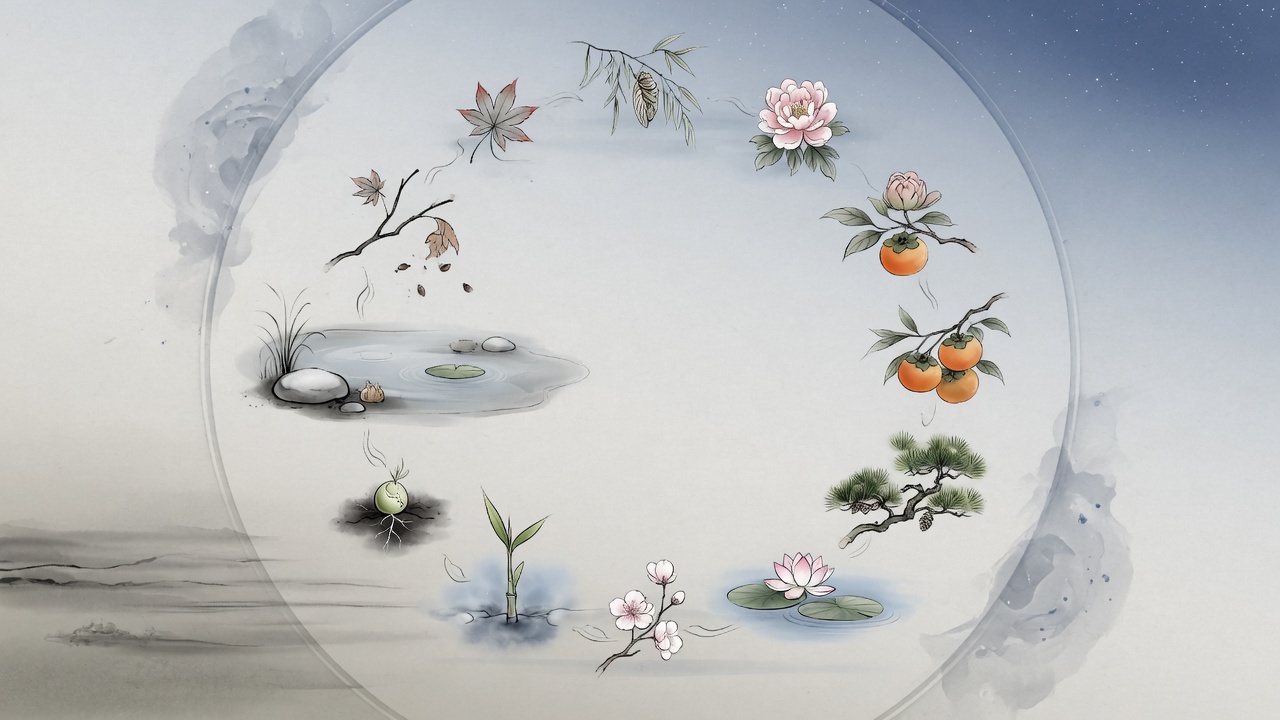
Basic Clarification: The Twelve Stages Are Not Fortune-Telling, But a Map of Life
Common Misconceptions
- Misconception One: The twelve stages directly determine lifespan or illness. In fact, stages like 'Death,' 'Grave,' and 'Extinction' in Bazi describe the state of Qi, akin to autumn leaves withering—a symbol of natural rhythm, absolutely not equivalent to physical death or disaster.
- Misconception Two: The twelve stages are only for personal destiny analysis. Their essence is an ancient philosophical abstraction of the lifecycle of all things, applicable to any field with fluctuations, such as career, relationships, or psychological states.
- Misconception Three: Entering the 'Decline' or 'Sickness' stage is bad. The ancients viewed decline as an opportunity for convergence and introspection, a necessary process where energy shifts from external release to internal storage, carrying profound transformative meaning.
Cultural Positioning
The Twelve Stages originate from the theory of the Five Elements' resting places, likening human life to the complete journey of a plant. It answers 'where Qi comes from and where it goes,' not 'when fortune or misfortune strikes.'
Introducing this framework into the Korean death studies discussion is precisely to reclaim a forgotten cyclical life perspective: there is rising and falling, gathering and parting—this is the fundamental rhythm of the universe.
Core Insights: Decoding the Twelve Stages as Metaphors and Their Modern Reflections
Phase One: From 'Long Birth' to 'Imperial Prosperity'—Insights from the Ascending Arc
Long Birth is like a newborn infant, with Qi stirring and all possibilities just opening up. Bathing resembles a young adolescent, full of naivety and exploration, easily influenced by the external world.
Cap Wearing symbolizes coming of age and beginning to shoulder responsibilities. Approaching Officials is stepping into society, where one's abilities can be applied. Imperial Prosperity reaches the peak, like the sun at high noon, the moment of fullest energy.
The ancients used these five stages to remind us: the rising period requires care, learning, and accumulation. Modern people often rush for results, craving the glory of 'Imperial Prosperity' while still in the 'Long Birth' stage, thereby damaging their foundation.
- Core Metaphor: Life needs a growth rhythm; forcing growth disrupts the natural cadence.
- Modern Reflection: Career development and intimate relationships both need to experience the complete arc from budding to maturity. Skipping any stage leads to structural fragility.
Phase Two: From 'Decline' to 'Extinction'—The Wisdom of the Descending Arc
After the peak, Decline begins, with a gentle reduction in physical strength or influence. Sickness manifests as a clear downturn, like autumn leaves turning yellow. Death is the end of the old form, with Qi entering stillness.
Grave seals the energy within the earth, awaiting transformation. Extinction is the state of void where old Qi has dissipated and new Qi is yet unborn; seemingly empty, it holds the greatest potential for regeneration.
The 'forgetting to stay' criticized by the Korean death studies column is precisely the modern collective evasion of this descending arc. We refuse to acknowledge the inevitability of Decline, Sickness, Death, Grave, and Extinction, and thus cannot truly accompany ourselves or others through low points.
- Core Metaphor: Decline is not failure but a necessary process for energy recovery and form transformation.
- Psychological Adjustment: Accepting the vulnerability of the 'Sickness' stage and allowing the ending of the 'Death' stage enables new life to be conceived in 'Extinction.' Farewell is the prelude to transformation.
Phase Three: 'Embryo' and 'Nourishment'—The Code of Cyclic Regeneration
Embryo is the re-coagulation of Qi, formless yet already possessing a rudimentary shape. Nourishment is like a fetus absorbing nutrients in the womb, gathering strength for the next 'Long Birth.'
These two stages form the bridge connecting the end point to the new beginning. The ancients placed 'Embryo' after 'Extinction' rather than jumping directly to 'Long Birth,' emphasizing that transformation requires time and space for gestation.
Looking at the Korean societal reflection on the 'lack of companionship,' modern people precisely lack the patience for 'Embryo' and 'Nourishment.' After a relationship ends, one rushes into the next; after a project fails, one immediately fills the void with a new goal, never leaving a window for rest and reconstruction.
- Core Metaphor: True transformation needs a quiet period; within the void, future forms are being conceived.
- Practical Significance: After loss or ending, deliberately preserve a period of 'Embryo and Nourishment' time for reflection, integration, and recovery, rather than acting immediately.
Pitfall Avoidance Guide: How to Rationally Borrow Wisdom Without Superstitious Misuse
Important Notes
- Do not self-diagnose or label: Don't panic if you see 'Death' or 'Grave' in a Bazi chart. The twelve stages appear in different pillars (Year, Month, Day, Hour) representing different life dimensions. A holistic analysis is needed; taking things out of context only creates anxiety.
- Do not use for individual illness or death prediction: The Twelve Stages are a cultural metaphor system, not a medical diagnostic tool. Any act linking the 'Sickness' or 'Death' stages to specific physical diseases is a serious misinterpretation of traditional culture.
- Do not ignore real-world agency: The ancients spoke of 'destiny's course' but also emphasized 'doing one's best.' The twelve stages describe the rhythm of major trends, but individuals can still optimize their state through cultivation, learning, and adjustment at each stage.
- Do not equate the cyclical view with fatalism: Recognizing life's ups and downs is precisely to cope with change more calmly, not to passively await fate. Understanding that 'Imperial Prosperity' must be followed by 'Decline' allows one to stay clear-headed at the peak and maintain hope in the trough.
- Do not use the twelve stages to emotionally hijack others: Avoid telling friends or family in a low phase, 'You're going through a decline phase,' as this causes secondary harm. This knowledge should be internalized as wisdom for understanding and companionship, not a tool for judging others.
Summary and Review
The questioning from the Korean death studies column essentially calls for a cultural narrative that can accommodate decline, ending, and transformation. The Twelve Stages of Life in Bazi precisely offers such an ancient lifecycle metaphor: it uses twelve phases to fully depict the cycle from sprouting to returning to the root, and from void to regeneration, viewing 'Death,' 'Grave,' and 'Extinction' as necessary portals for transformation, not terrifying endpoints.
The key conclusion is: what modern people need is not a verdict on specific fortunes, but to relearn how to accompany the natural fluctuations of life—accumulating during the rise, introspecting during decline, bidding farewell at the end, and gestating in the void. This is both ancient wisdom and a cultural remedy for the contemporary 'lack of companionship.'