Mid-Autumn Festival Prayers and BaZi: Personality, Choice, and Timing Through Văn Khấn Rằm Tháng 8
On the fifteenth day of the eighth lunar month in 2026, Vietnamese families once again recite the văn khấn rằm tháng 8 prayer to seek blessings. The popularity of this ancient text is not only a revival of cultural memory, but also implies a deep res
Opening Introduction
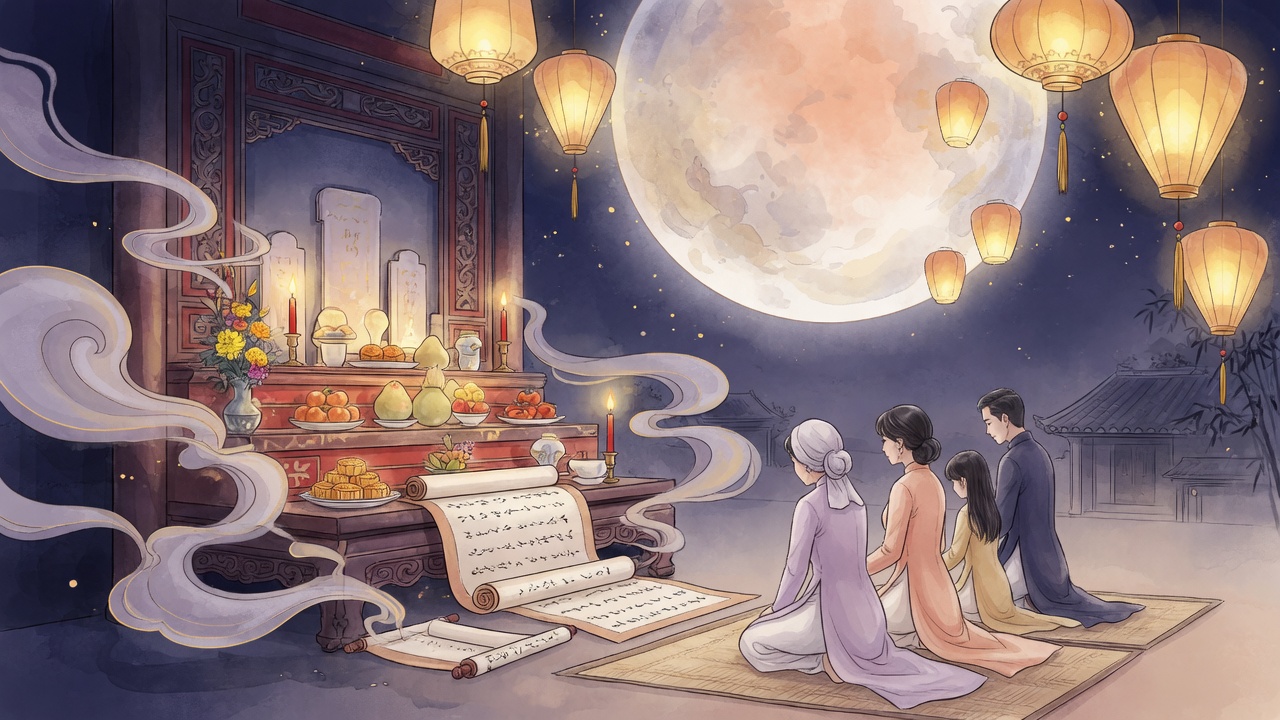
Every fifteenth day of the eighth lunar month, the recitation of văn khấn rằm tháng 8 resounds across Vietnam. This prayer is used during the Mid-Autumn Festival to honor ancestors and the moon deity, carrying meanings of reunion, gratitude, and blessing.
In 2026, this prayer is once again praised by many practitioners, and search interest is rising. Why does it continue to attract modern people? From the perspective of BaZi astrology, the Mid-Autumn prayer is not merely a text; it is a conscious attunement between a person and the rhythm of time and space.
Basic Clarification: The Real Relationship Between Prayer and BaZi
Common Misconceptions and Correct Understanding
Many people mistakenly believe that reciting a specific prayer can directly change one's fortune, or that a text alone can reverse a life chart. This understanding deviates from the original meaning of BaZi culture.
- Misconception 1: The prayer is a “patch” for whatever is missing in the BaZi. The Five Elements lacking in a chart require long-term cultivation, career choices, and environmental adjustment—never a one-time ritual.
- Misconception 2: The prayer’s effect depends only on the text. In fact, the timing of the ritual—the Mid-Autumn Rooster month—carries an energy field that is more decisive than the words themselves.
- Correct understanding: The prayer is a resonance device between mind and cosmic timing. It helps people at the Mid-Autumn moment, when Metal energy is at its peak, to use a respectful heart to clarify inner needs and make choices more aligned with their personal chart.
The Mid-Autumn Prayer from a BaZi Perspective: Personality, Choice, and Timing
Mid-Autumn Rooster Month: Full Metal Energy and the Month-Order Aura
The eighth lunar month corresponds to the earthly branch You (Rooster), whose Five Element is Metal, making it the purest and most flourishing month of Metal energy. Mid-Autumn also coincides with the full moon, when lunar yin energy is strongest, forming a unique field of pure Metal and clear Water.
In BaZi, the month order determines the basic energy undertone at a person’s birth. As the most concentrated point of Metal energy all year, Mid-Autumn naturally resonates with charts that favor Metal or favor Water.
Reciting the prayer at this time is essentially reinforcing positive intention within a favorable time-space window. For example, if the Day Master is Jia Wood and relatively weak, encountering the Rooster month’s Direct Officer in command, the ritual can help internalize discipline and self-restraint.
- You Metal imagery: swords, jewels, decisiveness, and restraint. Mid-Autumn prayers often contain words of gratitude and self-reflection, echoing Metal’s introspective quality.
- Full moon symbolism: yin wanes as yang grows, completeness, and the subconscious. For yin-soft Day Masters such as Gui Water and Yi Wood, Mid-Autumn is an excellent time to awaken intuition and flexibility.
- Value of timing: regardless of whether Metal is favorable or unfavorable, strong Metal energy at Mid-Autumn amplifies decisiveness and consolidation. Life choices made at this time, such as career adjustments or relationship repair, often carry a clearer sense of boundaries.
Day Master Temperament: Personality Projection Behind Prayer Choices
People with different Day Masters (the heavenly stem of the birth day) pay attention to and feel the same prayer very differently. This is not because the prayer is supernatural, but because individual personality tendencies selectively amplify certain parts of the text.
For example, a Bing Fire Day Master is warm and outgoing, and may focus more on passages about “praying for light”; while a Ji Earth Day Master is tolerant and pragmatic, and is more easily moved by phrases such as “gratitude to the earth and ancestral protection.”
This selective attention exactly reflects a person’s inner Ten Gods tendencies. The prayer becomes a mirror of the mind, helping people see their current needs—whether seeking career status, wealth, or inner peace.
- Jia Wood Day Master: a natural leader, focuses on order and benevolence in the prayer. The ritual may strengthen their sense of responsibility and courage to grow upward.
- Geng Metal Day Master: strong and decisive, perceives justice and reform in the prayer. Mid-Autumn Metal energy can help them restrain impulsiveness and turn it into strategic adjustment.
- Gui Water Day Master: delicate and sensitive, tends to feel the nourishment and wisdom of the prayer. The full moon’s power can stimulate deep intuition, benefiting artistic creation or spiritual healing.
- Wu Earth Day Master: steady and solid, values heritage and trustworthiness in the prayer. After the ritual, they often make grounded choices in family affairs or long-term planning.
Timing and Decision: The Life Wisdom of Aligning with Cosmic Time
BaZi is not fatalism; it emphasizes the combined effect of heavenly timing, geographical advantage, and human harmony. The popularity of Mid-Autumn prayers is essentially people unconsciously aligning with heavenly timing.
When a person chooses to sincerely recite the prayer on the fifteenth day of the eighth month, they have already made a choice aligned with autumn Metal energy: gathering the mind, reviewing, and giving thanks. This is fully consistent with Metal’s meaning of summarizing and refining.
Looking further, phrases in the prayer such as “praying for household peace” and “career success” actually correspond to the Useful God and Favorable God directions in one’s chart. If you can rationally analyze your own BaZi and then turn the ritual’s intentions into concrete action plans, you can truly leverage the timing without becoming lost in it.
- Action suggestion: After reciting the prayer, compare your chart’s Favorable and Useful Gods, and list the areas to focus on over the next three months, such as learning (Resource), generating income (Wealth), or expanding connections (Officer).
- Avoid vague prayers: Turn “bless me with wealth” into “sign a specific project” or “improve a certain skill,” so that intention becomes grounded and connects with real-world momentum.
- Timing is not speculation: Strong Metal energy at Mid-Autumn especially supports organizing, cutting off, and restructuring. If there are delayed or unresolved problems, use this period to produce a plan rather than waiting for a miracle.
Avoidance Guide: Rational Boundaries for Using the Prayer
Precautions
- Do not superstitiously believe a single prayer is all-powerful: No text can replace personal cultivation and effort. Improving a BaZi requires systematic adjustment; ritual is only one supportive condition.
- Avoid ignoring individual chart differences: For the same Mid-Autumn prayer, those with a strong Day Master and excessive Fire may need to shorten recitation time to avoid overactive intention; those with a weak Day Master and cold Metal can immerse more, but should keep a balanced mindset.
- Avoid reciting during extreme emotional swings: When the heart is full of anger or fear, the positive words in the prayer are easily distorted by negative emotions, which may deepen attachments.
- Do not use the prayer as an excuse to escape reality: After the ritual, be sure to return to real life and fulfill your wishes through action, rather than waiting for external forces to change everything.
- Maintain cultural respect and avoid casually claiming “empowerment”: văn khấn rằm tháng 8 carries the collective emotions of the Vietnamese people. Rationally understanding its cultural meaning is far better than blindly chasing mystical experiences.
Summary and Review
The popularity of văn khấn rằm tháng 8 during Mid-Autumn 2026 reflects a deep desire for self-awareness and acting in accord with timing. From a BaZi perspective, the prayer’s value lies not in mystical power, but in providing an opportunity for dialogue with oneself and attuning to cosmic time.
Key conclusion: Personality determines how we interpret the ritual, timing influences whether we choose to leverage it, but the final direction of life still depends on how much concrete right action we turn gratitude and reflection into after the ceremony. Recognizing this is the most pragmatic inheritance of traditional destiny wisdom.