Behind the Zodiac Trends: Understanding the Cultural Wisdom of the Twelve Zodiac Signs through Ba Zi and the Heavenly Stems and Earthly Branches
Recently, 'twelve zodiac luck' has once again become a focal point, with claims such as Oxen facing unstable finances and Pigs receiving support from benefactors sparking heated discussion. In reality, the Chinese zodiac is not a verdict of fate,
Opening Guide
In September 2026, 'twelve zodiac luck' once again topped trending searches. Media headlines like 'Oxen face unstable finances' and 'Pigs receive benefactor support' sparked public concern about the zodiac. However, what role does the zodiac actually play in traditional destiny analysis? Can it truly dictate financial fortune and benefactor luck?
This article returns to the origins of Ba Zi studies, deconstructing the cultural meaning behind the zodiac layer by layer—from Heavenly Stems and Earthly Branches and the Sexagenary Cycle to the Four Pillars of Destiny. It aims to help you view this ancient time wisdom with a rational eye, rather than blindly following superficial predictions.
Basic Clarification: The Zodiac Is Not a Single Code of Fate
Common Misconceptions
The public often equates the zodiac with personal destiny, and may even make major decisions based on it. The following three misconceptions are the first step to understanding the zodiac rationally.
- Misconception 1: The zodiac determines your entire life. The zodiac is merely the Earthly Branch of the year pillar in Ba Zi. A complete destiny chart must combine the month, day, and hour pillars—eight characters in total. Looking only at the zodiac is like peeping at a leopard through a tube.
- Misconception 2: Your birth year (Ben Ming Nian) inevitably offends Tai Sui. Whether one offends Tai Sui depends on the overall relationship between the Heavenly Stem and Earthly Branch of the year pillar and the current year, as well as the favorable and unfavorabe elements in the Ba Zi chart. Not every birth year is unlucky.
- Misconception 3: Zodiac compatibility determines marriage. Zodiac matchmaking is merely a folk custom. Marital happiness depends on both partners' personalities, values, and the full interaction of their Ba Zi charts. It cannot be judged based on the zodiac alone.
Core Decoding: From Zodiac to Ba Zi, Reading the Code of Time
1. Heavenly Stems and Earthly Brances and the Zodiac: The Building Blocks of the Calendar System
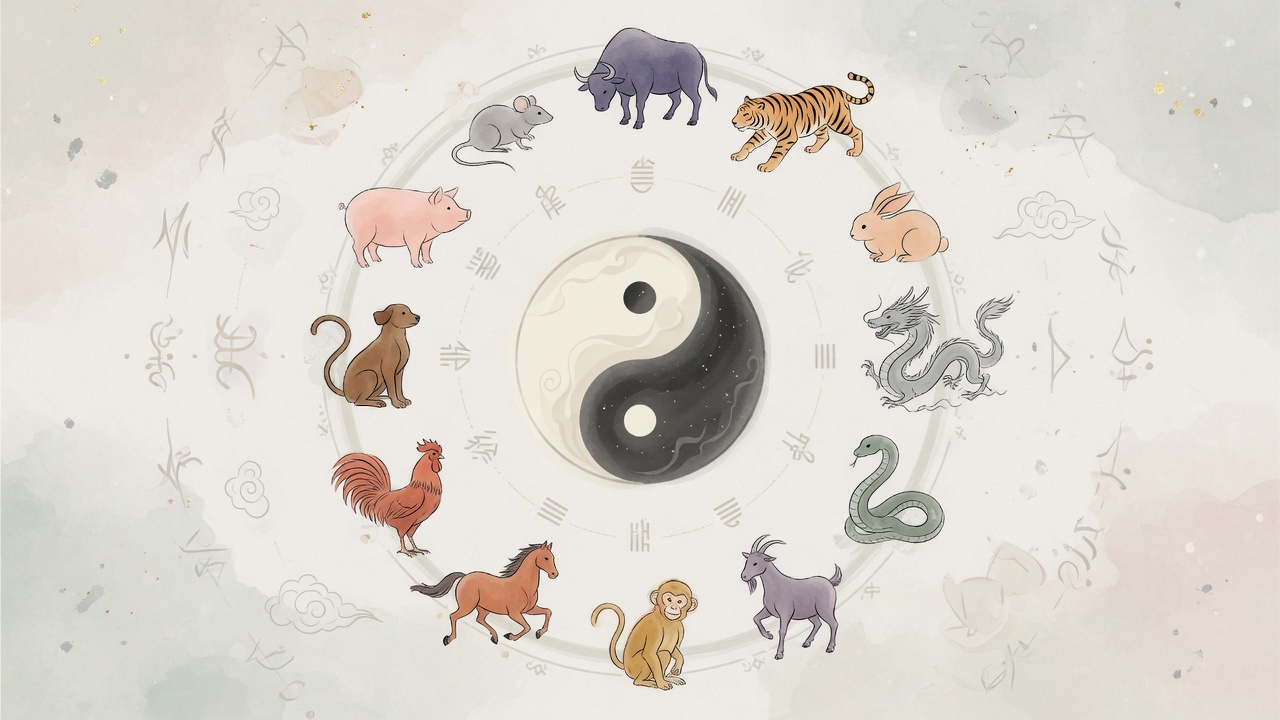
The twelve zodiac animals correspond to the twelve Earthly Brances: Rat (Zi), Ox (Chou), Tiger (Yin), Rabbit (Mao), Dragon (Chen), Snake (Si), Horse (Wu), Goat (Wei), Monkey (Shen), Rooster (You), Dog (Xu), Pig (Hai). But above the Earthly Brances, there are the ten Heavenly Stems: Jia, Yi, Bing, Ding, Wu, Ji, Geng, Xin, Ren, Gui.
The Heavenly Stems and Earthly Brances combine in a fixed sequence to form the Sexagenary Cycle (60 combinations), used to mark years, months, days, and hours. For example, 2026 is a Bing Wu year—'Bing' is the Heavenly Stem, associated with the Fire element; 'Wu' is the Earthly Branch, and its zodiac animal is the Horse. Clearly, the zodiac alone reflects only the Earthly Branch, omitting the Heavenly Stem.
The ancients used this system to observe celestial movements and seasonal changes. The zodiac was a way to visualize the Earthly Branches for easy memory and transmission. It is fundamentally a time symbol, not a mystical force.
- Heavenly Stems: Ten symbols representing cosmic energy attributes, such as Jia Wood or Bing Fire; they are the celestial manifestation of the Five Elements.
- Earthly Brances: Twelve symbols representing the twelve months, the twelve double-hours, and the orbit of Jupiter, with zodiac animals as their symbols.
- Sexagenary Cycle: The smallest common multiple of 10 and 12 is 60, forming a complete cycle, e.g., Jia Zi, Yi Chou... Ren Xu, Gui Hai. Used for years, each cycle lasts 60 years.
- Ba Zi Four Pillars: A person's birth year, month, day, and hour each have one Heavenly Stem and one Earthly Branch, making four pillars with eight characters in total. The zodiac is just one of these characters.
2. The Real Role of the Zodiac in a Ba Zi Chart
In Ba Zi destiny analysis, the Earthly Branch of the year pillar (the zodiac) represents ancestral roots, childhood environment, and fortune before the age of 15. It is like the roots of a tree, providing early nourishment, but the tree's mature shape depends more on the month pillar (parents, siblings, early adulthood), the day pillar (self, spouse), and the hour pillar (children, later years).
For example, a person born in the Year of the Ox has the Earthly Branch Chou on the year pillar. But if the month pillar is Zi, the Chou-Zi combination transforms into Earth, potentially strengthening the Earth element in the chart. If the day pillar is Wei, the Chou-Wei clash indicates a conflict between the early environment and personal aspirations. The influence of the zodiac must be weighed within the overall dynamics of the entire chart.
The core of Ba Zi is the Heavenly Stem of the day pillar, called the 'Day Master', representing the self. Analyzing personality, career, and wealth all start with the Day Master, examining the Five Element cycles of generation and control and the Ten Gods configuration from the other stems and branches. The zodiac, as only the year branch, cannot determine good or bad fortunes alone.
- Year Pillar: Foundation; influences early years, but its effect diminishes in adulthood.
- Day Master: The Heavenly Stem of the day pillar; it is the 'self' in the chart, and all analyses revolve around it.
- Five Element Balancce: Each zodiac has a Five Element attribute—e.g., the Ox (Chou) is Earth, the Pig (Hai) is Water—and must be judged in the flow of the overall elements.
- Ten Gods Relationship: Through the interactions of the Day Master with other stems and branches, the Ten Gods (like Direct Officer, Direct Resource) are determined. The zodiac's year pillar reveals the corresponding God; for example, if Chou is the Day Master's Direct Resource, it may indicate help from elders.
3. Zodiac Personality Traits: Cultural Projection and Rational Boundaries
Traditional destiny analysis projects animal habits onto human character—e.g., Oxen are diligent and steadfast but stubborn; Pigs are easy-going, considerate, but perhaps too laid-back. This analogical thinking stems from observations of nature in agrarian society and is a probabilistic generalization, not a scientific law.
Modern psychology has found that birth season may have a slight influence on temperament. The zodiac as a marker of birth year might correlate with social environments or climate in specific years, but should never be used to label individuals. People of the same zodiac sign vary greatly; education and life experiences are the main shapers of personality.
We can treat zodiac personalities as a cultural mirror for self-reflection or understanding others, but must avoid judging a person's abilities or character by it. Rationally, it is more like a kind of folk psychology—interesting but not absolute.
- Ox (Chou): Earthly Branch Chou, Five Element Earth; symbolizes steadiness, endurance, but may lack flexibility.
- Pig (Hai): Earthly Branch Hai, Five Element Water; symbolizes easy-going nature, wisdom, but may be overly comfort-seeking.
- Horse (Wu): Earthly Branch Wu, Five Element Fire; symbolizes passion, vitality, but may be impetuous.
- Cultural Differences: Descriptions of the same zodiac's personality vary across regions, reflecting the local nature of folk wisdom.
- Rational Boundaries: Do not label others by zodiac, and never use it as a rigid criterion for hiring or choosing a partner.
4. Annual Interactions: Seeing Earthly Branch Dynamics from 'Oxen's unstable finances'
The trending claims—'Oxen's finances unstabe' and 'Pigs receive benefactor support'—can be culturally interpreted through the relationship between the current year's Earthly Branch and the zodiac Earthly Branch. 2026 is a Bing Wu year, with the Tai Sui (Grand Duke Jupiter) being the Horse (Wu). The Ox corresponds to Chou; Chou and Wu have a mutual harm relationship, traditionally indicating quarrals and financial losses.
The Pig corresponds to Hai. Hai and Wu relate by covert harmony—an unpublicized harmonious connection symbolizing secret help or benefactor support. These statements derive from the rules of Six Harmonies, Six Clashes, Six Harms, and Three Penalities among the Earthly Branches, which are interaction patterns summarized by the ancients.
However, this is merely a one-dimensional analysis between year branch and year branch. Actual fortune must look at the interaction between the Day Master in the personal Ba Zi chart and the Heavenly Stem-Earthly Branch of the current year, as well as the Ten-Year Luck Pillar. An Ox person whose Ba Zi chart contains the Earthly Branch Zi would see Zi-Chou combination resolving the Chou-Wu harm; and if the chart also has the Heavenly Stem Gui, it could control the Bing Fire, meaning finances might not necessarily be unstabe.
- Mutual Harm: Chou-Wu harm means two forces impair each other; folk belief suggests financial fluctuations.
- Covert Harmony: Wu-Hai covert harmony is an unspoken harmony, symbolizing secret help from benefactors.
- Tai Sui: The Earthly Branch on duty each year is called the Tai Sui (Grand Duke). Those whose zodiac clashes, harms, or penalizes the Tai Sui traditionally need to 'appease Tai Sui'—essentially a reminder to act cautiously.
- Holistic View: Annual fortune must combine the natal Ba Zi chart and current Luck Pillar; accuracy based solely on zodiac-Tai Sui relationship is very low.
- Do Not Be Superstitious: These notions are part of folk culture and should not be the basis for investment or life decisions.
5. Ben Ming Nian and Tai Sui: Rationally Deconstructing Folk Taboos
'Ben Ming Nian' refers to the year that matches one's own zodiac sign, e.g., a Horse person encountering a Horse year. Folklore holds that one 'sits atop Tai Sui' in one's birth year, brings misfortune, and must wear red to counter it. In reality, from a destiny analysis perspective, a Ben Ming Nian simply means the Earthly Branch is the same; if that Branch is a favorable god in the chart, the year may actually bring good fortune.
There are twelve Tai Sui in total, one on duty each year. Besides sitting atop Tai Sui, there are also clashing Tai Sui (Six Clashes), harming Tai Sui (Six Harms), and penalzing Tai Sui. These rules establish a system of time taboos, whose origin lies in the ancients' psychological need to seek good fortune and avoid harm.
Modern people treating Ben Ming Nian might see it as a cyclical self-reminder. Every birth year, review growth over the past 12 years and plan for the next 12—far more meaningful than fretting over red accessories. Folk rituals provide psychological comfort; rational action is the real key to change.
- Sitting Atop Tai Sui: When the zodiac is the same as the year's Earthly Branch, e.g., Horse year for a Horse person—not necessarily dangerous.
- Clashing Tai Sui: The six clashes among Earthly Branches, e.g., Zi-Wu clash, represent changes that can be opportunities or challenges.
- Harming Tai Sui: The six harms, e.g., Chou-Wu harm, hint at frictions in interpersonal relationships.
- Penalzing Tai Sui: Penalties among Earthly Branches, e.g., Yin-Si-Shen, often relate to disputes and health issues.
- Rational Approach: These taboos can serve as annual references, but do not panic; maintaining a positive mindset is most important.
Avoidance Guide: How to Properly Treat Zodiac Culture
Key Points
Faced with the vast array of online zodiac luck predictions, keep a clear mind so traditional culture can truly nourish your life.
- Do not make major decisions based solely on the zodiac: Career choices, investments, and marriage should integrate real-world factors; the zodiac is only for fun reference.
- View zodiac luck articles rationally: Most are for entertainment, not professional destiny analysis; do not take them seriously.
- Do not panic during your Ben Ming Nian: Wearing red is more of a psychological cue; positive actions and planning are the key to turning things around.
- Zodiac clashes and combos are only references: Relationships rely on real interaction; do not distance yourself based on zodiac incompatibility and miss good connections.
- Learn Ba Zi starting from the Stems and Brances: If you wish to delve deeper, systematically study the Heavenly Stems, Earthly Brances, Five Element dynamics, and Ten Gods—rather than staying at the zodiac level.
- Respect cultural diversity: The zodiac is a shared cultural memory for Chinese communities, but it should not be imposed on others or become an excuse for discrimination or prejudice.
- Use professional tools: When analyzing personal Ba Zi, use a reputable destiny analysis platform for professional reports to avoid being misled by biased information.
Summary and Reflection: The Zodiac Is a Symbol, Wisdom Lies in Rationality
The twelve zodiac animals are a crystallization of ancient observations of time cycles. Using animals as symbols, they transform abstract Earthly Brances into vivid cultural images. In Ba Zi destiny analysis, the zodiac, as the Earthly Branch of the year pillar, is only one of eight characters and cannot determine fortune on its own.
When faced with trending zodiac luck predictions, we may appreciate them with am admirer's eye for folk culture, understanding the logic behind Heavenly Stems and Earthly Brances and Five Element dynamics, but always remember: rationality is the true tool for modern people to grasp their destiny. Let ancient zodiac wisdom be a window through which we understand time and know ourselves, not chains that bind our hands and feet.