Mexico vs Colombia: Decoding Character, Choice, and Momentum Through Ba Zi
When Mexico and Colombia meet on the pitch, the world watches a clash of cultures. From the perspective of Ba Zi (Eight Characters) destiny analysis, people from different regions and with different temperaments often reflect the Five Elements in the
Opening Guide
When Mexico and Colombia meet on the pitch, the world watches a clash of cultures. From the perspective of Ba Zi (Eight Characters) destiny analysis, people from different regions and with different temperaments often reflect the Five Elements in their behavior and timing. This article does not predict the score; instead, it uses this spotlight to explore how Ba Zi culture helps us understand character, timing, and life decisions.
Clarification: Ba Zi Is Not Fatalism
Common Misconceptions
Many people misunderstand Ba Zi as an ironclad fortune-telling technique. In reality, it is a traditional study of how space-time energy relates to personal traits.
Based on Heavenly Stems, Earthly Branches, Yin-Yang, and the Five Elements, it reveals trends and possibilities, not fixed outcomes.
- Misconception 1: Ba Zi determines destiny. Ba Zi is more like a life map, showing the terrain, but the path is yours to choose.
- Misconception 2: Ba Zi can predict specific events. It reveals trends and possibilities, not football scores or exact dates.
- Misconception 3: People with the same chart share the same fate. Different environments, eras, and choices mean that even identical Four Pillars lead to very different lives.
- Misconception 4: Ba Zi only looks at the year pillar. True analysis requires examining all Four Pillars—year, month, day, and hour. Judging by zodiac animal alone is overly simplistic.
Core Insights: Ba Zi Wisdom on Character, Choice, and Momentum
Day Master and the Five Elements: A Cultural Mirror of Character
In Ba Zi, the Day Master (the Heavenly Stem of the birth day) represents a person’s core character. Different Five Element qualities shape distinct behavioral styles.
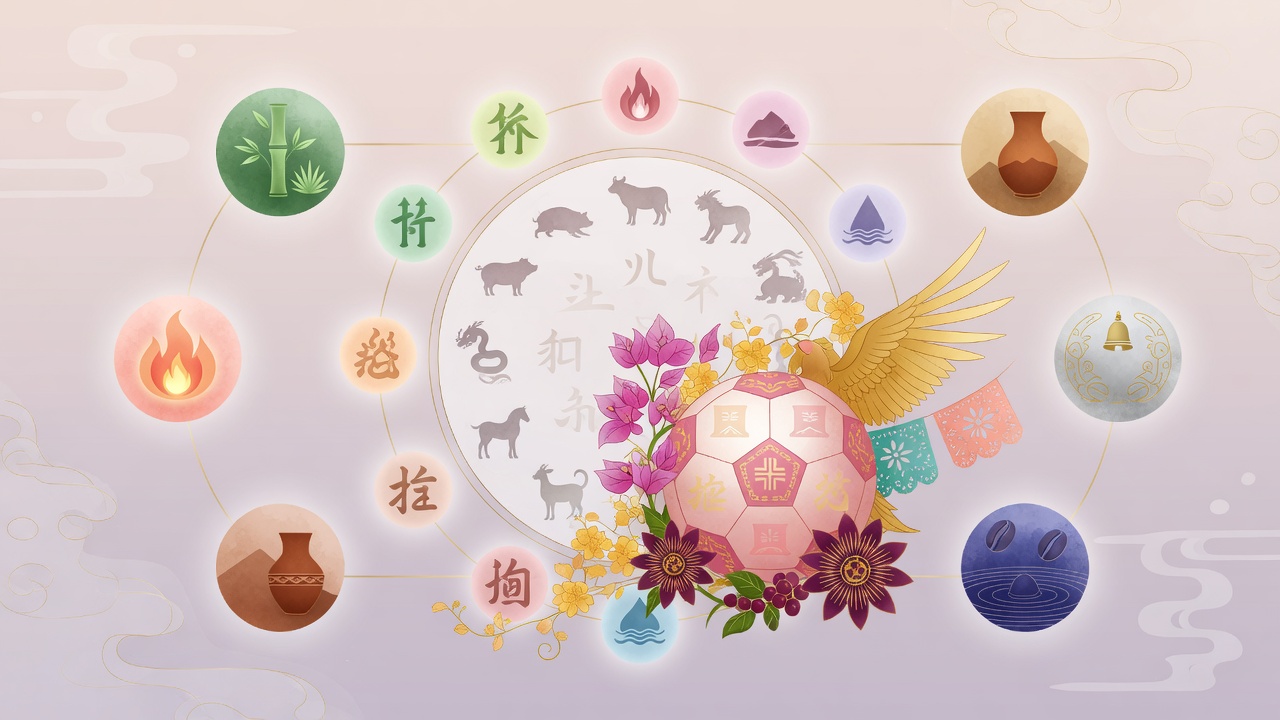
Mexican culture is often associated with Fire and Earth traits—passionate, resilient, and grounded. Colombian culture carries Water and Wood qualities—fluid, graceful, and ever-growing. Such metaphors are not definitive, but they help us understand Five Element personalities.
A Wood Day Master tends to be kind, upright, and upward-striving, much like Colombia’s relentless pursuit of football artistry, constantly pushing technical boundaries.
A Fire Day Master is enthusiastic, proactive, and highly infectious, like the vibrant energy of Mexican festivals that can quickly ignite team morale.
An Earth Day Master is trustworthy, steady, and deeply inclusive, reminiscent of the strong family values in Latin American society, providing a solid backbone for the team.
A Metal Day Master is loyal, decisive, and good at driving change, like a critical tactical adjustment at a key moment that brings a breakthrough.
A Water Day Master is wise, adaptable, and extremely flexible, mirroring Colombia’s history of diverse integration, always finding a new path forward.
- The generating and controlling cycles of the Five Elements: Fire produces Earth, Water nourishes Wood. A team needs balance and complementarity, just as a forward’s attacking thrust (Fire) requires a defender’s stability (Earth) to support it.
- Character has no good or bad: Each element has strengths and challenges. The key is understanding your own favorable and unfavorable elements to play to your strengths.
- Cultural impression ≠ personal chart: A country’s cultural temperament is a collective expression. An individual’s Ba Zi must be analyzed through a full chart; generalizations do not apply.
- Useful God as climate adjuster: If a chart has too much Fire, Water is needed to adjust it. When a team is too aggressive, calm strategists are needed to restore balance—similar to a coach’s tactical adjustments on the field.
- Five Element personalities and positions: Fire-type players suit forward positions with strong attacking power; Earth-type players suit defense with steady guarding; Water-type players suit midfield with flexible distribution.
- Day Master strength: A strong Day Master can handle Wealth and Authority and is suited to pressure; a weak Day Master needs Resource and Companion support and is better in teamwork than solo efforts.
Luck Cycles and Annual Influences: The Wisdom of Seizing the Moment
In Ba Zi theory, the Luck Cycle changes every ten years, while the Annual Cycle shifts each year, together shaping life’s rhythms of rise and fall. This reminds us that timing is crucial.
A match result depends not only on skill but also on momentum. From a Ba Zi perspective, every team or individual has a luck cycle. Doing the right thing at the right time yields twice the result with half the effort.
The Luck Cycle is like seasonal change: during a ten-year favorable cycle, advance actively; during an unfavorable cycle, consolidate and accumulate. A player’s career peak often occurs during a Useful God Luck Cycle.
The Annual Cycle is like daily weather: even in a good Luck Cycle, an unfavorable year calls for caution. The Stem-Branch combination on match day may be more favorable for certain Five Element types.
The ancients spoke of timing, terrain, and human harmony. Timing refers to the energy field of the year and month. Understanding momentum is not about passive waiting, but about actively aligning with the times and adjusting strategies.
- How Luck Cycles are arranged: For yang male and yin female, the cycle follows the forward order; for yin male and yang female, the reverse order. Starting from the month pillar, each ten-year cycle influences life’s general direction.
- The Grand Duke of the Year: Each year’s ruling Earthly Branch should not be offended. If a team’s key figure violates the Year Breaker, that year may bring turbulence and requires advance precautions.
- Ten years to temper a blade: During a Resource cycle (learning), accumulate knowledge and skills. During a Wealth cycle, pursue commercial value. During an Authority cycle, take on greater responsibility.
- Choice matters more than fate: Ba Zi shows potential, but critical decisions determine the outcome. A transfer choice or a tactical adjustment can change the ending.
- Momentum creates heroes: Understand your Five Element preferences. Act boldly in favorable years and keep a low profile in unfavorable ones. This is the ancient wisdom of aligning with the times.
- Month and day cycles: For even finer timing, important negotiations, signings, or matches can reference the Chinese almanac to choose a day compatible with your Five Elements.
- Do not superstitiously trust predictions: Even the most favorable timing requires strength and preparation as a foundation. Ba Zi is a map, not the car.
The Ten Gods: Team Dynamics and Role Positioning
The Ten Gods in Ba Zi—such as Direct Officer, Seven Killings, Direct Resource, and Eating God—describe a person’s relationship patterns with the outside world. This can be likened to role divisions within a team.
A successful team needs the discipline and decisiveness of Officer and Seven Killings, the wisdom and support of Resource stars, the creativity and talent of Output stars, and the goal-orientation and execution of Wealth stars.
The Ten Gods are not fixed labels but dynamic relationship energies. The same person may transition from a creative Output type to a managerial Direct Officer type under different Luck Cycles.
The key to team harmony lies in a strong Useful God and restrained Annoying God. If Seven Killings is too heavy and the Day Master is weak, Resource is needed to resolve it—just as a strict coach needs a gentle team manager to balance things out.
- Direct Officer: The rule-follower, corresponding to executing the coach’s tactics with discipline. But too much can stifle creativity.
- Seven Killings: The bold decision-maker, like a star player who steps up at a critical moment with courage. Needs Eating God to control it and prevent recklessness.
- Direct Resource: Logistics and wisdom, like the team doctor or analyst providing support, protecting players and enhancing stability.
- Indirect Resource: The specialist, such as a set-piece expert or surprise substitute, capable of unexpected success but sometimes unconventional.
- Eating God: Creativity and harmony, displaying fluid teamwork and artistic football, with a calm mindset that benefits team atmosphere.
- Hurting Officer: The technical genius, showcasing brilliant footwork and individual breakthroughs, but needs Direct Resource to restrain it and avoid excessive self-focus.
- Direct Wealth: The steady executor, diligent and practical, seizing regular opportunities like a poacher in front of goal.
- Indirect Wealth: The opportunist, good at grabbing momentary openings, like a fast counter-attacker, but with higher risk.
- Companion: Teammates and partners, advancing and retreating together, strengthening cohesion, but too many can lead to a lack of variety.
- Rob Wealth: The competitor, which can both stimulate fighting spirit and trigger internal conflict. Needs Officer to balance it and maintain healthy competition.
- Useful God and Annoying God: A team needs to identify its core Useful God, such as creativity (Output) or defense (Resource), and resolve the Annoying God, such as internal friction (Rob Wealth merging).
- Combinations and transformations: Heavenly Stem combinations and Earthly Branch combinations represent tacit understanding. If key figures in a team have compatible Ba Zi charts, they often produce chemistry.
Practical Guide: Viewing Ba Zi Culture Rationally
Points to Note
- Do not use Ba Zi to predict match results: Ba Zi analyzes human nature and trends, not specific events. Avoid superstition. Any claim to precisely predict a score is pseudoscience.
- Do not label people with Ba Zi stereotypes: Five Element personalities are only a reference framework. Everyone is unique; cultural background, education, and experience have a greater impact. Do not assume someone is impulsive just because they are a 'Fire' person.
- Do not neglect real-world effort: Ba Zi is a map, not the car. Even the best chart requires action. A player’s sweat and training are the real foundation of performance.
- Understand cultural differences: In Malaysia’s multicultural society, Ba Zi as a Chinese tradition should be respected alongside other cultures. Do not impose interpretations or use the Five Elements to judge other ethnic groups.
- Study Ba Zi systematically: Avoid taking things out of context. Heavenly Stems, Earthly Branches, clashes, combinations, and harms must be considered holistically. It is best to learn from a professional teacher, starting with classics like The Sea of Knowledge on the Occult and Comprehensive Treatise on the Three Destinies.
- Be wary of commercial hype: Many 'Ba Zi luck-changing' services exaggerate their claims. True practitioners emphasize self-cultivation and going with the flow, not selling anxiety.
- Protect personal privacy: Do not casually disclose your birth time to untrustworthy platforms to prevent misuse of your information.
- Ba Zi and psychology: You can view Five Element personalities as a personality classification tool, similar to MBTI, but it cannot replace professional psychological assessment.
- View destiny dynamically: A Ba Zi chart changes with Luck Cycles and Annual Cycles. Today’s difficulty may be tomorrow’s turning point. Maintaining a positive mindset is most important.
Summary and Reflection
The showdown between Mexico and Colombia is a clash of cultural characters and a stage for timing and choice. What Ba Zi teaches us is not to predict victory or defeat, but to understand ourselves, seize the moment, and collaborate harmoniously. In a world full of uncertainty, knowing fate without resigning to it, and using the wisdom of the Five Elements to optimize decisions—this is the true Eastern philosophy of living.