From Korean Prison Revival to the Bazi 'Official Star': The Dual Nature of Pressure and Order
In the fall of 2026, a news story from South Korea sparked heated discussion: a rural village, once facing extinction, was revived by the establishment of a prison, attracting a wave of young people in their 20s and 30s. This seemingly contradictory
Opening Introduction
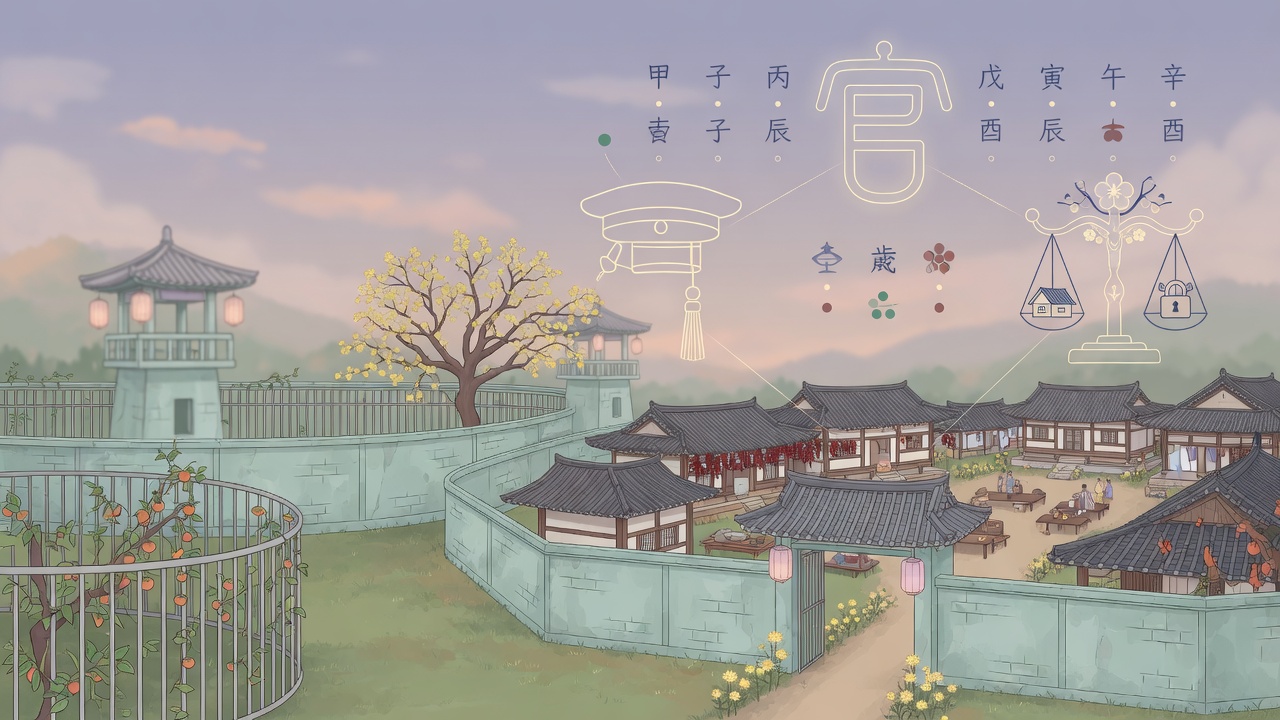
In the fall of 2026, a news story from South Korea sparked heated discussion: a rural village, once facing extinction, was revived by the establishment of a prison, attracting a wave of young people in their 20s and 30s. Shops revived, population flowed back—all 'thanks to the prison.'
This seemingly contradictory phenomenon perfectly mirrors the Official Star in Bazi. The Official Star represents both pressure and constraint, as well as order, protection, and community rebuilding. Using this current event as a starting point, this article will rationally dissect the auspicious and inauspicious sides of the Official Star, dispelling common misconceptions.
In traditional destiny analysis, the Official Star is often simplistically equated with 'career luck' or 'disaster,' but its essence is that which controls me—the projection of all rules and boundaries in life. Only by understanding it can we harness its power, just as the villagers skillfully utilized the prison's resources.
Basic Clarifications
Common Misconceptions
Many people have a superficial understanding of the Official Star, leading either to blind pursuit or excessive fear. The following five clarifications will help you build a correct foundation and avoid interpreting it literally.
- Misconception 1: Many Official Stars mean a thriving career. In reality, an overly strong Official Star without restraint is like an overcrowded prison—it becomes crushing pressure, leading to career setbacks or health issues. A chart values balance, not quantity; a clear, transparent, and strong Official Star is best.
- Misconception 2: The Official Star only represents career and officialdom. In Bazi, the Official Star also symbolizes rule-consciousness, self-discipline, responsibility, and even maps to the spouse (for women, the Direct Officer is the husband star) or children (for men, Officers and Killings represent children). It encompasses all relationships with a restraining and protective nature.
- Misconception 3: The Seven Killings (Indirect Officer) are always inauspicious. Though the Seven Killings carry a fierce energy, if they are controlled or transformed (by the Hurting Officer restraining the Killings, or the Resource star transforming the Killings), they can turn into extraordinary leadership and execution ability, just as strict prison management can bring a sense of community safety—heroes emerge in chaotic times.
- Misconception 4: If the Official Star is unfavorable, life is doomed. Luck cycles change, and even an unfavorable god can be controlled or transformed. Through postnatal choices (career, location, behavior), one can adjust the influence of the Official Star; destiny analysis is not fatalism. The village's transformation is a real-life example of 'turning an unfavorable god into a useful one.'
- Misconception 5: The Official Star only controls the self and does not protect the self. While providing constraint, the Official Star also builds a shield of order, protecting the Day Master from harm caused by lawlessness. The low crime rate in the Korean village is a real-world reflection of the Official Star's 'protective' function.
Core Insights
The Essence of the Official Star: A Symbiosis of Order and Constraint
In Bazi, that which controls me is the Official Star. Same-polarity control is the Seven Killings (Indirect Officer), and opposite-polarity control is the Direct Officer. The two are like two sides of the same coin, jointly forming the 'rule system' of life; neither can be missing.
The Direct Officer is gentle and persistent, like the daily laws of a society governed by the rule of law, guiding people toward goodness. The Seven Killings are fierce and sudden, like emergency martial law, forcing breakthroughs in crises. The daily operation of the Korean prison is the Direct Officer-like maintenance of order, while its deterrence of crime is the Seven Killings-like powerful constraint.
It is worth noting that the Official Star does not exist in isolation; it forms complex generating and controlling chains with the Resource Star, Wealth Star, and Hurting Officer/Companion Stars. Only by understanding these relationships can we truly grasp the auspicious and inauspicious transformations of the Official Star and avoid the trap of a single perspective.
- Core traits of the Direct Officer: discipline, reputation, sense of responsibility. When the Direct Officer is favorable, the person tends to be upright and suitable for institutional careers, such as civil servants or compliance officers. The village gaining stable employment due to the prison is a manifestation of the Direct Officer 'nourishing life.' But if the Direct Officer is unfavorable, it manifests as conservatism, timidity, and inflexibility—just as if the village relied solely on the prison, its economic structure would become rigid, and a policy change would plunge it into crisis.
- Core traits of the Seven Killings: boldness, competition, crisis management. When the Seven Killings are controlled, the person can become a hero in chaotic times or a top manager. The prison initially had a 'Seven Killings' impact on the village (land price fluctuations, psychological resistance), but through planning, it was transformed into developmental momentum—a perfect example of 'controlling the Killings to gain authority.'
- The dilemma of mixed Officers and Killings: When the Direct Officer and Seven Killings appear simultaneously, it is like a village facing two governance rules at once, easily leading to decision-making chaos and inconsistent policies. The chart owner needs to 'clarify,' i.e., focus on one path, or else many plans will yield few results. When choosing a career, it is advisable to be clear about direction and avoid constantly jumping between institutional and entrepreneurial paths.
- Relationship between the Official Star and the Resource Star: Officer generates Resource, Resource protects the self. The Resource Star (learning, benefactors, property) is the key to transforming the pressure of the Official Star. The village introduced educational and cultural facilities (Resource), transforming the 'Official pressure' of the prison into community 'cultural veins'—a real-life example of the Bazi pattern of Officer generating Resource, turning pressure into resources.
- Hidden dangers of an overly weak Official Star: If a chart lacks an Official Star or it is extremely weak, there is a lack of rule-consciousness and reverence, easily leading to misconduct and loose social relationships. Without the prison, the village might have continued to decline—a portrayal of 'no Officer, no governance.' But too much is as bad as too little; balance is precious. An overly strong Official Star also becomes shackles.
- Transformation between Direct Officer and Seven Killings: Too many Direct Officers can turn into Seven Killings-like pressure; controlled Seven Killings can manifest Direct Officer-like authority. If the village's prison were mismanaged (Direct Officer turning into Seven Killings), it could trigger resident protests; if well-reformed (Seven Killings turning into Direct Officer), it becomes a community asset. The 'mixed Officers and Killings' in Bazi often requires this transformative wisdom.
- Manifestations of the Official Star in annual luck: When the annual luck brings an Official Star, it may manifest as new rules, a new superior, or social obligations. When the prison was first built, it was the arrival of an annual 'Official Star,' bringing both impact and opportunity. The residents' choices determined whether they were 'controlled' or 'shouldered the Officer'—the same applies to the chart owner.
Auspicious and Inauspicious Transformation of the Official Star: Strong vs. Weak Day Master Determines Favorability
To judge whether the Official Star is auspicious or inauspicious, the first thing to consider is the strength of the Day Master (the chart owner). A strong Day Master is like a giant tree that can withstand the axe's chop (Officer's control); a weak Day Master is like a tender sprout that cannot endure frost. This is the most basic dialectic in Bazi and the starting point for all interpretations.
In addition, the position of the Official Star (year, month, day, hour) and the combination of the Ten Gods are crucial. An Official Star revealing in the month branch often influences the tone of one's career throughout life; an Official Star in the hour pillar is related to later luck and children. Different positions bring vastly different auspicious and inauspicious manifestations.
- Strong Day Master meeting Officer: The Official Star is a favorable god, representing authority, position, and achievements brought by discipline. Such people can thrive within rules, just as the village leveraged the prison's law-and-order image to attract safety-conscious residents and businesses, achieving dual growth in population and economy.
- Weak Day Master meeting Officer: The Official Star is an unfavorable god, manifesting as pressure, illness, and official disputes. If the luck cycle or annual luck again encounters Officers or Killings, it is easy to face unemployment, lawsuits, and other difficulties. Correspondingly, if the village were completely dependent on a single institution, a policy change would plunge it into crisis, and residents would need to seek other paths (Resource or Companion stars).
- Special cases of climate adjustment and patterns: Even if the Day Master is weak, if the Official Star is transformed by the Resource Star (Officer → Resource → Self), it can instead become a noble pattern. This is called 'Officer generating Resource,' turning pressure into knowledge and support. Just as the prison introduced cultural and educational projects, transforming hostility into harmony and attracting knowledge workers, turning waste into treasure.
- Hurting Officer controlling the Killings: When the Seven Killings are overly strong, if there is a Hurting Officer (talent, skill) to control them, the violence can be transformed into authority. The village used prison labor for crafts and manufacturing (Hurting Officer), creating economic value—a manifestation of 'controlling the Killings to gain authority,' using skill to overcome force.
- Dynamic influence of luck cycles and annual luck: If the natal chart's Official Star is unfavorable, but a Resource luck or Companion luck cycle arrives, the pressure can be temporarily relieved. Conversely, if someone favors the Officer but encounters a Hurting Officer luck (which controls the Officer), career instability is likely. Bazi emphasizes 'timing'; nothing is static. The village's rise and fall also fluctuates with policies (luck cycles).
- Conforming Strong and Conforming Killing patterns: In special patterns, if the Day Master is extremely strong or extremely weak, the Official Star may instead become favorable. A Conforming Strong chart favors Resource and Companion stars, with the Official Star being unfavorable; a Conforming Killing chart favors Officers and Killings, liking Wealth and Officer stars. Such charts often achieve extraordinary things but with dramatic ups and downs, like a village completely restructured around a prison—success or failure hangs on a single thread.
- The 'virtual' and 'real' Official Star: An Official Star revealed in the stems is 'virtual,' governing reputation and status; an Official Star hidden in the branches is 'real,' governing actual power and position. The village's prison is a 'real Officer' (buildings, jobs), while the sense of security it brings is a 'virtual Officer' (reputation). The two complement each other; neither can be missing.
Real-World Mapping: The Official Star Is Not Just Career, but Rules and Protection
In modern society, the Official Star in Bazi can correspond to all things with a constraining and protective nature: legal systems, company regulations, industry standards, and even personal habits of self-discipline. It is everywhere, profoundly influencing everyone's life trajectory.
From the Korean case, the prison as an 'Official Star' entity did not destroy the village; instead, it provided an order dividend—low crime rate, stable employment, and improved public facilities. This is the ultimate embodiment of the Official Star's 'protective' side, breaking the stereotype of 'turning pale at the mention of Officer.'
- Career fields: Explicit 'Officer' roles include civil servants, judges, and disciplinary forces; implicit ones cover any position requiring a high sense of responsibility and compliance, such as doctors, auditors, and safety engineers. These professions are both constrained by rules and trusted because of rules, especially suitable for those with a favorable Official Star.
- Interpersonal relationships: For women, the Direct Officer is the husband star, representing the responsibility and restraint a husband should possess, and also hinting that marriage needs order. For men, Officers and Killings represent children, symbolizing educational norms for offspring—too strict and the children rebel, too lenient and they lack discipline. Balancing the Official Star balances family relationships.
- Psychology and behavior: People with a strong Official Star tend to be self-disciplined, punctual, and respectful of authority; those with a weak or damaged Official Star tend to be undisciplined and challenge rules. The influx of young people into the Korean village is essentially a pursuit of 'bounded security,' matching the psychological need of a favorable Official Star—rules bring freedom.
- Society and the nation: On a macro level, the Official Star corresponds to government, law, and national defense. If a nation's chart has a clear and strong Official Star, the rule of law often flourishes; mixed and uncontrolled Officers and Killings can lead to policy swings. But this is a macro analogy and should not be applied mechanically; it must be combined with specific national conditions.
- Transformative thinking: What Bazi teaches us is not resignation but transformation. When the Official Star is unfavorable, you can strengthen the Resource Star (study, certification, property purchase) or Companion Star (exercise, teamwork) to share the pressure, or choose the Hurting Officer (creativity, technology) to counterbalance. The village transformed the single prison's 'Official pressure' through diversified industries (Hurting Officer) and public services (Resource).
- Female chart, Official Star, and marriage: For women, the Direct Officer is the husband; if the Official Star is clear and strong, they often marry a noble husband or one with a sense of responsibility; if Officers and Killings are mixed or the Official Star is damaged, romantic relationships are turbulent. Modern women can also view themselves as the 'Officer,' pursuing career status without being bound by ancient theories—the Official Star can also represent one's own achievements.
- Official Star and children's education: For men, Officers and Killings are the children stars; if too strong, the children are rebellious or under great pressure; if too weak, the children lack discipline. In modern families, parents need to balance 'Officer' (rules) and 'Hurting Officer' (freedom), just as the village balances the seriousness of the prison with the leisure of life, to raise a healthy next generation.
Pitfall Avoidance Guide
Key Considerations
After understanding the Official Star, in actual chart reading and self-adjustment, you need to avoid the following common traps to prevent misinterpretation and misuse, allowing destiny analysis to truly serve life.
- Do not blindly pursue the Official Star: If your chart has a weak Day Master and strong Officer, forcing a career in government or management may lead to physical and mental exhaustion. You should first strengthen the Resource Star (study, benefactors) or Companion Star (collaboration, fitness), and seek official positions only after the Day Master becomes strong. Otherwise, it is like a village unable to support a large prison, suffering instead of benefiting.
- Mixed Officers and Killings must be clarified: When the Direct Officer and Seven Killings appear together, it easily causes choice dilemmas and indecision. It is advisable to 'clarify' by combining away the Officer and keeping the Killings, or controlling the Killings and keeping the Officer, focusing on one track. In career, avoid simultaneously juggling a stable institution and high-risk entrepreneurship; focus leads to breakthroughs.
- Manifestations of the annual Official Star: When the annual luck brings an Official Star, it may bring job changes, marriage (for women), or lawsuits. Judge the auspiciousness based on the natal chart's favorability; if the Officer is unfavorable, be conservative and study more; if favorable, be proactive and seize opportunities. Planning ahead can turn annual challenges into turning points.
- Environmental feng shui assistance: The Official Star is associated with the Metal element or certain directions, but more important than ornaments is establishing an orderly life and work flow, using 'behavioral feng shui' to resonate with the positive energy of the Official Star. For example, fixed routines and organizing your desk—making rules a habit rather than a burden.
- Learn flexible application from the Korean case: The village turned a 'constraining resource' into a 'developmental resource'—the same applies in Bazi: pressure is momentum, and the key lies in the transformation mechanism (Resource star transforming Officer, Hurting Officer controlling Killings). When facing the 'prisons' in your life, think about how to make them your 'infrastructure' rather than a cage.
- Do not ignore the 'protective' side of the Official Star: Many people panic when an Officer year arrives, but the Official Star also represents legal protection and benefactor support. If it is favorable, the annual Official Star can bring promotion, marriage, and other happy events. View it dialectically to seek good fortune and avoid misfortune, and do not miss opportunities out of ignorance.
- Do not determine a lifetime by spirits and demons alone: The Official Star should be viewed together with Na Yin and spirits and demons (such as General Star, Canopy Star). A General Star meeting an Officer often indicates leadership; a Canopy Star meeting an Officer often indicates an affinity for religion or philosophy. But spirits and demons are only auxiliary; do not let them overshadow the main structure. The core remains the pattern and favorability.
Summary and Reflection
The revelation of the Korean prison saving a village aligns seamlessly with the wisdom of the Official Star in Bazi: constraint and protection are two sides of the same coin. The Official Star is not a simple auspicious or inauspicious deity, but the 'force of rules' in life. Those with a strong Day Master can use it to build a career; those with a weak Day Master can transform it to turn danger into safety. Just as the villagers did not fear the prison but skillfully used the order and resources it brought, when facing the Official Star in our charts, we should also adopt this wisdom of transformation. Understanding the Official Star is not about escaping pressure, but learning to turn order into strength and find freedom within rules. Destiny analysis is ultimately a tool for self-understanding; auspiciousness and inauspiciousness lie in 'me,' not in the 'star.' The key is how you receive and transform it.