Indonesia's JKN Funding Growth and the Ba Zi Wisdom of Yin and Cai Stars: Health Protection and Resource Allocation in Destiny Analysis
Indonesia's national health insurance (JKN) funding has surged from IDR 188 trillion to IDR 247 trillion, prompting deeper reflection on the flow of health resources. In Ba Zi destiny analysis, the Yin Star symbolizes nourishment, protection, and
Introduction
Recently, Indonesia's JKN health insurance fund size has grown from IDR 188 trillion to IDR 247 trillion, drawing public attention to the flow of massive funds.
In Ba Zi destiny analysis, the Yin Star represents nourishment, protection, and health, while the Cai Star symbolizes wealth and resource distribution. Their relationship mirrors social security systems: how to transform resources (Cai) into universal health protection (Yin) is a timeless challenge.
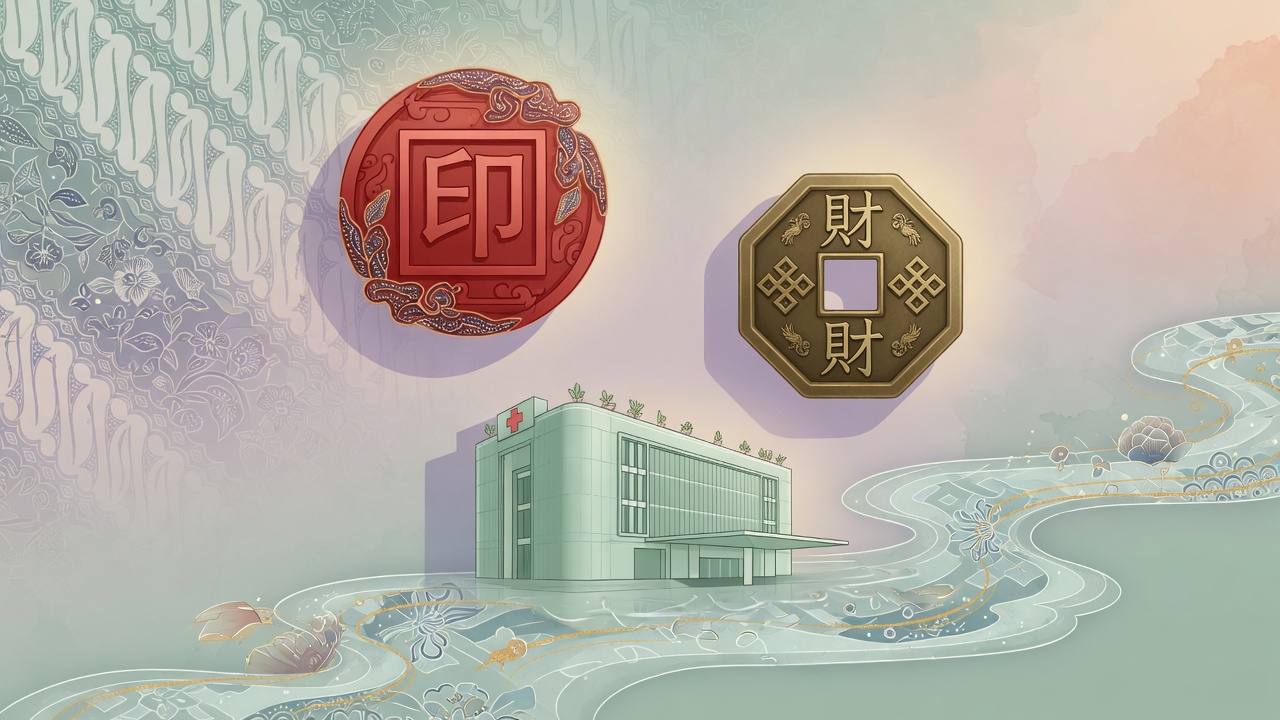
Basic Clarification: Yin Star and Cai Star in Ba Zi Are Not Superstition
Quick Start: Day Master, Yin Star, and Cai Star
In Ba Zi, the Heavenly Stem of the birth day is the Day Master, representing the person. That which gives birth to the Day Master is the Yin Star, like a mother providing nourishment; that which the Day Master controls is the Cai Star, representing disposable resources.
The Five Elements' generating and controlling cycles build this symbolic system: if the Day Master is Wood, Water generates Wood, so Water is Yin; Wood controls Earth, so Earth is Cai. All things seek balance within generation and control.
- Yin Star categories: Direct Yin (opposite polarity generation) governs education, mother, and stable protection; Indirect Yin (same polarity generation) governs inspiration and unconventional security.
- Cai Star categories: Direct Cai (opposite polarity control) governs salary and savings; Indirect Cai (same polarity control) governs investments and liquid wealth.
- Core logic: Yin Star provides a sense of security, Cai Star provides material foundation; both are indispensable.
Common Misconceptions Clarified
- Misconception 1: Ba Zi can directly predict social policies. Ba Zi is a personal destiny tool; using it for social analysis is only an analogy and must not be mechanically applied.
- Misconception 2: The stronger the Yin Star, the better. An overly strong Yin Star suppresses initiative, just as excessive welfare can weaken individual responsibility.
- Misconception 3: Cai Star represents greed. In destiny analysis, Cai Star is a neutral symbol; the key lies in circulation and balance, not quantity.
Core Insights: The Cultural Logic of Social Security from the Yin-Cai Relationship
Yin Star: The Protective Archetype from Mother's Milk to National Health Insurance
In Ba Zi, the Yin Star represents that which gives birth to the Day Master, like a mother. From breastfeeding in early life, to educational shelter during growth, to the medical safety net provided by the state, this symbol expands layer by layer.
In traditional Chinese medicine theory, the Yin Star is associated with Kidney Qi and Primordial Qi, forming the foundation of vitality. A strong Yin Star implies robust physical constitution and recovery ability.
At the societal level, universal health insurance is precisely the health protection granted by the state as the 'Great Mother,' reducing the helplessness individuals face when illness strikes.
- Health protection: Yin Star directly corresponds to physical immunity and resilience, and also symbolizes the accessibility of medical resources.
- Psychological security: Yin Star provides mental support, just as knowing 'illness will be treated' can alleviate anxiety.
- Cultural roots: East Asian traditions emphasize family mutual aid and official relief, which are extensions of the Yin Star's 'protective' philosophy.
- Modern mapping: The expansion of JKN can be seen as an increase in Yin Star power, but attention must be paid to whether it equitably covers all citizens.
Cai Star: The Destiny Code of Capital Flow
The Cai Star represents what the Day Master controls, i.e., wealth obtained through labor and management. The JKN fund pool is the 'Cai' gathered from citizens' contributions and government subsidies.
In destiny analysis, Cai Star is divided into Direct Cai and Indirect Cai: Direct Cai is like stable premium income; Indirect Cai is like sudden fiscal allocations or investment returns.
Cai Star needs to flow. If Cai stagnates or is contested by Bi Jie (Peers/Rivals), distribution becomes unfair; if Cai generates Guan Sha (Authority), it may be used for public management.
- Funding growth: JKN funds growing from IDR 188 trillion to 247 trillion reflects Cai Star expansion, but the key lies in where the funds flow.
- Excessive Cai Star: If Cai Star is uncontrolled, resources may concentrate or be wasted, lacking effective channels to transform into Yin Star.
- Cai generating Guan: Rational distribution requires institutional guidance (Guan Star) to transform Cai into Yin's protection, achieving 'Cai-Guan-Yin' circulation.
- Bi Jie contesting Cai: Without effective oversight, funds may be misappropriated or abused, corresponding to Bi Jie seizing Cai, leaving Yin Star without a source.
The Way of Circulation: The Ideal Model of Cai-Guan-Yin Mutual Generation
Destiny analysis most favors smooth circulation with affection, i.e., Cai Star generates Guan Star, Guan Star generates Yin Star, Yin Star generates the Day Master, forming a virtuous cycle.
Corresponding to social security: funds (Cai) pass through government or management institutions (Guan) to be transformed into medical services (Yin), ultimately nourishing the populace (Day Master).
Any blockage in this chain leads to imbalance: a weak Guan Star results in chaotic management; a weak Yin Star results in insufficient services.
- Cai as the source: Abundant funds are the starting point, but if piled up without institutional channels, they are like a flood without direction.
- Guan as the channel: Institutions are like canals, guiding funds toward the health sector, preventing misappropriation or misuse.
- Yin as the blessing: The resulting health protection network nourishes all citizens and enhances overall well-being.
- Day Master benefits: Improved public health boosts productivity, creating more wealth and forming a positive feedback loop.
Imbalance Warnings: When Cai Star Overcomes Yin or Yin Star Exhausts Cai
In Ba Zi, if Cai Star is overly strong and overcomes Yin Star, it is called Cai Destroying Yin, indicating health damaged by the pursuit of wealth or protection weakened by unfair resource distribution.
Conversely, if Yin Star is overly strong and drains Cai Star, it leads to Excessive Yin Exhausting Cai, potentially causing the security system to over-expand while finances become unsustainable.
If JKN's funding growth cannot effectively translate into services, it may fall into the dilemma of prosperous Cai without Yin; if coverage is too broad with insufficient funds, it becomes Excessive Yin Exhausting Cai.
- Cai Destroying Yin example: In some countries, excessive commercialization of healthcare leads funds to chase profit, weakening basic public health and harming health equity.
- Excessive Yin Exhausting Cai example: High-welfare states with overly strong Yin Star may run high fiscal deficits, eventually cutting security and damaging Yin Star.
- Balance principle: JKN's funding growth must synchronize with improved protection efficiency to avoid Yin-Cai imbalance, embodying the doctrine of the mean in destiny analysis.
- Warning signals: If premiums rise too fast while reimbursement ratios decline, it may be a sign of Cai Destroying Yin, requiring structural adjustment.
Cultural Echoes: From Ancient Granaries to Modern Health Insurance
Ancient China established Ever-Normal Granaries and Charity Granaries: storing grain in bumper years (Cai) and distributing relief in famine years (Yin), an early practice of Yin-Cai balance.
This thought shares the same root as Ba Zi destiny analysis: resources must be saved in abundance and released in scarcity to protect livelihoods. Modern health insurance follows the same principle.
Indonesian tradition also embodies the spirit of Gotong Royong (mutual cooperation), which resonates with the concepts of Yin Star protection and Cai Star sharing.
- Charity Granary system: During the Sui and Tang dynasties, people voluntarily contributed grain, and in disaster years the granaries were opened for relief, embodying community mutual aid that transforms Cai into Yin.
- Destiny mapping: The grain stored is Cai, the relief act is Yin, and official management is Guan; the three work in concert for social stability.
- Contemporary inspiration: The JKN fund pool resembles a national charity granary, requiring transparent and efficient distribution mechanisms so that Cai truly generates Yin.
- Cultural integration: Combining Ba Zi wisdom with local mutual aid traditions can offer a unique perspective for Indonesian health insurance reform.
Day Master Strength: The Interaction Between Individuals and the System
The Day Master represents the overall quality of the populace. A strong Day Master can bear the circulation of Cai, Guan, and Yin; a weak Day Master may be too frail to absorb nourishment, unable to benefit even with abundant resources.
JKN must not only provide funds but also enhance public health literacy (Day Master) so that the Yin Star can exert its effect.
If Yin Star is overly strong while the Day Master is weak, it may lead to welfare dependency, weakening individual self-sufficiency—a warning from destiny analysis known as 'Mother's Kindness Destroys the Child.'
- Strong Day Master: Citizens with strong health awareness can make good use of medical resources, forming a virtuous cycle.
- Weak Day Master: Even with insurance, lack of health knowledge may cause minor illnesses to become severe, preventing real benefit.
- Strengthening the Body: Health education and preventive medicine are like tonifying the Day Master, allowing Yin Star nourishment to take effect.
- Balance key: Social security requires Yin-Cai equilibrium, but even more so a robust Day Master; only with the interaction of all three can it endure.
Pitfall Guide: Rationally Applying the Destiny Analysis Perspective
Important Notes
- Do not use Ba Zi to predict policies: Personal destiny analysis and social systems are fundamentally different; do not directly extrapolate fund trajectories or health crises.
- Avoid forced analogies: The Yin Star and Cai Star analogy provides only a cultural perspective and cannot replace economic or public health analysis.
- Beware of over-interpretation: Funding growth is not necessarily auspicious; if distribution is unfair, it may correspond to uncontrolled Cai Star. Destiny analysis merely reminds us of balance.
- Do not personalize the discussion: The text does not constitute personal health or financial advice; consult professionals if you have concerns.
- Respect cultural differences: Ba Zi originates from China; when interpreting Indonesian phenomena, note cultural adaptability and treat it only as cross-cultural dialogue.
- View tradition rationally: Destiny analysis is an ancient model for observing the world with philosophical value, but modern governance must incorporate scientific methods.
- Pay attention to actual data: For the specific allocation of JKN funding growth, refer to official reports; destiny analogies cannot replace empirical research.
- Maintain an open mind: Integrating traditional wisdom with modern management may inspire new ideas, but never use the past to negate the present.
Summary and Recap
The growth of Indonesia's JKN funding reflects the expansion of the Cai Star, while the essence of health protection lies in the shelter of the Yin Star.
Ba Zi destiny analysis reveals: resources (Cai) can only achieve social well-being when transformed into nourishment (Yin) through sound institutions (Guan).
The balance of Yin and Cai and smooth circulation provide a cultural foundation of balance and flow for modern social security systems.
Finding the middle way between funding growth and coverage expansion is the profound insight destiny thinking offers to the contemporary world.