Arsenal's Preseason Loss: How BaZi Decodes Personality, Choices, and Timing?
On August 5, 2026, Arsenal fell 1-3 to Real Betis in a preseason friendly, with defensive frailties ruthlessly exposed. A match's outcome hinges on countless technical details, yet from a BaZi (Eight Characters) perspective, it mirrors something
Opening Introduction
The scoreline of a single preseason friendly sparked over 50,000 searches in Thailand. While fans debate tactics, form, and transfers, destiny enthusiasts see another layer: when the Day Master's energy clashes with the current month's Five Elements, even the strongest squad can spring an unexpected “defensive leak.” This is precisely the classic BaZi lesson on personality and timing.
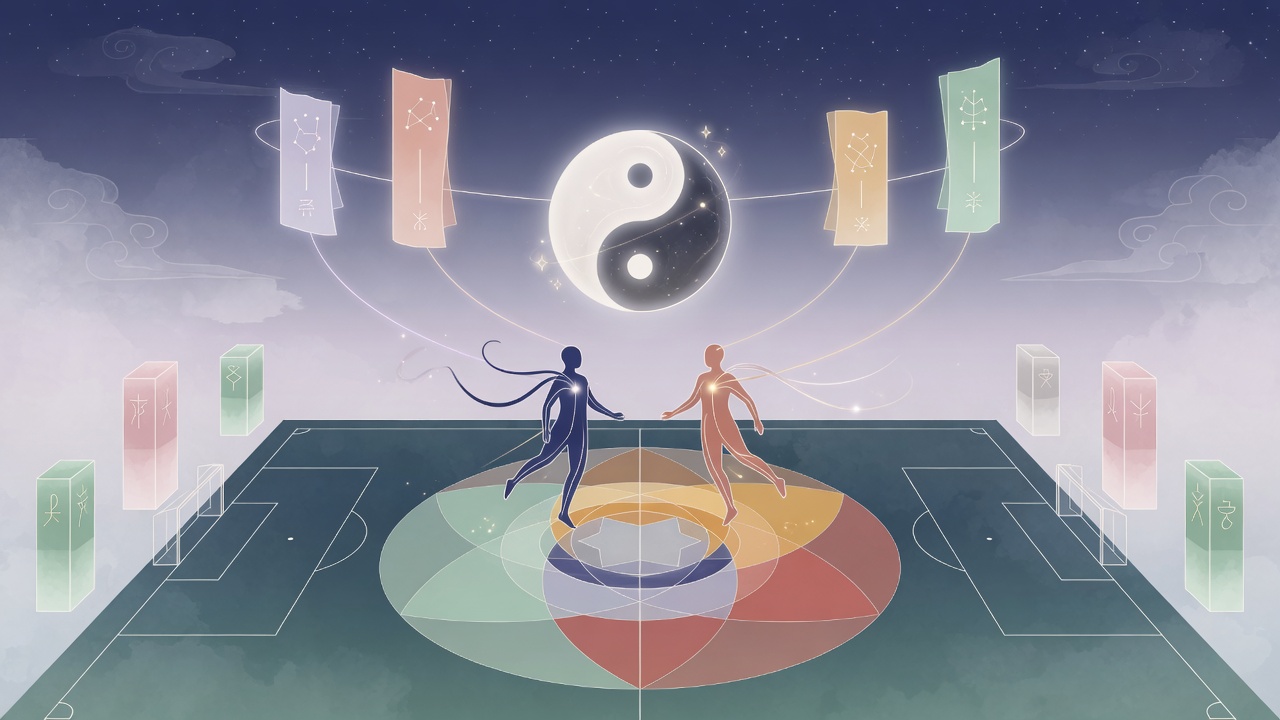
Basic Clarification: BaZi Is Not a “Predictor”
Common Misconceptions
- Misconception 1: BaZi can precisely predict match results. BaZi reveals energy trends and character inclinations, not concrete events. A match is shaped by hundreds of variables; destiny analysis only helps us understand “why certain players are prone to mistakes at this moment,” rather than scripting the score in advance.
- Misconception 2: The birth time determines everything. The Hour Pillar in BaZi is just one of four pillars; it must be synthesized with the Year, Month, and Day Pillars. People born in the same two-hour window can have vastly different life trajectories due to geography, family, and personal choices. Destiny study emphasizes innate blueprint + acquired agency, never fatalism.
- Misconception 3: BaZi only applies to Easterners. BaZi is based on the solar calendar and Five Element interactions, essentially an ancient Chinese modeling of spatiotemporal energy. By converting to local true solar time, anyone from any cultural background can have a natal chart, and the analytical logic is universally applicable.
Core Insights: How BaZi Interprets Personality, Choices, and Timing
The Personality Code: The Day Master and the Ten Gods' Inner Drive
At the heart of BaZi lies the Day Master (the Heavenly Stem of the birth day), representing the self. The Day Master's Five Element nature (Jia/Wood, Yi/Wood, Bing/Fire, etc.) defines the fundamental character palette. For instance, a Jia Wood person often possesses leadership and integrity, much like a team's spiritual captain; a Bing Fire person radiates outward passion, akin to a fiery attacker.
Around the Day Master, the other Stems and Branches form Ten Gods relationships—Direct Officer, Seven Killings, Direct Resource, Indirect Resource, Eating God, Hurting Officer, Friend, Rob Wealth, Direct Wealth, Indirect Wealth. The Ten Gods are not fixed labels but dynamic role interactions. Someone with a strong Hurting Officer is highly creative but prone to challenging rules; on the pitch, they might produce a moment of genius or drift out of position through over-casualness.
- Friend and Rob Wealth: Represent teammates, peers, and competitors. When Friend/Rob Wealth are overly strong without restraint, coordination errors and resource squabbles tend to occur—just like multiple defenders tracking the same zone while leaving a key opponent unmarked.
- Direct Officer and Seven Killings: Symbolize discipline, pressure, and opponents. When Seven Killings attack the self without the Resource star to resolve it, a person's movements can seize up under heavy stress—the BaZi explanation for “choking at the critical moment.”
- Eating God and Hurting Officer: Govern expression, talent, and judgment. Eating God generating Wealth points to fluid attacking organization; Hurting Officer clashing with Officer can lead to impulsive decisions, bookings, or fatal giveaways.
The Logic of Choice: How Luck Cycles and Annual Stars Influence In-Game Decisions
If the natal BaZi chart is the factory setting, then Luck Cycles and Annual Stars are life's version updates. Each ten-year Luck Cycle activates a particular Five Element energy within the chart, thereby shifting a person's decision-making preferences.
When the Annual Stem-Branch interacts with the natal chart through Punishment, Clash, Combination, or Harm, one's judgment can be significantly disturbed. For example, a Zi-Wu Clash (Water vs. Fire clash) often brings emotional volatility and sudden mishaps—on the field, this translates to unexpected slips, own goals, or red cards. This is not a mystical force, but an internal state affecting split-second muscle reactions and attention allocation.
- Combination Turning Favorable: When the Annual Star combines with the chart and favors the Useful God, interpersonal harmony improves, teamwork flows, and intricate combinations are more likely to succeed.
- Clash Bringing Adversity: When the Annual Star clashes with the Month Pillar or Day Branch, inner turmoil rises, making irrational choices more probable—like reckless pressing or speculative long shots.
- Luck Cycle Transition Period: The two years around a Luck Cycle shift often bring chaotic energy; many players experience form dips or transfer dilemmas during this phase, which is essentially the outward manifestation of energy realignment.
The Timing Model: Team Five Elements and the Seasonal Rhythm
A football team can be viewed as a Five Element system. The coach, tactical style, and player composition collectively form a certain energy field. For example, a high-pressing team often carries strong Fire-Metal energy, while a possession-based team relies more on Water-Earth regulation.
The preseason period corresponds to the lunar Wei month or Shen month, when Earth and Metal energies strengthen and Fire energy recedes. For players whose charts favor Fire, their form may naturally dip during this time; meanwhile, those who favor Metal and Water find themselves in their element. From a destiny perspective, Arsenal's collective defensive slump might have coincided with a stacking of unfavorable months for several key players, causing an overall Five Element imbalance in the backline.
This is not an excuse for defeat, but a reminder that timing is a genuine energy field. The ancients divided the seasons into 24 Solar Terms, each corresponding to specific Five Element waxing and waning. If preseason preparations ignore individual players' biological cycles and Five Element affinities, even the most scientific training can yield half the result with twice the effort.
- Five Element Proportioning: An ideal team needs a balance of Wood (planning), Fire (passion), Earth (stability), Metal (discipline), and Water (adaptability). The defense especially depends on Earth's solidity and Metal's decisiveness; if Earth and Metal are under attack, the defensive line easily loosens.
- Monthly Energy Timing: The Earthly Branch of the match day's month temporarily amplifies certain elements. For instance, a Shen (Metal) month strengthens Metal, which can restrain players with a Wood-dominant chart, limiting their movement and creativity.
- Combined Chart Resonance: When multiple players' charts share the same clash or combination patterns, a resonance effect can occur—the team either performs exceptionally or collectively loses its way. That's why an entire side sometimes “switches off” suddenly; it's not an attitude problem but synchronized energy fields.
Avoidance Guide: Applying Destiny Wisdom Rationally
Points of Caution
- Never use BaZi to directly predict matches: Destiny analysis examines a “person's” state in a specific time-space, not event outcomes. A match's result also involves opponent form, referee decisions, crowd energy, and other incalculable factors. Using BaZi as a gambling tool is a desecration of traditional culture.
- Do not cast charts for players without consent: Without an accurate birth hour, any chart is mere speculation. Analyzing players with fictitious birth data in public is not only unrigorous but may also spark privacy disputes and accusations of superstition. Education should focus on methodology, not specific individuals.
- Avoid labeling personality traits: The combinations of Ten Gods are endlessly varied. The same “strong Hurting Officer” can be channeled constructively if restrained by the Resource star, or run wild if unchecked. One must read the whole chart; never draw conclusions from a single Ten God.
- Timing is only the backdrop; choice is the key: BaZi reveals the slope of a trend, not the coordinates of the endpoint. Even in an unfavorable Annual Star year, negative impacts can be mitigated by adjusting tactics early, strengthening psychological training, and rotating rest wisely. Destiny's value lies in early warning, enabling clearer choices.
- Respect scientific training and professional judgment: BaZi can serve as a supplementary cognitive tool, helping coaches understand players' emotional cycles and decision-making styles, but it must never replace sports science, medical diagnosis, or tactical analysis. Any approach that elevates destiny study above professional expertise is dangerous.
- Be mindful of cultural differences: Thailand, as a Buddhist country, has a relatively high acceptance of destiny arts, but when applying BaZi concepts in cross-cultural teams, communication must be handled sensitively to avoid misunderstanding or resentment. It is often best to reframe it in the modern language of “personality and energy management.”
Summary and Recap
Arsenal's 1-3 preseason loss to Betis played out like a vivid BaZi open lecture: the Day Master defines a person's behavioral core, the Ten Gods act out role dynamics within a team, Luck Cycles and Annual Stars quietly alter the precision of in-game decisions, and the seasonal Five Elements set the energetic backdrop for the entire campaign. BaZi never promises clairvoyance; it teaches us one thing—to make more conscious choices once we understand our character code and timing rhythms. Whether fan or player, stepping onto the pitch with this self-awareness adds a layer of equanimity beyond victory and defeat.