The BaZi Reflection of the "Rogue Benevolent Doctor": How the Yin Star and Food God Inscribe a Heart of Compassionate Healing
Hong Kong's "Rogue Benevolent Doctor" Dr. Yu Yu-kai, over ninety-three years of life, provided free treatment to countless grassroots patients at his old clinic in Yau Ma Tei, leaving behind a legend of chivalrous medicine. This perseverance beyond p
Opening Introduction
Mr. Yu Yu-kai, the "Rogue Benevolent Doctor," recently passed away at the age of ninety-three. He took over the old clinic in Yau Ma Tei for forty years, providing long-term free treatment to grassroots patients, thus becoming a folk legend in Hong Kong. This life of medical practice without regard for return naturally evokes many people's contemplation of "goodness" and "professional calling."
In traditional Chinese metaphysics, there is a complete symbolic system explaining a person's temperament, talents, and value choices. Among them, the two Ten Gods—the Yin Star and the Food God—can profoundly reflect the chart characteristics of a healer's benevolent heart and skill in serving the world. This article does not speculate on anyone's BaZi; it only uses the current event as a lead and, starting from the original principles of these two stars, provides a rational popularization.
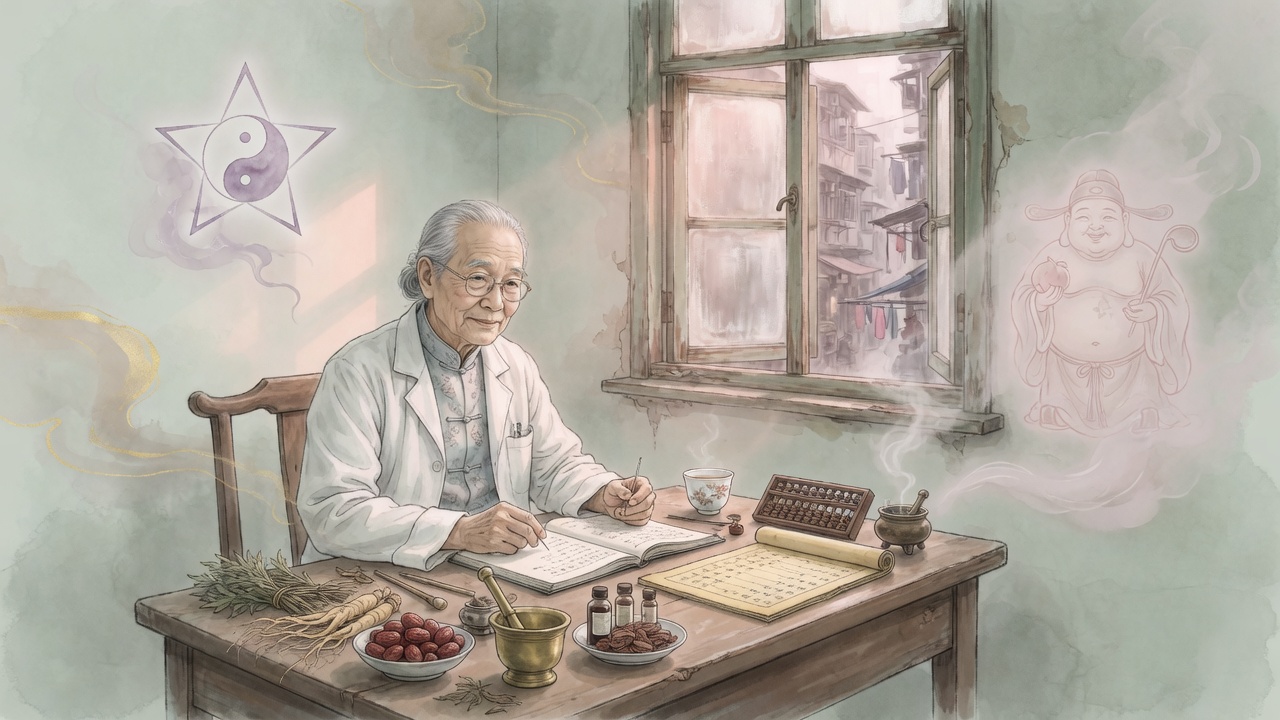
Basic Clarification: The Ten Gods Are Not Fate Labels
Clarifying Common Misconceptions
Many people automatically associate BaZi terminology with fortune-telling and good or bad luck. But the Yin Star and Food God are not simple labels of good or bad; they are essentially abstract models describing the flow of energy and life tendencies.
- Misconception 1: Having a Yin Star means one is necessarily compassionate. If the Yin Star is excessively strong without control, it may instead manifest as overprotection, dependence, or complacency—not unconditionally equivalent to great love.
- Misconception 2: The Food God only cares about eating, drinking, and pleasure. In BaZi, the Food God represents output, creativity, skill, and gentle expression. When combined with social value, it is precisely the primal driving force of a spirit of aiding the world.
- Misconception 3: BaZi can directly determine one's profession. The chart reveals energy tendencies, not a career manual. Among doctors, some focus on technical breakthroughs while others emphasize humanistic care—the Ten God combinations behind them differ.
Core Points: The Energy Codes of the Yin Star and Food God
The Essence of the Ten Gods: From Five Element Interactions to Personality Imagery
In the BaZi system, the Day Master represents the person. The Five Element relationships between the other seven stems and branches and the Day Master are summarized into ten star gods, collectively called the Ten Gods. Among them, those that generate the Day Master are the Yin Star, and those generated by the Day Master are the Food God and Hurting Officer. These two groups are directly related to one's inner nourishment and outer expression.
The Yin Star is divided into Direct Yin and Indirect Yin. Direct Yin is like gentle shelter; Indirect Yin has more unique spirituality. Their commonality lies in giving the Day Master support, protection, and energy for learning and absorption. Projected onto human nature, this energy naturally draws close to compassion, tolerance, and guardianship.
The Food God is what the Day Master generates with the same polarity, and its nature is gentle and stable. It represents creativity, skill, enjoyment, and service output from the self outward. Because it lacks the sharp rebellion of the Hurting Officer, the Food God's expression tends to be more peaceful, enduring, and altruistic—extremely suitable for explaining long-term skill dedication without regard for return.
- Core formula: What generates me is the Yin Star → being nourished and protected → manifesting as compassion and sense of responsibility.
- Output logic: What I generate is the Food God → spontaneous creation and skill sharing → manifesting as a spirit of aiding the world and service.
- Key distinction: The Hurting Officer is also something I generate, but with opposite polarity, its energy is more intense, often bringing breakthroughs and sharpness; the Food God is gentle like a stream, closer to everyday perseverance.
Yin Star: From Sheltering Instinct to a Healer's Benevolent Heart
The original imagery of the Yin Star is mother, teacher, house, knowledge. The mother gives life nourishment, the house provides shelter, the teacher imparts learning—all point to an energy pattern of unconditional acceptance and protection.
When the Yin Star plays a positive role in a chart, the person often shows strong empathy, responsibility, and natural care for the vulnerable. When this energy falls into the medical profession, it is not practicing medicine for fame or profit but because one cannot bear to see others suffer. Dr. Yu Yu-kai's forty years of free medical treatment, in the language of metaphysics, can be understood as an outward extension of Yin Star-style sheltering.
Typical Yin Star individuals, when facing patients, rarely calculate costs and benefits. They have an inner intuitive drive: "This person needs me, so I should protect them." This is not the result of forced moral education but the natural outward radiation of the energy that generates me in metaphysics.
- Direct Yin traits: Benevolent, tolerant, conservative, willing to be a long-term silent guardian.
- Indirect Yin traits: More unique perspective, skilled in niche fields, can also become a healer, but the form may be more reclusive or niche.
- Energy imbalance warning: If the Yin Star is overly strong and lacks the Wealth Star to balance it, one may fall into the dilemma of "only talking about ideals without considering sustainability," requiring real-world resources to sustain long-term.
Food God: From Skill Output to a Spirit of Aiding the World
The Food God is the outward leakage of the Day Master's essence. What it generates can be understood as the person's intelligence, skills, creativity, and emotional expression. People with a strong Food God or a Food God structure often have one or more refined skill specialties and are happy to share and give output generously.
More subtly, the Food God inherently resists excessive control by the Indirect Yin (Owl God). This means Food God-type people have an inner tendency: unwilling to be completely locked down by utilitarian logic. They pursue the joy of skill itself and its value to others, easily embarking on the path of nourishing virtue through skill. Dr. Yu Yu-kai's perseverance in the old clinic without pursuing commercial expansion is a classic manifestation of the Food God's "valuing skill over wealth."
Placing this energy into the medical profession, the Food God drives one to continuously study medical skills, enjoy the treatment process itself, and transform this enjoyment into sincere dedication to patients. Free treatment is not only a moral choice but also a Food God-type satisfaction—using skill to reduce the world's suffering, which in itself constitutes meaning.
- Food God core drive: Continuously output due to love for the skill, disdaining to simply monetize the skill.
- Gentle persistence: The Food God does not erupt violently like the Hurting Officer, so it can support decades of steady, enduring dedication.
- Best partner: Food God paired with Yin Star—skill has foundation, compassion has outlet, a typical "benevolent doctor combination" in metaphysics.
- Caveat: If the Food God is paired with too much Indirect Yin, talent may be suppressed, causing the pain of unrecognized ability, requiring later environmental guidance.
Value Choices in the Chart: Yin-Food Combinations and Life Paths
Different chart configurations can lead people with the same Yin Star or Food God to walk vastly different paths of value realization. Here, purely from a traditional cultural perspective, examples are given to illustrate combination logic, not to analyze any real person's chart.
Strong Yin Star with Food God revealing: Both what generates me has root and what I generate has strength. Such people are internally abundant and productive, extremely likely to appear in education, medicine, and public welfare, often capable of long-term perseverance without regard for gains or losses. Their metaphysical dynamic structure naturally matches a "dedication-type" life.
- Case 1 (hypothetical logic): If the Day Master is weak and the Yin Star is close by to generate it, it is like a mother never leaving one's side. This person's original intention in studying medicine may be to relieve the suffering of loved ones, then extend that to others, forming a sheltering doctor model.
- Case 2 (hypothetical logic): If the Food God reveals in the stems without a Wealth Star intercepting, skill flows directly to society. Under this structure, the person is less sensitive to money and more likely to choose free or low-cost service.
- Case 3 (hypothetical logic): A structure where Wealth Star breaks Yin Star and Food God generates wealth may lead to high-end paid medicine or medical commercialization. They are also doctors, but the path of value realization is completely different—no higher or lower, just differences in energy flow in the chart.
- Cultural insight: Metaphysics does not judge moral superiority; it only explains tendencies. The emergence of every "benevolent doctor" involves both personal cultivation and a certain energy resonance. The Yin-Food combination is the classic grammar of this resonance.
Pitfall Avoidance Guide: Viewing Metaphysics and Professional Spirit Rationally
Precautions and Prevention of Common Misunderstandings
BaZi culture is a lens for observing human nature, not a verdict. Taking the following reminders into consideration can prevent slipping from popularization into superstition.
- Reminder 1: Do not force-fit hot topic figures. Dr. Yu Yu-kai's BaZi has not been made public, so any specific chart inference is fabrication. All analysis in this article is limited to the prototype principles of the Ten Gods, never targeting individuals.
- Reminder 2: The Ten Gods are tendencies, not destiny. Even if a chart lacks Yin Star or Food God, later cultivation, cultural environment, and personal choices can still shape a healer's benevolent heart. Metaphysical culture never denies human agency.
- Reminder 3: Yin-Food combination does not equal a "good person badge." People with strong Wealth Star or Officer/Killing can also do good. Metaphysics talks about the diversity of energy patterns, not moral hierarchy.
- Reminder 4: Do not simplify complex human nature with Ten Gods. A doctor's choice to provide free treatment may involve family teachings, faith, historical circumstances, and many other factors. The Ten Gods are only one perspective offered by traditional culture, not the entire explanation.
- Reminder 5: Distinguish between appreciation of traditional culture and fate assertions. The purpose of this article is to use a hot topic to spread the humanistic wisdom within BaZi theory, absolutely not to make any form of metaphysical evaluation of Dr. Yu or his family. Readers are asked to discern clearly.
Summary Review
Dr. Yu Yu-kai spent forty years providing free medical treatment, writing a legendary tale of chivalrous medicine in Yau Ma Tei, Hong Kong. The Yin Star and Food God in BaZi culture, from the level of traditional wisdom, provide a profound footnote: the Yin that generates me transforms into compassionate guardianship, and the Food that I generate turns into skill for aiding the world. When the two meet, they form the energy foundation of the "benevolent doctor archetype" in metaphysics.
The core conclusion of this popularization is: metaphysics does not speak of destiny but of how energy tendencies resonate with life choices. The Yin Star's sheltering instinct and the Food God's selfless output are not yardsticks for judging whether a person is noble, but reminders that when skill and compassion combine, enduring good deeds have inner sparks of support. Viewing this ancient wisdom rationally is the best respect for the spirit of the benevolent doctor.