From Yasuda Yuka to the Yoshida Sisters: How BaZi Deciphers Character, Choices, and Timing in the Arena
In August 2026, the spotlight in Japanese women's golf intensifies: the Yoshida sisters are poised for simultaneous victories in Japan and the U.S., with younger sister Yoshida Suzu surging to the top with a 66. Meanwhile, fellow rising star
Opening Guide
Recently, Japan's sports focus has been on the women's golf tour: the Yoshida sisters are chasing titles on both sides of the Pacific on the same day, with younger sister Yoshida Suzu firing a 66 to take a commanding lead. On the same stage, the steady growth of young players like Yasuda Yuka also fuels curiosity about the explosive potential of the new generation.
Moments of glory seem accidental, but behind them lie a complex interplay of character, training, and opportunity. BaZi, a traditional Chinese time-analysis model, offers a unique framework for interpreting innate traits, decision-making tendencies, and the rise and fall of timing. This article uses current events as a starting point for a purely educational dive into traditional culture.
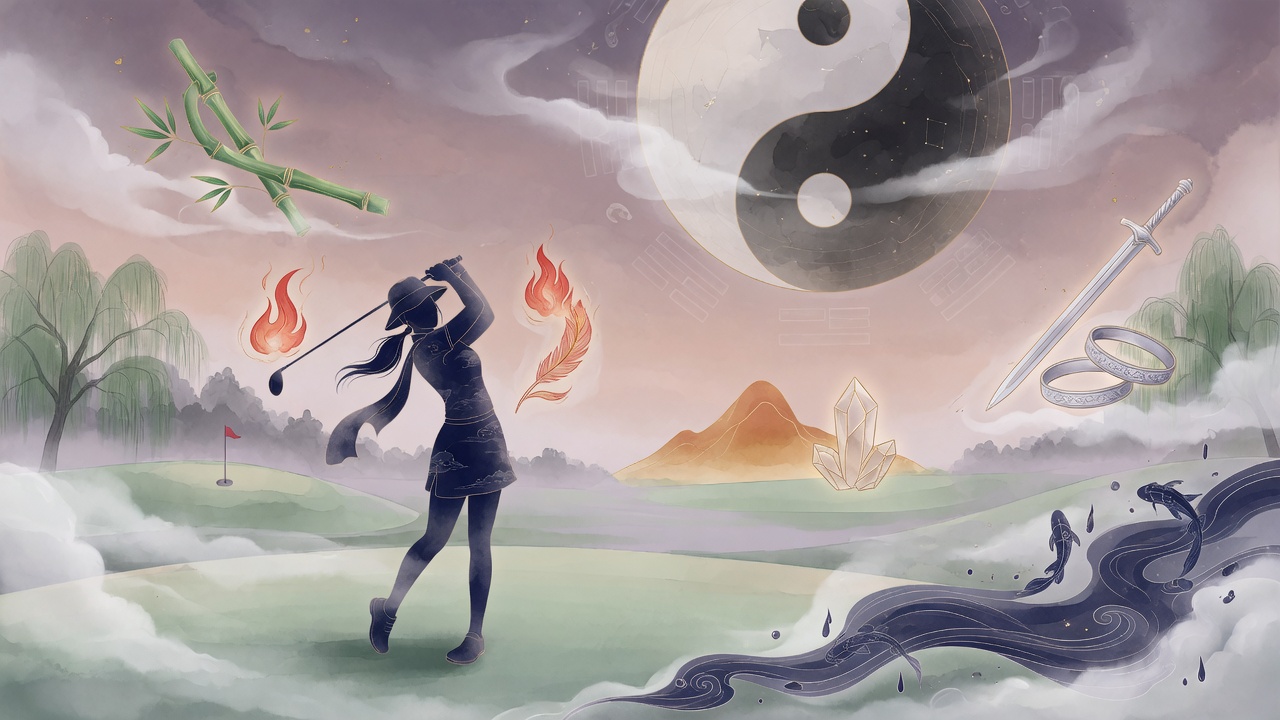
Basic Clarification: BaZi Is Not Fatalism, It's an Energy Map
Common Misconceptions
Many people associate BaZi with absolute predictions and a predetermined life. This is the biggest misunderstanding about Chinese metaphysics.
- Misconception 1: BaZi determines success or failure. In reality, BaZi reveals innate energetic tendencies, like a character's initial parameters. Acquired environment, deliberate practice, and key choices are the main drivers of outcomes.
- Misconception 2: The same chart means the same destiny. Twins or people born at the same time can have vastly different life paths due to environment and personal decisions. BaZi analyzes probability ranges, not a single fixed solution.
- Misconception 3: Only focusing on Day Master strength. A complete analysis must integrate the Ten Gods, Chart Structure, Luck Pillars, and Annual Stars. Looking at a single point easily leads to one-sided conclusions.
- Misconception 4: Metaphysics equals superstition. BaZi is a symbolic system built on Yin-Yang, the Five Elements, and the Heavenly Stems and Earthly Branches. Its essence is the classification of time-energy fields, sharing similarities with modern psychology and personality typology.
Core Insights: How BaZi Views Character, Choices, and Timing
1. Ten Gods Configuration: The Code of Competitive Character
In BaZi, the Ten Gods are ten symbolic archetypes derived from the relationship between the Day Master's Heavenly Stem and the other stems and branches. They represent different psychological traits and behavioral patterns. For athletes, especially in a sport like golf requiring high focus and mental resilience, certain Ten God combinations often confer advantages.
It must be emphasized that the following analysis reflects universal principles, never targeting any specific individual, nor serving as a criterion for judging success.
- Eating God and Hurting Officer: Creativity and expressiveness. The Eating God is gentle and self-regulating; the Hurting Officer is passionate and pursues breakthroughs. Both represent output and expression, ideal for sports demanding technical finesse and on-the-spot performance. Those with strong吃货 or Hurting Officer stars often maintain fluidity under pressure.
- Seven Killings: Competitive drive and stress resistance. The Seven Killings star represents challenges, authority, and high-pressure environments. When this star is useful in the chart, the individual thrives against strong opponents, unleashing astonishing energy at critical events. If too strong without control, it leads to impatience, requiring the Resource star to dissolve it.
- Friend and Rob Wealth: Teamwork and self-drive. The Friend star represents peers and competitors; Rob Wealth carries a stubborn, unyielding spirit. In individual sports, a moderate presence of these stars grants unwavering determination; in team contexts, it manifests as synergy.
- Direct Resource and Indirect Resource: Learning ability and strategic thinking. The Resource stars govern thinking, absorption, and planning. Golf requires reading the course and calculating strategy. Those with strong Resource stars excel at summarizing lessons and possess outstanding tactical awareness.
- Wealth Star: Goal orientation and pragmatism. The Wealth Star represents the pursued goal and tangible results. When this star is useful, the person has clear objectives, trains solidly, and knows how to convert talent into actual performance.
2. The Flow of Luck Pillars: Why Timing Is So Crucial
The natal BaZi chart is like a script outline, while the Luck Pillars and Annual Stars are the unfolding chapters. Each Luck Pillar spans ten years, activating different energies in the natal chart and influencing a person's state of mind and opportunities.
The peak years of an athlete's career often correlate with their Luck Pillar trends, but this is not fatalism; it reflects energy resonance.
- Favorable Luck that supports the Useful God: When the Heavenly Stem and Earthly Branch of a Luck Pillar are favorable to the chart—such as a weak Day Master encountering Resource or Friend stars, or a strong Day Master encountering Wealth or Output stars—the athlete feels energetic, judgment is sharp, and both training and results tend to improve.
- Favorable Luck that controls the Annoying God: When a natal weakness is controlled or combined away by the Luck Pillar, a breakthrough can occur. For example, if the natal chart has an uncontrolled Seven Killings star and the Luck Pillar brings the Eating God, the Eating God controls the Seven Killings, transforming pressure into driving force.
- Annual Stars triggering key points: When a specific year's stem and branch clash, combine, or conjoin with the natal chart, it can trigger major events. A clash opening the Wealth vault or a combination activating the Authority star might correspond in reality to signing a sponsorship deal or a ranking surge.
- The wisdom of going with or against the flow: The insight from BaZi is to act boldly during favorable times and to settle and recharge during adverse ones. Understanding one's luck rhythm helps better plan training cycles and career trajectory.
3. Five Elements Balance: A Holistic Map from Body to Mind
The Five Elements in BaZi (Wood, Fire, Earth, Metal, Water) correspond not only to organ systems but also mirror personality traits. A top athlete's physical and mental state can be understood through the generating and controlling cycles of these elements.
- Wood governs the liver/gallbladder, also benevolence and extension. Those with strong Wood are resilient, with expansive movements, suited for sports needing flexibility and rhythm. But excessive Wood leads to stubbornness, requiring Metal to prune it.
- Fire governs the cardiovascular system, representing passion and explosive power. Strong Fire individuals have powerful bursts of energy, performing astonishingly when emotionally charged. They need Water to regulate and avoid impulsive errors.
- Earth governs the spleen/stomach, symbolizing stability and endurance. Strong Earth individuals are steady and handle pressure, but may lack agility, needing Wood to create flow.
- Metal governs the lungs/large intestine, representing decisiveness and rhythm. Strong Metal individuals are decisive with good timing, but excessive rigidity leads to brittleness, needing Water to soften.
- Water governs the kidneys/bladder, ruling wisdom and adaptability. Strong Water individuals are calm and highly adaptable, but can overthink, requiring Earth to provide boundaries.
- Harmonious flow of the Five Elements: The most ideal state is not one extremely strong element, but a regenerative cycle where all five flow freely. Such a configuration often implies mind-body harmony, fewer injuries, and consistent competitive form.
Pitfall Guide: Viewing BaZi Rationally, Avoiding Over-Interpretation
Key Precautions
- Never apply analysis to specific individuals. All analysis here describes general principles and does not target the chart of Yasuda Yuka or any specific athlete. Without explicit consent and an accurate birth time, any public BaZi inference is irresponsible.
- Do not overlook acquired effort. BaZi reveals trends and potential, but technical refinement, psychological training, and team support are the core determinants of competitive results. The best chart cannot deliver results without sweat equity.
- Avoid single-indicator superstition. Do not blindly judge based on hearsay, like 'strong Hurting Officer means good at sports.' A chart requires holistic evaluation of structure, useful/annoying gods, and luck pillar coordination. A single god or element is only one piece of the puzzle.
- Annual star analysis is not match prediction. Even if an annual star shows dynamics like the 'Traveling Horse' or 'General Star,' this cannot be simplistically equated to winning a championship. Match results are influenced by opponents, course conditions, and on-the-spot performance. BaZi only reflects personal energy states.
- Respect privacy and science. The birth data of public figures is private and should not be unearthed or spread. The purpose of BaZi education is to pass on cultural wisdom, not to generate gossip or pry into others' lives.
- Distinguish culture from superstition. BaZi is a traditional cultural heritage. Its value lies in offering a perspective for understanding oneself and time. Treating it as an absolute predictive tool violates both the scientific spirit and undermines cultural depth.
Summary and Reflection
From the Yoshida sisters' explosion onto the scene to Yasuda Yuka's growth, the allure of competitive sports lies precisely in the certainty within uncertainty—the resonance of character, choices, and timing. BaZi uses the symbolic system of Ten Gods, Luck Pillars, and the Five Elements to offer a unique cultural lens for understanding this resonance. It does not promise success, but helps us read our own energetic rhythms: to swing boldly when riding the momentum, and to settle our minds and train when against the current. This is the true revelation of ancient wisdom for the modern individual.