A 4-2 First Win for West Ham: Character, Choice, and Timing Through the Lens of BaZi
West Ham United vs Wolverhampton Wanderers ended 4-2, giving the Hammers their first win of the season. Behind this trending match, we explore the interplay of character, choice, and timing through BaZi culture. BaZi is not fatalism; it is a
Opening Guide
West Ham United vs Wolverhampton Wanderers ended 4-2, giving the Hammers their first win of the season. Behind this trending match, we explore the interplay of character, choice, and timing through BaZi culture.
BaZi is not fatalism; it is a systematic framework for observing the person and the environment. A game shifts moment by moment, much like the chessboard of life: concepts such as Day Master strength, Five Elements flow, and annual luck cycles are all ancient wisdom for understanding 'change and constancy.' This article offers only cultural insight, no fortune-telling, no score predictions.
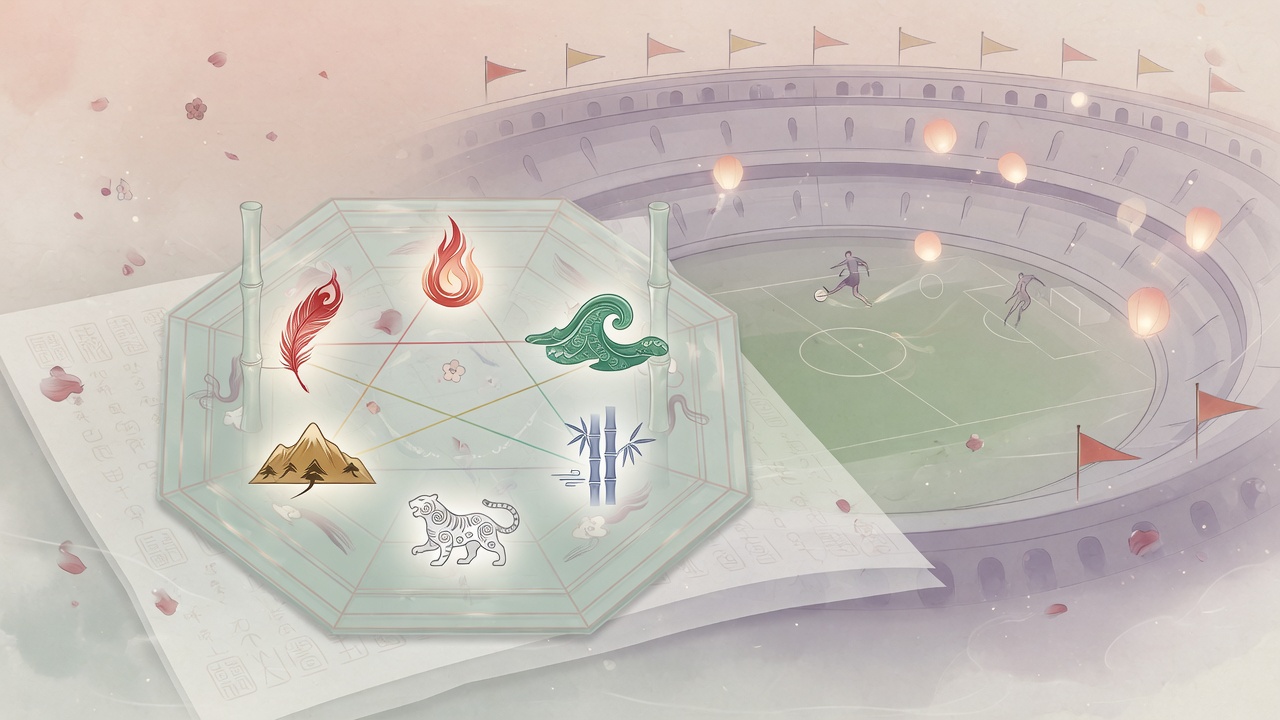
Basic Clarification: BaZi Doesn't Read Match Results
BaZi originated from China's ancient time-recording system, using Heavenly Stems and Earthly Branches to mark the moment of birth. It analyzes character tendencies and cyclical patterns, not specific events. Pinning a match's outcome on BaZi is a typical cognitive misplacement.
Common Misconceptions
- Misconception 1: BaZi can calculate who wins. In reality, BaZi describes probability trends, not deterministic results.
- Misconception 2: Birth time determines everything. BaZi emphasizes acquired choices and environmental interaction far more; timing can amplify or weaken innate traits.
- Misconception 3: Charting trending figures is harmless. Doing so without authorization and making definitive claims breaches ethics and can spark privacy disputes.
- Misconception 4: Whatever element is missing should be supplemented. The true focus is chart balance; a missing element is not necessarily a flaw, nor is an abundant one always a blessing.
A Quick Primer on BaZi Basics
A BaZi chart consists of four pairs of Heavenly Stems and Earthly Branches for year, month, day, and hour, totaling eight characters. The Heavenly Stem of the Day Pillar is the Day Master, representing the subject of analysis.
- Heavenly Stems and Earthly Branches: Stems are outward expression; Branches are hidden foundation. Their combinations form the 60-term cycle.
- Five Element Interactions: Wood, Fire, Earth, Metal, and Water create and control each other—the core language of BaZi analysis. These interactions are not good or evil, but relational states.
- Luck Cycles and Annual Influences: A Luck Cycle governs a decade-long direction; an Annual Influence governs the events of a single year. Together, they form the external timing.
- Useful God: The key element that brings balance to the chart, symbolizing active choice in BaZi analysis.
- Ten Gods: Relationships like Direct Officer, Seven Killings, and Direct Seal describe various modes of interacting with the outside world, akin to a team's role distribution in attack and defense.
Core Points: Viewing a Match's 'Change and Constancy' Through the BaZi Framework
BaZi principles rest on three pillars: the Day Master defines core character; Luck Cycles and Annual Influences define external timing; the Useful God defines active choice. West Ham's 4-2 victory serves as a fitting cultural reference for this three-layer structure.
Character as Day Master: Team Temperament and Five Element Bias
In BaZi, the Day Stem is the Day Master, representing the self. Its strength and Five Element composition outline fundamental character. West Ham has traditionally been tough and direct—comparable to Yang Metal or Yang Earth: solid, impactful, but at times overly rigid and lacking adaptability.
Wolves often display resilience and flexible tactics, reminiscent of the fluidity of Yin Wood or Water. This 'team character' won't change because of one win or loss, but it will manifest differently under varying timing conditions.
The Day Master is only the starting point. BaZi also considers the Month Command (birth month) influence—called 'in command' or 'out of command.' Those in command are innately more confident; those out of command need to borrow strength. A team's 'foundation' offers an analogy: home-field momentum or psychological advantages from past encounters can both act as a 'Month Command.'
But character is not destiny. A weak Day Master can still succeed through the Indirect Resource star (learning, support) and Companion star (teammates, collaboration). The same goes for teams: individual brilliance, divorced from a system, struggles to shine.
Five Element bias has no absolute good or bad. Wood governs expansion, Fire governs explosion, Earth governs defense, Metal governs decision, Water governs adaptation. A successful team is often a dynamic balance of multiple elements.
- Day Master Strength: A strong Day Master withstands pressure well; a weak one needs to borrow momentum. Teams have similar 'pressure resilience,' whether they stabilize after a big lead reflects their character.
- Five Element Bias: Wood governs expansion, Fire explosion, Earth defense, Metal decision, Water adaptation. Different styles can map to different element labels, but don't apply them mechanically.
- Significance of Resource and Companion: The Resource star represents tactical execution; the Companion star represents team synergy. Only when these are aligned can character advantage translate to on-field dominance.
- Character ≠ Destiny: Character provides a behavioral tendency, but the concrete action depends on choice and environment.
- Month Command and Home Advantage: Being 'in command' makes effort more effective; a home atmosphere is akin to being 'in command,' capable of lifting the team's state.
Timing as Annual Influence: The 'Environmental Variables' of a Season Phase
In BaZi, Luck Cycles represent decade-long macro rhythms, and Annual Influences represent the external environment of a specific year. For a team, early-season point pressure, home atmosphere, and fan expectations can all be seen as 'monthly' or 'annual' variables.
West Ham had not won previously, and timing—a home fixture—offered a rebound opportunity. A 4-2 scoreline doesn't stem from a single factor but results from the interplay of both sides' form, tactical setups, and in-game execution.
This mirrors the complex linkage of Heavenly Stems and Earthly Branches in BaZi. Stems are visible events; Branches are hidden foundations. Goals, cards, and saves in a match are 'Stems,' while fitness reserves and psychological fluctuations are 'Branches.'
An Annual Influence may activate Wealth, Officer, or Resource components in the natal chart, but it cannot create something from nothing. A team's victory, similarly, is sparked by timing on top of existing strength. Without foundational quality, even the best 'Annual Influence' cannot produce a great achievement.
Notably, timing is not one-directional. Teams can also actively adjust to suit the timing, or even partially reshape it. This is the BaZi concept of 'climate adjustment': if the environment is cold, use Fire to warm it.
- The Role of Timing: An Annual Influence may activate elements in the chart, but it doesn't conjure what isn't there. A team's victory, similarly, is sparked by timing on top of existing strength.
- Cannot Attribute to a Single Variable: A match result cannot be simply attributed to a single player's 'BaZi chart'. It is the emergence of collective behavior.
- Concurrent Luck and Year: When the Annual Influence and the Luck Cycle share the same stem-branch, ancient scholars regarded changes as especially intense. By analogy, a team at key junctures—like a manager change or key player injury—sees amplified fluctuation.
- Environment is Adjustable: Timing is not a monolith. Through tactical, personnel, and psychological adjustments, one can to a degree ameliorate an unfavorable 'Annual Influence'.
- Annual Influence is Not Fate: It merely provides the scene; the true performance depends on the 'script'—namely, the team's own quality and tactics.
Choice as Useful God: Active Adjustment is the Key
The Useful God in BaZi is the key element that balances the chart. In real-world terms, this represents active choice: a coach's substitution, tactical tweaks, or a player's mental management. West Ham's timely adjustments to stabilize the game serve as a metaphor for 'using the Useful God effectively.'
Destiny analysis never encourages passive waiting. Even if timing is favorable, advantage can evaporate without active effort. This is like BaZi's climate adjustment: cold requires Fire, drought requires Water; people must also adjust according to circumstances.
The Useful God is not fixed. It can shift under different Luck Cycles and Annual Influences. A team's tactical choices are likewise: different opponents demand different 'Useful Gods'—sometimes strengthening midfield control, other times raising counter-attacking efficiency.
BaZi also discusses mediation: when two Five Elements clash, an intermediary element is needed to harmonize them. For example, when Metal and Wood fight, Water acts as the mediator. A team's internal attack-defense conflicts also require a 'mediating' role—a pivot player who bridges defense and attack.
Choice presupposes self-knowledge. BaZi analyzes Day Master strength and element preferences precisely so that a person understands their strengths and weaknesses. Likewise for a team: knowing what you excel at enables correct decisions at crucial moments.
- Useful God Equals Choice: Identify the 'one element' most needed at the moment—be it defensive solidity or attacking width.
- Fortune and Effort: A good Annual Influence doesn't mean lying down to win; it means effort becomes easier to actualize. Only with the right choice does timing stand in your favor.
- Mediation Thinking: Facing a contradiction, don't collide head-on; find a third-party harmonizer. This is a BaZi wisdom mapped onto real decision-making.
- Dynamic Adjustment: The Useful God can change with Luck Cycles and Annual Influences; choices should also adapt to shifting environments—reject rigidity.
- Choice Requires Wisdom: Those adept with the Useful God don't blindly supplement the missing; they discern the core contradiction and exert precise force.
Pitfall Avoidance Guide: Viewing BaZi and Trending Events Rationally
Using BaZi to view a match easily slides into entertainment fatalism. The following points help you maintain a rational boundary.
Points of Caution
- Don't use BaZi to predict scores: BaZi analysis concerns trends and character, not scoreboards. Any claim of calculating exact numbers is pseudo-destiny.
- Don't randomly chart celebrities: Public figures have private birth times; open charting borders on violation. Even if known, it's improper to interpret without consent.
- Don't mistake correlation for causation: A team's win is unrelated to a single player's BaZi; it's the overlay of collective effort and timely coincidence.
- Don't ignore acquired effort: BaZi holds that 'innate is foundation, acquired is application.' Individual and team choices, training, and tactical adjustments will always outweigh a natal chart.
- Don't force Five Element interactions onto matches: Football is a complex system, not a simplistic Five Element game. Over-simplification only breeds misunderstanding.
- Don't exploit hot topics to sell anxiety: Destiny education should convey rationality and composure, not manufacture 'mystical panic' through trending events.
- Don't superstitiously trust 'ironclad predictions': Any destiny analysis should maintain openness, leaving room for choice and space for change.
- Don't treat BaZi as a shortcut: What truly determines outcomes is skill, preparation, and in-the-moment decision-making, not an elusive 'fortune.'
- Don't treat hot events as textbook material: Trending events can spark interest, but deep learning requires systematic study of the classics—avoid fragmented misinterpretation.
Summary and Reflection
West Ham's 4-2 over Wolves is but a single slice within the broader flow of timing. What BaZi culture reveals is this: Character provides the foundation, Timing creates conditions, and Choice determines the direction.
Rather than ask 'Is my destiny good?,' ask 'What can I do right now?' This is the correct modern application of destiny wisdom.