When Typhoon Saudel Meets Bazi: Understanding Character, Choices, and the Flow of the Times Through a Storm’s Path
In September 2026, the rare twin typhoon phenomenon—Tropical Storm Saudel coexisting with another cyclone—drew nationwide attention in Taiwan. The storm’s shifting direction, intensity, and timing closely mirror the dialectical relationship b
Opening Introduction
Weather maps show Saudel moving in a unique 'looping' path, approaching Taiwan from tomorrow, with the entire island bracing for three days of severe convective weather. This repetitive, meandering trajectory resembles those moments of decision in life that seem like detours but hold deeper meaning. Bazi does not determine fixed fortune, but rather reveals a person’s reactive patterns and turning points under external pressure through the interplay of Day Master strength, Ten Gods configuration, and Luck Cycles.
The uncontrollability of storms and humanity’s desire for order create an eternal tension. This article uses that tension as a starting point to explain how Bazi deciphers one’s fundamental character, decision-making tendencies at critical moments, and the resonance between personal micro-cycles and the broader social macro-environment.
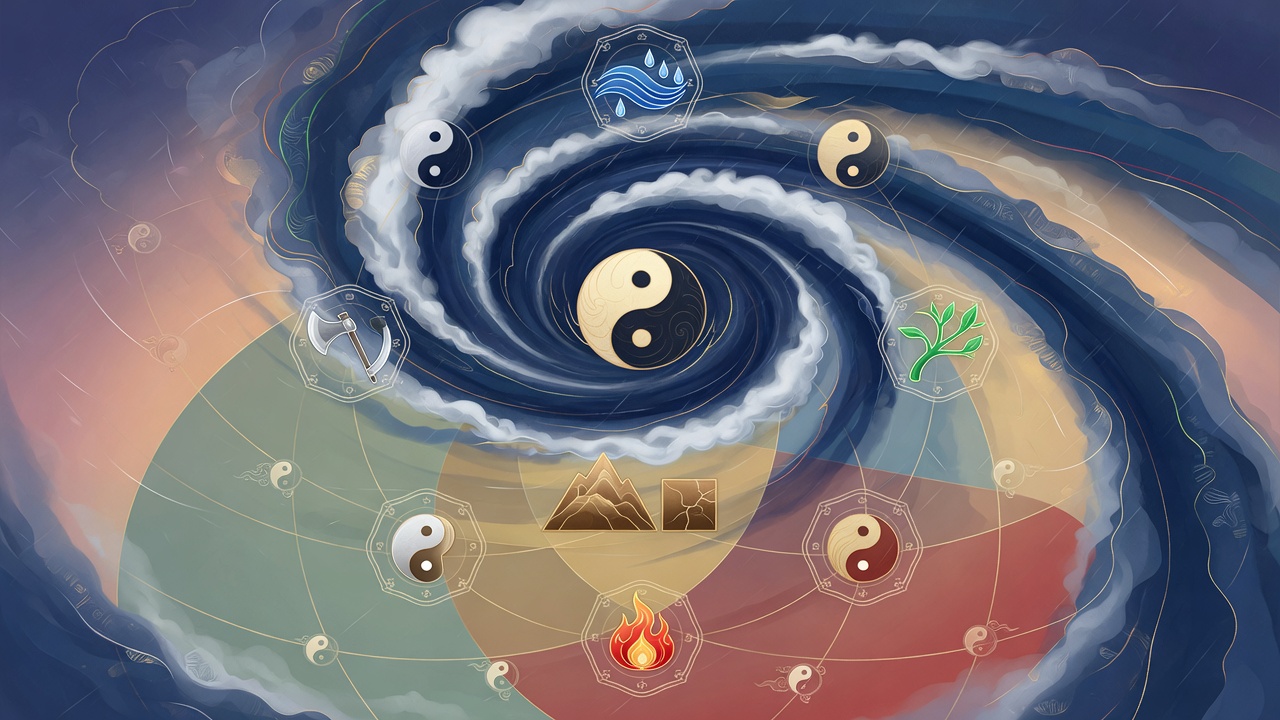
Basic Clarification: Bazi is a Tool for Interpreting Character and Rhythm, Not Fortune-Telling
Common Misconceptions
- Misconception 1: Bazi can predict typhoon paths or disasters. Bazi focuses on a person’s innate energy configuration and acquired rhythms; it cannot deduce natural phenomena. Saudel’s wind and rain changes belong to meteorological science. Bazi only explains the differences in 'why some people remain calm and others anxious when facing the same weather'.
- Misconception 2: People with the same Bazi chart have identical destinies. Bazi reveals fundamental character and energy preferences, but specific life paths are still influenced by geography, era, family, and personal choices. For example, two people with the same chart—one facing the storm directly on Taiwan’s east coast, the other sheltered in a western city—will have completely different daily experiences, yet their deep reactive patterns may be similar.
- Misconception 3: A good or bad Bazi chart determines life success. There is no absolute good or bad in Bazi, only whether the energy configuration matches the environment. During a typhoon, a steady person with abundant Earth and Water elements may remain more grounded, while a fiery, impatient person is more easily agitated by external turmoil. These are traits, not flaws.
Core Insights: Character, Choices, and Timing in Bazi, Seen Through Saudel’s 'Looping'
1. Saudel’s Meandering Path Mirrors the 'Hesitant Character' Energy in Bazi
Saudel does not approach in a straight line but repeatedly shifts direction and even loops at sea. In Bazi studies, certain Day Master configurations exhibit a similar 'circuitous' decision-making style.
For instance, a person with Yi Wood as the Day Master (the Heavenly Stem of the birth day is Yi) often possesses flexible, vine-like thinking. Under pressure, Yi Wood tends to observe first, probe, then circumvent direct conflict. This storm-like, winding character may seem hesitant during major decisions but can thereby avoid unnecessary head-on collisions.
- Yi Wood Traits: Flexible and highly adaptable, decision-making is circuitous but conserves strength; the downside is potentially missing direct opportunities, much like a typhoon’s detour prolongs its stay but reduces instantaneous damage.
- Excessive Resource Stars (abundant Direct and Indirect Resource in the chart): Layered thinking and repeated deliberation, similar to Saudel unable to find immediate direction amidst multiple air currents. Such individuals need the 'push and pull' of external timing to make a decision.
- Overly Strong Output Stars: Full of ideas and highly divergent, sometimes self-reversing like a drifting storm, but once a target is locked in, their creativity erupts.
2. The 'Twin Typhoon' Pattern as a Metaphor for Directional Pull in Life Choices
The phenomenon of twin typhoons coexisting is like the simultaneous influence of two energies from a Luck Cycle and Annual Cycle in Bazi, pulling and pushing, trapping one in a dilemma. Saudel interacts with another typhoon, creating complex atmospheric dynamics; similarly, life often presents dual calls from family versus career, stability versus adventure, or rationality versus emotion.
When analyzing key choices, Bazi does not look at a single factor but examines the power balance between Officer Stars and Output Stars, Resource Stars and Wealth Stars. When two opposing Ten Gods are strong at the same time, a person is like being caught in a twin typhoon circle and must soberly judge which side is truly needed by their natal chart.
- Mixed Officer and Killer (Direct Officer and Seven Killings appearing together): Wanting both to follow rules and break the mold, like twin typhoons pulling each other’s direction. The analysis depends on the Day Master’s strength—a strong Day Master can master the conflict to make integrated decisions, while a weak one should first stabilize one side before handling the other.
- Wealth Star Breaking Resource (Indirect Wealth countering Direct Resource): A practical money opportunity on one side versus a sense of stable security on the other. Under the tearing force of twin typhoons, clearly knowing one’s Useful God orientation (needing Resource to guard stability, or Wealth to seize opportunity) is key to resolving hesitation.
- Sibling Rivalry for Wealth (friends and competitors vying for benefits): Like the peripheral wind circles of typhoons grabbing energy from each other, reflecting the coexistence of cooperation and competition in relationships. It is advisable to find one’s own low-pressure zone within the twin typhoon field to temporarily shelter before striking again.
3. The Three-Day Severe Convective Period Near Taiwan Mirrors 'Phased High Pressure' and Turning Points in Life
Weather reports emphasize 'the entire island must guard against severe convection for these three days.' In destiny analysis, three days correspond to the superimposed effects of Monthly Cycles, Daily Cycles, or even Hourly Cycles. Bazi examines not only the lengthy ten-year Luck Cycles but also the close-range impact of short time units on emotions.
When a person’s Daily Stem-Branch Cycle clashes with their natal Day Pillar, it is like a sudden convective storm—irritability rises, judgment biases, and verbal disputes increase. Recognizing this as merely a short-term energy fluctuation prevents one from making rash long-term decisions within a three-day storm.
- Day Pillar Under Clash: Emotions are easily agitated that day. It’s advisable to reinforce inner defenses like typhoon preparation—reduce critical negotiations and avoid impulsive speech.
- Hour Pillar Activation: Sudden disputes often erupt at specific hours. For those with Fire-Metal conflict in their Bazi hour, friction with others is likely during Shen and You hours (3 PM–7 PM), much like convective rain striking suddenly in the evening.
- Luck Cycle Transition Period: The period before and after a ten-year Luck Cycle change is like the wind shift before a typhoon’s arrival, where old order shakes and new directions emerge. These three days serve as a microcosmic metaphor, reminding people to leave more leeway and postpone final decisions during transitional phases.
Pitfall Avoidance Guide: Using Bazi Thinking to Navigate Uncertain Environments
Key Notes
- Do not rigidly apply Bazi to natural disasters: Saudel is an atmospheric phenomenon, while Bazi is a tool for analyzing people. The two must not be confused, and unscientific statements like 'a certain Bazi chart attracts typhoons' must never be made. Rationally view Bazi’s auxiliary value for psychological adjustment.
- Avoid altering Luck Cycle judgments during emotional peaks: During severe convective weather or high-pressure life phases, people amplify pessimistic expectations. Analyzing one’s Bazi and predicting the future during such times easily leads to misinterpretation. Wait until the inner storm subsides before revisiting the chart.
- Understand the value of 'detours' rather than stigmatizing them: If you find your Bazi chart has a circuitous tendency, don’t blame yourself for being 'indecisive.' Saudel’s looping, though prolonging its influence, also disperses concentrated destructive power. Life’s detours often accumulate experience, waiting for a better landing opportunity.
- Anchor your core Useful God when pulled by twin typhoons: When facing dilemmas, return to the element most needed by your Bazi (the Useful God)—if you need Water, don’t force a Fire path; if you need Metal, don’t get stuck in a forest of Wood. Internal anchoring trumps external tug-of-war.
- The Three-Day Rule: No long-term contracts during short-term impulses: During emotionally convective periods (Daily Clashes, high-conflict points), opt for postponement over decision. The storm will eventually pass; the person you are three days later is your everyday self.
- Environmental consensus does not equal personal direction: When twin typhoons arrive, everyone is tense, but some remain calm due to thick Earth energy, while others are melancholic due to overflowing Water. Recognize your Bazi traits, stay vigilant, and don’t blindly follow collective panic.
Summary and Review
Tropical Storm Saudel's meandering, coexistence, and approach reflect three layers of insight from Bazi metaphysics for life: Character is like a storm’s path—non-linear is not necessarily inferior, as detours are often energy accumulation; Choices resemble the entanglement of twin typhoons—one must first anchor their own Useful God to avoid being torn apart by external forces; Phased high pressure is like three days of severe convection—it is a reminder, not destiny, to be weathered with stability and eased with patience.
The study of Bazi, at its core, teaches us to understand our own energy rhythms, so that amidst the storms of the era, we neither resist blindly nor follow blindly, but soberly know when to evade, when to endure, when to detour, and when to land. This is each person’s inner meteorology.