From Trader Joe's Mango Dessert to Bazi Food God: Why Eat Cooling Foods When Summer Fire Is Strong?
Trader Joe's in the U.S. has launched a classic Thai dessert, putting mango sticky rice back in the food spotlight. Coincidentally, Taiwan is in peak mango season, with Irwin and Jinhuang varieties hitting the market. This is more than a culi
Opening Introduction
Trader Joe's in the U.S. has launched a new Thai classic dessert, making mango sticky rice a social media topic. Taiwan is in peak mango season, with the fragrance of Irwin mangoes drifting through streets and alleys.
This coincidence is not just about food—it also touches the ancient logic of the Food God and seasonal Five Elements in Bazi culture. Why is it suitable to eat cooling fruits when summer fire is strong? Beneath it lies a wisdom of balance worth re-examining.
Basic Clarifications
Common Misunderstandings
Before going further, several ideas need to be clarified to avoid misreading the ancients' wellness philosophy.
- Misconception 1: Treating the Food God in Bazi simply as “gluttony,” when it actually emphasizes keen taste and the capacity to enjoy life.
- Misconception 2: Assuming Five Element attributes are fixed labels; mango cannot be assigned to just one element—it must be judged by color, flavor, thermal nature, and season together.
- Misconception 3: Thinking that eating more cooling fruits in summer is always better, while ignoring individual constitution differences and portion control.
- Misconception 4: Believing the Food God only relates to eating when it is also linked to talent, expression, and emotional flow.
- Misconception 5: Treating “seasonal” as a mystical slogan when it is actually the ancients' observational summary of natural cycles.
- Misconception 6: Equating the cooling nature of fruit with ice from the refrigerator; room temperature and iced are very different.
- Misconception 7: Assuming that whatever element is missing in a Bazi chart should be eaten more; for summer diet, climate adjustment (tiao hou) is the key.
- Misconception 8: Thinking mango tree is Wood and fruit is Earth, so it never changes; season and flavor alter its effect.
Core Points
The Food God—Mysteries of the Star of Culinary Fortune in the Ten Gods
Among the Ten Gods in Bazi, the Food God is the energy the Day Master produces, with the same polarity. It represents gentle output, non-aggressive, like an artist who knows how to enjoy life.
People with strong Food God often have refined sensitivity to smell, mouthfeel, and color, easily finding joy in food. But this is not gluttony; it is dialogue with seasonal energies through taste.
Traditional fate analysis sees the Food God as a “draining and showing talent” force that transforms the Day Master's exuberant energy into creativity and taste. Food is the most direct expression of this transformation.
Many historical food-loving literati often had Food God qualities. They were not just eating; they recorded the connection between food, season, and land. For example, Yuan Mei, who loved writing recipes, showed the Food God's delicacy.
The Food God is also linked to emotional flow. If the Food God is constrained, one may not only have poor appetite but also blocked expression. Restoring diet often helps the overall qi to relax.
In the context of solar terms, the Food God does not encourage off-season eating. It leans toward using ingredients currently provided by nature, keeping body and heaven-earth in step.
Modern people often label the Food God as a “foodie”; but a higher-level Food God knows “moderation in eating and drinking.” It adjusts flavors with the seasons: light in summer, warm and thick in winter.
- Source: The Day Master produces the Food God with same polarity, e.g., Jia Wood produces Bing Fire; Bing Fire is Jia's Food God.
- Personality: People with a strong Food God tend to be easygoing, optimistic, and naturally appreciate food.
- Common error: The Food God is not indulgence; it needs Companion (Bi Jie) support, otherwise it can become fantasy or depletion.
- Seasonal link: The Food God prefers different ingredients in different seasons; in summer it naturally gravitates to refreshing juicy fruits.
- Cultural expression: The Chinese dietary principle of “not eating what is not in season” reflects the Food God's sensitivity to seasonal timing.
- Modern application: Rather than blindly following viral foods, learn from the Food God to feel the real interaction between food and body.
- Modern transformation: Applying Bazi Food God thinking to daily life means cultivating keen awareness of seasonal ingredients rather than chasing off-season delicacies.
Summer Fire Abounds—Five Element Strength and the Body as a Small Universe
In Bazi seasonal terms, summer belongs to Fire, governing heat, rising, and outward energy diffusion. Heaven and earth are at peak fire qi; the human body, as a small universe, is also prone to dryness and heat.
Strong Fire overcomes Metal; Metal corresponds to lungs and skin in the body. When summer dryness fire is too strong, symptoms like dry mouth and skin discomfort easily appear, so the ancients emphasized clearing heat and moistening dryness.
Fire generates Earth; the spleen and stomach belong to Earth. When Fire is strong, Earth qi also strengthens, but excessive Earth may bring dampness and digestive burden, requiring appropriate Water for balance.
In addition, Wood qi begins to recede in summer as Fire takes dominance. Wood generates Fire, so Wood energy is heavily consumed, making people prone to fatigue; nourishing Liver Wood with sour-sweet fruits helps.
The traditional “climate adjustment” (tiao hou) theory holds that people born in summer months have a dry chart; if Ren Water or Gui Water appears, it is like a clear spring in hot summer. Diet follows the same logic: water-natured foods are needed for adjustment.
The human microcosm resonates with the macrocosm; in summer, sweating increases and fluids are lost quickly, so naturally one needs water and cooling moisture. Seasonal fruits play exactly this role.
Strong summer Fire affects not only the body but also emotions. Fire governs propriety; excess leads to irritability. Cooling foods help heart fire descend and restore calm.
- Five Element strength: In summer, Fire is in command; Wood gradually retreats; Earth, Metal, and Water all need climate adjustment.
- Tiao hou principle: In Bazi, summer-born people often consider “tiao hou,” using Water to cool down so the whole chart is not overly dry.
- Dietary echo: Juicy, slightly cooling summer fruits are nature's water-based adjustment resources.
- Body signals: Thirst, irritability, poor appetite are often signs of strong Fire and weak Water, requiring moderate hydration.
- Organ correspondence: Heart belongs to Fire; in summer, nourish the heart; cooling and moistening foods help relieve anxiety from excessive heart fire.
- Don't step in trap: Not all cooling foods are suitable; excessive ice actually suppresses yang qi, creating “cold wrapping fire.”
- Emotional care: In Bazi, Fire governs the heart; too much Fire causes irritability; cooling diet is also a way to calm the mind.
Seasonal Mango—The Harmonizing Code of a Cooling Fruit
Taiwan's summer is peak mango season, with varieties like Irwin and Jinhuang being juicy and sweet. In Five Element terms, mango is yellow and sweet, mainly entering Earth; but its juicy flesh and slightly cooling nature also carry Water properties.
In summer when Fire is strong, fighting it solely with ice products can easily harm the spleen and stomach. The ancients preferred eating seasonal cooling fruits so the body naturally receives water and yin nourishment.
Mango's Earth nature can soothe the spleen and stomach disturbed by Fire; its Water nature can moisten dryness and reduce heat. This multi-attribute character matches summer's need for “Water to adjust when Fire is strong, and moistening when Earth is strong.”
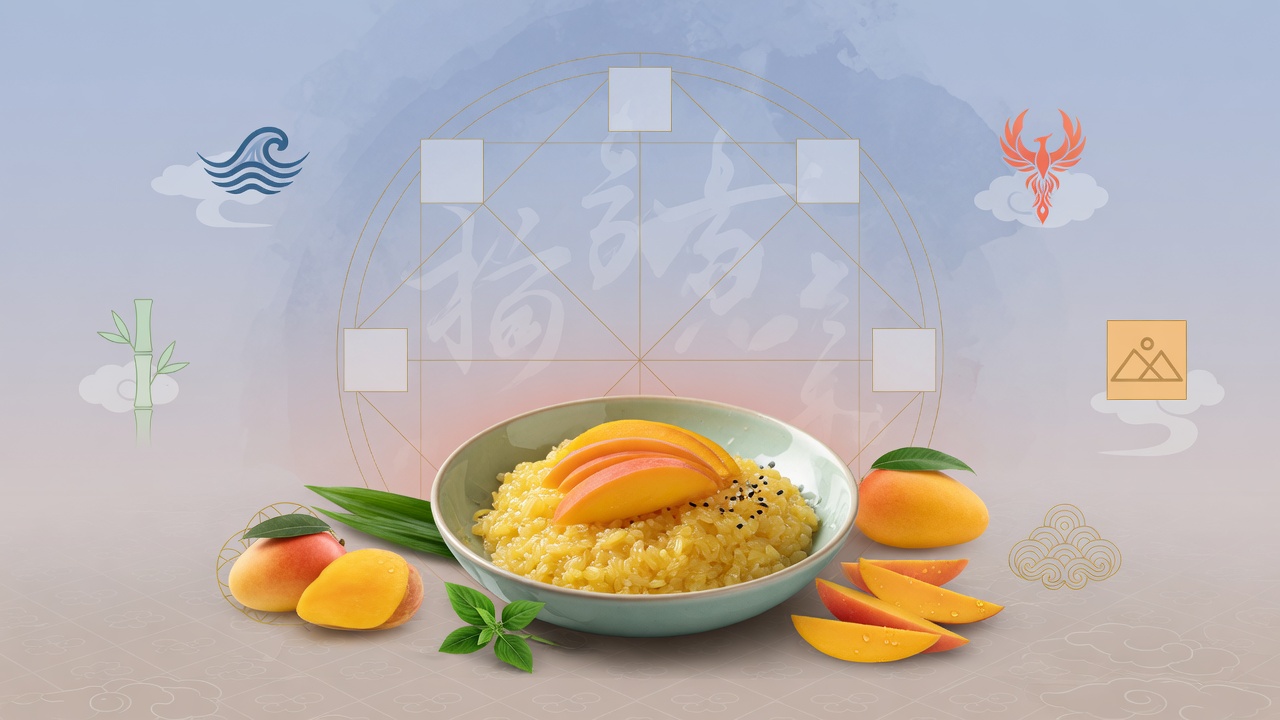
The pairing of mango sticky rice also hides balance: glutinous rice is warm, neutralizing mango's cooling; coconut milk moistens and supplements fluids. This is not only a flavor combination but an extension of ancient Five Element thinking.
Modern people often consume ice-cold drinks to cool down, but ice is different from cooling. Cooling fruits provide cooling moisture at natural temperature without harming yang qi; ice is excessive and easily causes spleen-stomach cold.
From Taiwan's mango ice to Trader Joe's mango dessert, the world is rediscovering this seasonal beauty. Behind it lies the natural logic: “Heaven feeds people with five qi; Earth feeds people with five flavors.”
The ancients said “eat sour in summer” because sourness can astringe fire qi and generate fluids. Mango's slight sourness paired with sweetness fits this principle.
- Seasonal principle: Nature provides juicy, slightly cooling fruits in the hot summer—a heavenly arrangement to reduce fire and replenish water.
- Five Element breakdown: Mango is yellow and sweet, entering Earth; juicy and cooling, entering Water; Earth and Water support each other, buffering fire.
- Balance logic: It is not about fighting summer heat but using seasonal ingredients to lower excessive rising fire in the body.
- Taiwan terroir: Taiwan's high-temperature, high-humidity summer makes the refreshing juiciness of Irwin mango a natural seasonal relief.
- Pairing wisdom: Mango with glutinous rice and coconut milk—cool and warm complement each other—embodies the traditional “cold-heat harmony” dietary view.
- Ancient and modern echo: From Trader Joe's mango sticky rice to Taiwan's street-side mango ice, they share the same seasonal dietary philosophy.
- Five flavors harmony: Mango is not purely sweet; slight sourness generates fluids, sweetness tonifies Earth; sour-sweet transforms into yin—exactly the yin fluid needed in summer.
Avoiding Pitfalls Guide
Precautions
- Reminder 1: Having the Food God in your Bazi does not mean unlimited sweet treats; the Food God also needs Companion energy support, otherwise it can lead to “deficiency not receiving nourishment.”
- Reminder 2: Mango is a seasonal cooling fruit, but high in sugar and fruit acid; traditional wellness says “excess sweetness harms the spleen,” so don't overeat at once.
- Reminder 3: Don't treat fruit as medicine; it is part of natural regulation only and cannot replace professional TCM or medical advice.
- Reminder 4: People with a cold-deficient constitution prone to diarrhea can pair mango with a bit of warm ingredients, like glutinous rice or ginger juice, to balance its cooling nature.
- Reminder 5: If your Bazi lacks Fire or is cold-water dominant, you don't need to eat large amounts of cooling fruits in summer; instead, warm nourishment may be better.
- Reminder 6: Don't let Bazi overrule your daily diet; diet requires observing current body sensations and seasonal changes.
- Reminder 7: The glutinous rice in mango sticky rice is warm, complementary to the cooling mango—this itself reflects the traditional balance thinking of pairings.
- Reminder 8: In summer, eat fruits at room temperature or slightly cool; excessive chilling adds cold qi.
- Reminder 9: Summer fire is strong and humid; eating too much mango may aggravate dampness; pair with a little dried tangerine peel or ginger shreds.
- Reminder 10: Understanding the Food God is not about fortune-telling; it's about learning a more nuanced seasonal diet perspective.
- Reminder 11: Mango is good, but different varieties differ slightly in cooling degree; Irwin is relatively gentle and moistening, Jinhuang is lighter and sweeter—choose according to body response.
Summary and Review
From Trader Joe's Thai dessert to Taiwan's summer mango, behind it lies a harmonizing logic of the Food God and Five Element seasonality. Eating seasonal cooling fruits when summer fire is strong is not superstition but life wisdom in accord with nature's timing. Remember the principle of not eating what is not in season, and keep body and nature in sync.