The Solar Term Code Behind Thunderstorm Warnings: How Ba Zi Culture Interprets Anomalous Weather
On July 26, 2026, the Malaysian Meteorological Department issued a thunderstorm warning (Amaran Ribut Petir) for five states. In Ba Zi culture, this sudden afternoon downpour is far from accidental. The shifting of Solar Terms and the flow of
Opening Introduction
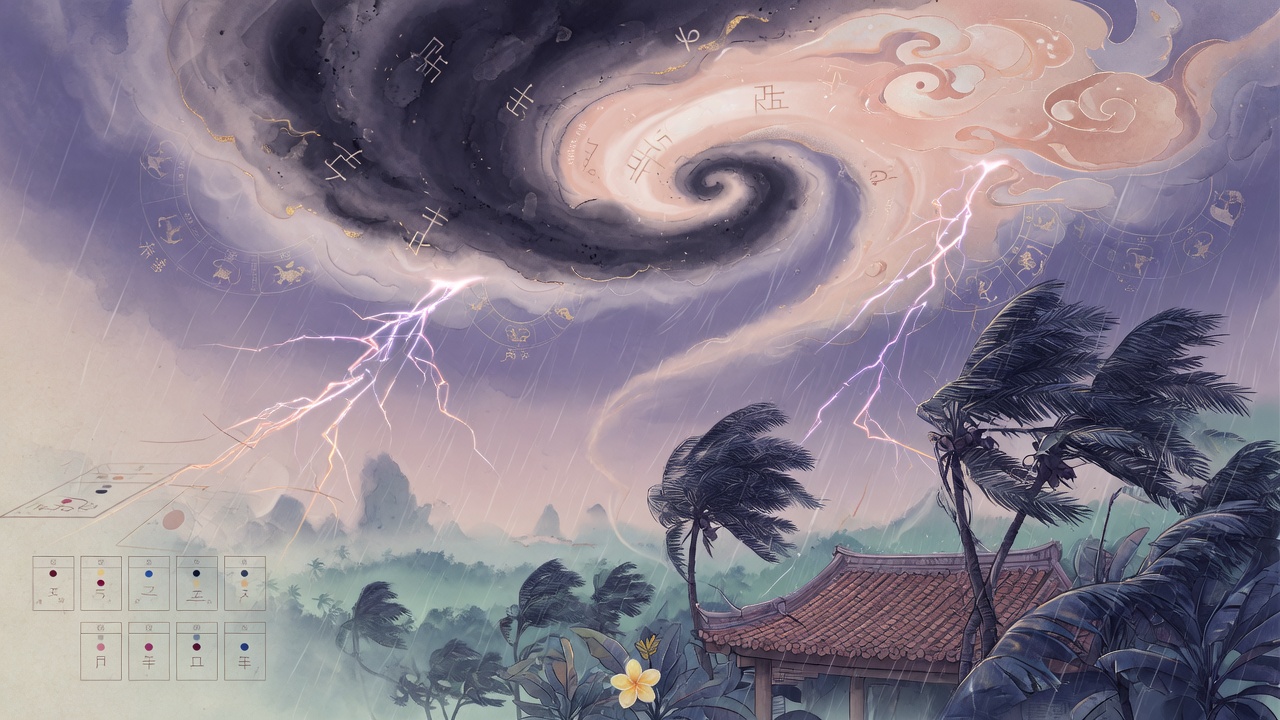
When an afternoon downpour accompanied by lightning strikes Kuala Lumpur, the meteorological thunderstorm warning reminds people to seek shelter. But in Ba Zi culture, this rain is a signal of Solar Term energy transformation.
Starting from the actual weather in Malaysia, this article helps you understand the interpretation of anomalous celestial phenomena in the Farmers' Almanac, and how the Ba Zi system incorporates climate change into the reference framework of human destiny.
Basic Clarification: Solar Terms Are Not Weather Forecasts, Ba Zi Is Not Fatalism
Common Misconceptions
Many people mistakenly believe the 24 Solar Terms are ancient meteorological forecasts, or that Ba Zi can calculate the exact day of a thunderstorm. This is a complete misunderstanding.
- Misconception One: Solar Terms equal actual climate. In reality, Solar Terms are markers of the sun's ecliptic longitude position, reflecting the periodic pattern of solar energy received by Earth throughout the year, not specific weather at a certain time and place.
- Misconception Two: Ba Zi can predict natural disasters. Ba Zi destiny study investigates the potential influence of temporal energy fields on people, not the prediction of concrete events like thunderstorms or earthquakes.
- Misconception Three: The Farmers' Almanac is just a farming calendar. The traditional Farmers' Almanac integrates astrology, phenology, and the Five Elements' engendering and overcoming cycles. It's a complex system for interpreting the timing of Heaven, where anomalous weather like thunderstorms possesses specific cultural encoding.
Core Insights: Cultural Decoding of Solar Terms, Ba Zi, and Thunderstorms
1. Solar Terms: The Rhythmic Switch of Heaven-Earth Qi Interaction
Among the 24 Solar Terms, those most closely related to thunderstorms are Awakening of Insects, Minor Heat, and Major Heat. Awakening of Insects signifies spring thunder rousing hibernating creatures, symbolizing Yang energy breaking through Yin cold.
The 2026 thunderstorm warning occurred on July 26, right around the Major Heat Solar Term (Major Heat falls roughly between July 22-24). Major Heat is the hottest period of the year, where ground moisture evaporates intensely under strong heat, clashing vigorously with cold air aloft, making severe convective weather highly likely.
Ba Zi culture describes this fierce collision of Heaven and Earth energies as 'Metal-Wood Warfare' or 'Fire-Water Conflict'. During this season, Fire energy is extremely strong. If Metal energy (cold air) invades, it acts like water hitting hot oil, resulting in lightning and thunder.
- Solar Term Energy: Major Heat belongs to the Month of Wei (Earth). Wei conceals Ji Earth, Ding Fire, and Yi Wood. Earth is strong and Fire blazes; it marks the peak of Yang energy for the year and the turning point from Yang to Yin.
- Rising Earth Qi: In traditional geomancy and farming concepts, Earth Qi during Major Heat steams like a cauldron. If it encounters 'Metal Wind' (cold air currents from the west), then 'dragons thunder and rain pours down.' The ancients used this to explain the inevitability of afternoon thundershowers in mid-summer.
- Benchmark for Anomalous Weather: If a Solar Term arrives but the climate doesn't correspond (e.g., Major Heat isn't hot, Awakening of Insects has no thunder), the Farmers' Almanac records it as 'Qi Not Aligned'. It's believed the cosmic order is disrupted, potentially affecting agriculture and human health.
2. 'Climate Adjustment' in Ba Zi Destiny Analysis and Thunderstorm Imagery
In Ba Zi theory, the warmth, cold, dryness, and dampness of the climate directly affect the balance of a destiny chart, giving rise to the unique 'Climate Adjustment' theory. A violent weather event like a thunderstorm often corresponds to an extreme combination of Fire and Water conflict in a chart.
If a Ba Zi chart is born in the last month of summer (Month of Wei), with the Day Master being Bing or Ding Fire, or if Fire and Earth are overly strong while Water is lacking, it forms a 'Fire Blazing, Earth Parched' structure. People with this structure might have impatient, passionate personalities and be prone to feeling summer heat, needing Water to adjust the climate.
The Water element used in Climate Adjustment is not just the Five Elements' Water but also symbolizes calmness, fluidity, and wisdom. If Water is weak in the chart while Fire is extremely strong, and a Major Luck cycle or annual pillar brings more Fire and Earth, the ancients warned of irritability and sudden conflicts caused by 'Fire flourishing, Water drying up'. Its imagery mirrors a thunderstorm—a sudden burst of energy.
- Climate Adjustment as a Priority: The Ba Zi classic *Qiong Tong Bao Jian* emphasizes that for charts like Summer Wood or Summer Fire, 'Climate Adjustment is the Priority'. This means solving the climate warmth and coldness problem first before addressing other structural patterns. It embodies the unity of Heaven and humanity, where climate directly impacts chart quality.
- Thunder and Rain as Release: The I Ching's hexagram Jie (Deliverance) states, 'Thunder and rain act, Jie. The superior person forgives errors and pardons crimes.' Thunder and rain are viewed as a mechanism for Heaven and Earth to release stagnation and restore balance. In Ba Zi, a thorough rainfall (corresponding to Water's emergence in a chart) can alleviate a blazing fire and parched earth chart, bringing a turning point.
- Daily Cycle Induction: The specific date of a thunderstorm can correspond to the Daily Stem and Branch Pillar in certain Ba Zi schools. For example, July 26 is a day after the Bing Wu month. If the daily pillar is Ren Zi or Gui Hai (strong Water days) conflicting with the month's Wei Earth branch, it forms a 'Heaven Stem Clash, Earth Branch Clash', triggering extreme weather patterns. This is not prediction, but a symbolic system for post-hoc explanation of Heaven-human resonance.
3. How the Traditional Farmers' Almanac Records and Interprets Anomalous Weather
The traditional Farmers' Almanac (Tong Shu) doesn't just list Solar Terms; it also records the positions of deities like the 'Thunder Duke' and 'Lightning Mother', as well as the daily 'Celestial Response Periods'. Anomalous thunderstorms are often given special markings in the almanac.
For instance, if a day's Stem and Branch is 'Wu Zi' or 'Ji Chou', which are Thunderbolt Fire days, and it coincides with a 'Five Mismatched Hours' or a 'Solar or Lunar Eclipse', the almanac will note 'Unsuitable for travel, beware of thunderstorms.' This isn't superstition but a summary of climate-sensitive days based on long-term observation.
In tropical regions like Malaysia, although the four seasons aren't distinct, the Solar Terms still apply. This is because Solar Terms are fundamentally defined by the sun's position relative to Earth. Near the equator, temperature variation is small, but the movement of the Intertropical Convergence Zone still correlates with the sun's direct point. Around Major Heat, the southwest monsoon is strong, making afternoon thunderstorms frequent, highly consistent with the Solar Term.
- Phenological Verification: The Farmers' Almanac records, 'Major Heat's three signs: first, decaying grass transforms into fireflies; second, soil moistens with sweltering heat; third, heavy rains travel in season.' The third sign 'heavy rains travel in season' clearly points out the feature of frequent thunderstorms at this time, crystallizing ancient wisdom.
- Deity and Sha System: Deities and Sha Gods in the almanac, such as 'Thunder Sha', 'Heavenly Fire', or 'White Tiger', if overlapping with specific directional sectors, are seen as omens of 'thunder stirring'. These symbols essentially transform complex meteorological statistics into easily understood Dos and Don'ts guides.
- Warnings from Anomalous Weather: If counter-seasonal phenomena like 'winter thunder' or 'summer snow' occur, the Farmers' Almanac combines 'Five Movements and Six Qi' to infer potential epidemics or crop damage for that year. For example, winter thunder means Yang energy leaks outward, likely leading to spring epidemics the next year. This is actually a rudimentary observation of climate anomalies and microbial activity.
- Cross-Regional Application: The Tong Sheng (Farmers' Almanac) used by the Malaysian Chinese community often includes local Nanyang climate experience, such as 'During Major Heat, Northern Malaysia is dry, Southern Malaysia floods.' This merges traditional Solar Terms with local climate patterns, forming unique regional knowledge.
Pitfall Avoidance Guide: Rationally Viewing Solar Terms and Celestial Interpretations in Destiny Analysis
Points to Note
- Do Not Simply Equate Solar Terms with the Gregorian Calendar: Solar Terms are a solar calendar system, but the exact moments of their transition are precise to the minute and vary slightly each year. When checking the Farmers' Almanac, pay attention to the transition time of the Solar Term, not just the date.
- Do Not Use Ba Zi to Predict Weather: Ba Zi is a temporal model and doesn't include geographical factors. The same Ba Zi chart in a desert versus a rainforest yields completely different actual climates. Specific weather events like thunderstorms must rely on modern meteorology.
- Do Not Over-panic About Anomalous Weather: Terms in the Farmers' Almanac like 'Thunder Sha' or 'Heaven's Wrath' are cultural rhetoric, not prophecies of disaster. They should be rationally viewed as expressions of the ancients' reverence for natural forces.
- Do Not Ignore Regional Differences: The causes of thunderstorms in Malaysia differ from those in temperate zones. When applying Solar Term theory, you must integrate local climate characteristics and avoid rigidly copying experiences from the Central Plains of China.
- Do Not Treat Climate Adjustment Deity as a Panacea: Ba Zi Climate Adjustment is one part of holistic chart reading. You cannot simply judge that someone 'lacks Water in their chart' and conclude they must love rainy days or suit living near water. Comprehensive analysis combining structural patterns, Ten Gods, and Palaces is necessary.
- Do Not Be Superstitious About 'Remedies' for Thunderstorms: Folk customs like 'sacrificing to the Thunder God' or 'hanging iron swords' belong to the realm of folk culture, not to be confused with Ba Zi destiny analysis, nor can they change actual weather.
Summary and Review
Through the lens of Ba Zi culture, an afternoon thunderstorm is the inevitability of Solar Term energy transformation, a vivid metaphor for Climate Adjustment theory, and an ancient secret code of Heaven-human resonance within the Farmers' Almanac.
The key point is: Traditional culture does not predict natural disasters but provides a thinking framework for understanding natural rhythms. When thunder roars, we can both open a weather radar and smile knowingly—realizing that the Qi of Heaven and Earth is simply completing a cathartic transition.