Behind Thomson Reserve's Hot Sales: How BaZi Reveals the Resonance of Character, Choice, and Timing
In October 2026, Singapore's Thomson Reserve sold over 90% of its units at launch, with an average price of S$2,900 per square foot. This phenomenon is not just a property market hotspot; it also offers a lens through **BaZi (Chinese Eight Characters
Opening Introduction
In October 2026, Thomson Reserve launched to strong sales, with 1,143 units sold—over 90%—in a short period at an average price of S$2,900 per square foot. This figure quickly became a focal point in Singapore's property market.
Amid the rush, we cannot help but ask: why do major collective decisions emerge at specific moments? From the perspective of BaZi (Chinese Eight Characters), this is not driven by mysterious forces, but rather the result of interaction among personal character, decision-making tendencies, and the energy of the times. This article focuses on rational science communication, using the property market hotspot to explain the decision-making wisdom embedded in traditional culture.
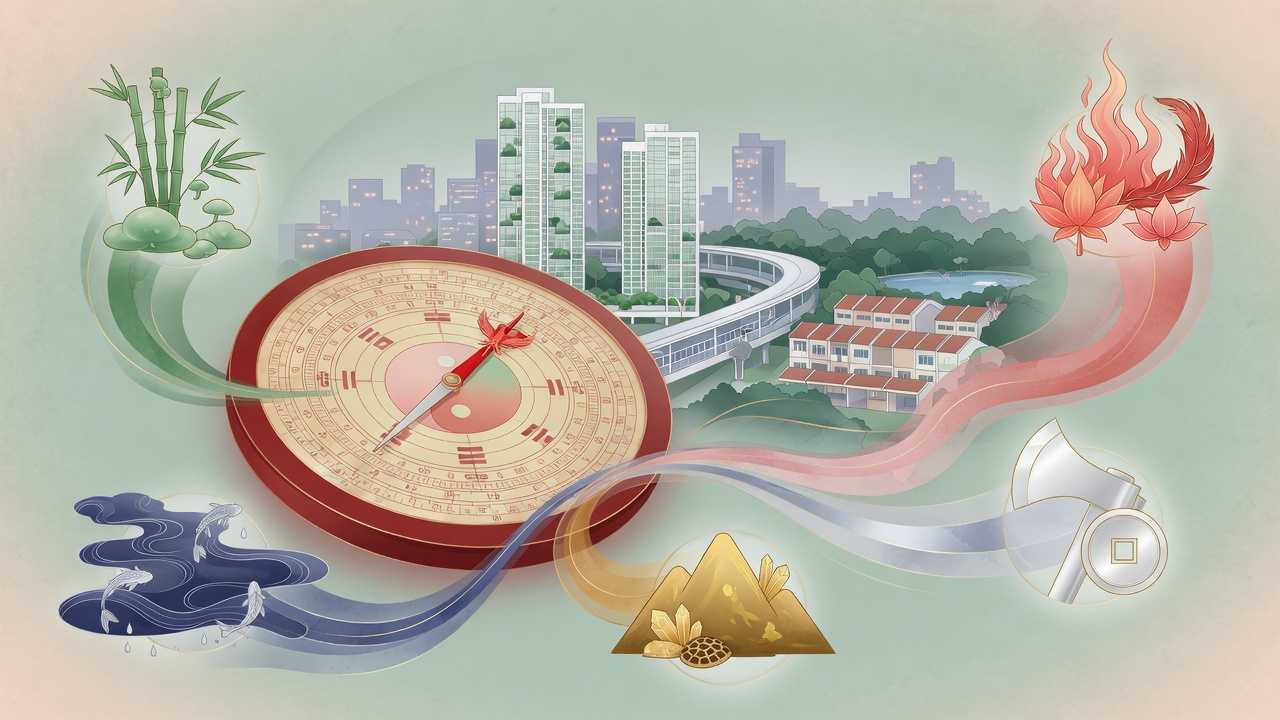
Basic Clarification: BaZi Is Not Fatalistic Prediction
Common Misconceptions
Many people mistakenly believe BaZi is a form of deterministic fortune-telling, but it is actually closer to a framework for analyzing personality traits and the energy of time and space.
- Misconception 1: BaZi determines destiny. BaZi reveals innate energy tendencies, much like providing a life map. However, the path taken still depends on acquired choices and interaction with the environment.
- Misconception 2: People with the same BaZi have the same fate. Even with the same birth time, differences in upbringing, education, and personal cultivation lead to vastly different life trajectories.
- Misconception 3: BaZi can predict specific events. BaZi analyzes qi field trends and personality tendencies, not precise predictions of buying a home or investing in a particular year. It offers decision-making reference, not definite conclusions.
- Misconception 4: A good BaZi chart means everything goes smoothly. A so-called 'good chart' only means certain Five Element configurations are relatively balanced, but life's ups and downs still depend on Luck Cycle changes and personal responses. There is no once-and-for-all chart.
The Real Relationship Between BaZi and Major Decisions
In traditional culture, BaZi is often used to understand a person's decision-making style. For example, those with a strong Resource Star tend to be cautious and research-oriented; those with strong Output Stars are good at seizing opportunities; those with prominent Wealth Star are sensitive to the flow of resources.
- Core understanding: BaZi does not make decisions for you; it helps you recognize your habitual thinking patterns so you can make clearer choices at critical moments.
- Application boundaries: It is suitable for self-awareness and trend perception, but should not replace financial analysis, market research, or professional legal advice.
Core Analysis: The Triple Resonance of Character, Choice, and Timing
1. Ten Gods Personality and Property Purchase Decision Tendencies
The Ten Gods system in BaZi, starting from the Day Master, defines different energies and mental traits. In property market decisions, these traits manifest as distinct behavioral patterns.
The following analysis does not point to any specific individual, but provides a traditional cultural framework for understanding differences in group behavior.
- Direct Officer (Zheng Guan) traits: Values rules and security, tends to choose properties in mature locations with clear ownership. They are highly sensitive to official planning and community stability; projects like Thomson Reserve with clear regional positioning easily gain their trust.
- Direct Resource (Zheng Yin) traits: Focuses on long-term value and quality of life, prefers areas with quiet environments and rich educational resources. They read extensively before purchasing, have a long decision cycle, but once decided, they rarely waver.
- Eating God (Shi Shen) traits: Pursues comfort and aesthetic experience, has high requirements for layout design and landscape views. They are willing to pay a premium for design and are loyal supporters of quality developments.
- Indirect Wealth (Pian Cai) traits: Highly sensitive to market fluctuations and arbitrage opportunities, skilled at spotting price troughs. They tend to enter early during launch, leveraging information and timing advantages, but need to guard against impulsive decisions.
- Seven Killings (Qi Sha) traits: Strong action orientation, willing to compete for resources. Facing hot sales, they react quickly, but are also prone to amplifying urgency amid group emotions; they need to remind themselves to return to rational evaluation.
2. Luck Cycles, Annual Luck, and the Perception of 'Timing Windows'
In BaZi theory, Luck Cycles (Da Yun) change every ten years, while Annual Luck (Liu Nian) changes every year. These interact with a person's natal chart through combinations, clashes, punishments, and harms, creating different energy fields.
2026 is a Bing Wu year—Heavenly Stem Bing fire and Earthly Branch Wu fire—making fire energy strong. In the Five Elements, Fire governs propriety, civilization, and rapid spread, and also symbolizes passion and action.
- Characteristics of a strong Fire year: Group emotions are easily ignited, information spreads faster, and the pace of decision-making clearly accelerates. The market is prone to a collective 'act now or miss out' psychology, which forms an interesting parallel with Thomson Reserve's rapid sales at the spatiotemporal energy level.
- Personal chart resonance: If a person's BaZi favors Fire, this year often brings abundant energy and decisive judgment, making them more inclined to act. If Fire is unfavorable, they may feel restless or pressured, and must pay extra attention to decision quality rather than speed.
- Sensitive periods around Luck Cycle transitions: People near the end or beginning of a Luck Cycle often experience shifts in inner drive. Those previously conservative may suddenly dare to act, while those usually aggressive may turn cautious—explaining why choices differ so greatly at the same moment.
- Objectivity of timing windows: The so-called 'right timing', from a BaZi perspective, means the resonance between an individual's energy cycle and the external environment's energy cycle. This is not mysticism, but a classical description of the overlapping of multiple factors.
3. Five Elements Balance and Classical Wisdom in Asset Allocation
Five Elements theory emphasizes the dynamic balance of Metal, Wood, Water, Fire, and Earth. This thinking can be extended to modern asset allocation logic.
Real estate belongs to Earth—stable, bearing, and rooted. In a person's overall asset portfolio, whether the proportion of Earth is too high or too low requires examining its balance.
- Excessive Earth: May be overly conservative with insufficient asset liquidity. People with strong Earth in their charts who further allocate heavily to real estate should consider increasing Metal attributes (e.g., cash, financial products) or Water attributes (e.g., knowledge investment, liquid assets) to activate the overall structure.
- Insufficient Earth: May lack a stable foundation and feel insecure. Moderate real estate allocation can supplement Earth's stabilizing energy, but must be within one's means and avoid excessive borrowing driven by anxiety.
- Fire generating Earth effect: In 2026, the Bing Wu year has strong Fire, and Fire generates Earth. From the perspective of Five Elements circulation, Earth energy is reinforced this year, so people naturally pay more attention to Earth-related fields such as real estate, construction, and land planning.
- Five Elements is not a mechanical correspondence: The above is only a thinking model. Actual decisions still require combining personal financial conditions, market cycles, and long-term planning; one must not apply it rigidly.
Avoidance Guide: Application Boundaries of BaZi Thinking in Major Decisions
Practical Reminders Checklist
Integrating BaZi thinking into modern life is about absorbing its essence of self-knowledge and reading the times, not using it as an excuse for fatalism. Keep the following points in mind.
- Do not use BaZi as the sole basis: Property purchase decisions involve financial capacity, family needs, location, market trends, and other practical factors. BaZi only provides a reference at the self-awareness level and cannot replace due diligence.
- Beware of over-interpreting 'annual fortune': Even if a year's Wealth Star shines brightly, it does not mean buying with eyes closed will yield profit. Annual Luck indicates energy tendencies, not guaranteed results. All investments carry risk.
- Avoid making decisions at emotional peaks: In strong Fire years or hot sales scenes, group emotions are highly contagious. If Fire is already excessive in your chart, deliberately cool down impulses and leave at least a 24-hour cooling-off period.
- Distinguish 'need' from 'want': People with Eating God or Indirect Wealth traits are easily attracted by aesthetics or arbitrage opportunities. Return to core residential needs when evaluating, and avoid paying excessive premiums for secondary factors.
- Do not skip professional consultation: A BaZi consultant can help you understand personality tendencies, but financial planners, lawyers, and property agents provide indispensable professional advice in the decision chain.
- Respect individual differences: Family members or partners have different BaZi configurations, so their feelings and judgments about the same decision may be completely opposite. Full communication and seeking consensus are more important than unilaterally 'seizing the moment'.
- Long-term perspective over short-term gambling: BaZi Luck Cycles operate in ten-year units, and life planning should follow suit. A single year's strength or weakness cannot define success or failure; continuous learning and dynamic adjustment are the fundamental path.
Summary and Review
The hot sales of Thomson Reserve are the result of specific time, place, and crowd choices converging. From the perspective of BaZi culture, it happens to mirror the classical wisdom that personality traits drive choices and spatiotemporal energy influences rhythm.
The core conclusion of this article: BaZi is a tool for self-understanding, not a magic mirror for predicting destiny. No matter how the property market fluctuates, clear self-awareness, rational analytical frameworks, and prudent decision-making processes are the unchanging laws for navigating cycles.