From Thailand Nursing Home Controversy to the Yin Star in BaZi: Filial Piety and Modern Shelter in Chinese Astrology
Recently, a nursing home in Kanchanaburi, Thailand, was exposed for having cage-like, crude facilities, sparking deep reflection on elderly care. In BaZi astrology, the Yin Star is the core symbol of elders, shelter, and filial devotion. This art
Introduction
A popular Thai program recently revealed that a nursing home in Kanchanaburi had deplorable, cage-like conditions, igniting deep anxiety about elderly care. In BaZi astrology, the Yin Star is precisely the concentrated expression of elders, shelter, and filial piety. Taking this as a starting point, this article rationally explores the balance between family responsibility and social care through the essence of the Yin Star. It does not judge the specific incident; it only uses traditional wisdom to illuminate the present.
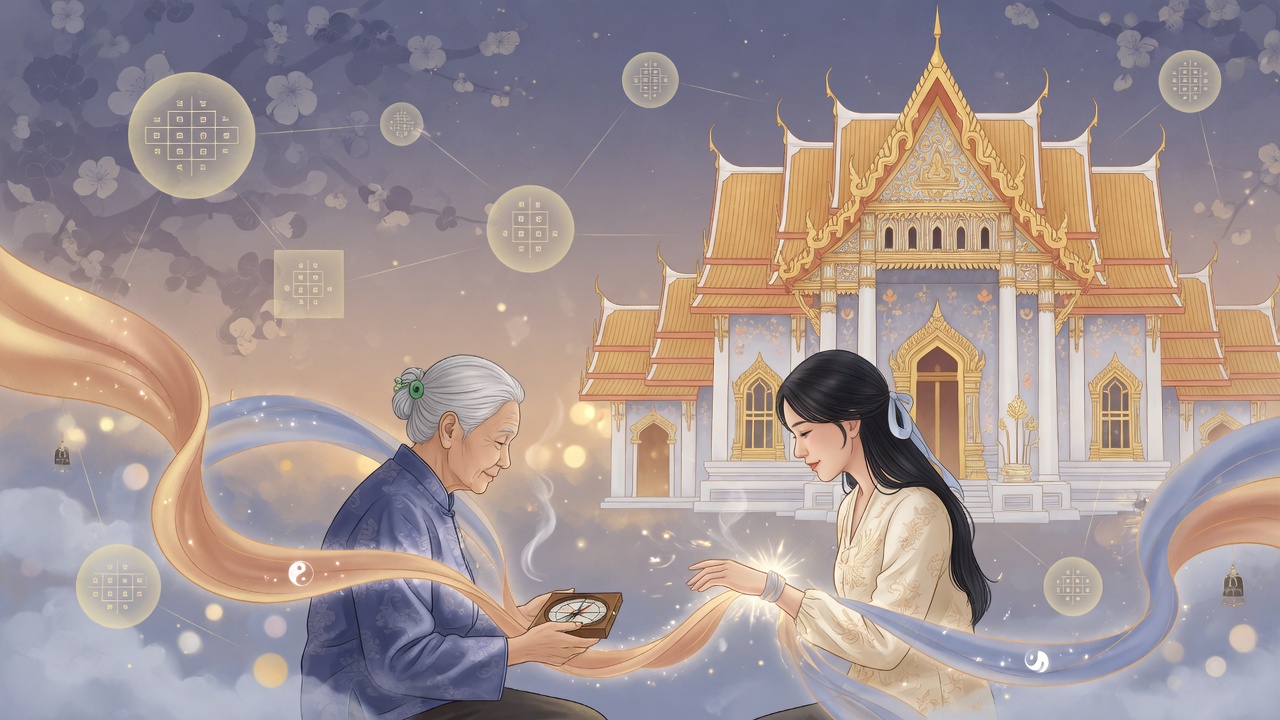
Basic Clarification: The Yin Star Does Not Mean 'You Must Personally Provide All Care'
Common Misconceptions
- Misconception 1: The Yin Star only represents the mother. In reality, the Direct Yin Star usually symbolizes the mother, elders, and benefactors, while the Indirect Yin Star can represent a stepmother, non-lineal elders, or even broader social shelter systems.
- Misconception 2: More Yin Stars equals more filial piety. When the Yin Star is a Useful God, one receives support from elders; if it is an Annoying God and overly strong, it may instead cause excessive dependence or a sense of bondage. Filial piety is a two-way energy and cannot be judged by quantity alone.
- Misconception 3: Sending the elderly to a nursing home damages the Yin Star. Traditional astrology was born in agrarian family structures. In modern society, the expression of the Yin Star has long expanded to institutional shelter such as social security and professional care. The form can change; the core is the compassionate heart of nourishing and protecting me.
Core Insights: How the Yin Star Explains Intergenerational Responsibility and Shelter
1. The Essence of the Yin Star: That Which Nourishes Me, That Which Protects Me
In BaZi, the Day Stem is 'self,' and that which nourishes the self is the Yin Star. When yin and yang nourish each other, it is the Direct Yin Star, such as Jia Wood meeting Gui Water; when same yin or same yang nourish, it is the Indirect Yin Star, such as Jia Wood meeting Ren Water. The Direct Yin Star is gentle and loving; the Indirect Yin Star is perceptive and deep. Both represent knowledge, elders, dwelling, and shelter.
From the perspective of the Five Elements cycle, without the nurturing support of the Yin Star, the Day Master becomes water without a source. Thus, in a natal chart, the Yin Star first corresponds to the nurturing forces in life — not only parents, but also the support provided by culture, tradition, and social institutions.
- Direct Yin Star: Benevolent, tolerant, patiently instructive; often mapped to the mother, teachers, and a stable home.
- Indirect Yin Star: Original, alert, unconventional shelter; can be mapped to step-parents, special caregivers, or social assistance systems.
- Yin Star as Useful God: Receives help from elders, easily inherits ancestral protection, feels inner security, and tends to give back in the same way.
- Yin Star as Annoying God: May feel overly interfered with by elders, or caregiving responsibilities become a heavy burden; boundaries need to be established rather than indulging in self-blame.
2. The Filial Piety Code in BaZi: The Triangular Relationship of Wealth, Officer, and Yin Stars
Filial piety does not exist in isolation in astrology; it is revealed through the interaction of Wealth, Officer, and Yin Stars. Wealth Star overcomes Yin Star, symbolizing that material pursuits may clash with the support of elders; Officer Star nourishes Yin Star, representing the support of social norms and legal systems for elderly care.
Many modern families, busy with work (strong Wealth Star), find it difficult to provide hands-on care (Yin Star is overcome). This is not unfilial; it is a reflection of changing historical structures. Astrology reminds us that balancing Wealth and Yin is about finding a fulcrum between material striving and the protection of family bonds.
- Wealth-Yin Clash: If the chart has an overly strong Wealth Star and a weak Yin Star, one may easily neglect elders' needs due to earning money and career pursuits. Beware of the regret of 'wanting to care but the parent is already gone.'
- Officer Nourishes Yin: The Direct Officer represents public order; Direct Officer nourishing Direct Yin suggests that sound elderly policies and community support can compensate for insufficient family strength.
- Yin Star Sitting on Emptiness: May hint at thin affinity with elders or loosening traditional family structures. In such cases, socialized care is even more necessary to actualize shelter.
- Companions Carry Wealth to Protect Yin: Siblings (Companions) sharing the pressure of support is an effective astrological model for resolving Wealth overcoming Yin, corresponding in reality to multi-child collaboration or community mutual aid.
3. Viewing the Transformation of Intergenerational Relations in an Aging Society through the Yin Star
The Thailand nursing home controversy reflects a universal dilemma: when the traditional extended family disintegrates, the 'aging at home' model represented by the Yin Star becomes unsustainable. But astrology has never been rigid dogma. The essence of the Yin Star is nourishing me, protecting me; the form can evolve with the times.
In ancient times, the Yin Star mostly referred to the parents' home and ancestral halls. Today's Yin Star can be professional care facilities, elderly insurance, senior universities, and digital companionship. As long as the energy of 'nourishing and protecting' flows, the Yin Star remains unextinguished.
- Socialized Expressions of the Yin Star: Community day-care centers, remote health monitoring, and senior interest groups are all new carriers of the Yin Star.
- The Revelation of the Indirect Yin Star: The Indirect Yin Star represents unconventional, innovative shelter, implying that social enterprises, non-profit organizations, and tech-assisted aging models also align with astrological logic.
- Weak Day Master with Strong Yin Star: If the Day Master is overly weak in the chart, excessive reliance on family care may deplete both sides. At such times, using external professional strength (Yin Star) can achieve true 'nourishment and support.'
- Redefining Filial Piety Astrologically: True filial piety is not formal cohabitation, but allowing Yin Star energy to circulate — respect, communication, emotional support. Even if separated by thousands of miles, the Yin Star can still 'nourish' both the Day Master and the elders.
Practical Guide: Using Yin Star Wisdom to Care for Elders Without Pitfalls
Points to Note
- Do not use Yin Star strength to morally judge: A weak Yin Star in the chart does not mean unfilial behavior, and a Yin Star as an Annoying God should not be criticized. Astrology is a cognitive tool, not a standard of judgment.
- Beware the self-blame trap of 'Wealth Overcoming Yin': It is a structural issue that modern people cannot provide full-time care; do not fall into guilt due to busy work. Proactively seek alternative shelter solutions instead.
- Avoid using BaZi to dictate others' elderly care decisions: Everyone's Ten God configuration and Luck Pillar trends differ. Never assert based on a chart that someone 'must go to a nursing home' or 'must stay at home.' Respect real-life choices.
- Boundary awareness when Yin Star is too strong: If an elder's Yin Star is an Annoying God and overly strong, it may manifest as excessive control. In such cases, children need to gently set boundaries; filial piety does not equal unconditional submission.
- Make good use of social resources where Officer nourishes Yin: Understand and utilize long-term care insurance, elderly allowances, community volunteers, and other institutional Yin Stars, making public welfare an extension of family shelter.
- Anticipate when Yin Star changes in Luck or Annual Pillars: When entering a Luck Pillar where Wealth overcomes Yin, plan care resources in advance; when the Yin Star is combined, pay attention to elders' health or communication distance, and strengthen emotional connection in time.
- Cross-cultural interpretation of the Yin Star: In Buddhist cultural areas like Thailand, temples and monks also partially undertake elderly care functions. This is precisely a socialized manifestation of the Indirect Yin Star, and its spirit of community mutual aid can be drawn upon.
- Yin Star and mental health: The Yin Star also represents inner security. While caring for elders, children must also nurture their own Yin Star energy to avoid depletion; otherwise, they cannot continue to provide shelter sustainably.
Summary and Reflection
The Thailand nursing home controversy acts like a mirror, revealing cracks in the traditional family-based elderly care model. The Yin Star in BaZi tells us that the essence of shelter is the flowing energy of nourishing and protecting, not a fixed form. Whether at home, in an institution, or through community mutual aid, as long as that compassion and responsibility continue, filial piety finds vivid expression in the contemporary world. The Yin Star remains unextinguished because the heart nourishes and protects; filial piety does not become rigid because love keeps circulating.