Thailand's July Free Toll Sparks Travel Rush? The Wisdom of "Auspicious Days" and "Timing Travel" in Bazi Culture
From July 28 to 30, 2026, the Expressway Authority of Thailand (กทพ.) will waive tolls on three major expressways, prompting millions to hit the road. While modern travelers rely on GPS and weather forecasts, ancient Chinese people would consult the
Introduction
July 28 coincides with the Thai King's birthday, followed by free expressways from the 28th to the 30th, sparking a surge in short-distance travel demand.
Faced with peak travel, modern people focus on road conditions and vehicle checks, while the ancients had a complex auspicious selection system.
This system uses Bazi as its warp and the almanac as its weft, aiming to find the optimal resonance between person and space-time.
It is not superstition, but a long-term observation and statistical summary of natural rhythms by the ancients.
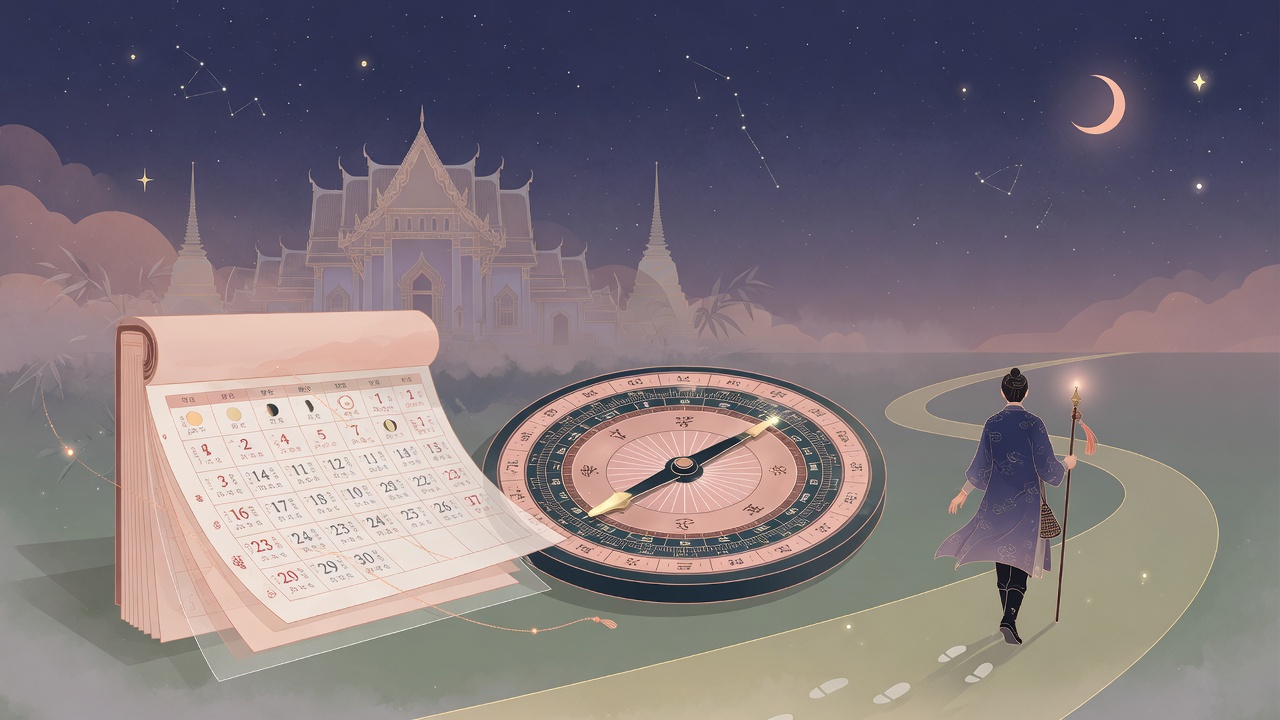
Clarification: Auspicious Days Are Not About "Luck"
Common Misconceptions
- Misconception 1: An auspicious day means everything will go smoothly. Date selection only adds weight to the favorable side; it cannot eliminate all risks.
- Misconception 2: Almanac auspicious days work for everyone. The "suitable for travel" label in the almanac targets the general public, but individual Bazi likes and dislikes differ greatly, leading to vastly different effects.
- Misconception 3: Date selection only looks at the day. Complete date selection must consider the four pillars of year, month, day, and hour, as well as direction and purpose.
The Underlying Logic: The Energy Fields of Heavenly Stems and Earthly Branches
The core of Bazi date selection is the Five Element generation and overcoming of Heavenly Stems and Earthly Branches. Every day has its stem-branch combination, forming a specific energy field.
Travel is essentially human movement through space, interacting with the day's space-time energy.
If a traveler's Bazi favors Water, choosing Ren, Gui, Hai, or Zi days is like sailing with the current; conversely, if Water is unfavorable, encountering a Water day easily brings a sense of blockage.
This choice is not mystical; it is similar to modern people scheduling important meetings according to their biological clock—wisdom of following rhythms.
- Heavenly Stems: Jia, Yi, Bing, Ding, Wu, Ji, Geng, Xin, Ren, Gui, each with a Five Element attribute.
- Earthly Branches: Zi, Chou, Yin, Mao, Chen, Si, Wu, Wei, Shen, You, Xu, Hai, also assigned to Five Elements and containing hidden stems.
- Clashes and Combinations: The six branch clashes (e.g., Zi-Wu clash), six combinations (e.g., Zi-Chou combination), and three-harmony frames determine whether energy is conflictual or harmonious.
The Scientific Resonance Between Date Selection and Astronomical Calendars
Ancient date selection often referenced the Twenty-Eight Lunar Mansions and moon phases. Modern science has found that moon phases indeed affect the Earth's magnetic field and biological rhythms.
Around New Moon (1st day) and Full Moon (15th day), human qi and blood fluctuate more intensely, so the ancients mostly avoided long journeys on these days.
Furthermore, during solar term transitions (such as the four beginnings, two equinoxes, and two solstices), the energy field is unstable, making them nodes to avoid in date selection.
These rules are not groundless but a high-level summary of natural cycles, bearing striking similarities to chronobiology.
- Moon phase taboos: The last day of the month (Hui Ri) and New Moon (Shuo Ri) are unsuitable for travel, as the moon is dim, symbolizing unfavorable conditions.
- Solar term nodes: The day before Li Chun, Li Xia, Li Qiu, and Li Dong are the "Four Severance Days," on which long journeys are taboo.
- Black Days: The "Black Days" marked in the almanac derive from the auspicious and inauspicious combinations of the twelve duty gods and stars; caution is required.
Core Principles: The Five Pillars of Bazi Travel Date Selection
1. The Traveling Star (Yi Ma): The Travel Switch in Your Destiny
In Bazi, the Yi Ma Star is a symbolic deity representing奔波, relocation, and long journeys. Those born with Yi Ma in their chart tend to move frequently throughout life.
When Yi Ma appears in the annual or daily pillar, it often manifests as a travel event. The year 2026 is Bing Wu; Wu is the Horse, itself a Yi Ma year.
If the birth day branch is Shen, Zi, or Chen, Yi Ma is at Yin; traveling on a Yin day easily triggers changes.
- Formula: Shen-Zi-Chen see Ma at Yin; Yin-Wu-Xu see Ma at Shen; Si-You-Chou see Ma at Hai; Hai-Mao-Wei see Ma at Si.
- Auspiciousness judgment: If Yi Ma is the favorable deity, travel is beneficial; if it is the unfavorable deity, travel brings toil and restlessness.
- Combinations: Yi Ma meeting Lu (e.g., Jia's Lu at Yin) indicates gains during the journey; meeting Emptiness suggests plans easily fall through.
2. Core Principles of Date Selection: Avoid Clashes, Seek Harmony, and Use the Favorable Element
For travel date selection, the first taboo is the day branch clashing with the natal year branch or day branch. For example, those born in the Rat year (Zi) should avoid Wu days.
Next, seek three-harmony or six-combination days to increase smoothness. For those born in the Ox year (Chou), choose Zi days (Zi-Chou combination) or Si-You days (Si-You-Chou three harmony).
At a deeper level, match the personal Bazi favorable element. If the favorable element is Wood, choose Yin or Mao days; if Metal, choose Shen or You days.
- Avoid clashes: A clash to the year branch shakes the foundation; a clash to the day branch disturbs the spouse palace, affecting travel companions.
- Seek harmony: Heavenly Stem five combinations (e.g., Jia-Ji combination) are also auspicious, indicating receiving help from others.
- Nobleman days: Jia-Wu-Geng meet nobleman in Ox and Goat; Yi-Ji meet in Rat and Monkey; Bing-Ding meet in Pig and Rooster; Ren-Gui meet in Rabbit and Snake; Xin meets in Horse and Tiger. Traveling on a nobleman day easily brings assistance.
3. Historical Origins: From the "Xie Ji Bian Fang Shu" to Folk Almanacs
The Qing dynasty officially compiled the "Xie Ji Bian Fang Shu", a comprehensive compendium of date selection, systematically organizing the matching rules of stems and branches, symbolic deities, and Five Elements.
The book categorizes travel under "imperial tours, travel, and relocation" and emphasizes avoiding malefic deities like Wang Wang, Gui Ji, and Yue Yan.
Folk almanacs (Tong Sheng) simplified these rules, using "auspicious" and "inauspicious" labels for daily convenience.
While Thailand lacks an almanac tradition, Buddhist holy days and astrological timing are essentially cultural expressions of choosing auspicious moments.
- Wang Wang Day: Seven days after Li Chun, fourteen days after Jing Zhe, etc. Travel on this day implies going and not returning; even ancient armies avoided it.
- Gui Ji Day: Chou in the first month, Yin in the middle month, Zi in the last month. Returning home from a long journey on this day is feared to encounter obstacles.
- Yue Yan Day: Xu in the first month, You in the second month, etc. This is a day when yin energy peaks, unsuitable for long journeys.
4. Case Analysis: Day-by-Day Breakdown for July 28–30
Taking July 28, 2026 as an example, the stem-branch is Bing Wu month, Bing Wu day, with extremely strong Fire energy.
For those whose Bazi favors Fire (e.g., winter-born with a cold, damp chart), traveling on this day brings abundant energy and high efficiency.
For those whose Bazi dreads Fire (e.g., summer-born with a hot, dry chart), it easily leads to irritability, fatigue, and even conflicts.
July 29 is Bing Wu month, Ding Wei day, with Fire generating Earth; Wei is the Wood storage. Those born under Rabbit, Pig, or Goat signs can receive assistance from the storage qi.
July 30 is Bing Wu month, Wu Shen day; Shen is Yi Ma and the place where Water is born. Those who favor Water will have a smoother journey on this day.
Meanwhile, Wu day clashes with Zi: those born in the Rat year should exercise extra caution on the 28th for long trips and are advised to avoid the Wu hour (11 a.m.–1 p.m.).
- 28th Clash and Sha: Rat clash, Horse self-punishment (Fu Yin), Rabbit harm, Ox harm—relevant zodiac signs need caution.
- 29th Characteristics: Wei day clashes with Ox; those born in Ox year should be careful. Wei is Wood storage, so those favoring Wood may receive hidden help.
- 30th Yi Ma: Shen day clashes with Tiger; those born in Tiger year should avoid long journeys. But Shen is Yi Ma, so those whose chart favors movement may benefit instead.
- Auspicious hours reference: Common auspicious hours for the three days are Yin hour (3–5 a.m.), Mao hour (5–7 a.m.), Shen hour (3–5 p.m.), and You hour (5–7 p.m.).
5. A Practical Modern Guide to Simple Date Selection
Ordinary people do not need to master Bazi to apply simple principles to enhance the travel experience.
Step one: Check the almanac (Tong Sheng) and filter for days marked "suitable for travel, relocation."
Step two: Cross-reference with your zodiac sign, excluding dates that clash with your year branch (the six clashes).
Step three: Combine with departure hour, choosing auspicious hours like 5–7 a.m. (Mao hour) or 3–5 p.m. (Shen hour) as much as possible.
Step four: If traveling as a family, prioritize the zodiac of the driver or decision-maker, while also accommodating the elderly and children to avoid clashing with any member.
- Recommended tool: The mobile app "Old Almanac" can quickly check daily auspicious/inauspicious indications and clashes.
- Emergency plan: If you must travel on an inauspicious day, you can wear a Five Element accessory (e.g., black obsidian to supplement Water, red agate to supplement Fire) or silently recite the Six-Syllable Mantra to calm the mind.
- Scientific coordination: While selecting the date, be sure to check vehicle conditions and plan routes; do not become complacent just because it's an auspicious day.
- Mindset adjustment: Date selection is essentially psychological suggestion and energy resonance. Maintaining a peaceful mindset is the greatest auspicious day.
Avoidance Guide: The Five Major Pitfalls of Auspicious Travel Dates
Precautions
- Pitfall 1: Blind faith in "universally auspicious days." Lists of "auspicious travel days this month" circulating online do not consider individual differences and may backfire.
- Pitfall 2: Ignoring the hour pillar. Even on an auspicious day, departing during a Five Misfortune Hour (e.g., Jia day, Geng Wu hour) still indicates unfavorable conditions.
- Pitfall 3: Clashing with fellow travelers. If family members' zodiac signs clash with the day branch, disputes or accidents are likely; harmony must be sought.
- Pitfall 4: Focusing on the day while neglecting the direction. If the travel direction is toward the Year Breaker or Disaster Sha sector, it is also inauspicious. In 2026, the Grand Duke Jupiter is at Wu, so the due north Zi direction is the Year Breaker and unsuitable for long journeys.
- Pitfall 5: Relying on date selection while ignoring reality. On Thailand's toll-free days, traffic will be dense; even an auspicious day can mean traffic jams. You should stagger departure times and remain patient.
- Pitfall 6: Blindly pursuing grand auspicious patterns like the "Three Nobilities." Special configurations have strict conditions that ordinary people rarely meet; forcing their application can bring harm.
- Additional suggestion: If you are unsure about destiny analysis, consult a professional date selection master, providing the whole family's Bazi to customize travel time and direction.
Summary and Recap
Thailand's July free toll is a great opportunity for travel, while traditional Chinese Bazi date selection offers a unique perspective on space-time optimization.
The core of auspicious selection lies in avoiding clashes, seeking harmony, and using the favorable element, with the ultimate goal of achieving harmony between heavenly timing, earthly advantage, and human unity.
View it rationally—neither blindly superstitious nor entirely dismissive—and let ancient wisdom add a touch of composure to modern life.