Typhoon Approaches Taipei: How Bazi's 'Yin Star' and 'Guan Star' Interpret Nature and Disaster Prevention Wisdom
Severe Typhoon In-fa may make a major turn next week, heating up discussions about Taipei weather and typhoon days off. Bazi astrology doesn't forecast weather directly, but it uses the Yin Star to represent the shelter of heaven and earth, and t
Opening Introduction
The path of Severe Typhoon In-fa may take a major turn, making Taipei weather and the question of whether a typhoon day off will be declared the focus of attention.
What people truly care about is whether personal safety and daily order can be protected.
Bazi astrology doesn't forecast weather directly, but it uses the Yin Star to reflect heavenly shelter and the Guan Star to reflect rules and constraints.
This article rationally deconstructs the cultural psychology and disaster prevention awareness behind typhoon season from a traditional perspective.
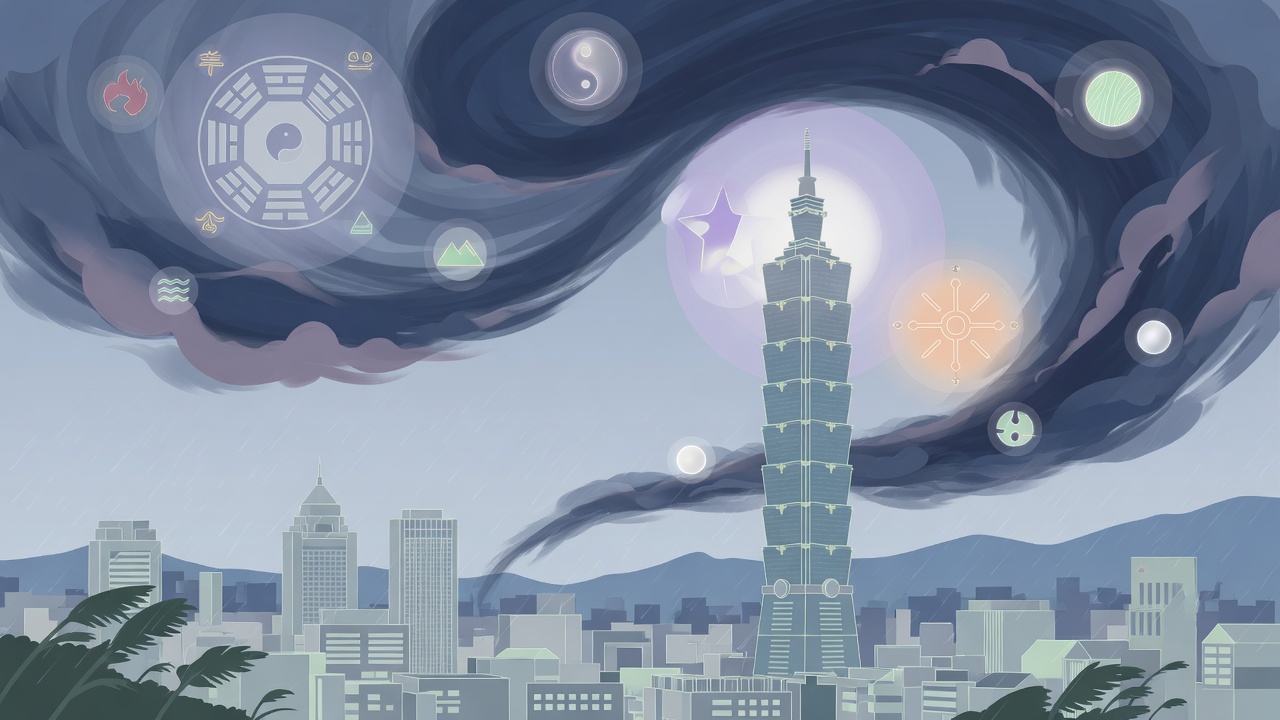
Basic Clarification
Common Misconceptions
Many people's understanding of the Yin Star and Guan Star remains limited to academics and career positions.
Returning to their more primitive astrological symbols, they correspond to heaven and earth nature and personal safety.
When a typhoon approaches, these primitive meanings better explain the collective anxiety of the public.
- Misconception One: Treating Bazi as a weather forecasting tool. Astrology doesn't predict typhoon paths; it only provides a framework for observing the relationship between humans and nature.
- Misconception Two: Believing that the 'Yin Star' only governs academics and the 'Guan Star' only governs career. In fact, they originally correspond to shelter and constraint.
- Misconception Three: Thinking that feng shui rituals can 'dissolve' a typhoon. Traditional wisdom emphasizes compliance and prevention, not confronting natural disasters.
- Misconception Four: Using someone else's birth time to infer they are 'destined for disaster.' This is both disrespectful of privacy and lacking in scientific basis.
Conceptual Origins
The prototype of the Yin Star is the mother, the earth, and shelter, corresponding to the natural forces of nurturing and protection.
The prototype of the Guan Star is institutions, laws, and administrators, corresponding to rhythm and constraint in nature.
Typhoons belong to the category of 'Guan Sha,' representing coercive forces from the outside.
Bazi doesn't predict specific natural disasters, but provides an interpretive framework of heaven-human correspondence.
- Yin Star Keywords: shelter, nurturing, rear support, resources, education.
- Guan Star Keywords: rules, early warning, management, responsibility, risk.
- Typhoon Attributes: sudden, forceful, uncontrollable; therefore classified as 'Guan Sha' rather than 'Yin' in astrology.
Core Points
The Yin Star and Guan Star in Bazi represent nurturing and management respectively.
A typhoon approaching Taipei offers the perfect opportunity to examine this pair of relationships.
Yin Star: The Sheltering Power of Heaven and Earth Nature
The Yin Star in astrology represents the forces that birth, nurture, and shelter us.
It corresponds to atmospheric circulation, terrain barriers, and sturdy buildings in nature, as well as human sense of security.
When a typhoon arrives, the Central Mountain Range weakening wind force and houses providing shelter are realistic projections of 'Yin.'
Ancient people extracted the symbol of 'Yin governing shelter' precisely from such experiences.
In modern disaster prevention, shelters, disaster kits, and neighborhood mutual aid are all modern extensions of the Yin Star.
If a person's Bazi chart has a strong Yin Star, it often represents stronger ability to obtain external protection.
- Natural Shelter: Mountains, bays, and vegetation can buffer wind disasters; this is geographic 'Yin.'
- Human Shelter: Sturdy homes, disaster prevention facilities, and neighborhood mutual aid are modern society's ways of reinforcing 'Yin.'
- Psychological Shelter: Facing an uncertain typhoon path, stable information and family support can alleviate anxiety.
- Traditional Wisdom: Repairing houses, storing food, and securing doors and windows before typhoon season were concrete actions ancient people took to supplement 'Yin.'
- Modern Application: Preparing three days of drinking water and dry food, checking emergency lighting—these equal storing energy for 'Yin.'
- Signs of Weak Yin: Old doors and windows at home or living alone without support can be seen as weak 'Yin,' requiring proactive reinforcement.
- Public Shelter: Government shelters and community activity centers are collective-level 'Yin.'
- Information Shelter: Continuously receiving official weather information and avoiding rumor interference is also a way of settling the mind's 'Yin.'
Guan Star: Rules, Constraints, and Disaster Prevention Order
The Guan Star represents restraint, management, regulation, and order.
Typhoon warnings, work and school suspension standards, and disaster prevention regulations are all manifestations of the Guan Star in reality.
The Guan Star is not merely pressure; its essence is protective constraint.
With Severe Typhoon In-fa's path unclear, experts analyzing the probability of Taiwan impact is precisely the Guan Star's rational risk management.
Facing a typhoon, without 'Guan's' early warning and control, casualty risks would rise dramatically.
In astrology, when the Guan Star is overly strong without Yin to resolve it, a person feels tremendous pressure—corresponding in reality to excessive panic or chaotic management.
- Forecast System: Meteorological agencies issuing sea and land typhoon warnings serve the 'Guan' early warning function.
- Days Off Standards: Whether work and school are suspended is based on wind force and rainfall data, avoiding emotional decision-making.
- Disaster Prevention Laws: Designating danger zones, evacuation routes, and sailing bans are all positive aspects of Guan Star restraint.
- Excessive Fear: Treating 'Guan' as an omen of disaster ignores the order value it brings.
- Guan-Yin Balance: Receiving a warning (Guan) and then calmly preparing (Yin) is the ideal state.
- Rational Days Off: A typhoon day off is not 'an extra day of rest' but rather the Guan Star's forced reduction of group exposure risk.
- Civil Self-Discipline: Businesses taking down signs and construction sites halting work reflect 'Guan' awareness that doesn't require government orders.
- Post-Disaster Order: Traffic control and power repair scheduling all rely on the Guan Star's sustained constraint.
Yin-Guan Mutual Generation: Disaster Prevention Philosophy of Heaven, Earth, and Humanity
In Bazi, Yin can dissolve the rigidity of Guan Sha, and Guan can restrain the Day Master from reckless action.
Facing the external 'Guan Sha' force of a typhoon, people need Yin to stabilize their foundation.
In modern disaster prevention, weather warnings belong to 'Guan,' while family disaster kits and safe residences belong to 'Yin.'
Only when the two cooperate can a complete defense line be formed against natural disasters.
Traditional culture emphasizes the Three Realms of Heaven, Earth, and Humanity: heaven has typhoons, earth has barriers, and humans must respond.
Yin-Guan mutual generation is not empty astrological jargon; it reminds people to use order to guide preparation, and use preparation to absorb risk.
- Yin-Guan Mutual Generation: Warning information (Guan) gives people time to prepare supplies (Yin), reducing risk.
- Community Mutual Aid: Reporting disaster conditions (Guan) combined with shelter and resettlement (Yin) enables faster post-disaster recovery.
- Personal Responsibility: Following evacuation instructions is respecting 'Guan'; carrying identification and medication is protecting 'Yin.'
- Cultural Psychology: Ancient people offering sacrifices, repairing houses, and storing food essentially employed both 'Guan' reverence and 'Yin' preparation.
- Family Division of Labor: Parents monitoring warnings (Guan) while other members organize emergency kits (Yin) creates orderly cooperation.
- Corporate Disaster Prevention: Companies developing emergency response plans (Guan) and providing safe spaces and supplies (Yin) protect employees.
- Urban Resilience: Drainage systems and levee projects are the hardware of 'Yin,' while evacuation plans are the software of 'Guan.'
- Psychological Recovery: Post-disaster counseling is 'Yin' nurturing, combined with 'Guan' order restoration, preventing long-term trauma.
Guidance for Avoiding Pitfalls
Combining Disaster Prevention with Astrology
- Don't replace weather information with astrology: Typhoon paths and intensity should be based on official meteorological agencies; Bazi only provides cultural interpretation.
- Avoid catastrophic associations: When seeing terms like 'major turn' or 'severe typhoon,' don't apply astrological labels like 'divine punishment' or 'predestined calamity'—this is both unscientific and panic-inducing.
- Don't spread personal birth data or privacy: Never use typhoon topics to speculate that others are 'destined for disaster.' This is disrespectful and unfounded.
- Disaster prevention trumps divination: Rather than seeking fortune-telling, check windows and doors, secure signs, and prepare drinking water, dry food, and flashlights.
- View typhoon days off rationally: Days off result from the Guan Star's protective management, not a benefit or reward; the core purpose is reducing outings and accidents.
- Keep traditional rituals moderate: Worship and prayer can calm the mind but cannot replace actual disaster prevention measures.
- Pay attention to vulnerable groups: Elderly living alone and people with mobility challenges have weaker 'Yin' and need the community's 'Guan' to proactively inspect and assist.
- Remain cautious after the typhoon: Post-disaster risks from standing water, broken branches, and downed power lines still require the Guan Star's order awareness and the Yin Star's self-protection.
Cultural Psychological Adjustment
- Anxiety is a normal reaction: Feeling uneasy when a typhoon approaches Taipei aligns with humanity's instinctive alertness to unknown natural disasters; no need for self-denial.
- Use information to settle the mind: Regularly checking official warnings is more effective at stabilizing emotions than repeatedly refreshing social media rumors—this is supplementing 'Yin.'
- Avoid excessive hoarding: Prepare supplies in moderation; panic buying actually increases the burden on public order.
- Stay in contact with others: Those living alone should proactively check in with family and friends, and neighbors should look out for each other, strengthening interpersonal 'Yin.'
- Maintain flexible plans: Typhoon paths may change; pre-planning multiple response scenarios reduces the shock of 'Guan Sha' surprises.
- Don't let down your guard after the disaster: Inspect environmental safety before returning to work or school, avoiding neglecting latent risks in the rush to recover.
Summary and Reflection
As a typhoon approaches Taipei, the Yin Star reminds us to seek and reinforce shelter, while the Guan Star demands we follow rules and heed warnings.
Traditional astrology is not a prediction tool but an intellectual heritage through which ancient people connected heaven and earth nature with personal safety.
True 'resolution' lies in implementing disaster prevention awareness, preparation, and mutual assistance.