Singapore drunk-driving accident prompts reflection: "Qi Sha" and "Zheng Guan" in BaZi teach knowing when to stop and self-restraint
A fatal single-vehicle drunk-driving accident in Singapore has once again drawn public attention. Behind the incident, Qi Sha and Zheng Guan in traditional BaZi astrology form a precise pair of symbols for impulse and self-discipline. This ar
Opening Introduction
Recently, Singapore police reported that a middle-aged man died in a single-vehicle crash late at night, with preliminary investigations pointing to drunk driving. Such incidents are deeply saddening and once again bring the inner struggle between 'impulse' and 'rules' to the forefront.
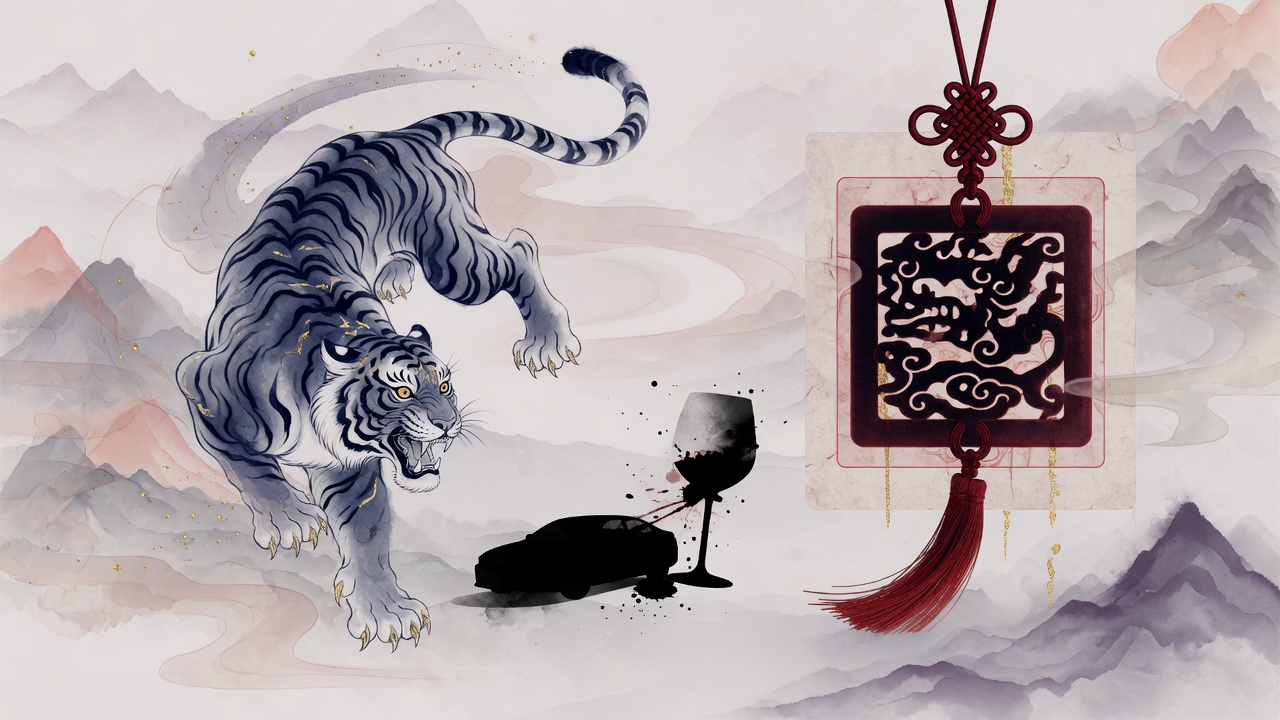
In traditional BaZi astrology, there is a highly precise set of symbols: Qi Sha represents raw impulse and boundary-breaking force, while Zheng Guan represents norms, restraint, and social law. Their ebb and flow mirrors the inner tension between desire and reason.
Basic Clarification: BaZi Is Not a Fatalistic Label
Common Misconceptions
- Misconception 1: Assuming that Qi Sha in a BaZi chart is always a malefic star and Zheng Guan is always a benefic star. In reality, no Ten Gods are absolutely good or bad; the key lies in the overall chart structure and interactions.
- Misconception 2: Directly attributing drunk driving to having Qi Sha in one's chart. Destiny analysis is never so simplistic; acquired self-cultivation and choices far outweigh innate symbols.
- Misconception 3: Using destiny analysis to excuse boundary-crossing behavior. Traditional wisdom never encourages fatalism; 'knowing your destiny' is meant to cultivate yourself more clearly, not to indulge instinct.
This Article's Position
This article only uses the hot topic as a starting point to popularize traditional culture and the concept of self-cultivation. It does not involve any specific personal chart, does not predict fortune, and does not judge responsibility for the accident. Its aim is to explore the two core themes that run through the Chinese tradition of self-cultivation: 'knowing when to stop' and 'self-restraint'.
Core Interpretation: The Cultivation Dialectic of Qi Sha Impulse and Zheng Guan Self-Discipline
Qi Sha: The Destiny Symbol of Impulse, Risk, and Boundary-Crossing
In the Ten Gods system of BaZi, Qi Sha is the element that controls the Day Master and shares the same polarity. It is fierce, decisive, and aggressive by nature, dislikes restraint, and often carries intense energy that breaks conventions. On the positive side, it manifests as courage, boldness, and pioneering spirit; on the negative side, it shows as impatience, recklessness, and contempt for rules.
Drunk driving is a typical state of 'uncontrolled Qi Sha': alcohol temporarily disables the inner Zheng Guan review mechanism, allowing impulse to cross safety boundaries with ease. At that moment, judgment declines, yet the person mistakenly believes they are still in control—highly similar to the arrogance and risk-taking of uncontrolled Qi Sha.
As the ancients said, 'Those with deep cravings have shallow heavenly awareness.' When Qi Sha is excessive and not tamed, it plants seeds of boundary-crossing in every layer of life. Drunk driving is not the only example; any addictive behavior or impulsive decision carries the shadow of uncontrolled Qi Sha. Destiny analysis reminds us that this force must be seen before it can be transformed.
- Core traits of Qi Sha: decisive yet prone to indulgence, brave yet prone to reckless risk-taking.
- Image of being uncontrolled: like a fierce beast escaping its cage, destructive power spreads rapidly, commonly seen in out-of-control behavior.
Zheng Guan: The Inner Anchor of Rules, Restraint, and Social Law
Opposite to Qi Sha is Zheng Guan. Zheng Guan also controls the Day Master but has the opposite polarity, carrying a gentle, restraining, and guiding force. It symbolizes social norms, national laws, teachings from elders and teachers, and even one's personal moral bottom line. A person with strong Zheng Guan is usually self-disciplined, respects order, and acts with moderation.
The most fundamental failure in drunk driving is that Zheng Guan temporarily goes 'offline.' Legal prohibitions, inner shame, and fear of consequences all fall under Zheng Guan's jurisdiction. When these voices are drowned by alcohol, a person is left with only Qi Sha-driven instinct. This is exactly what the ancients warned: 'Following the heart's desires without overstepping the rules' requires extremely strong Zheng Guan cultivation.
In BaZi structure, if Zheng Guan's force is clear and unobstructed, it can effectively control Qi Sha. The ancients called this 'mixed Officer and Killing brought under control,' meaning the ability to turn challenges into discipline. Many high achievers have both Zheng Guan and Qi Sha in their charts because they can channel their drive into a structured path of struggle, rather than blind action.
- Essence of Zheng Guan: the inner embodiment of 'propriety' and the composure to refrain from what should not be done.
- Key function: drawing a runway for Qi Sha, so courage does not become destructive force.
The Way of Balance: Seeing Knowing When to Stop and Self-Restraint Through 'Officer and Killing Controlling Each Other'
True self-cultivation is not about eliminating Qi Sha—the vitality, competitiveness, and breakthrough power of life come precisely from this yang energy. BaZi wisdom emphasizes not 'removing the Killing' but 'transforming Killing through Officer.' That is, by consciously establishing behavioral boundaries and following social rules, raw drive can be released on a safe track.
In daily life, this is equivalent to cultivating a kind of 'clear self-observation': knowing when impulses arise and where one is prone to cross the line, and setting up safeguards in advance. For example, 'don't drink and drive' is exactly turning rules into an inner ritual, using Zheng Guan to firmly lock the loopholes Qi Sha might create.
In history, models of self-cultivation such as Zeng Guofan constantly practiced self-reflection and self-restraint, thereby continuously strengthening the power of 'Zheng Guan.' In his diaries, he repeatedly emphasized 'endurance,' 'caution,' and 'guarding against arrogance'—in essence, consciously taming the tiger of Qi Sha in his heart. This cultivation has nothing to do with destiny or fortune, but with the quality of one's character.
- Transforming Killing through Officer: using rules to channel courage, not to suppress courage.
- Knowing when to stop: recognizing your impulse threshold and stopping in advance.
- Self-restraint: mobilizing inner Zheng Guan for active intervention when desires rise.
Avoidance Guide: View Destiny Analysis Rationally and Don't Fall into Misconceptions
Precautions
- Don't overgeneralize: Just because someone has Qi Sha in their BaZi chart does not mean they are prone to breaking rules. Acquired education, environment, and self-reflection can greatly transform innate tendencies.
- Don't use destiny analysis as an excuse: Even if Qi Sha is overly strong, it does not justify wrongful behavior. Traditional destiny analysis emphasizes that 'cultivation can transform one's temperament,' and self-responsibility is the bottom line.
- Distinguish cultural education from actual prediction: This article only discusses from the perspective of cultural symbols. Any real-world legal or moral judgment should be based on facts, not BaZi.
- Beware of cheap destiny-remedy tricks: Many talismans and 'luck-changing' secret methods claiming to 'resolve Qi Sha' have no basis. True transformation comes from daily self-restraint, not paying to avert disaster.
- Cultivate Zheng Guan habits in life: Regular routines, obeying traffic rules, arranging a designated driver before drinking—these are the most effective 'transforming Killing through Officer' practices.
- Don't ignore psychological and physiological factors: Drunk driving also involves addictive tendencies and social pressure. BaZi can offer a self-reflective perspective, but it cannot replace professional psychological counseling or medical intervention.
Summary and Review
The tragic accident in Singapore serves as a mirror, reflecting the eternal tension between Qi Sha and Zheng Guan in our shared human interior. BaZi is not meant for labeling people, but for helping us see the high-risk configurations in our character, and then consciously nurture the Zheng Guan power of 'refraining from what should not be done.' True knowing when to stop and self-restraint is not about eliminating energy, but finding the safest outlet for it.