Can Shensha Really Be Trusted? Why Peach Blossom, Post Horse, and Canopy Can Only Serve as Auxiliary Judgments
In Bazi fate analysis, Shensha are often misunderstood as decisive destiny “codes,” yet stars like Peach Blossom, Post Horse, and Canopy are merely auxiliary indicators. This article clarifies the essence and limits of Shensha from fi
Opening Guide
In Bazi, Shensha are often treated as “shortcut keys” for quick fortune assessment. Seeing Peach Blossom immediately labels someone romantic; seeing Post Horse presumes a life of constant movement — such readings stray from the fundamentals of destiny analysis.
This article clarifies a core proposition: Shensha can be trusted, but only with preconditions. They are merely auxiliary annotations to the chart, never the independent master of fate.
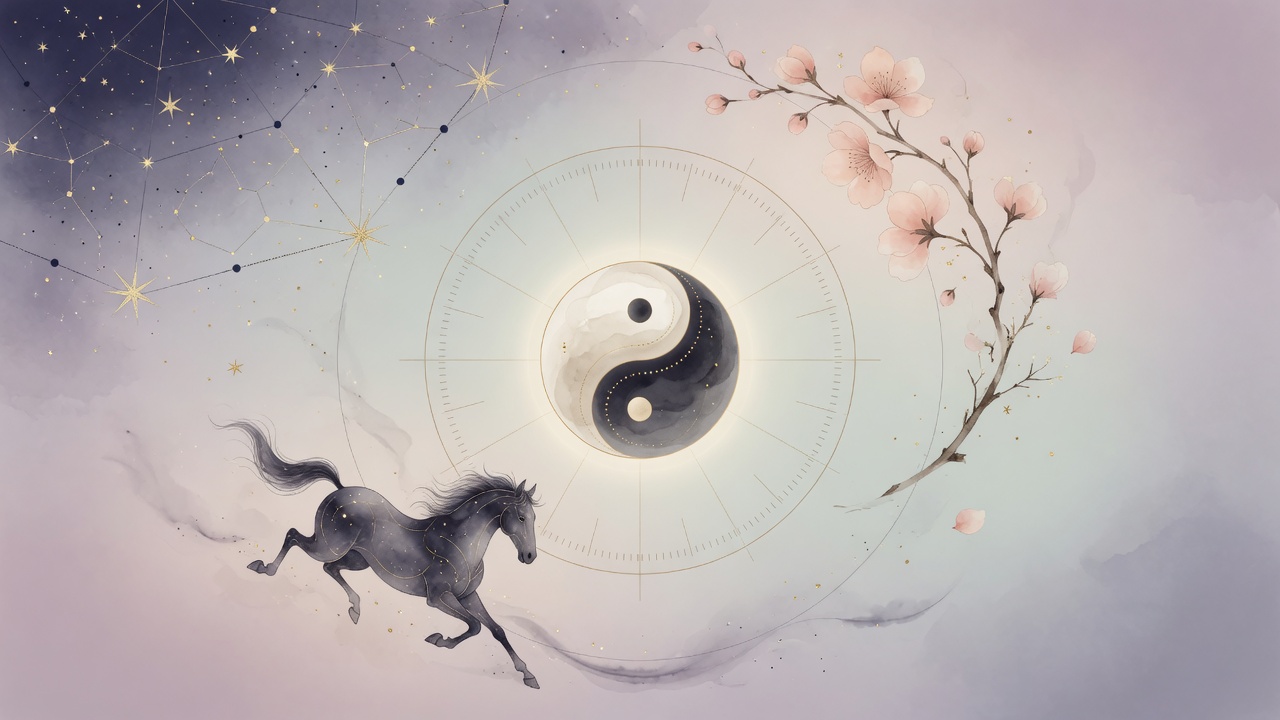
Basic Clarification: Shensha Are Not Destiny Switches
The Shensha system originated from a blend of star-ming studies and folk experience, essentially serving as symbolic labels for specific ganzhi combinations. They are like weather warnings, not the underlying geological structure.
Common Misconceptions
- Misconception 1: Shensha determine good or bad fortune. Auspicious Shensha do not necessarily bring good luck, nor inauspicious ones inevitably cause disasters. The key lies in whether they clash with the pattern (Géjú) and the favorable/useful gods (Xǐyòngshén).
- Misconception 2: More Shensha is better. A chart cluttered with Shensha often signifies a scattered mind and a life full of winding paths; only purity can highlight nobility.
- Misconception 3: Taking Shensha based solely on the year or day branch. Shensha should be derived mainly from the year and day branches with reference to the month and hour, and must be evaluated within the overall chart momentum — never judged in isolation.
Core Point: The Auxiliary Logic of Three Typical Shensha
Peach Blossom, Post Horse, and Canopy are the most frequently asked about Shensha. They respectively point to tendencies in desire, mobility, and intellectuality. However, without the foundation of the Five Elements, these tendencies are but castles in the air.
1. Peach Blossom (Táohuā): Mirror of Romance, Not Its Source
Peach Blossom — also called Xianchi — governs ambiguity, emotion, and artistic aesthetics. Those with Peach Blossom in the chart indeed tend to exude charm, but whether this leads to a good marriage or entanglements depends entirely on the stability of the Day Master (Rìzhǔ).
If the Day Master is weak and Peach Blossom overflows, one easily becomes trapped by emotions and loses oneself. If the Day Master is strong and Peach Blossom is a favorable god, charm can be transformed into social resources and a rich network.
Peach Blossom falling in the Hour Pillar is “outer Peach Blossom,” often indicating interpersonal appeal after middle age or a graceful late-life romance; it should not be simplistically judged as infidelity.
- Core rule: Peach Blossom must reside with auspicious gods like Direct Officer (Zhèngguān) or Direct Seal (Zhèngyìn), or be supported by the Useful God (Yòngshén), to be truly beautiful. If accompanied by Seven Killings (Qīshā) or Rob Wealth (Jié Cái), it usually indicates emotional debts and entanglements.
- Auxiliary judgment: Peach Blossom is a mirror reflecting the actual state of Water-Fire adjustment (Diào Hòu) and Metal-Wood conflict in the chart. When dry earth repeatedly sees Zi, Wu, Mao, You, Peach Blossom may turn into a calamity.
2. Post Horse (Yìmǎ): Directional Sign of Motion, Not Engine of Success
Post Horse governs travel, relocation, and change. Those carrying Post Horse are inherently restless, but whether this energy leads to success or fruitless toil depends on the carrying capacity of the pattern (Géjú).
When Post Horse meets Wealth Star as a favorable god, movement often brings financial gain, suitable for dynamic industries like commerce or logistics. If it meets an unfavorable god or Emptiness (Kōngwáng), it results in busy effort without reward, like a headless fly.
- Key distinction: Post Horse divides into the “Grass-carrying Horse” and the “Lame Horse.” The grass-carrier pairs with Eating God (Shíshén) or Hurting Officer (Shāngguān) generating wealth, profiting through movement. The lame variety clashes with punishing or harming energies, inviting mishap with every move.
- Auxiliary value: Post Horse cannot independently determine career nature; it must combine with the Ten Gods. For example, Post Horse with Direct Seal may indicate studying abroad or mobile scholarly roles; with Hurting Officer, freelance or tech-related mobility.
3. Canopy (Huágài): Island of Wisdom, Needing Five Elements as Foundation
Canopy symbolizes talent, solitude, and inclination toward religion and philosophy. Chart-holders with Canopy often possess unusual insight, yet easily fall into self-admiration.
If Canopy is a favorable god and supported by the Seal Star (Yìn), it forms a typical scholar, artist, or practitioner’s structure with deep thought. When it becomes an unfavorable god without control, it leads to eccentricity, empty fantasy, and disconnection from reality.
- Deep logic: Canopy’s “solitude” arises from refusal to compromise with worldly rules. If the chart has mixed Officer and Killing (Guān Shā Hùn Zá) or overly strong Eating God/Hurting Officer, Canopy intensifies internal conflict. When the Five Elements flow smoothly, Canopy becomes the ultimate expression of concentration.
- Auxiliary principle: When examining Canopy, first check whether Earth energy is robust. Canopy belongs to Earth; if the pillars have thin Earth and brittle Metal, Canopy is a mere mirage, with talent hard to ground in reality.
In-Depth Analysis: Why Shensha Can Only Be Supporting Roles
The skeleton of fate analysis consists of Five Elements interactions and the Ten Gods system; Shensha are merely textures attached to it. Discussing texture without the skeleton is like building a tower on quicksand.
1. From Principles: Shensha Are Empirical Summaries, Not First Principles
Five Elements interaction is based on the natural law of Yin-Yang waxing and waning, carrying universality. The Ten Gods derive from the relationship between the Day Master and other stems/branches, forming a framework for social-role interpretation.
Shensha, by contrast, are statistical labels arising from specific ganzhi collisions. For example, “Yin-Wu-Xu sees Mao as Peach Blossom” essentially describes a Fire frame meeting Wood, fueling a blaze that symbolizes the spread of emotion.
- Fundamental difference: The Five Elements determine essence, the Ten Gods determine roles, and Shensha determine coloring. However vivid the coloring, it cannot change the object’s shape and material.
- Historical evolution: Early Bazi classics, represented by *Yuān Hǎi Zǐ Píng*, emphasized patterns over Shensha. Later works like *Sān Mìng Tōng Huì* compiled many Shensha but always stressed that “Shensha must not override the pattern (Shā bù duó gé).”
2. From Practice: Shensha’s Validity Heavily Depends on Conditions
The same Shensha performs very differently in different charts. Heavenly Noble (Tiānyǐ Guìrén) on a strong Day Master with robust Officer denotes real power and support; on a weak Day Master overwhelmed by Killings, it might just be empty fame or brief shelter.
Shensha need activation by Luck Pillars (Dà Yùn) and annual cycles (Liú Nián). A dormant Shensha in the natal chart often slumbers for life without such triggers, further weakening its value as an independent judge.
- Conditions checklist: For a Shensha to be effective, it must — 1. Not clash with the pattern’s Useful God; 2. Its own Five Element must have Qi (strength); 3. Residing in an empowered palace; 4. Be favorably triggered by the Luck/Annual cycle. All are indispensable.
- Cautionary counterexample: If someone judges lifelong loneliness merely based on Solitary Star (Gūchén Guǎsù) while ignoring a Direct Seal forming a pattern and a well-rooted Day Master, they discard the fundamentals and risk serious misreading.
3. From System View: Synergy and Conflict Between Shensha and Ten Gods
In high-level fate reading, Shensha are often used to refine the imagery of the Ten Gods. Direct Officer meeting Peach Blossom could be a handsome and upright official; Seven Killings meeting Peach Blossom could be a charismatic underworld boss or a charming authoritarian.
When Shensha conflict with the Ten Gods, the Ten Gods take priority. For instance, if Canopy encounters Indirect Wealth (Piān Cái), and the Indirect Wealth destroys the Seal, Canopy’s scholarly focus is dissolved by business desires, turning into speculative mentality.
- Synergy case: Eating God controlling Seven Killings, with Eating God sitting on Canopy, indicates an ability to resolve crises with superb skill or artistry — a uniquely clean pattern.
- Conflict case: Post Horse carrying Rob Wealth as an unfavorable god: movement will inevitably bring treacherous people and financial loss. Here you must not simply conclude “gain wealth through movement” upon seeing Post Horse.
Pitfall Avoidance Guide: Three Iron Rules for Using Shensha
To avoid the extremes of “Shensha almighty” or “Shensha useless,” the following principles must be ingrained as a reading habit.
Practical Rules
- Iron Rule 1: Pattern first, Shensha last. When reading a chart, first determine the month-order pattern (Yùelìng Géjú), the Day Master’s strength, and the favorable/unfavorable gods. Shensha are merely the final gloss; never reverse this order.
- Iron Rule 2: Shensha reveal image; Five Elements reveal substance. Peach Blossom tells you the person is emotionally rich, but whether the marriage is successful depends on the Spouse Palace and the state of Wealth/Officer. Canopy tells you the person is intelligent, but whether they achieve depends on Seal Star and Eating/Hurting Officer configuration.
- Iron Rule 3: When multiple Shensha appear, the more significant one takes priority. If a chart contains both Heavenly Noble and Death God (Wángshén), do not interpret each separately. See which Shensha occupies a more critical palace, which has a tighter connection to the pattern, and then synthesize a judgment.
- Iron Rule 4: A Shensha is effective only when it has Qi; otherwise it is void. If the character carrying the Shensha is born or supported in the month order, or is a favorable god to the Day Master, its symbolic meaning will be amplified. If it sits in a dead or exhausted state, or is clashed/punished/destroyed, its nature remains unexpressed.
- Iron Rule 5: Annual Shensha only serve as triggering signals. Shensha brought by the annual cycle are “switches” that activate natal chart information; they do not create events out of nothing. If the natal chart has no Peach Blossom, even a strong Peach Blossom in the annual cycle is just a gentle breeze, hard to stir waves.
Summary and Recap
Shensha can be trusted, but never superstitiously. Peach Blossom, Post Horse, Canopy are the graceful rhymes of fate, not the poem itself. The true level of a chart is determined by the intensity of Five Elements interactions and the efficiency of Ten Gods combinations.
View Shensha as an auxiliary lens, through which to observe the fine texture of the Five Elements and Ten Gods — this is the way of advanced fate reading. Remember: Auspicious Shensha cannot rescue a failing pattern; inauspicious Shensha cannot destroy a robust Day Master.