What Day Is September 1? The Cultural Significance of Specific Dates Through the Lens of Bazi Date Selection
Indonesians have recently been searching “What day is September 1?” in high numbers, a query that reflects a quest for historical memory and cultural identity tied to specific dates. In traditional Bazi culture, date selection and the **daily ste
Introduction
Indonesians have recently been searching “What day is September 1?” in high numbers, a query that reflects a quest for historical memory and cultural identity tied to specific dates.
In traditional Bazi culture, date selection and the daily stem-branch are the ancient frameworks for understanding the energy of dates and collective temporal coordinates.
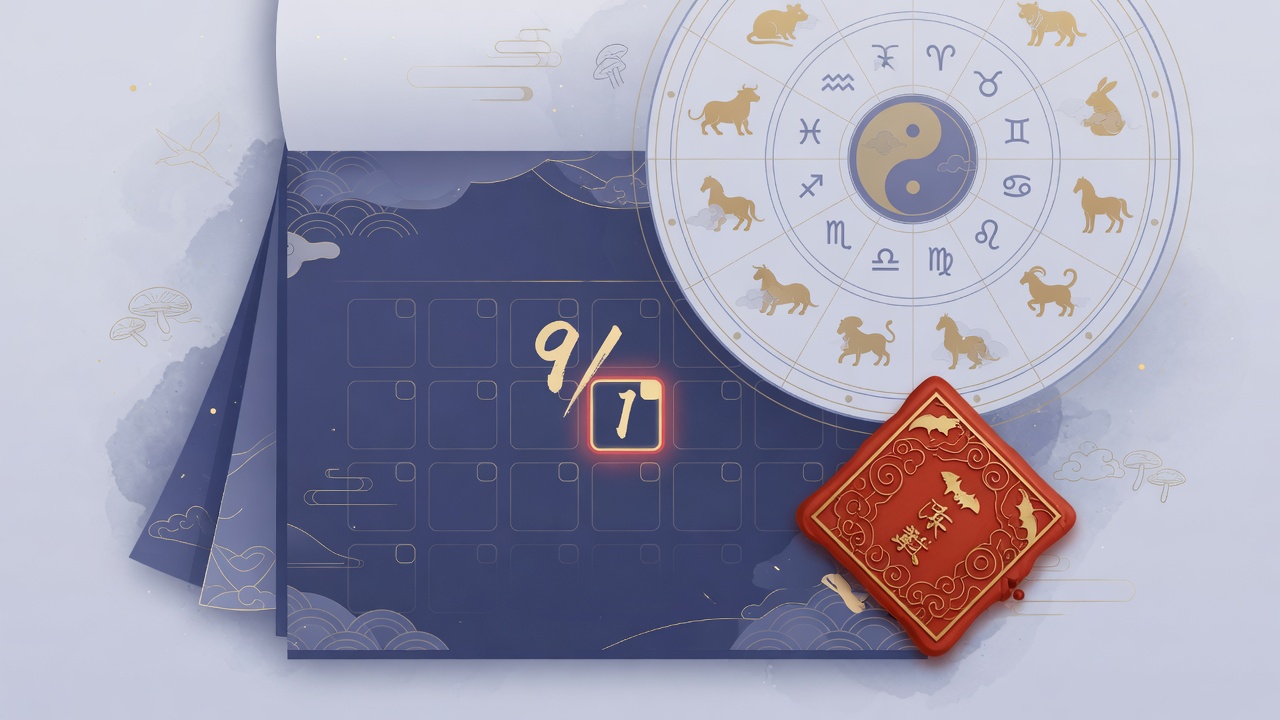
Foundational Clarification: Commemorative Days Are Not Superstition, but Cultural Temporal Coordinates
Common Misconceptions
Many equate date selection with blindly flipping through an almanac, but it is actually a time classification system based on the interaction of the Five Elements.
The claim that commemorative days have nothing to do with personal destiny is also too absolute, because collective memory subtly shapes cultural psychology.
- Misconception 1: Date selection is just picking auspicious days; in reality, it requires comprehensive judgment based on the specific matter and the person involved.
- Misconception 2: A date can determine the success or failure of an event; actually, dates only provide energetic tendencies, not absolute causality.
- Misconception 3: Commemorative days are just national holidays, unrelated to individuals; in fact, they carry collective memory and shape cultural identity.
- Misconception 4: The daily stem-branch is just daily fortune-telling; modern people should focus on the cultural logic rather than the predictive function.
Concept Clarification
The daily stem-branch is the combination of a Heavenly Stem and an Earthly Branch assigned to each day, such as Jiazi day or Yichou day, each with a Five Element attribute and symbolic meaning.
Date selection is the practice of choosing a relatively harmonious time point for a specific matter based on understanding the energy of the stem-branch, a traditional time-management wisdom.
- There are ten Heavenly Stems, representing the energy levels of celestial timing; there are twelve Earthly Branches, corresponding to hidden stems and the Chinese zodiac.
- The Five Elements are Metal, Wood, Water, Fire, and Earth. The combination of stems and branches can deduce the dominant element of the day, which the ancients used to judge suitable activities.
- Commemorative days are time rituals in modern society, sharing a similar logic with how the ancients assigned special meanings to specific stem-branch days.
Historical Origins
As early as the Shang and Zhou dynasties, ancestors used the sexagenary cycle to record days, with complete 60-day tables found on oracle bones.
After the Han Dynasty, date selection became increasingly systematic, with specialized works like the *Xieji Bianfang Shu* integrating stems, branches, Five Elements, and deities into a practical guide.
- The stem-branch day counting is one of the world's longest continuously used day-counting systems, unbroken since the Spring and Autumn period.
- Date selection culture is closely tied to ancient agricultural rhythms and sacrificial rites, embodying the agrarian civilization's alignment with celestial timing.
- Commemorative day traditions exist everywhere, such as Indonesia's Independence Day and National Heroes Day, whose chosen dates themselves contain cultural logic.
Core Insights: The Temporal Philosophy from Daily Stem-Branch to Date Selection
Daily Stem-Branch: Every Day Carries a Five-Element Energy Tag
In the Bazi system, time is divided into year pillar, month pillar, day pillar, and hour pillar, among which the Heavenly Stem of the day pillar is called the Day Master, representing the day's core energy.
For example, on a Jiazi day, the Heavenly Stem Jia belongs to Wood and the Earthly Branch Zi belongs to Water, so the day's energy shows a tendency of Water nourishing Wood, suitable for initiating, education, and cultural activities.
The daily stem-branch constantly changes, forming a 60-day cycle. The ancients understood the ebb and flow of daily energy by observing these combinations.
- The Ten Heavenly Stems each have Yin-Yang and Five Element attributes: Jia-Yi Wood, Bing-Ding Fire, Wu-Ji Earth, Geng-Xin Metal, Ren-Gui Water.
- The Twelve Earthly Branches correspond to the twelve two-hour periods and the zodiac, each hiding one or more Heavenly Stems, forming a complex energy structure.
- Each day's stem-branch is different, forming a complete 60-day cycle, so the daily flow is a constantly changing energy sequence.
- The ancients observed the daily stem-branch to compare it with the Day Master in their own Bazi chart, seeking points of resonance or harmonization.
- Five Element generating cycle: Wood generates Fire, Fire generates Earth, Earth generates Metal, Metal generates Water, Water generates Wood; controlling cycle: Wood controls Earth, Earth controls Water, Water controls Fire, Fire controls Metal, Metal controls Wood.
- Stem-Branch Yin-Yang: Odd numbers are Yang, even numbers are Yin; the Yin-Yang attribute influences the visibility and hardness or softness of energy.
- Hidden Stem system: Each Earthly Branch contains one to three hidden Heavenly Stems, further detailing the day's energy composition.
- Day Master strength: Based on the day's stem-branch within the seasonal framework, one can judge whether the energy is supported, a key reference in date selection.
Date Selection Tradition: How the Ancients Matched Time to Important Matters
Date selection is not random drawing; it involves picking a date whose stem-branch energy coordinates with the Five Element needs of the specific matter.
For example, weddings often use days with generating or Three Harmony combinations for harmony; groundbreaking or construction avoids stems and branches that clash with the sitting orientation.
Public festivals and commemorative days are often chosen on the same stem-branch day as the historical event, to perpetuate the energetic metaphor of that time.
The underlying logic of date selection is the unity of heaven and humanity, believing that human activities should follow the rhythms and tempos of nature.
- Matter classification: Weddings, business openings, relocations, and rituals each have their preferences, requiring integration of the day's stem-branch with the person's Bazi chart.
- Avoiding clashes: When the day's Earthly Branch clashes with the person's zodiac sign (e.g., Zi-Wu clash, Chou-Wei clash), tradition advises caution.
- Three Harmony and Six Harmony: Earthly Branch Three Harmonies (e.g., Shen-Zi-Chen forming Water) and Six Harmonies (e.g., Zi-Chou forming Earth) are often seen as harmonizing energies.
- Solar term influence: Date selection also considers seasonal transitions, especially the key nodes like the Four Beginnings, Two Equinoxes, and Two Solstices.
- Daily flow and annual flow: Date selection considers not only the day but also the year's stem-branch, avoiding clashes between year and day.
- Hour selection: Even when the date is set, the stem-branch of the hour affects the overall energy; traditional date selection often specifies the exact hour.
- Folk customs: Different regions have different date selection sayings and taboos, but the core is always aligning with the Five Element cycles.
- Official application: Ancient courts had dedicated institutions for date selection, like the Imperial Board of Astronomy, showing its importance in social operations.
Commemorative Days and Ritual Sense: Cultural Identity from a Bazi Perspective
When modern people search what day a certain date commemorates, they are essentially seeking a temporal anchor, much like how the ancients emphasized specific stem-branch days in date selection.
Through collective rituals, commemorative days transform abstract time into a tangible cultural narrative, strengthening community belonging, paralleling how Bazi marks time nodes with stem-branch labels.
The Indonesian public's query about September 1 shows a desire to understand the public memory behind a date, a need that drives cultural transmission and life rituals.
In a fast-paced modern society, the ritual sense provided by commemorative days helps individuals find certainty and security in the torrent of time.
- Collective memory: Through repeated rituals, commemorative days turn historical events into symbols of group identity.
- Personal participation: Even without knowing stem-branch, people participate in commemorative activities, gaining psychological comfort and social connection.
- Value of ritual sense: Doing fixed things on fixed dates, similar to performing specific rites on specific days in date selection, can stabilize emotions and enhance a sense of order.
- Cultural identity: Understanding the meaning of dates helps individuals locate themselves in the long river of history, alleviating modern anxieties.
- Rational perspective: Commemorative days and stem-branch are both cultural symbols; they should not be overly mystified but used as tools for understanding time and tradition.
- Inheritance and innovation: Contemporary commemorative days can incorporate traditional time wisdom, such as designing themed activities based on the day's stem-branch characteristics, adding cultural depth.
- Personal application: Looking back at the stem-branch of a personal important day (like a wedding anniversary) adds cultural interest, not a means of predicting fortune.
- Community connection: Commemorative gatherings and rituals strengthen community cohesion, akin to the contemporary transformation of ancient village sacrifices.
Pitfall Avoidance Guide: Rational Approach to Date Energy and Commemorative Days
Points to Note
- Don't confuse: Bazi date selection and Western astrology/horoscopes are different systems; do not mix them up.
- Don't deify: Any date has both auspicious and inauspicious aspects; there is no absolutely perfect day; the key is to match needs.
- Don't copy blindly: Someone else's auspicious day may not suit you; date selection must consider the individual's Bazi or specific matter, not be applied mechanically.
- Don't ignore history: Commemorative days carry real history; respect historical facts and avoid using Bazi to explain historical causality.
- Don't over-consume: Commercialization of festivals can dissolve ritual sense; preserving the cultural core is more important than the form.
- Don't create anxiety: If a day's stem-branch clashes with your zodiac, don't panic; you can adjust plans or mindset.
- Don't neglect the daily: Date selection culture emphasizes aligning with natural rhythms, not opportunistic shortcuts; daily accumulation is more important than a single auspicious day.
- Don't be closed off: Commemorative days and date selection are living cultural transmissions; they should evolve with the times and integrate with modern life needs.
- Don't be superstitious: The daily stem-branch is not fate; personal effort and rational decision-making are always the keys to success.
- Don't ignore regional differences: Indonesian local commemorative days have unique historical backgrounds; do not apply metaphysical interpretations from other countries.
- Don't focus only on form: If commemorative days are just about check-in photos without inner resonance, the ritual sense becomes superficial.
- Don't over-interpret: Bazi culture is a philosophical system, not a scientific law; maintain an open and critical mindset when applying it.
Summary and Reflection
Starting from the trending Indonesian search “What day is September 1?”, we see that the daily stem-branch is a traditional time-energy label, date selection is the ancient wisdom of matching matters to dates, and commemorative days are the collective practice for modern people to find cultural identity and ritual sense.
Understanding these is not about predicting fortune or misfortune, but about learning to place oneself in the long river of time, gaining order and warmth in life through cultural temporal coordinates.