Sepang Circuit Returns to F1: Insights from BaZi on Character, Choice, and Timing
In 2026, the Sepang Circuit will once again host an F1 race, a shift that has garnered widespread attention. Viewed through the lens of BaZi (Eight Characters), the change in venue, team decisions, and even individual performance, all subtly
Opening Introduction
In 2026, the Sepang Circuit will once again host an F1 race, a shift that has garnered widespread attention. Viewed through the lens of BaZi (Eight Characters), the change in venue, team decisions, and even individual performance, all subtly echo the ancient wisdom of right time, right place, and right people. Taking the Sepang F1 as a starting point, this article explores the interconnected relationship of character, choice, and timing within BaZi culture, avoiding definitive predictions and focusing solely on cultural logic.
Clarification: BaZi is Not a Fatalistic Predictor
Common Misconceptions
- Misconception One: BaZi can predict specific race results or accidents. BaZi analyzes trends and inner nature, not fixed events. It reveals the energy tendencies of a person or a team, but it will not specify the outcome of a particular race.
- Misconception Two: BaZi is synonymous with fatalism. The Destiny component in BaZi is an innate framework of character and potential, while Luck represents the rhythm of time. A person's choices and environment can significantly modify the final result.
- Misconception Three: People with the same BaZi chart have the same fate. Even with identical Four Pillars, differences in birthplace, family background, and life encounters will lead to vastly different lives. BaZi is an analytical tool, not a verdict.
- Misconception Four: BaZi only applies to individuals, not organizations or events. In practice, a team's founding date or an event's opening time can be seen as its 'birth moment' to analyze its qi characteristics, but this is limited to cultural interpretation.
- Misconception Five: Learning BaZi allows for perfect timing and guaranteed success. BaZi provides a probabilistic reference, not an absolute guarantee. Real-world decisions must be combined with technology, data, and rational judgment.
Core Insights: How BaZi Interprets Character, Choice, and Timing
1. The Character Code in BaZi: Day Master and Ten Gods
The core of a BaZi chart is the Day Master, the Heavenly Stem of the birth day, representing the individual. The Day Master's Five Element attribute (Metal, Wood, Water, Fire, Earth) determines their fundamental temperament. For instance, a Yang Wood person often has a pioneering spirit, Yang Fire is passionate and outgoing, and Yang Metal is resolute and decisive.
Surrounding the Day Master, the other seven characters form the Ten Gods relationships, such as Direct Officer, Seven Killings, Direct Resource, Indirect Resource, Eating God, Hurting Officer, Friend, and Rob Wealth. Each pair corresponds to specific psychological patterns and behavioral tendencies.
Eating God and Hurting Officer govern creativity and expression, which in F1 can be likened to breakthrough thinking in car design or a driver's adaptive reflexes on the track. Direct Officer and Seven Killings relate to discipline, rules, and competitive pressure, much like the stringent standards and championship ambitions in team management.
Friend and Rob Wealth represent peers, cooperation, and competition, reflecting internal teamwork and external rivalry. A driver with overly strong Friend and Rob Wealth influences may have exceptional individual ability but be prone to working alone; if Officer and Killing stars are powerful, they excel at performing within the rules.
These character traits are not static but provide an innate tendency. Postnatal training, education, and environment can strengthen or balance certain energies, which is the application of BaZi's 'Regulating' concept.
- Day Master Five Elements: Yang Wood (enterprising), Yin Wood (resilient); Yang Fire (fervent), Yin Fire (focused); Yang Earth (steady), Yin Earth (receptive); Yang Metal (sharp), Yin Metal (meticulous); Yang Water (wise), Yin Water (profound).
- Ten Gods Mapping: Eating God and Hurting Officer represent talent; Officer and Killing represent pressure and responsibility; Resource stars represent learning and protection; Wealth stars represent resources and goals; Friend and Rob Wealth represent relationships and competition.
- Character Combination: A BaZi chart is a synthesis of Ten Gods. For example, someone whose Eating God produces Wealth is good at monetizing ideas, while someone with Officer and Resource in mutual generation is steady, reliable, and good at planning.
- Inspiration for Racing: A driver needs the agility of Eating God, the courage of Seven Killings, and the discipline of Direct Officer; an engineer needs the learning ability of the Resource star and the creativity of Eating God; a manager needs a balance of Wealth, Officer, and Resource.
2. The Rhythm of the Times: Luck Pillars, Annual Cycles, and Windows of Choice
In BaZi, 'time' is not clock time but a cyclical system composed of Luck Pillars and Annual Cycles. A Luck Pillar spans ten years, derived from the month pillar, and represents the energy theme of different life stages.
An Annual Cycle is the Heavenly Stem and Earthly Branch for each year, acting as a catalyst from the external environment. When an Annual Cycle interacts with the Luck Pillar or natal chart through clashes, punishments, harms, or combinations, it triggers changes in corresponding life areas.
Taking 2026 as an example, its stem-branch is Bing Wu (Yang Fire Horse). The Heavenly Stem is Yang Fire, and the Earthly Branch is the Horse (Fire), creating a very potent Fire energy. For someone whose BaZi favors Fire, this year may bring a sense of momentum and opportunity; whereas for someone averse to Fire, it might bring restlessness and exhaustion.
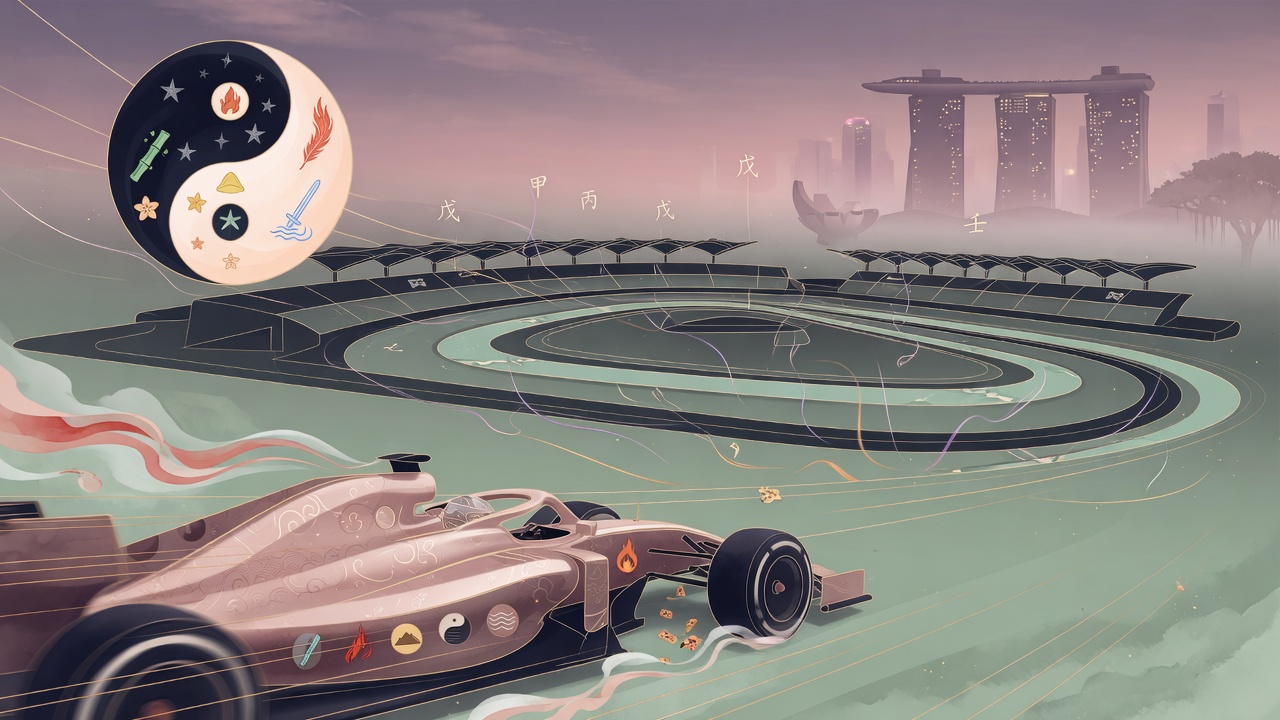
The timing of Sepang's return to F1 falls precisely in a Bing Wu year. Fire governs communication, speed, and passion, resonating strongly with the imagery of motorsport. This isn't a mystical force, but a traditional cultural concept of correspondence between heaven and humanity—the qi field of a specific year may be more conducive to certain activities.
But BaZi never advocates passive waiting. Luck Pillars and Annual Cycles merely provide different 'weather' conditions; whether to dress for it or travel depends on one's personal choice. Just as a team adjusts a car's setup based on track characteristics, individuals can adjust their strategies according to the times.
- Luck Pillar Shifts: A change every ten years often accompanies major life transitions, like a career change or relocation.
- Annual Cycle Manifestations: The Heavenly Stem governs external appearances, and the Earthly Branch governs internal causes. For example, a Wealth star appearing in the Heavenly Stem might signal a financial opportunity; an Earthly Branch clashing with the Day Pillar indicates significant inner disturbance.
- Combinations, Clashes, Punishments, and Harms: Combinations signify merging and cooperation; clashes signify upheaval and change; punishments signify entanglements and pressure; harms signify hidden damage and misunderstandings. These are the basic keys to analyzing an annual cycle's influence.
- Inspiration from the Bing Wu Year: A year of strong Fire is good for launching new projects and increasing visibility, but one must pay attention to pacing to avoid impulsiveness and rashness due to excessive Fire.
- Choice Windows: Years corresponding to a chart's 'Useful God' are often more advantageous for leveraging one's strengths; but a 'Taboo God' year is by no means a dead end. Adjustments in direction, industry, and behavior can still help navigate toward the favorable.
3. Geographical Advantage and Relocation: Viewing Sepang's Return Through the 'Traveling Horse' and 'Favorable Location'
The Sepang Circuit is located in Malaysia, geographically close to Singapore. In BaZi theory, direction is closely linked to the Five Elements: East is Wood, South is Fire, West is Metal, North is Water, and Centre is Earth.
When the Bahrain Grand Prix is moved to Sepang, it is like an event 'relocating' to a new direction. The Traveling Horse Star in BaZi (Tiger, Monkey, Snake, Pig) represents change, travel, and long journeys. Such moves often occur when an Annual Cycle activates the Traveling Horse.
If we consider an event's opening time as a 'BaZi chart', then in 2026, the Bing Wu year's Fire Horse signifying the South resonates with Sepang's southern locale, creating a directional resonance. This culturally strengthens the 'geographical advantage' factor for the event.
For an individual, choosing a favorable direction is a common BaZi method. For example, someone whose BaZi favors Wood might develop in the East, and someone favoring Fire may thrive in the South. This is not superstition, but using environmental Five Element energy to balance one's own qi field.
Similarly, when F1 teams choose testing locations or establish headquarters, they implicitly consider 'Five Element' factors like climate and track characteristics. The high-temperature Sepang track places high demands on tires and engine cooling, much like the BaZi balancing rule that strong Fire needs Water to regulate.
Singapore, as a neighboring financial and tech hub, has Metal and Water attributes (finance is Metal, the ocean is Water), forming a complement to Sepang's Fire attribute. This inter-regional flow of the Five Elements provides a modern, vivid footnote to the concept of 'environmental choice' in BaZi culture.
- Directional Five Elements: East (Wood, growth), South (Fire, passion), West (Metal, decisiveness), North (Water, wisdom), Centre (Earth, inclusiveness).
- Traveling Horse Star: Yin (Tiger), Shen (Monkey), Si (Snake), Hai (Pig) are the four rebirth portals, signifying movement. Encountering them in a Luck Pillar or Annual Cycle often means more travel, relocation, or industry changes.
- Sepang's Directional Significance: Located in Southeast Asia, it is a Fire region, and the amplified Fire energy of the Bing Wu year may magnify the event's visibility and dynamism.
- Favorable Location: Choosing a residence or work direction based on one's BaZi needs is a traditional 'luck adjustment' method, essentially using environmental Five Elements to supplement one's own energy.
- Five Element Balance in F1: A hot track (Fire) needs an efficient cooling system (Water); high speeds (Metal) require stable downforce (Earth). These engineering principles share similarities with the generating and overcoming cycles in Five Element theory.
Practical Guide: A Rational View of BaZi and Current Events
Key Notes
- Do not use BaZi to predict race results. Any attempt to use metaphysics to infer specific outcomes, rankings, or accidents exceeds BaZi's cultural function and easily falls into superstition.
- Do not casually 'cast a chart' for public figures. Analyzing someone's BaZi without consent violates their privacy and can lead to legal and ethical issues. This article is purely cultural science; it does not involve any real individuals.
- Avoid making 'absolute pronouncements'. BaZi interpretation should remain open and probabilistic, using phrases like 'tendency,' 'possible,' or 'likely,' rather than definitive statements of fortune or misfortune.
- Distinguish between culture and science. BaZi is part of traditional Chinese humanistic wisdom. Its value lies in providing a cognitive framework, not in replacing modern scientific decision-making. Team strategy must still rely on data and engineering.
- Be cautious with claims of an 'unfavorable year'. Even if an Annual Cycle clashes with one's chart, disaster isn't inevitable. It is more a reminder to be prudent and strengthen preparations.
- Do not treat BaZi as an excuse to avoid effort. A chart showing 'wealth luck' doesn't mean wealth without labor; showing 'career luck' doesn't mean waiting for a promotion. Everything remains based on practical effort.
- Respect individual differences. People with similar chart types can have vastly different life paths due to environment, education, and personal choices. Never use BaZi to label people.
- Studying BaZi requires a systematic, in-depth approach. Blindly changing names or altering feng shui based on a superficial understanding of 'which element is missing' often backfires. Seek reliable teachers or study the classics.
- Do not over-mystify event changes. Sepang's return to F1 is a result of commercial and sporting decisions. A BaZi analysis offers only a culturally interesting perspective, not a causal explanation.
- Stay rational and enjoy the race. BaZi culture can add cultural depth to watching a race, but the real excitement remains on the track.
Summary and Recap
BaZi is not a prophecy of fate but a set of traditional wisdom for understanding oneself, navigating the times, and optimizing choices. Sepang Circuit's return to F1 is like a 'Traveling Horse' shift in life, reminding us to judge the situation and leverage the environment. Against the backdrop of the Bing Wu year's Fire luck, may every reader find their own 'Favorable Location' and, amidst the speed and passion, maintain both rationality and composure.