The Core Logic of Plum Blossom Divination: From a Stirring Thought to the Number in All Things
Plum Blossom Divination emphasizes observing phenomena to extract symbols and using numbers to form hexagrams. The process does not rely on complex tools, but transforms momentary impressions of time, numbers, and external responses into hexa
Opening Guide
The essence of Plum Blossom Divination is transforming the very instant a thought arises into a calculable numerical model. It does not rely on tossing coins or analyzing a birth chart, but extracts hexagrams directly from time, sounds, numbers, and observed objects.
Mastering the basic logic of hexagram casting is like obtaining the key to unlocking the door of Plum Blossom Divination. This article focuses on the three essential elements of casting and the Subject-Object positioning to help you build a clear logic for hexagram creation.
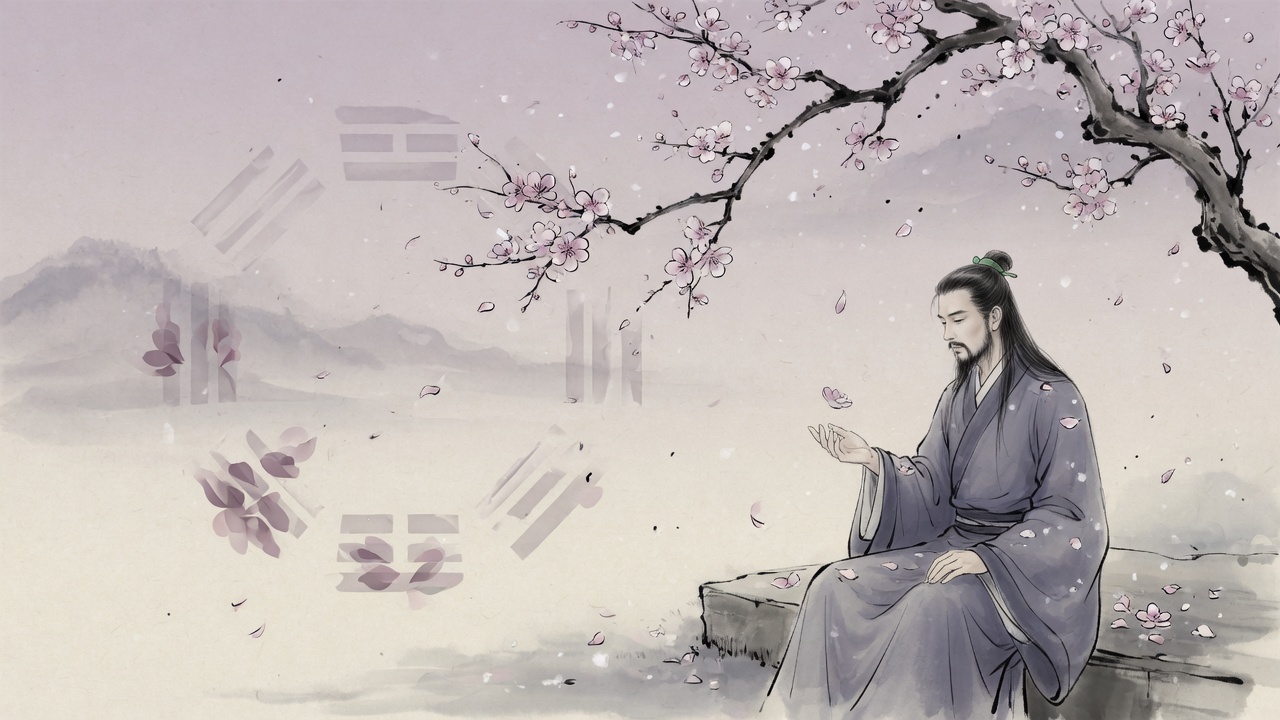
Basic Clarification: Casting is Not Random, but a Responsive Connection
Common Misconceptions
- Misconception 1: Thinking that casually mentioning any three numbers leads to an accurate hexagram. In reality, the core of casting lies in mental focus and the capture of external responses; the numbers are merely carriers of intent. A scattered mind yields a scattered hexagram; a sincere heart yields true symbols.
- Misconception 2: Treating hexagram casting as a pure game of probability. Plum Blossom Divination stresses “Do not divine if nothing stirs you” . Without a genuine question or inner trigger, forcing a divination often yields inaccurate readings and only adds confusion.
- Misconception 3: Believing that more complex casting methods are more accurate. In fact, the greatest truth is simplicity. Methods like time-based casting or object-number casting, when aligned with the current mental intent, most truthfully reflect the workings of fate.
The Underlying Logic of Hexagram Casting
Plum Blossom Divination follows the transformative chain of “Symbol — Number — Hexagram.” First, an impression creates a Symbol (like seeing a flower petal fall). Then, a corresponding Number is derived (the number of petals, a directional number). Finally, the number is used to calculate the Trigram and the Hexagram.
The entire process emphasizes “understanding the symbol through the number.” The number is not a cold abstraction but a bridge connecting the mind's intent to the hexagram image. Therefore, the level of inner focus during casting directly determines the clarity of the hexagram.
Core Essentials: The Three Steps of Casting and the Subject-Object Nexus
Step 1: Deriving Numbers — Grounding Mental Intent in Digits
Deriving numbers is the first critical step and the most inspired part of the process. The three common methods are: Time-based derivation, External response derivation, and Active number stating. Regardless of the method, you must capture the numbers the instant the thought first arises. The longer you hesitate, the more distorted the numbers become.
- Time-based Casting Method: Use the current lunar month, day, and hour as three independent numbers. For example, the 5th hour (Chen) on the 5th day of the 8th lunar month yields the numbers 8, 5, 5. The month is taken directly, the day is taken directly, and the hour corresponds to the earthly branch sequence number. This is the most stable method, ideal when no special external responses are present.
- External Response Casting Method: Derive numbers from suddenly perceived external stimuli, like the number of knocks on a door, a flock of birds flying by, or a number casually spoken by another person. This method relies on “the first thought” ; avoid pondering or second-guessing. For example, if a person coughs three times during a conversation, immediately use 3 as the number for the upper trigram.
- Stated Number Casting Method: Ask the querent to casually state three numbers, or silently think of three numbers yourself. When stating numbers, the mind must be free of distracting thoughts. Speak the first numbers that emerge without deliberately choosing “auspicious” digits. Typically, the first number forms the upper trigram, the second the lower trigram, and the third determines the moving line.
- Key to Deriving Numbers: Regardless of the method, the three numbers must be determined in one go and cannot be changed. If a number exceeds 8, divide by 8 and take the remainder (a remainder of 0 counts as 8). If the moving line number exceeds 6, divide by 6 and take the remainder (a remainder of 0 counts as 6). This is the iron rule: “For trigrams, divide by eight; for lines, divide by six.”
Step 2: Determining the Hexagram — From Numbers to Trigrams to a Full Hexagram
With the three numbers obtained, a complete hexagram can be mapped. The upper trigram is determined by the first number, the lower trigram by the second number, and the moving line by the third. The correspondence between numbers and trigrams strictly follows the sequence of the Early Heaven Bagua: Qian 1, Dui 2, Li 3, Zhen 4, Xun 5, Kan 6, Gen 7, Kun 8.
For example, the numbers 3, 5, 4 are taken. 3 corresponds to Li (upper trigram) and 5 to Xun (lower trigram), forming the Wind Over Fire hexagram (Jia Ren). The moving line is the 4th line (counting from bottom to top). This line changes (Yin to Yang or vice versa), generating the derivative hexagram.
- Original Hexagram: Formed directly by the upper and lower trigrams, this represents the current state. As in the example above, the Jia Ren hexagram.
- Mutual Hexagram: Extracted from the middle four lines of the original hexagram. Lines 2, 3, and 4 form the lower mutual trigram, and lines 3, 4, and 5 form the upper mutual trigram. The mutual hexagram reveals the intermediate process of an event's development, offering a unique multi-dimensional perspective characteristic of Plum Blossom Divination.
- Derivative Hexagram: The new hexagram formed after the moving line changes, representing the final outcome. The original hexagram is the Subject, the derivative hexagram is the Object. One is static, the other dynamic, and fortune or misfortune becomes apparent.
- Reverse and Inverted Hexagrams: These are advanced techniques. The Reverse hexagram is formed by changing all lines to their opposites, and the Inverted hexagram by flipping the trigrams upside down. They are used for multi-angle verification. For beginners, mastering the Original, Mutual, and Derivative hexagrams is sufficient.
Step 3: Distinguishing Subject and Object — Anchoring the Host and Guest for Clear Judgment
Casting is only the beginning; the core of interpretation lies in the generating and overcoming cycles of the Subject and Object. The Subject hexagram represents the querent or the main body of the matter. The Object hexagram represents the other party, the environment, or the object of the matter. The trigram containing the moving line is the Object hexagram, and the static trigram is the Subject hexagram.
If both upper and lower trigrams have moving lines (e.g., with identical numbers triggering line movement), the trigram with fewer moving lines is the Subject. If both have the same number of moving lines, the upper trigram is the Subject, and the lower trigram is the Object. Once Subject and Object are determined, fortune can be judged based on their Five Element interactions.
- General Rule for Subject-Object Interactions: Subject generating Object means energy drainage (minor misfortune). Object generating Subject signifies great fortune. Subject overcoming Object is moderate fortune but requires effort. Object overcoming Subject signifies major misfortune and difficult outcomes.
- Relationship Between Subject/Object and the Derivative Hexagram: The Subject and Object in the original hexagram indicate the current state, while their roles in the derivative hexagram reveal the final result. For instance, if the Object overcomes the Subject in the original hexagram, but the Subject generates the Object in the derivative hexagram, the situation is initially difficult but eases later, though a cost must still be paid.
- External Responses Must Not Be Ignored: During interpretation, the external response at the moment of casting (like hearing sudden laughter or seeing a red object) directly overlays onto the Subject-Object interaction. Sometimes, it can even overturn the hexagram's indication of favorable or unfavorable, and must be carefully noted.
Pitfall Avoidance Guide: The Twelve-Word Mantra for Effective Casting
Important Notes
- Do not cast with a distracted mind: Before casting, calm the mind for 3 seconds, clearing away stray thoughts and holding only one clear question. If the mind is scattered, it is better not to cast. Otherwise, the hexagram will be chaotic and interpretation futile.
- Do not divine twice for one matter: Repeatedly casting hexagrams for the same question within a short time is a major taboo. The first hexagram has already provided the answer. Asking again shows a lack of trust and only yields confusing information. Wait at least a two-hour period, or until a clear change in the situation occurs.
- Do not divine out of jest: Do not use Plum Blossom Divination for joking, testing, or challenging a diviner. If the heart is not sincere, the hexagram will not respond. Forcing an interpretation only damages one’s reverence for the Yi Jing.
- Record the number immediately; do not look back and change it: Once a number emerges in the mind, record it instantly. Do not change it because you think it is a “bad number.” The first thought is the true working of fate. A modified number is a human fabrication, drastically reducing the accuracy of the interpretation.
- Do not interpret without clarifying Subject and Object: After casting, always clearly identify the Subject and Object hexagrams first. This is especially crucial when the upper and lower trigram numbers are the same or when moving lines are distributed atypically. Carefully verify the rules. If the Subject and Object are misidentified, the entire reading fails.
- Prioritize external responses over theory: During interpretation, if the hexagram shows great fortune but a strongly ominous external response occurs at the moment of casting (like an object shattering), the external response takes priority. Plum Blossom Divination emphasizes symbolism, and an external response is the most direct symbol.
- Beginners should favor simplicity over complexity: When first practicing, use only the Subject-Object interactions between the original and derivative hexagrams. There is no need to force the use of mutual, reverse, or inverted hexagrams. Dive deeper layer by layer only once you are proficient; otherwise, it's easy to get lost in the hexagram symbols and miss the main point.
Summary and Review
The basic logic of casting a hexagram in Plum Blossom Divination tightly revolves around four links: “Thought — Number — Hexagram — Subject/Object.” Deriving numbers must be swift and focused. Determining the hexagram requires strict adherence to the Early Heaven number sequence. Distinguishing Subject and Object requires clearly separating the host from the guest. Bear in mind the principles: Do not divine if nothing stirs you, divine only once per matter, and prioritize external responses. In doing so, every hexagram cast becomes a clear dialogue with the universe.
Ultimately, casting is only the method; cultivating the mind is the true foundation. The efficacy of a hexagram lies not in technique, but in the heart.