From Palmeiras vs Santos: A Traditional Cultural Interpretation of Character, Choice, and Timing Through Bazi
In a recent Brazilian football spotlight, Palmeiras and Santos are set to clash, with reports mentioning that Santos may rest some star players—Neymar is absent, and Gabigol becomes an option. This hot topic mirrors the ancient wisdom of *character
Opening Introduction
The Palmeiras vs Santos derby has drawn attention, with media reports highlighting star player rotations and squad choices.
Behind such team decisions, there is actually a resonance with the Bazi cultural approach to character analysis, favorable element selection, and timing judgment.
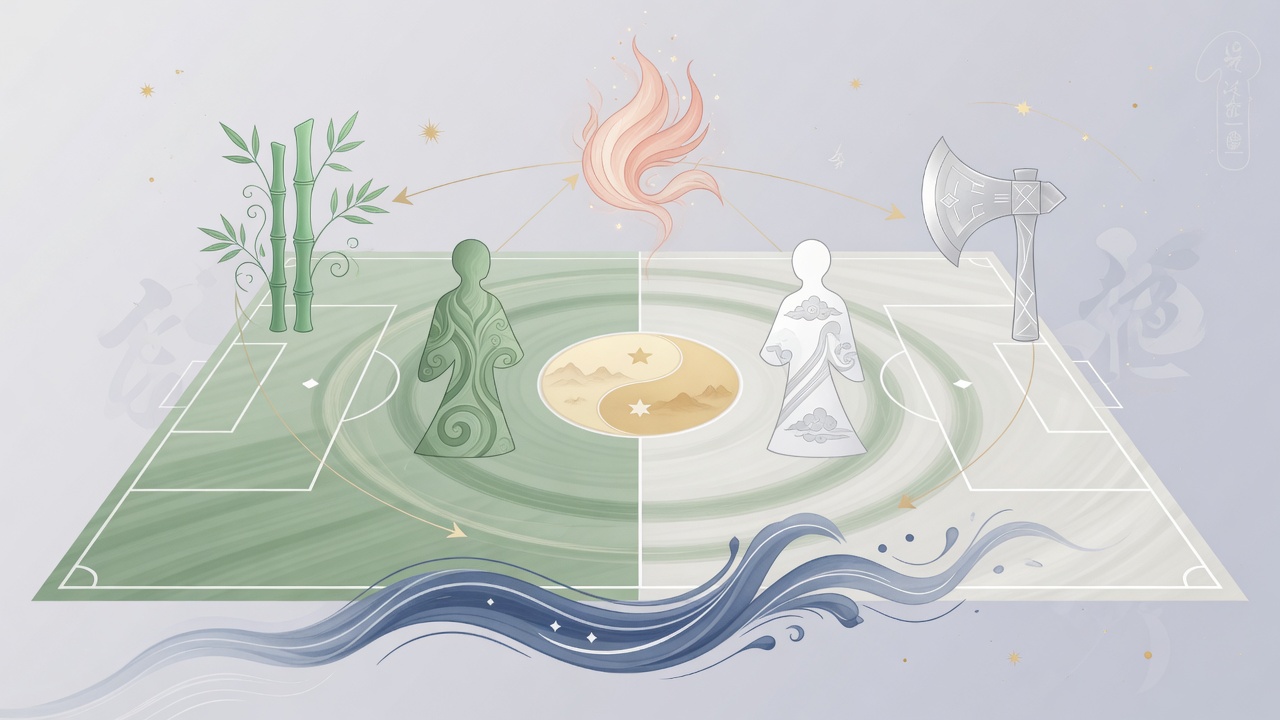
The Five Elements, Yong Shen (Favorable Element), and Da Yun (Major Luck Cycles) in Bazi culture correspond to player characteristics, squad trade-offs, and form cycles in the football world.
Basic Clarifications
Common Misconceptions
Bazi is not fatalistic prophecy, nor does it directly correspond to match results.
- Misconception One: Believing Bazi can calculate the exact score. In reality, Bazi only provides an observational framework for personality tendencies and environmental interaction.
- Misconception Two: Confusing an individual athlete's personal fortune with team performance. Bazi looks at the individual; team results are determined by countless variables together.
- Misconception Three: Using the private birth data of trending figures to make speculations. This article never involves any real birth information, only makes cultural analogies.
- Misconception Four: Simply equating the Five Elements with on-field positions. For example, saying forwards belong to Fire, defenders to Earth is merely a metaphor, not a fixed rule.
- Misconception Five: Assuming that Bazi analysis must include the birth hour. In fact, using just the year, month, and day can reveal broad directions, but a more precise analysis requires the complete Bazi chart.
Core Points
Character and the Five Elements: The Day Master Determines the Fundamental Tone
In Bazi, the Day Master—the heavenly stem of the birth day—represents a person's core self.
Different Day Master elements bring different character tendencies: Wood governs benevolence, with a sense of growth and pioneering; Fire governs propriety, passionate and explosive; Earth governs trustworthiness, steady and capable of bearing; Metal governs righteousness, decisive and rule-abiding; Water governs wisdom, flexible and adaptable.
This classification is not about labeling people, but about describing a kind of innate temperament. For example, on a football pitch, some are good at charging forward, some at organizing, forming an interesting parallel with the Five Elements traits.
When the Santos coach considers rotations before the derby, he is also observing which players' current form is more suitable for a specific opponent.
Form fluctuations are related to the annual luck cycle (Liu Nian) and its Five Elements interactions, but this is by no means the only factor.
We can regard a player's technical characteristics as an expression of their 'Day Master,' but we must never directly equate the Five Elements with football skills.
Reports on Neymar's absence and Gabigol as an option reflect the coach's weighing of different styles.
From a Bazi perspective, this is exactly the mindset of allocating resources based on the balance of Five Elements in the team.
A derby battle in football often requires players of different character types to perform their duties, which closely parallels the Bazi emphasis on harmonizing the Five Elements.
- Wood nature: Good at creating opportunities, like a winger making breakthroughs, often showing initiative.
- Fire nature: Strong explosiveness, sharp in front of goal, akin to a striker's instinct.
- Earth nature: Solid in defense, good positional awareness, suitable for defensive midfield or center-back.
- Metal nature: Highly disciplined, strong execution, suited for systematic play.
- Water nature: Highly adaptable, capable of playing multiple positions, like a versatile midfielder.
- Day Master strength: A strong Day Master can shoulder great responsibilities; a weak Day Master is better off leveraging the team's momentum.
- Five Elements flow: A team needs different Five Elements to complement each other, avoiding one-sidedness.
- No character is superior or inferior: The key is being placed in the right position to maximize strengths.
- Bi Jian and Jie Cai (Companions and Competitors): Represent peer competition, similar to internal squad competition, which promotes growth.
Choice and Yong Shen: The Wisdom of Trade-offs Behind Rotations
Bazi analysis emphasizes the Yong Shen (Favorable Element), which is the most needed Five Elements energy in the overall chart.
When a certain element is too strong, it needs to be controlled, drained, or exhausted; when too weak, it needs to be generated or supported.
This is similar to team lineup decisions: when attacking firepower is excessive, defensive solidity may be needed; when midfield control is lacking, an organizing player is required.
Facing Palmeiras, Santos, according to media reports, may rest several key players, making Gabigol and others options.
This kind of squad rotation is like adjusting the Five Elements ratio in a Bazi chart, aiming to achieve an overall balance.
But the Yong Shen in Bazi is not fixed; it changes with the Major Luck Cycles (Da Yun) and Annual Luck (Liu Nian).
Similarly, a coach's personnel strategy dynamically adjusts based on opponents, match schedules, and player conditions.
Therefore, labeling a player as an 'absolute core' or 'marginal figure' is not as insightful as observing their suitability under specific timing and circumstances.
If Neymar is absent and Gabigol replaces him, it reflects the coach's weighing of different traits, such as Fire or Metal qualities.
All of this aligns with the logic of Yong Shen: it's not about choosing the strongest, but the most needed.
Every decision a coach makes involves trade-offs: speed versus control, experience versus vitality. This is highly similar to the mindset of selecting the Yong Shen in Bazi.
- Core of Yong Shen: The Bazi 'cure'; supplement what is lacking, drain what is excessive.
- Handling excess: For example, excess Wood suffocating Fire—use Metal to prune, or Fire to bring clarity.
- Handling deficiency: For example, weak Earth being controlled by Wood—use Fire to generate Earth, or Metal to control the Wood.
- Squad balance: A luxurious attacking line may sacrifice defense; a strong midfield benefits the forwards.
- Dynamic adjustment: Major Luck Cycles change every ten years, Annual Luck influences year by year, and the Yong Shen is subtly fine-tuned accordingly.
- Team Yong Shen: A team also needs a 'Yong Shen,' which is the most critical role type.
- Case analogy: When lacking a playmaker, introducing a technical midfielder is analogous to supplementing Water or Metal.
- No assertions: Specific personnel choices are professional decisions; Bazi merely provides a framework for understanding.
Timing and Cycles: State Fluctuations in Major Luck and Annual Luck
The Major Luck Cycle (Da Yun) in Bazi rotates every ten years, representing the main theme of different life stages.
The Annual Luck (Liu Nian) changes every year, interacting with the Major Luck and the original chart to form the annual fortune keynote.
An athlete's career has similar cycles: peaks, valleys, and recovery periods from injuries.
Looking at the historical encounters between Palmeiras and Santos, the strengths of the two sides are not static; they fluctuate with squad changes and era backgrounds.
This is like the two teams being in different Major Luck Cycle stages, making the outcome of their clash difficult to simply predict.
The resting of star players in the trending reports can also be seen as adapting to the rhythm of the Annual Luck.
Bazi culture emphasizes going with the flow: exert force when it's time to exert, rest when it's time to rest.
But Bazi never encourages fatalism; it reminds us to pay attention to timing and environment.
On a football pitch, the course of a match is influenced by many factors: tactics, on-the-spot performance, referees, weather, etc.
Attributing everything to 'destiny' is neither factual nor in line with the rational core of Bazi culture.
We can only treat Bazi as a mirror, observing the interaction between character and timing, rather than predicting specific events.
Fans in Malaysia can also use this perspective to view derby results and player rotations more calmly.
Malaysia, located in the tropics with year-round heat and humidity, tends to have a stronger presence of Fire and Earth in the Five Elements. Local fans may find it easier to understand how environment affects form.
- Major Luck (Da Yun): A ten-year cycle, dominating life direction and career type.
- Annual Luck (Liu Nian): The yearly energy, bringing specific events and emotional fluctuations.
- Original Chart (Yuan Ju): The foundational configuration determined by birth time, akin to a team's youth academy system.
- Three Combinations and Six Combinations: Interactions between Annual Luck, Major Luck, and the Original Chart, similar to positive synergies between match schedules and form.
- Clashes, Punishments, Harms, and Restrictions: Represent pressure and challenges, but are not necessarily negative; they often stimulate potential.
- Go with the flow and adjust: Resting a player in poor form aligns with the body's cycle, similar to 'Tiao Hou' (climate adjustment) in Bazi.
- Timing makes the person: Changes in football styles across different eras also affect the space for players to perform.
- Rational perspective: Any cycle analysis cannot replace professional training and on-the-spot decision-making.
Pitfall Avoidance Guide
Points to Note
- Do not make win/loss predictions: Bazi cannot determine match results; any so-called 'calculated score' is pseudoscience.
- Do not intrude on personal privacy: Do not discuss any player's real birth data; only make cultural-level analogies.
- Do not mechanically equate the Five Elements: The metaphor of forwards being Fire and defenders being Earth is just for easy understanding—do not rigidly apply it.
- Do not overlook professional factors: Rotations and tactics are primarily based on professional football considerations; Bazi only offers an alternative perspective.
- Do not believe in fatalism: Bazi emphasizes knowing destiny and using it; it is an analytical tool, not an excuse for passive waiting.
- Do not confuse cultural differences: In Malaysia's multicultural context, Bazi is just one thinking model; an open attitude should be maintained.
- Do not exaggerate cyclicity: Major Luck and Annual Luck trends do not dictate inevitable individual experiences, especially not for specific matches.
- View trending topics rationally: Combining hot topics with culture is for popular science; do not over-interpret it as metaphysical prediction.
- Avoid binary opposition: In Bazi, good and bad fortune are not absolute, but relative to specific goals.
Summary and Recap
The derby news of Palmeiras vs Santos reflects the threefold observation of character, choice, and timing in Bazi culture.
Core conclusion: Bazi is not a prophecy of victory or defeat, but a traditional wisdom that helps us understand the interaction between individual traits and the environment.
Proceeding from cultural popular science, we neither deify Bazi nor belittle trending topics; we only make rational connections.