Night Riding to Wuling: How the Yi Ma Star, Indirect Seal, and Eating God in BaZi Interpret Young People's Craving for Adventure
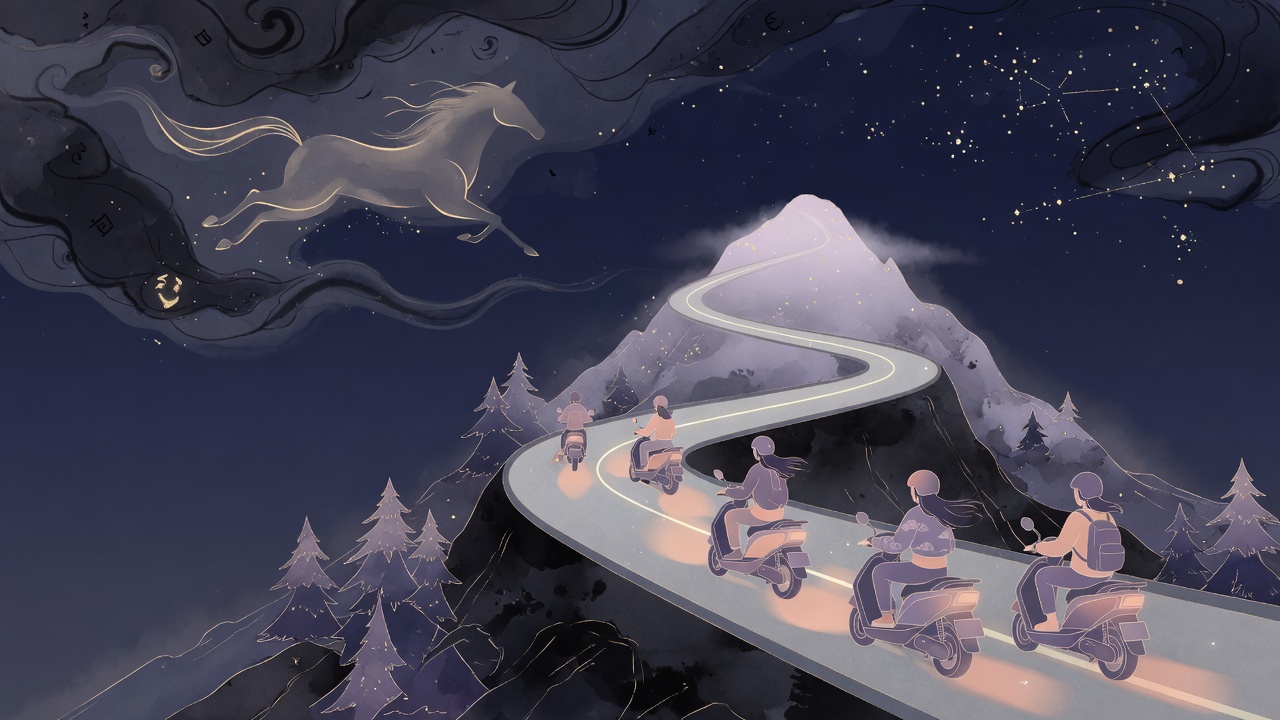
On the late-night Provincial Highway 14A, the roar of engines cuts through the silence as a group of young people head toward Wuling. This "night ride to Wuling" trend is more than just a social media check-in behavior; it deeply reflects con
Opening Introduction
In Taiwan, Wuling on Hehuan Mountain (3,275 meters above sea level) is the highest point reachable by road and has become a holy site for young people's "night rides" in recent years. They set off late at night, braving the cold wind, just to catch a glimpse of the dazzling starry sky or the sea of clouds at dawn. Behind this seemingly high-risk collective action lies a strong need for temporary escape from everyday frameworks and peer recognition.
BaZi metaphysics is not superstition, but an ancient tool for personality classification and kinetic energy analysis. Its Ten Gods—especially the Yi Ma Star, Indirect Seal, and Eating God—provide us with a cultural prism to rationally interpret this spontaneous late-night impulse to just get up and go.
Basic Clarification: BaZi Reveals Personality Dynamics, Not Fatalistic Verdicts
Common Misconceptions
- Misconception 1: BaZi equals fortune-telling that determines a person's fortune or misfortune. In fact, the Ten Gods system in BaZi is more like a classification of personality archetypes, interpreting innate character tendencies and behavioral drive patterns through the relationship between the Day Master and other stems and branches, without involving predictions of specific events.
- Misconception 2: The Yi Ma Star means a life of toil and constant rushing around. In modern contexts, Yi Ma reflects adaptability and exploratory desire toward environmental changes. It is a dynamic psychological energy and does not carry labels of good or bad fortune.
- Misconception 3: The Indirect Seal and Eating God contradict each other and cannot appear in the same behavior. In reality, the human mind is complex. A late-night solitary adventure may be driven simultaneously by the isolated thinking of the Indirect Seal and the pleasure-seeking expression of the Eating God. BaZi is precisely capable of accommodating such unity of opposites.
Core Points: How Yi Ma, Indirect Seal, and Eating God Weave the Soul Map of the "Night Ride"
1. Yi Ma Star: The Compass Needle That Always Points Toward the Distance
In BaZi, when checking the other earthly branches against the year branch or day branch, seeing Yin, Shen, Si, or Hai indicates the Yi Ma Star. These four earthly branches correspond to the positions of growth and symbolize the initial birth of things and the vigorous rise of kinetic energy. People with Yi Ma in their charts often possess a restless nature and an unconscious longing for movement, speed, and distant places.
Not every member of the "night ride to Wuling" necessarily has Yi Ma in their chart, but the collective act of setting out is essentially an external manifestation of Yi Ma energy. Departing late at night and striving to break free from daytime order is a form of rebellion against stillness. The ancients said, "Where the Horse Star moves, there is much activity." This movement is not just physical busyness, but also a spiritual yearning for freedom that refuses to be co-opted.
- Yi Ma and nighttime travel: Ancient texts say, "When the horse gallops, wind arises." When the Horse Star encounters water (such as night dew, clouds, and mist), it forms a flowing momentum of water nurturing wood, symbolizing the drive to explore the unknown in dark environments.
- Focus within motion: Riders must maintain intense concentration on winding mountain roads, which perfectly echoes the Yi Ma Star's characteristic of "finding stability within movement"—when the body moves at high speed, one paradoxically attains a pure state of flow.
- Collective Yi Ma: An individual's Yi Ma may lead to solitary wandering, but social media check-in culture gathers individual Yi Ma into a form of group pilgrimage, where people confirm each other's existence and give resonance to the journey.
2. Indirect Seal: The Unique Channel of Late-Night Thinking
The Indirect Seal is the heavenly stem that gives birth to the Day Master with the same yin-yang polarity, such as Jia Wood encountering Ren Water. It represents unconventional wisdom, late-night inspiration, and solitary contemplative power. Unlike the Proper Seal's orderliness and protection, the Indirect Seal brings a kind of marginal awareness, especially active outside regular routines.
Why do "night rides" have to take place late at night? Because daytime belongs to the socialized Proper Seal (institutions, study, work), while the darkness of early morning falls under the jurisdiction of the Indirect Seal. At this time, most people are already asleep and the world is exceptionally quiet. Indirect Seal types feel an indescribable clarity and ease, as if time finally belongs to themselves.
- Empowerment of the night: When a person has an Indirect Seal structure or is in an Indirect Seal luck cycle, they tend to feel a special affinity for late night, and their thoughts become unusually sharp. This explains why some young people become more energized after midnight and drive upward, becoming more alert the colder it gets.
- Overflow in solitude: The mountain road is pitch black, guided only by headlights. This sense of isolation strengthens the introspective quality of the Indirect Seal. Riders converse with their own breathing and the sound of the engine; external solitude paradoxically fosters internal richness.
- The artistry of the Indirect Seal: People with a strong Indirect Seal are often enthusiasts of photography, writing, and music. The endpoint of the night ride—capturing starry skies and seas of clouds—is precisely the Indirect Seal's instinct to transform momentary feelings into permanent records, elevating the adventure into a creative ritual.
3. Eating God: Rediscovering Pure Joy at the Mountain Summit
The heavenly stem produced by the Day Master with the same yin-yang polarity is the Eating God, such as Jia Wood encountering Bing Fire. The Eating God represents the expression of talent, sensory enjoyment, and free-spirited vitality. It dislikes constraints and yearns for experiential living, serving as the source of happiness in a chart.
The entire process of a night ride—from gathering, traversing mountain roads, reaching high altitude, to cheering together—is filled with the Eating God's spirit of experience as meaning itself. Eating a cup of hot instant noodles or sharing chocolate in the freezing cold at the summit creates a simple sense of satisfaction that is precisely the release of the Eating God's energy of "being content in the present."
- Extension of culinary pleasure: The Eating God also governs food and drink. In the cold wind at Wuling, the happiness brought by a sip of hot soup is infinitely amplified, bringing the Eating God's sensory satisfaction to its peak.
- Freedom of creation: People with a strong Eating God excel at transforming mundane daily life into play. The route planning, photographic composition, and even funny videos along the way are all spontaneous creations of the Eating God. Through their actions, they say: Life itself is an art that can be designed.
- Non-utilitarian adventure: The Eating God pursues a purpose without a destination. They are not trying to complete a task but simply want to "go up and take a look." This pure, heartfelt impulse is completely consistent with the Eating God's philosophy of "joy in non-action."
4. Seeking Stillness Within Movement: Spiritual Fulfillment in the Impulse of the Five Elements
From the perspective of Five Elements generation and control, the act of a night ride involves multiple interweaving elements: Metal (vehicles, roads), Water (late night, clouds and mist), and Wood (mountain forests, wind). The Yi Ma Star belongs to Fire (Yin is the growth of Fire, Si is Fire at its peak, Shen is Water, Hai is Wood, but the essence of the Horse Star is the moving energy of Fire), driving the circulation of Metal, Water, and Wood to form a dynamic balance.
Young people maintaining composure through continuous curves and fighting hypoxia as altitude rises—behind this challenge to physiological limits is the process of Five Elements energy surging within the body and ultimately achieving harmony. What the ancients called "external movement, internal stillness" describes exactly how, during intense activity, the mind can settle into an even deeper state of tranquility.
- Seeking harmony within clashes: In BaZi, "clashes" are not entirely destructive. The Yin-Shen clash and Si-Hai clash are themselves the essence of the Yi Ma Star, representing a collision and reintegration of energies. The thrill of a night ride is precisely a milder version of this "clash" experience, allowing participants to gain a sense of rebirth within controllable risk.
- Symbol of self-breakthrough: Every successful ascent to Wuling is a transcendence of one's own fear and fatigue. Unlike challenges represented by the Seven Killings in BaZi, this is more a combination of the Eating God and Yi Ma—the challenge is not for conquest, but to confirm that one can still live freely.
- The Five Elements mapping of peer recognition: In group activities, the energies of the Seal (sense of belonging) and Companions (peers) interweave. When a group takes a photo at the summit, it is not just social display, but also the image of companions supporting one another, mutually reinforcing courage so that the individual's Yi Ma does not become lost in solitude.
Pitfall Avoidance Guide: Rational Reminders Through the Lens of BaZi Thinking
Precautions
- Do not fall into fatalistic self-identification: All analysis in this article merely borrows the Ten Gods of BaZi as cultural symbols. It does not mean that "having Yi Ma means one must go on night rides" or that "people with a strong Indirect Seal necessarily love late-night activities." Human behavior is determined by social environment, personality, and opportunities working together. BaZi is only one observational cross-section.
- Safety is always the top priority: If the impulse of Yi Ma lacks the protection of the Seal (such as insufficient preparation or lack of sleep), it can easily turn into reckless behavior resembling Hurting Officer meeting Officer. Before departure, be sure to check vehicle condition and warm gear, travel with companions, and never drive while fatigued.
- Do not let the "pursuit of freedom" become social pressure: The experientialism of the Eating God is joy that comes from the heart. If one forces oneself to hit the road just for posting on social media, the mind is not present, and it instead becomes a new form of bondage. True freedom comes from inner ease, not external performance.
- Reverence for nature is indispensable: Although the night ride to Wuling is beautiful, mountain weather changes rapidly. Ancient texts say, "Rigid Metal sinks when it encounters Water," symbolizing that overly forceful actions are vulnerable in cold and damp environments. Rationally assessing risks and turning back when appropriate is the movement of the wise.
Summary and Reflection
The "night ride to Wuling" is a vivid slice of contemporary Taiwanese youth culture. Through the ancient mirror of BaZi, we see the Yi Ma Star's longing for distant places, the Indirect Seal's clarity in the deep night, and the Eating God's pure joy at the mountain summit. These three Ten Gods together outline a complete spiritual escape map—seeking stillness in high-speed movement, illuminating the self in pitch-black solitude, and confirming existence through group resonance.
Ultimately, traditional metaphysics is not meant for peering into heavenly secrets, but for helping us understand the never-extinguishing Five Elements impulse within human nature. When we read these youthful actions through a cultural lens, we find that the metaphysical wisdom of a thousand years ago has already written philosophical footnotes for today's engine roars. Recognizing the Yi Ma and Eating God within yourself is not for divination, but for more calmly navigating every mountain road of life.