Singapore Haze PSI Unhealthy: Viewing Natural Environment and Personal Energy Adjustment through the Balance of the Five Elements in Bazi
Recently, Singapore's haze has kept the PSI at unhealthy levels, making air quality a nationwide focus. The balance of the Five Elements in Bazi culture is essentially the ancients' summary of the relationship between humans and nature. T
Introduction
For days, Singapore has been shrouded in haze, with the PSI remaining at unhealthy levels, leaving many with throat discomfort and mental fatigue.
This is not just environmental news; it also evokes the interaction between external qi and internal qi in traditional Chinese metaphysics.
Bazi uses the Five Elements structure at birth as its foundation to explore the correspondence between humans and nature.
This article will break down for you: how haze as a form of turbid qi is understood from a metaphysical perspective, and what we can do about it.
The balance of the Five Elements is not a mystical symbol, but a practical tool the ancients used to observe nature and nurture body and mind.
Basic Clarification
Common Misconceptions
Many people think that haze directly equates to the unfavorable element in Bazi, but this is not true.
Bazi reflects the innate energy structure, not a real-time environmental test report.
- Misconception 1: Equating air quality directly with personal Bazi fortune. Bazi speaks of Five Element tendencies, not weather indicators.
- Misconception 2: Assuming that on hazy days, everyone must 'supplement Metal' or 'supplement Water'. Five Element adjustment must be tailored to the individual and cannot be applied uniformly.
- Misconception 3: Equating traditional Chinese metaphysics with fatalism. The ancients emphasized adapting to the times, not passively resigning oneself to fate.
Correct Understanding
Traditional Chinese metaphysics does not predict specific weather, nor does it make medical diagnoses.
It provides a framework for observing the world and the human body, emphasizing dynamic balance.
Haze, as an external factor, acts through an individual's internal factor (the Bazi Five Elements), which aligns with the modern medical concept of individual susceptibility.
Therefore, we must respect science while also drawing on the ancients' environmental wisdom.
- Understanding 1: The Five Elements in Bazi refer to energy tendencies, not chemical elements.
- Understanding 2: Air quality affects everyone, but sensitive groups need to be more cautious.
- Understanding 3: The goal of adjustment is to strengthen one's own righteous qi, not to change the weather.
Core Points
Balance of the Five Elements: The Ancients' Model of the Natural Environment
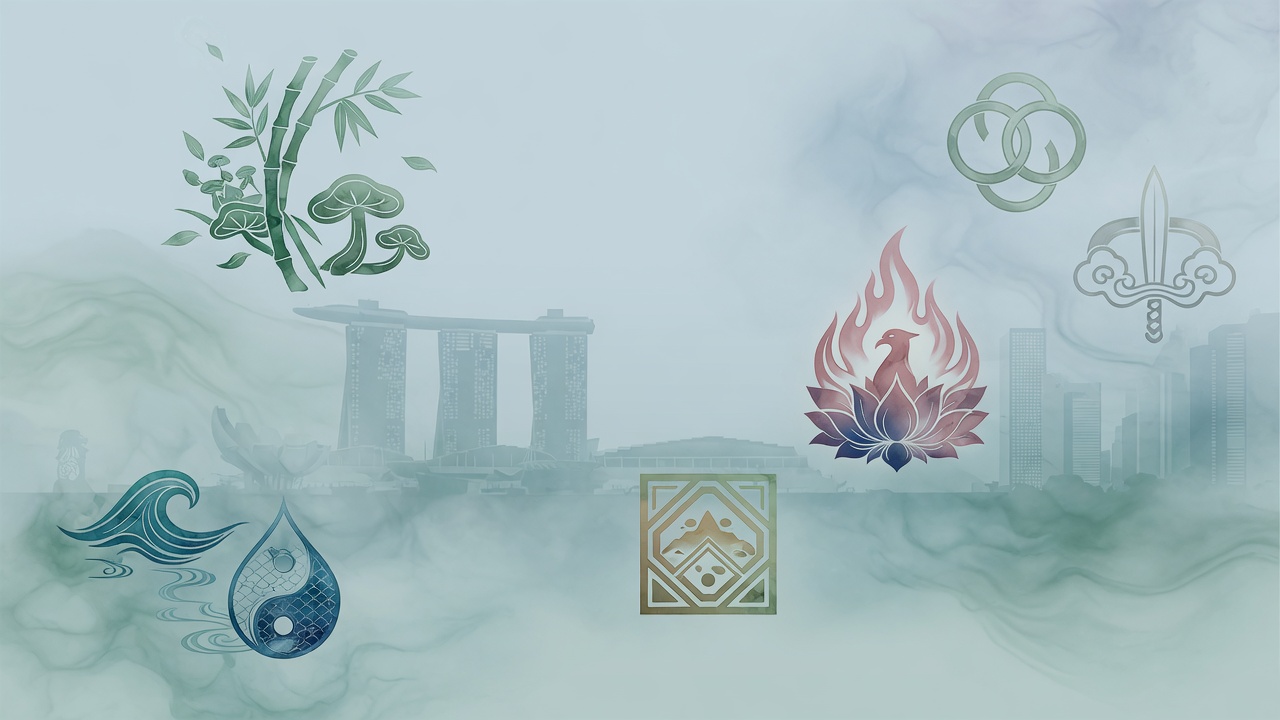
The Five Elements are not five substances, but five types of dynamic energy: Wood is characterized by bending and straightening, Fire by flaring upward, Earth by sowing and reaping, Metal by working and changing, Water by moistening and descending.
They generate and overcome each other, maintaining the dynamic balance of nature.
The seasonal cycle also corresponds to the Five Elements: spring belongs to Wood, summer to Fire, late summer to Earth, autumn to Metal, and winter to Water.
Singapore, located in the tropics, is hot and humid year-round, originally with a bias toward strong Fire and Earth, and the recent haze has further intensified dry Metal and turbid Earth.
In terms of the Five Elements, this weather manifests as the suppression of Water and Wood qi, causing the air to lose its moistening and freshness.
From a metaphysical perspective, this is an imbalance of the Five Elements in the external environment, which will affect the people within it.
- Wood: governs growth and free flow, corresponds to the liver, gallbladder, tendons, and vessels; favors smoothness.
- Fire: governs warmth and brightness, corresponds to the heart and small intestine; favors clarity.
- Earth: governs bearing and transformation, corresponds to the spleen and stomach; prefers dryness and dislikes dampness, but turbid Earth forming haze loses its proper nature.
- Metal: governs astringency and purification, corresponds to the lungs and large intestine; prefers moisture and dislikes dryness.
- Water: governs moistening, descending, and storage, corresponds to the kidneys and bladder; favors free flow and fears pollution.
- In haze, Metal and Earth are overly strong, while Water and Wood are deficient, easily disrupting the mini Five Element balance within the human body.
External Turbid Qi: How Traditional Chinese Metaphysics Views Air Pollution
Traditional Chinese metaphysics refers to undesirable environmental qi as turbid qi, the opposite of clear qi.
Turbid qi is not a mystical concept, but refers to an energy field that is muddy, stagnant, and lacking vitality.
Haze, smoke, and polluted air were all considered external pathogens by the ancients, capable of disrupting the body's righteous qi.
In Bazi, each person's strength and weakness of the Five Elements at birth differs, so their tolerance for external turbid qi also varies.
If a person's Bazi is biased toward cold and damp, encountering the dry turbidity of haze may trigger a more pronounced reaction.
But if the Bazi has strong Fire, the haze blocking sunlight can cause Fire qi to be stifled, also leading to a sense of oppression.
The key is not the haze itself, but whether the imbalance point of the individual's Five Elements is triggered.
- Energy field disturbance: Turbid qi makes the energy field around the body sticky, leading to a heavy head as if wrapped and sluggish thinking.
- Lung discomfort: The lungs are the canopy organ, most susceptible to external pathogens; haze entering the lungs triggers coughing and sore throat.
- Skin issues: The lungs govern the skin and hair; when turbid qi attacks externally, rashes, dryness, and allergies may occur.
- Low mood: The lungs correspond to the emotion of grief; when Metal qi is excessive or attacked, it easily produces a melancholy like autumn sadness.
- Poor sleep: Turbid qi disturbs the spirit; at night, yang cannot enter yin, leading to insomnia and dream-disturbed sleep.
Rational Adjustment: Combining Scientific Protection with Five Element Thinking
When facing haze, the first principle is scientific protection, which itself is a manifestation of avoiding harm.
Reducing outdoor activities, closing doors and windows, and using air purifiers with HEPA filters are all effective measures.
On this basis, one can refer to the idea of Five Element supplementation to make subtle adjustments in daily life.
Haze belongs to dry Metal and turbid Earth; the direction of adjustment should be to moisten Metal, dredge Earth, supplement Water, and nourish Wood.
Note: All suggestions cannot replace medical treatment; if you experience severe discomfort, seek medical attention promptly.
The purpose of environmental adjustment is to help the body restore its self-healing ability, not to directly combat the weather.
- Supplement Water to moisten dryness: Use a humidifier indoors to maintain humidity at 50%-60%, alleviating dry Metal.
- Dietary adjustment: Eat more white-colored foods such as snow pear, Chinese yam, lily bulb, and white fungus to moisten the lungs and nourish yin.
- Herbal teas: Brew monk fruit, sterculia seed, or ophiopogon in water to clear and moisten Lung Metal, but those with spleen deficiency should use cautiously.
- Green plants for purification: Plants like snake plant, English ivy, and peace lily can absorb some particulate matter while increasing Wood qi.
- Color adjustment: Wear or use colors like black, blue, and gray to visually supplement the energy of Water.
- Breathing exercises: When air quality improves, practice abdominal breathing to help expel turbid qi from the body.
- Acupressure: Massage acupoints such as Hegu, Yingxiang, and Taiyuan to unblock the Lung meridian qi flow.
- Regular routine: Go to sleep during the Hai hour (9-11 pm) to nourish the Triple Burner and Gallbladder meridian, strengthening righteous qi.
Harmony Between Heaven and Humanity: The Wisdom of Coexistence with Nature
The foundation of Bazi culture is harmony between heaven and humanity, recognizing that humans are part of nature.
Haze is not an isolated environmental problem, but a signal of the imbalance between humans and nature.
The ancients spoke of 'following the four seasons and adapting to cold and heat', reminding us to adjust our lives according to seasonal climates.
Although modern life cannot completely escape pollution, we can proactively create a more harmonious micro-environment.
Rather than anxiety and complaints, it is better to start with small actions: green commuting, energy conservation, planting trees and flowers.
Every rational choice is both protection for oneself and a return to nature.
The principle of seeking fortune and avoiding misfortune in Chinese metaphysics essentially guides us to respect natural laws and act in accordance with the situation.
- Reduce outdoor time: When haze is severe, reduce outdoor activities to avoid direct intake of turbid qi.
- Purify the home: Clean regularly to reduce dust accumulation and keep the energy field flowing.
- Calm the mind: Listen to soothing music, meditate, to reduce the anxiety of internal and external distress.
- Social support: Communicate with family and friends to relieve sadness and worry emotions, enhancing the warmth of Fire.
- Environmental action: Support clean energy, reduce plastic use, and reduce the production of turbid qi at the source.
Avoidance Guide
Cautions
- Reminder 1: Do not blindly 'supplement a Five Element'. For example, haze corresponds to Metal, but this does not mean everyone needs to supplement Water; it must be based on the individual Bazi, otherwise it may backfire.
- Reminder 2: Do not superstitiously believe in 'luck-changing items'. Crystals, ornaments, etc., can only provide psychological suggestion; scientific protection is fundamental.
- Reminder 3: Do not be overly anxious. Fear damages the kidneys; excessive fear actually weakens the energy of Water, lowering immunity.
- Reminder 4: Do not neglect basic protection. N95 masks and air purifiers are more direct and effective than any feng shui arrangement.
- Reminder 5: Do not self-administer Chinese herbal medicine or supplements. Moistening foods can be consumed in moderation, but medicinal diets should be consulted with a TCM practitioner.
- Reminder 6: Avoid strenuous exercise on hazy days. Even indoor exercise should avoid peak turbid qi times; choose gentle activities like yoga and tai chi.
- Reminder 7: Pay attention to official PSI data, arrange outings reasonably, and never ignore actual air quality due to metaphysical fortune assessments.
- Reminder 8: Avoid spreading panic. Worry can damage the lungs; maintaining a calm mindset is also an important energy field protection.
Summary and Recap
Haze is a reminder from nature to humanity: imbalance of the Five Elements is not an empty talk, but a reflection of the interaction between humans and the environment.
Bazi tradition teaches us to understand ourselves and adapt to the times, rather than resist or escape.
Facing unhealthy PSI, a dual approach of scientific protection + Five Element adjustment is the rational way.
May everyone preserve their inner clear qi amidst the turbid air, achieving harmony between heaven and humanity.