The Date-Selection Wisdom Behind National Day Parades: Viewing Bazi’s Big-Picture Perspective Through the Disaster Prevention Volunteers’ March
The 115th National Day ceremony and the grand march of 2,500 disaster prevention volunteers showcased collective cohesion and resilience. Behind such national celebrations lies an ancient wisdom rooted in Bazi culture: date selection and the **bi
Opening Introduction
As the disaster prevention volunteers march in orderly formation at the National Day ceremony, 2,500 individuals demonstrating societal resilience with every step, many may wonder: why are major events always held on specific days? It is not by chance, but a careful choice of timing.
In Bazi destiny analysis, date selection is precisely the study of finding the optimal intersection of time and space energies; while the big-picture perspective requires us to look beyond the individual and examine how collective fortune resonates with the rhythms of heaven and earth. This article will explore these two concepts to rationally dissect the traditional wisdom behind large-scale events.
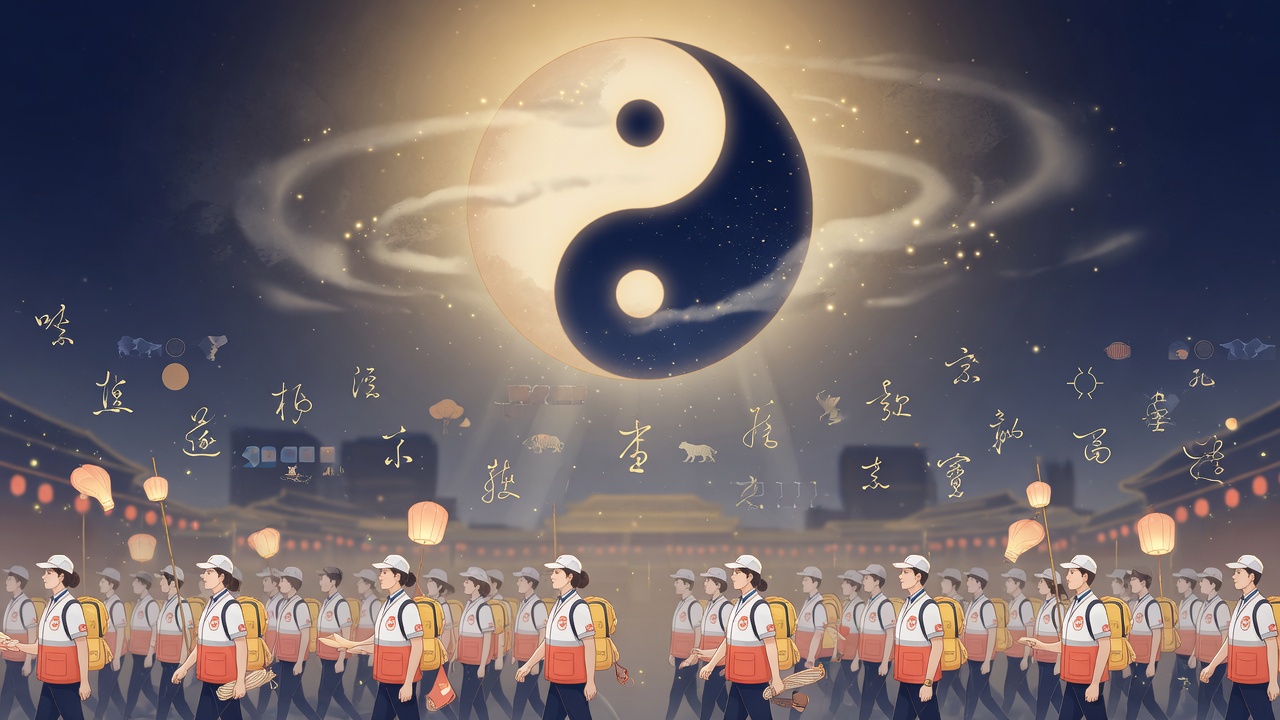
Basic Clarification: Date Selection Is Not Superstition, Big-Picture Perspective Is Not Fatalism
Common Misconceptions
Many equate date selection with “checking the almanac for a good day,” or regard the big-picture perspective as a passive belief in “national destiny being predetermined.” In reality, both are systematic methodologies distilled by the ancients from observing natural rhythms.
- Misconception 1: Date selection is just flipping through the almanac for “suitable for travel” or “suitable for celebrations.” Genuine date selection must integrate the event’s specific Yong Shen (Useful God), the participants’ natal charts, and the on-site Feng Shui; it is never a simple application of a general almanac.
- Misconception 2: The big-picture perspective equals fatalism. Bazi’s big-picture perspective emphasizes acting in accord with the trends, much like the resilience demonstrated by the disaster prevention volunteers’ march—proactively taking action after recognizing environmental trends, rather than passively waiting.
- Misconception 3: The dates of national celebrations are determined solely by administrative convenience. Traditionally, major ceremonies would reference seasonal transitions (Jie Qi), the Heavenly Stems and Earthly Branches of the current year, and directional auspiciousness and inauspiciousness to unite people’s hearts and avoid clashes and negative energies.
Core Points: The Operational Logic of Date Selection and the Big-Picture Perspective
The Foundation of Date Selection: Heavenly Stems, Earthly Branches, and the Energy Field of Time-Space
The core tool of Bazi date selection is the Gan-Zhi calendar, which transforms time into energy symbols possessing Five Element properties. The four pillars of year, month, day, and hour are each composed of one Heavenly Stem and one Earthly Branch, totaling eight characters—hence the name Bazi (Eight Characters).
Selecting an auspicious date means choosing a Day Pillar and Hour Pillar whose Five Element auras can support the event to be held. A National Day celebration pursues an atmosphere of solemnity, unity, and uplift, corresponding to the stability of the Earth element and the ceremonial nature of the Fire element in the Five Phases.
- The Day Pillar as the guiding principle: Celebrations often choose Cheng Day (Day of Accomplishment) or Kai Day (Day of Opening) among the Twelve Jianchu (Establishment and Removal) auspicious days, symbolizing achievement and new beginnings, while avoiding Po Day (Day of Destruction) or Bi Day (Day of Closure) to prevent a scattered energy field.
- The Hour Pillar as the application: The opening time for live broadcasts often falls within the Si Hour (9–11 AM) or Wu Hour (11 AM–1 PM), because Si and Wu belong to Fire, governing rites and ceremonies, civilization, and communication, which can amplify the event’s influence.
- Supporting the mountain and assisting the host: Traditional grand ceremonies also consider the sitting and facing directions and the natal chart of the principal person. For example, if the main stage faces south, one should avoid choosing a day that clashes with the Zi Mountain–Wu Facing orientation, to prevent directional conflict with the day’s energies.
- Three Harmonies and Six Harmonies: Select days that are in harmony with the year’s Tai Sui (Grand Duke Jupiter). For instance, 2026 is Bing Wu year, the Earthly Branch is Wu, which forms a Six Harmony with Wei (Goat) and a Three Harmony with Yin (Tiger) and Xu (Dog). Days with these Earthly Branches are more conducive to cooperation and unity.
The Big-Picture Perspective: Resonance Between Collective Fortune and the Rhythms of Heaven and Earth
Bazi never views individuals in isolation but places people within the great cycles of heaven and earth. Collective behaviors like national celebrations and the disaster prevention volunteers’ march are typical applications of the big-picture perspective—leveraging the momentum of the masses to echo heavenly timing.
Arranging the disaster prevention volunteers’ march within the National Day ceremony is not merely a display of manpower; it subtly aligns with the concept of supplementing heavenly timing with collective will. When the year’s climate is abnormal or society needs a confidence boost, large-scale collective rituals can form a powerful positive energy field.
- Annual Tai Sui (Grand Duke Jupiter): Each year has a reigning Tai Sui whose Five Element attributes influence the year’s overall tone. 2026, a Bing Wu year, features strong Fire, governing rites, brightness, and movement. Holding the celebration in a Fire-prosperous month or day can resonate with the yearly energy, strengthening the promotional effect.
- Seasonal Gateways (Jie Qi): National Day falls on October 10, near Cold Dew or Frost Descent. At this time, the Metal energy is in command, bringing a sense of solemnity and contraction. However, the celebration uses fiery red decorations and rousing music to apply the Five Element principle of Fire conquering Metal, diluting the autumn desolation and stimulating vitality.
- Human Unity as the most valuable: Bazi says, “First destiny, second luck, third Feng Shui, fourth accumulating hidden virtue, fifth education.” Human unity (Ren He) ranks after Feng Shui but before education. The 2,500-person disaster prevention volunteers’ march is the ultimate embodiment of human unity—unified steps, slogans, and beliefs can create a powerful bio-field that influences the local time-space.
- Directional big-picture: Site selection for large events usually avoids the directions where the Five Yellow Killing Star or the Two Black Sickness Star fly to. If the National Day ceremony venue undergoes a geomantic assessment, it will prioritize directions where auspicious stars of the year (such as the Eight White Wealth Star or the Nine Purple Joyous Celebration Star) arrive, to absorb prosperous energy.
From National Day to Civilian Life: Universal Wisdom in Timing Large-Scale Events
The principles of National Day date selection can be applied to various collective activities in civil society: corporate annual meetings, sports games, exhibition openings, and even disaster prevention drills. The core logic remains the coordination of heavenly timing, geographical advantage, and human unity.
Holding disaster prevention drills on National Day is itself a form of borrowing momentum. By leveraging the auspicious energy field of the national celebration, positive energy is infused into disaster prevention awareness, allowing the public to naturally absorb resilience education amid festivity.
- Three essentials of date selection: First determine the year (auspicious and inauspicious directions for the year), then choose the month (avoid months that broadly clash with the zodiac signs of participants), and finally select the day and hour (choose the Useful God according to the nature of the event).
- Avoid clashes and negative energies: If the event’s chief organizer or an important guest has the zodiac sign of Zi Rat, avoid choosing a Wu Day (Zi-Wu clash); if the sign is Chou Ox, avoid Wei Day. With a large number of participants in the disaster prevention volunteers’ march, individual matching is impossible, so the symbolic zodiac of the nation or city is usually used as a reference.
- Matching the Useful God: Commercial events seeking wealth choose days when the Wealth Star is prosperous; cultural celebrations seeking fame choose days when the Resource Star is prosperous; disaster prevention drills seeking safety choose days when the Resource Star or Companion Star is prosperous, to strengthen unity and protective forces.
- Weather coordination: Traditional date selection also references the Twenty-Eight Lunar Mansions and meteorological proverbs, such as “Ji Mansion favors wind, Bi Mansion favors rain.” For an outdoor National Day live broadcast, a day governed by a mansion with low probability of wind and rain is invariably chosen to ensure a smooth process.
Pitfall Avoidance Guide: Date Selection Is Not a Master Key
Important Considerations
- Don’t blindly trust a single auspicious date: Even with a perfect date-time selection, if the organization is chaotic or safety is neglected, the event will still fail. Date selection only provides a time-space boost and cannot replace human effort.
- Never ignore local time differences: Bazi uses True Solar Time. Taiwan has a slight difference from the Central Plains time zone. When selecting hours, corrections based on longitude must be made; Beijing Time cannot be directly applied.
- Avoid direct confrontation with major negative energies: If special celestial phenomena like solar eclipses or lunar eclipses are known to occur during the event period, traditionally viewed as imbalances of Yin and Yang, they should be avoided if possible, or additional blessing rituals should be added to reassure people.
- The big-picture perspective does not mean ignoring individuals: In collective events, the personal natal charts of key figures (such as the commander or the master of ceremonies) still need individual consideration. Their positioning or stage time can be fine-tuned without affecting the overall plan.
- Disaster prevention drills must pay even more attention to “timing”: Although the disaster prevention parade borrows the National Day’s auspicious date, if the drill involves simulating disasters, it is advisable to conduct it during the Wu Hour (11 AM–1 PM) when Yang energy is strong, to psychologically enhance the participants’ stress resilience.
Summary and Recap
The 115th National Day ceremony and the disaster prevention volunteers’ march are not only a display of Taiwan’s resilience but also a vivid practical lesson in Bazi’s big-picture perspective. Date selection pursues doing the right thing at the right time, while human unity injects collective will on top of heavenly timing and geographical advantage.
Viewing traditional wisdom rationally, we discover that so-called auspicious days are simply a synonym for acting in accord with the trends; the so-called big picture is merely a systemic thinking of harmony between heaven and humanity. The next time you participate in a large-scale event, try to sense that invisible rhythm of time and space.