Understanding 'Myeoneuri' Through the Lens of Ba Zi: Wisdom of Character, Choices, and Family Dynamics
A recent family ethics incident in South Korea has sparked public reflection on the role of 'myeoneuri' (daughter-in-law). Instead of moral judgment, this article returns to the traditional culture of Ba Zi, rationally analyzing the interplay of
Opening Guide
A recent family controversy has pushed 'myeoneuri' (daughter-in-law) into the spotlight. Amid the noise of public opinion, let us temporarily step away from emotions and look through the lens of Ba Zi fate analysis to see the invisible energy clues within family relationships.
Ba Zi is not a fatalistic verdict, but a personality map and a timing compass. It reveals how we interact with those around us and at which points in time conflicts or reconciliations are more likely to be triggered.
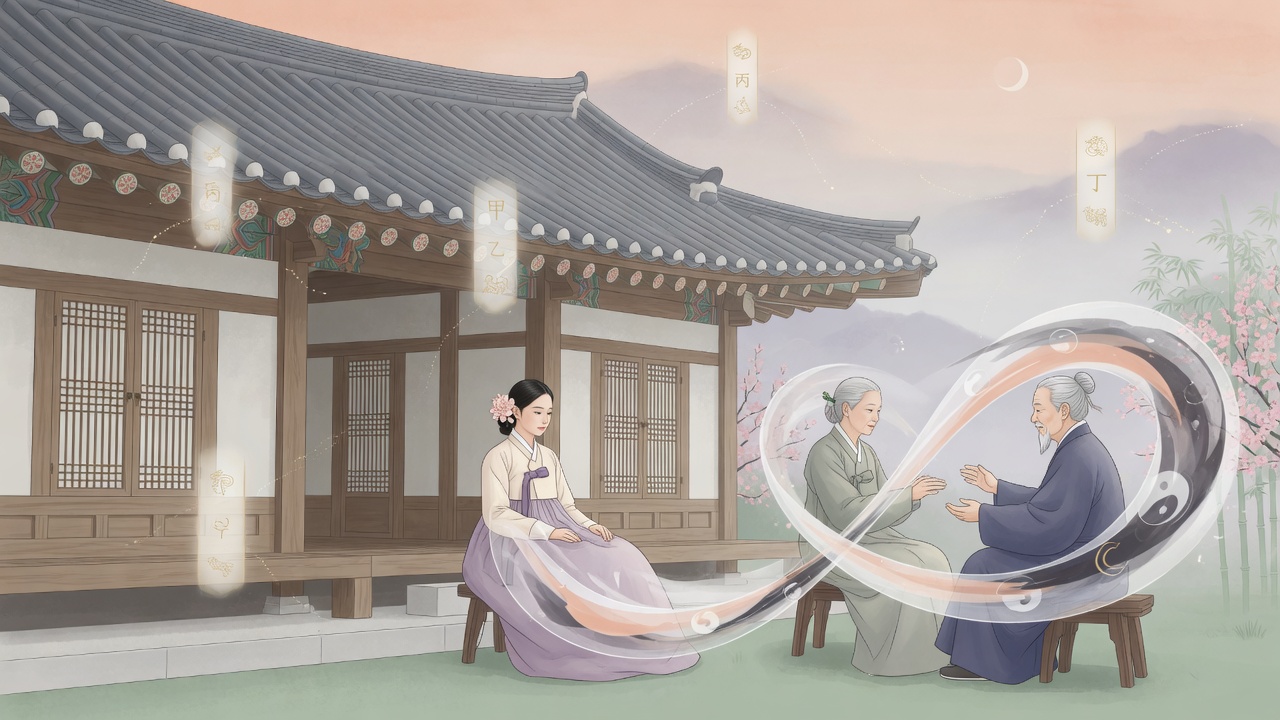
Basic Clarification: Ba Zi Is Not Fixed Fate, but a Relational Model
Common Misconceptions
- Misconception 1: Ba Zi determines everything. In reality, Ba Zi only describes innate tendencies; acquired choices and cultivation are key. For example, among people with a strong Resource star, some become overly dependent, while others transform it into profound tolerance.
- Misconception 2: Ba Zi only looks at oneself. The core of fate analysis is the Ten Gods relationships, which essentially map the energy between people and between a person and their environment, making it especially suitable for analyzing the forces at play among family roles.
- Misconception 3: A good Ba Zi chart means smooth sailing. True balance often comes from the circulation of the Five Elements. Some conflicting configurations can actually stimulate growth; the key lies in how one responds to the timing.
Core Points: Family Roles and Character Codes in Ba Zi
1. The Web of Family Relationships from the Ten Gods Perspective
In Ba Zi, the Day Master represents oneself, and the other seven characters form the Ten Gods through the generating and overcoming cycles of the Five Elements, each corresponding to different interpersonal roles. Direct Resource represents mother and elders; Direct Officer represents husband; Seven Killings represents pressure or authority; Companion represents siblings and peers.
For women, the Direct Officer is the husband star. The root strength of the Officer star and the palace it sits in often reveal the characteristics of the husband and his family. If strong Resource stars appear in the Year or Month Pillar, it often means the energy field of the elders (the in-laws) has a profound influence on the chart owner.
- Year Pillar: Represents ancestors and elders, and also the early family background, which can reflect the foundation of the in-law family.
- Month Pillar: The Parents Palace, also symbolizing the broader social environment; the interaction pattern with parents-in-law often manifests here.
- Day Branch: The Spouse Palace, the core of the marital relationship. If it is clashed or overcome by the Year or Month Pillar, it hints at possible turbulence caused by elder involvement.
- Ten Gods Combinations: For instance, Direct Officer sitting on Direct Resource often means the spouse has a close relationship with the elders, requiring the chart owner to have stronger harmonizing abilities.
2. Character and Timing: Resource Stars, Officer/Killing Stars, and Family Pressure
When a person's Ba Zi chart has overly strong Resource stars, especially appearing in the Year and Month Pillars, it easily forms a pattern of being enveloped by elders. Such individuals tend to be kind-hearted and highly dependent, but with blurred boundaries, often feeling suffocated in family relationships.
If the Direct Officer (husband star) interweaves with Indirect Resource (reluctant care), the classic triangle of 'the husband caught in the middle' often appears. It is not really anyone's fault, but rather the result of the energy structure.
In terms of timing, when the major luck cycle enters a Resource star phase, or the annual luck brings mixed Officer and Killing stars, family role identities are magnified, and previously latent conflicts suddenly surface. At such times, the task is not to fight back, but to read the signals of the times.
- Overly strong Resource star: Often manifests as overprotection or excessive interference, leaving both parties exhausted.
- Seven Killings close to the Day Master: May represent a strong, authoritative figure in the family, bringing pressure but also stimulating the chart owner's adaptability.
- Eating God and Hurting Officer: These are the chart owner's expression and rebellion. If they are overcome by the Resource star, it often means one's voice cannot be conveyed, accumulating into resentment.
- Major luck cycle transitions: For example, moving from a Companion luck cycle into a Resource luck cycle shifts the interpersonal focus from peers to elders, suddenly intensifying the sense of family role.
3. Choices and Responses: Finding Balance in the Flow of Time
Ba Zi never provides a single answer; instead, it reveals windows of choice. When the annual luck stirs the Spouse Palace or the Elders Palace, rather than clashing head-on, it is wiser to use the intelligence of the Five Elements' generating and overcoming cycles to find a mediating channel.
For example, if Wood as the Resource star is too strong, Fire (Eating God/Hurting Officer) can be used to drain it, meaning gentle expression can transform pressure. If Metal as the Officer/Killing star overcomes the self, Water (Resource star) can resolve it, but one must distinguish between the positive communication of Direct Resource and the passive avoidance of Indirect Resource.
In reality, whether to proactively establish boundaries or temporarily retreat and wait for a time lag can both find a basis in the rhythm of the Ba Zi major luck cycles. This is the flexible wisdom left to us by traditional culture.
- Mediating Useful God: Find the Five Element that can harmonize the conflict. For example, Eating God/Hurting Officer represents eloquence and art, which can become tools to express one's stance.
- Palace-based strategies: If the Day Branch is clashed, strengthening the independence of the couple's private world and making adjustments to the physical space is also a way to follow the trend.
- Timing: Certain years are suitable for patience and learning, while others are suitable for gentle communication. By clearly seeing the nature of the annual luck, one does not have to forcibly change the pattern in an unfavorable year.
- Self-cultivation: What a Ba Zi chart lacks often indicates what needs to be acquired postnatally. For example, a person lacking Metal can learn decisiveness and boundary-setting, which can improve situations of excessive interference.
Pitfall Avoidance Guide: Using Ba Zi Wisdom to Handle Family Relationships
Points to Note
- Do not take things personally: Any fate analysis is merely a reference framework. The backbone of family relationships remains love and respect; never use 'incompatible Ba Zi' as an excuse to hurt others.
- Avoid judging by a single palace: Saying mother-in-law and daughter-in-law are incompatible just by looking at the Year Pillar is extremely one-sided. A comprehensive judgment must combine the Day Master's likes and dislikes, Ten Gods configuration, and major luck trends.
- Do not use Ba Zi to judge: In hot-topic events, readers are prone to project fate analysis to 'judge' the individuals involved, which goes against the benevolent heart of traditional culture. Ba Zi is a tool, not a weapon.
- Pay attention to cultural differences: Korean society's expectations of 'myeoneuri' are highly isomorphic with the Resource star and Officer star culture in Ba Zi. However, modern society emphasizes individual equality more; avoid using traditional fate analysis to solidify stereotypical roles.
- Focus more on self-growth: Rather than obsessing over others' Ba Zi charts, it is better to clearly see your own Useful God and strengthen your own energy at the right time. This is more effective than trying to change others.
- Annual luck is not predestined: Even in a year when pressure from elders is strong, one can actively rewrite the script through spatial adjustments, career changes, or social circle support.
Summary and Review
Family relationships are never a single thread, but a complex interweaving of energies. The value of Ba Zi fate analysis lies in letting us see those hidden personality tendencies and rhythms of timing, thereby gaining more understanding in conflict and more clarity in decision-making.
True harmony is not about eliminating all contradictions, but learning to find space for each other to breathe within the generating and overcoming cycles of the Five Elements.