Muay Thai 7 Colors Meets Ba Zi: A Rational Dialogue Between Personality, Choice, and Timing
On July 26, 2026, Thailand’s Channel 7 popular Muay Thai program “Muay Thai 7 Colors” will feature a highly anticipated bout: Chuchai Chuchaibmuaythaiyim vs. Pornsenah S. Phumipat. Muay Thai is not only a contest of strength and skill, but also a
Opening Guide
On July 26, 2026, Thailand’s Channel 7 popular Muay Thai program “Muay Thai 7 Colors” will feature a highly anticipated bout: Chuchai Chuchaibmuaythaiyim vs. Pornsenah S. Phumipat. Muay Thai is not only a contest of strength and skill, but also a game of personality, strategy, and timing. Stepping away from the win-loss perspective, we can see that every fighter’s performance is intricately linked to their innate disposition and the rhythm of their fortune.
Traditional Chinese Ba Zi (Eight Characters) destiny analysis is a philosophy that studies the innate Five Elements energies and the trends of one’s life course. It is not used to predict specific events, but can serve as a cultural tool for self-understanding and timing assessment. Leveraging this popular topic, we discuss personality, choice, and timing in Ba Zi, without targeting any real individuals or match results—purely rational popular science.
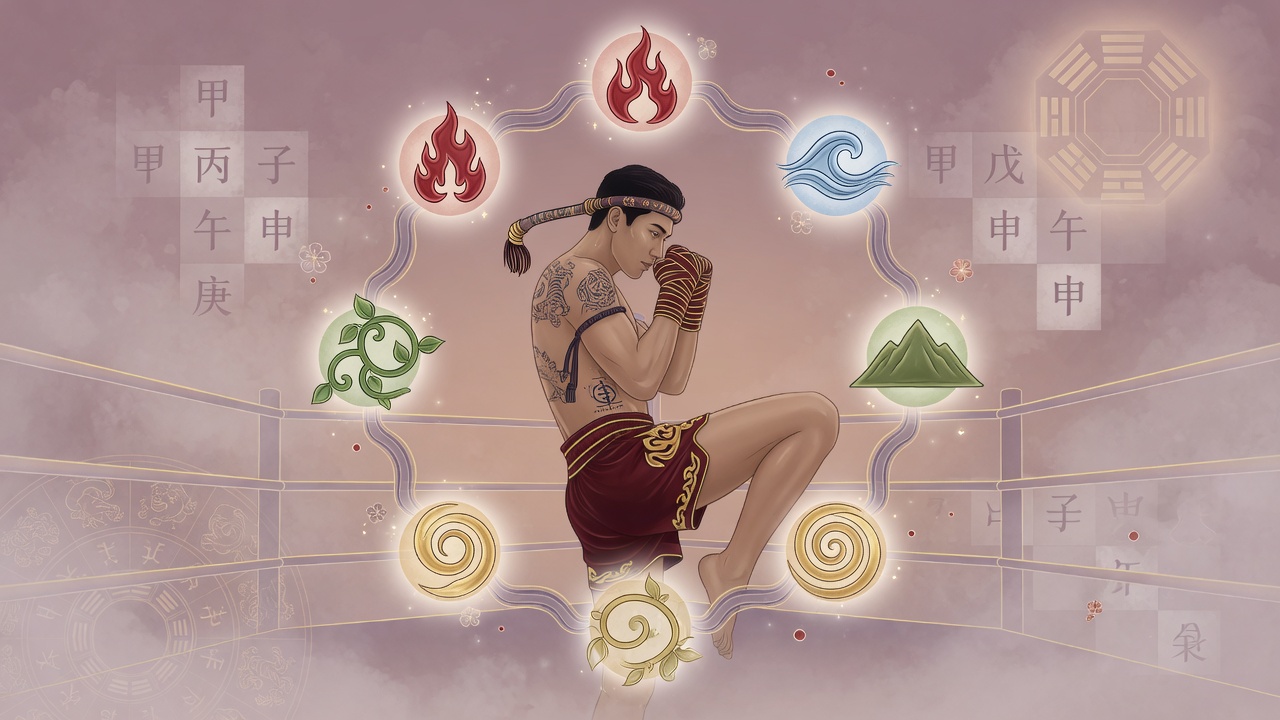
Basic Clarification: What Ba Zi Can and Cannot Do
Ba Zi is often mistaken for fortune-telling that can foresee everything. In reality, it is a philosophical system that analyzes innate Five Elements configurations and life fortune trends. It reveals personality inclinations, potential patterns, and periodic opportunities, rather than a predetermined script of specific events. Just as Muay Thai emphasizes rhythm and footwork, Ba Zi shows the “weather map” of life’s arena, not the landing point of every punch.
Common Misconceptions
- Misconception 1: Ba Zi can precisely predict the outcome of a single match. In fact, Ba Zi provides probabilities and inclinations, but competitive results are influenced by countless variables—mindset on the day, opponent’s state, tactical execution, even the stadium lighting—no single factor determines victory or defeat.
- Misconception 2: People with the same Ba Zi chart share the same destiny. Even those born at the same moment have vastly different life paths due to upbringing, education, and personal choices. The combination of Ten Gods and acquired efforts is what truly shapes specific achievements.
- Misconception 3: Ba Zi dictates personality, and personality determines fate. Ba Zi only reveals innate “materials”; later cultivation and training can completely reshape behavior patterns. The value of destiny analysis lies in leveraging strengths and avoiding weaknesses.
- Misconception 4: The auspiciousness or inauspiciousness of a Luck Pillar directly translates into real-world fortune or misfortune. A Luck Pillar is merely the “wind direction” of the environment. The same wind can be used to accelerate your run or to rest; a headwind may prompt you to pause and wait, or to detour. The power of choice always remains with you.
Core Insights: The Trio of Personality, Timing, and Choice
Ba Zi theory holds that the Four Pillars (year, month, day, hour) of birth determine the Day Master’s (self) Five Element nature and the overall chart structure. This structure is like basic Muay Thai training—it sets your “fighting stance” and “style genes”—while the Luck Pillars and annual cycles are rhythm changes in the ring, indicating when to attack and when to defend, with references drawn from destiny analysis.
1. Day Master’s Five Elements and Fighter Personality Tendencies
The Day Stem represents the self, and its Five Element attribute (Wood, Fire, Earth, Metal, Water) reflects innate temperament. In the Muay Thai context, different Elements often exhibit distinct ring styles. Note that this is only a reference framework and should not be rigidly applied; any fighter’s actual performance is a fusion of innate traits, training, and fight experience.
For common examples: Wood governs benevolence, like growing trees, so fighting style tends to emphasize rhythm and flow, using dense combinations and knee strikes to control distance. Fire governs propriety, like a blazing flame, with explosive power and aggressive openings, intimidating opponents with fierce low kicks and relentless pressure. Earth governs trustworthiness, steady and solid, with footwork that is stable, hard to knock down, excelling at grinding fights and staying calm under adversity.
Metal governs righteousness, hard and sharp, favoring close-range elbows and knees, decisive entries, with extremely firm willpower, often able to deliver a finishing blow from a disadvantaged position. Water governs wisdom, flexible and unpredictable, with tricky tactics, skilled at lateral movement, defense and counters, outstanding endurance, and often pulling off surprising wins.
It must be emphasized that the strength, weakness, and combination of the Five Elements in a chart are infinitely varied. The above are only general images of isolated Elements. If the Day Master is too strong or too weak, the expression differs: over-strong Wood without control may lead to stubborn recklessness, while weak Wood nourished by Water can become resilient. Therefore, style can never be determined by the Day Stem alone; the entire chart must be synthesized.
- Jia Wood Day Master: Like a towering tree, upright posture, orderly punches, favoring head-on clashes, but can be maneuvered by agile opponents when lacking adaptability.
- Bing Fire Day Master: Radiant as the sun, storming in from the start, low kicks and combinations come like a tempest, but must manage energy to prevent late-round fatigue.
- Wu Earth Day Master: Like a fortress wall, near-impenetrable defense, excellent durability, adept at clinching and knee strikes inside, waiting for the opponent’s opening.
- Geng Metal Day Master: Like a war axe, heavy punches and kicks, sharp elbow techniques, highly aggressive offense, often establishing dominance in the opening round.
- Ren Water Day Master: Like rivers and streams, nimble footwork, expert use of feints and dodges, precise counter-timing, keeping opponents guessing.
2. Luck Pillars and Annual Cycles: Rhythms of Timing in Competition
In Ba Zi, Luck Pillars shift every ten years, setting the main theme for each life stage; annual cycles are the yearly influence, akin to a season’s fight schedule. In competitive sports, if a Luck Pillar brings the favorable Element, it often signals an upswing in physical condition, mental state, and external opportunities—a window to challenge strong foes or vie for titles. If it brings an unfavorable Element, it’s wiser to defend and counter-attack, using fights to build experience, avoiding head-on battles against the odds.
For example, if a fighter’s chart favors Water, stepping into a Ren or Gui Water Luck Pillar may bring quicker physical recovery and clearer tactical thinking, raising the probability of victory. Conversely, in a year of strong Earth (such as Wu Xu year), Earth restrains Water; extra attention to joint injuries and emotional fluctuations is warranted, with preemptive conditioning in stamina and flexibility. Yet this is never a guarantee of success, because competitive outcomes also hinge on opponent strength, strategy, on-site coaching, and other real-world factors.
Notably, Sui Yun Bing Lin—when the Luck Pillar and annual branch are identical—can bring dramatic shifts, potentially a career turning point like a technical breakthrough, a major title fight, or an injury-led retirement. Another common scenario is the annual cycle clashing the Day Pillar, indicating travel and changes; the fighter may face frequent overseas bouts or training environment shifts, and embracing the change can broaden experience.
Muay Thai itself recognizes the concept of “heaven’s timing”: some fighters suddenly peak in a certain year while others inexplicably slump. Beyond training, this aligns with luck cycles. Using the Ba Zi Luck Pillar framework not to “resign to fate” but to plan fight schedules and adjust rhythms. For instance, knowing this year holds turbulence, one can arrange more counter-fighting training and avoid unnecessary hard matches, then go all-out when luck turns favorable next year.
- Favorable God Luck Pillar: Peak physical, mental, and external support—golden window for a title belt.
- Unfavorable God Luck Pillar: More obstacles, higher injury risk; reinforce fundamentals, use competitions as training, maintain ranking.
- Output (Eating God / Hurting Officer) Luck Pillar: Creativity surges, often developing new techniques or altering fighting style, keeping opponents off-balance.
- Authority (Direct Officer / Seven Killings) Luck Pillar: Pressure spikes dramatically, but if the natal chart can transform the killing force, it may lead to a breakout victory and overnight fame.
- Resource (Direct / Indirect Seal) Luck Pillar: Strong learning ability, ideal for seeking advanced mentorship, improving both technically and mentally.
- Wealth Luck Pillar: More commercial opportunities, yet distraction must be guarded against; pursue high-purse events, but don’t let money interfere with training focus.
3. Ten Gods Configuration: The Inner Code of Competitive Strategy
In Ba Zi, the Ten Gods (Friend, Rob Wealth, Eating God, Hurting Officer, Direct Wealth, Indirect Wealth, Direct Officer, Seven Killings, Direct Seal, Indirect Seal) represent relationships with the external world and psychological traits. In competitive sports, they function like different tactical modules, collectively shaping a fighter’s competitive style and strategic leanings.
Friend and Rob Wealth (collectively, Bi Jie) represent competitive drive and physical endurance. Fighters with strong Bi Jie are highly ambitious and resilient, suited for protracted hard battles, but can be overly rigid, lacking tactical flexibility, or commit fouls out of impulse. If channeled by Eating God or Hurting Officer, that excess energy transforms into refined technique.
Eating God and Hurting Officer represent talent, creativity, and self-expression. Fighters with strong Output stars usually have high comprehension, use unorthodox moves, display smooth and graceful techniques, and excellent energy management. However, they may experience emotional swings, dominating when ahead but doubting themselves in adversity. As stars of “speech,” these fighters often possess witty post-fight interviews.
Direct Officer and Seven Killings represent discipline, pressure, and authority. Well-configured Officer/Killing fighters are extremely self-disciplined, executing coaches’ instructions to the fullest, unfazed in critical rounds, and turning pressure into motivation. But if the Officer/Killing is overwhelming without resolution, anxiety may hinder performance. This is where Seal stars (Direct Seal, Indirect Seal) come in to diffuse pressure. Seal stars represent thought, learning, and resolving power.
Wealth stars (Direct and Indirect Wealth) represent material pursuit and tangible benefits. Fighters with strong, favorable Wealth stars are adept at seizing the financial gains from matches and possess strong commercial instincts; but if Wealth overpowers the Seal, they may neglect training in pursuit of fame and fortune, or face weight issues due to dietary indiscipline.
These Ten Gods are neither absolutely good nor bad; it all depends on combination and balance. An elite Muay Thai fighter’s chart often features smooth Output expression, strong Bi Jie resilience, controlled Officer/Killing, and supplementary Seal intelligence, forming a fluid circulation of the Five Elements. Yet in reality, most people have biases, which underscores the necessity of targeted training—innate weaknesses can be compensated by acquired effort.
- Strong Friend (Bi Jian): Ferocious in close-quarter exchanges, a positional fight expert, can withstand high-density attacks, but need to guard against stubbornness leading to rigid tactics; practice varied rhythms.
- Prominent Rob Wealth: Explosive instant power, excels at preemptive strikes and one-hit knockouts, yet must strengthen risk management to avoid counter-blows from recklessness.
- Favorable Eating God: Refined technique, fast recovery, aesthetically pleasing fight style; often seen in perennial ring veterans, ideal for developing multiple fight strategies.
- Hurting Officer with Seal: Blazing talent paired with composure, capable of miraculous moves in matches, strong resistance to interference—an ideal configuration for clutch performers.
- Seven Killings Transformed: Turns pressure into dominance, the more critical the bout, the more extraordinary the performance; but daily psychological adjustment is crucial to avoid excessive tension.
- Well-placed Direct Seal: Strong learning ability, quick tactical adaptation, rapidly absorbs opponents’ traits and devises counters, suited as the team’s strategic nucleus.
Pitfall Avoidance Guide: The Correct Stance for Viewing Competition through Ba Zi
When integrating Ba Zi culture with modern competitive thinking, it is essential to maintain rational boundaries and avoid stumbling into unrealistic predictions. The following reminders help you absorb traditional wisdom without blind faith.
Key Reminders
- Never use Ba Zi to predict a single match outcome: Ba Zi reveals long-term trends and potentials; a single match is affected by hundreds of real-time factors. Using Ba Zi to predict is like studying microbes with a telescope—it is unrealistic and contradicts the spirit of sports. Match results are always created by the fighters and teams in the present.
- Do not treat Ba Zi as a fatalistic verdict: A birth chart is a map, not a track. The same chart leads to vastly different lives through different choices. Countless “dark horses” in the Muay Thai world have rewritten the script with sweat, defying so-called “destiny disadvantages.”
- Respect privacy; do not deduce others’ charts without permission: Publicizing or analyzing someone’s birth data without consent is not just a breach of trust but a basic ethical bottom line. No one has the right to box another person under any destiny label.
- Understand that timing is larger than the individual: Luck Pillars and annual cycles shared common background colors for everyone, yet under the same trend some sink while others soar; the key lies in individual response and preparation. Instead of asking “Can I win this year?”, ask “How should I train this year to align with the trend?”
- Use destiny analysis as a tool, not a crutch: You can adjust training plans with personality insights—e.g., those with over-strong Bi Jie might add flexibility and reaction drills; those with over-strong Output stars might need mental coaching. But everything must be built on scientific training and actual fights; Ba Zi is only an auxiliary reference, never the main focus.
- Maintain a dynamic mindset: Facial features, personality, and physique change with age and experience. The same Ba Zi chart shifts emphasis across life stages. An interpretation for a teenager cannot be copied onto a professional fighter in their twenties. Adjust cognition based on the current reality.
- Beware of “master” scams: There are so-called destiny analysts in the market who promise to predict match results for profit—they should be firmly rejected. True promoters of traditional culture never make absolute assertions, but help people know themselves more comprehensively.
- Results remain the bottom line: No matter how plausible the destiny analysis, the only standard of truth is the ring. A fighter’s hard training, tactical execution, and on-the-spot adaptability will always be the primary factors for a championship. Ba Zi culture merely offers an observational lens and can never replace the fundamentals.
Summary and Reflection
The ring of Muay Thai 7 Colors is an arena of sweat and wisdom. From the lens of Ba Zi culture, what we see is not a prediction of victory or defeat, but a symphony of innate personality, acquired choices, and the flow of timing. Understanding one’s Five Element traits and luck cycles can help a fighter—and anyone striving—to assess the situation and make better decisions at different stages of life.
True champions never rely on destiny’s handouts. After recognizing themselves and the trends of the time, they still choose to give their all, day in and day out. Ba Zi is not a shackle, but an auxiliary tool for understanding the world and oneself—when used rationally, it leads to ease and composure.