Rie Mochizuki's Solo Life at 52: Understanding Midlife Energy Shifts in Women Through the Bazi Day Master and Luck Pillars
Recently, 52-year-old Japanese freelance announcer Rie Mochizuki topped trending topics for her age-defying beauty and 'solo life.' Her state sparks curiosity: why do some women appear more composed and resolutely independent after midlife? From
Introduction
Recently, 52-year-old Japanese freelance announcer Rie Mochizuki topped trending topics for her age-defying beauty and 'solo life,' sparking widespread discussion.
Her lifestyle makes many rethink: where does the independence and composure of midlife women truly come from?
From the perspective of the Bazi Day Master and Luck Pillars, we can interpret women's energy changes and life choices at different ages.
This article does not involve any personal birth data or marriage predictions; it only uses this trending topic to popularize how traditional Bazi interprets the connection between age and independence.
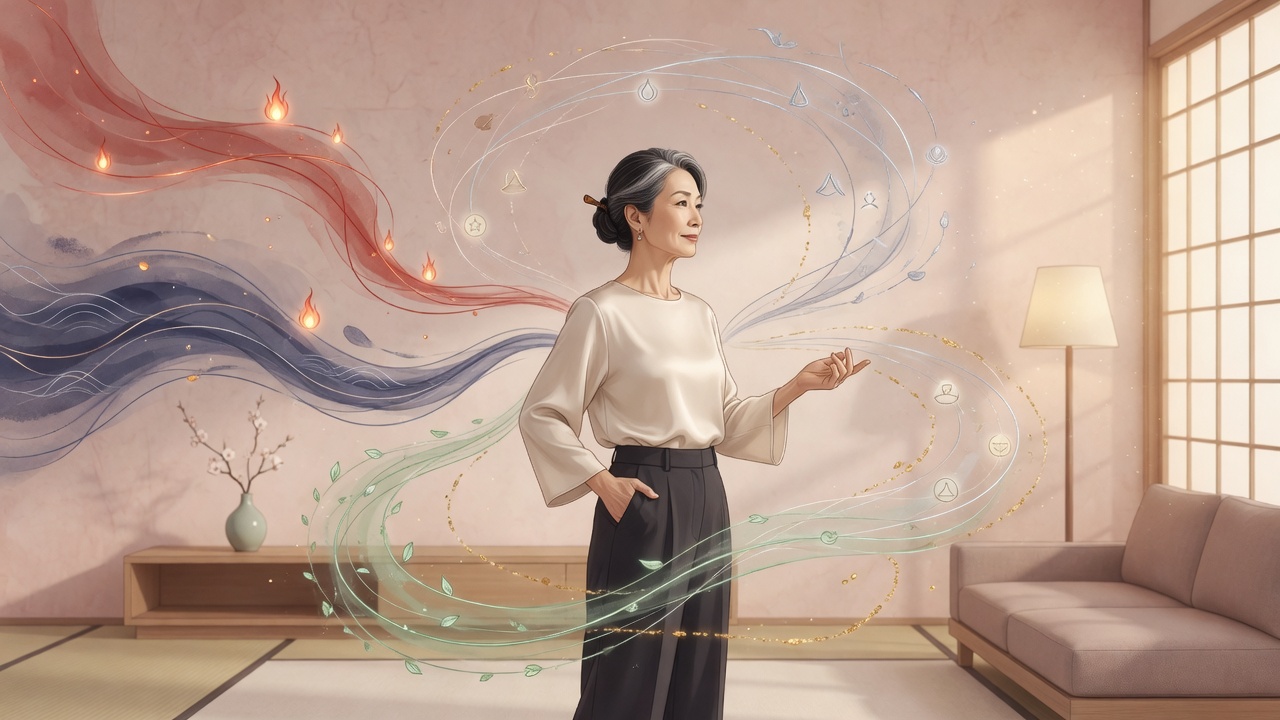
Basic Clarifications
Common Misconceptions
Many people equate Bazi with fatalism or only care about marital fortune. In reality, Bazi is more like an energy map, not a verdict.
- Misconception 1: Does Bazi determine destiny? Wrong. It describes innate energy tendencies; postnatal choices and environment are equally important.
- Misconception 2: Is a woman's independence a sign of 'loneliness'? Wrong. Independence is a natural choice after self-energy matures, unrelated to marital status.
- Misconception 3: Is a Luck Pillar change a sudden shift in fortune? Wrong. Luck Pillars are a gradual energy background, not an on-off switch.
- Misconception 4: Only specific Bazi charts lead to independence? Wrong. Every Day Master can awaken independent consciousness at different Luck Pillar stages.
- Misconception 5: Does midlife independence mean rejecting family? Wrong. Many reclaim personal space after caring for others.
A Few Basic Concepts
To understand this article, you need to distinguish three fundamental terms: Day Master, Luck Pillars, and Five Element Energy.
- Day Master: The Heavenly Stem of the birth day, representing 'self,' the core of a Bazi chart.
- Luck Pillars: Ten-year life phases calculated based on the Month Pillar.
- Five Elements: Metal, Wood, Water, Fire, Earth; the generating and controlling cycles between the Day Master and the elements of current luck create energy fluctuations.
- Energy State: Not fortune or misfortune, but tendencies—active or passive, outward or inward, dependent or independent.
Core Insights
The Day Master: The 'Self' in Bazi and Innate Energy Foundation
The Day Master refers to the Heavenly Stem of the birth day, such as Jia Wood, Bing Fire, or Wu Earth. It is the center of the entire Bazi chart, representing a person's core self and innate traits.
Women with different Day Masters express themselves differently. Wood Day Masters are flexible and growing; Fire Day Masters are passionate and outgoing; Metal Day Masters are decisive and sharp; Water Day Masters are fluid and adaptable; Earth Day Masters are stable and tolerant.
The strength of the Day Master doesn't indicate good or bad character, only whether the innate energy leans more active or passive. Women with a strong Day Master often show independent tendencies earlier, while those with a weak Day Master may awaken after receiving support from a Luck Pillar.
Looking only at the Day Master is insufficient; one must also consider how the other seven characters support or drain it. But the Day Master is the entry point to understanding a person's energy foundation.
In this trending topic, the composure and firmness Rie Mochizuki displays can be abstractly seen as a state of stable Day Master energy, but we do not speculate on her specific Bazi chart.
Regardless of the Day Master, every woman has the potential to reconnect with and live out her core traits at a specific Luck Pillar stage.
- Wood Day Master: Like a plant, needs space to stretch; independent consciousness often sprouts after pressure.
- Fire Day Master: Brings its own light and heat; after midlife, more unwilling to hide true thoughts, preferring to shine at its own pace.
- Earth Day Master: Stable and tolerant, but when stirred by a Luck Pillar, will proactively draw personal boundaries and stop over-accommodating.
- Metal Day Master: Innately principled; as age grows, more inclined to live by their own standards, not compromising easily.
- Water Day Master: Fluid and adaptable; independence often manifests as spiritual freedom and non-attachment, rather than living alone formally.
- Day Master and Independence: Independence is not decided by the Day Master, but is an energy expression of the Day Master under different Luck Pillars.
Luck Pillars: Decade-by-Decade Energy Phases of Life
Luck Pillars start from the Month Pillar, arranged forward or backward based on gender and the Yin/Yang polarity of the year stem, changing every ten years. They are like the changing seasons of life, altering the external energy environment.
In a woman's midlife, Luck Pillars often shift from 'social role' phases like Wealth/Officer or Resource stars, towards 'self-expression' phases like Output or Peer stars.
Around the age of 52, one is typically in the sixth or seventh Luck Pillar. At this time, many women re-evaluate their life focus: for family, for career, or for themselves?
The interaction between the Luck Pillar's Five Elements and the Day Master affects one's mindset, behavior, and tendencies. For example, an Output star phase stimulates creative desires, while a Peer star phase strengthens self-identity.
This shift is not a sudden change but a process of gradual energy transition. Many people first experience inner conflict before gradually finding a new balance.
The resonance sparked by Rie Mochizuki's 'solo life' may be because many midlife women, during an energy transition period, naturally move toward inner independence.
- Wealth/Officer Phase: Focuses on career achievement and family responsibility, energy projected outward, easily neglecting personal feelings.
- Resource Star Phase: Emphasizes learning and inner cultivation, easily prompts reflection and re-evaluates life's meaning.
- Output Star Phase: Creativity and desire for expression rise, unwilling to be constrained by frameworks, more daring to try new lifestyles.
- Peer Star Phase: Self-identity strengthens, more emphasis on personal space and equal relationships, rejecting draining social interactions.
- Experience of Luck Pillar Shift: The first few years may be confusing, the later years gradually become clearer, eventually forming a new life rhythm.
- Age is Not the Boundary: One doesn't automatically become independent at 52; rather, the Luck Pillar energy pushes an individual to make choices.
Why a Luck Pillar Shift Can Lead to an Independent, Self-Reliant Lifestyle
When the Luck Pillar moves into Eating God or Hurting Officer, women more easily develop the thought 'I want to be myself,' becoming sensitive to traditional role constraints.
When the Luck Pillar moves into Friend or Rob Wealth, self-awareness and boundary sense strengthen, making one more concerned with their own life rhythm and unwilling to be drained meaninglessly.
Rie Mochizuki's 'solo life' trending reflects a resonance among many midlife women: in an energy transition period, they begin to prioritize their own needs.
This independence does not reject intimate relationships, but means no longer anchoring one's life value entirely to others' evaluations, nor over-extending oneself to meet external expectations.
From a Bazi perspective, independence is a sign of energy maturity. It means a person can live harmoniously with their Day Master energy and, driven by the Luck Pillars, live out their true nature.
It must be emphasized: this article discusses general principles only, does not involve Rie Mochizuki's specific Bazi chart, and does not predict anyone's marriage or fortune.
- Output Star Phase: Enhances expression, aesthetics, and creativity; more willing to be alone or invest in beloved pursuits.
- Peer Star Phase: Reduces competitiveness, increases focus on self-satisfaction, may proactively simplify social circles.
- Midlife Shift: Moving from 'living for others' to 'living for oneself' is a normal state of energy maturity.
- Types of Independence: Some choose to live alone, some choose spiritual independence, some redesign their careers; forms are diverse.
- Cultural Perspective: Japanese society's focus on 'ohitorisama' (solo living) also reflects women's reflection on traditional roles.
- Bazi is Not Fatalism: Luck Pillars only provide an energy background; the final choice depends on personal will and environment.
Essential Tips
Points to Note
When using Bazi culture to understand trending figures, always maintain boundaries: do not fabricate birth data, do not make malicious speculations, and do not predict specific events.
- Reminder 1: Do not reverse-engineer a celebrity's Bazi chart based on trending topics; this is an invasion of privacy and violates Bazi ethics.
- Reminder 2: Independence ≠ marital failure; avoid using Bazi labels to pass judgment on others.
- Reminder 3: Luck Pillar shifts have both positive and negative aspects, but this article only discusses energy tendencies, not fortune predictions.
- Reminder 4: Bazi is one observational lens; it cannot replace real-world judgment and personal effort.
- Reminder 5: Women at any age have the right to choose a lifestyle that suits them, without needing Bazi endorsement.
- Reminder 6: Online trending topics are easily one-sided; do not treat a single case as a universal rule.
- Reminder 7: If interested in Bazi, it is recommended to consult a professional Bazi practitioner and avoid drawing personal conclusions on your own.
Summary and Key Takeaways
The Day Master is the root, and the Luck Pillars are the momentum. A midlife woman's move toward independence is often a natural expression of energy maturity.
The 'solo life' topic surrounding Rie Mochizuki shows us a possibility: from a traditional Bazi perspective, age is not a constraint, but an opportunity for self-return.