The Virtue of Water in the Five Elements: Ecological Reverence through the Lens of the Shiogama Oil Spill
In August 2026, a heavy oil spill occurred at Shiogama Port in Miyagi Prefecture, Japan, and the Minister of Agriculture, Forestry and Fisheries declared the fishing grounds safe. Viewed through the lens of Ba Zi and the Five Elements, th
Introduction
In August 2026, a heavy oil spill occurred at Shiogama Port in Miyagi Prefecture, Japan, and the Minister of Agriculture, Forestry and Fisheries declared the surrounding fishing grounds safe. From the perspective of traditional Ba Zi and the Five Elements, this incident is a vivid portrayal of the defilement of the Water element. The ancients believed that Water governs wisdom and wealth, and is the foundation that nourishes all things. Starting from this, this article will explain the symbolic meaning of the Water element in the Five Elements, interpret how the ancients understood the interaction between environmental nourishment and human activity, and reveal the philosophy of reverence for nature embedded within.
Basic Clarification: What is 'Water' in the Five Elements?
Common Misconceptions
Many people misunderstand the Five Elements in Ba Zi, thinking they are merely symbols of personal destiny, or directly equating Water with the chemical substance H₂O. In reality, the Five Elements is a vast system of symbolic associations, where Water represents qualities such as moistening downward, flowing, wisdom, and wealth, and also reflects the relationship between humans and nature.
- Misconception 1: Equating Five Elements 'Water' with the chemical substance. In Ba Zi, Water is rain and dew in the heavens, rivers and seas on earth, and in humans governs wisdom, the kidneys, and wealth—it is a symbolic energy classification.
- Misconception 2: Thinking Ba Zi theory only concerns personal destiny and is unrelated to the environment. In fact, the Five Elements' generating and overcoming cycles naturally include observations of the natural ecology. For example, phenomena like soil erosion and water pollution are often metaphorically described as mixing of Water and Earth in destiny analysis.
- Misconception 3: The generating and overcoming cycles are fixed mechanical formulas. Actually, the ancients emphasized balance of strength and weakness. Excessive Water leads to flooding; Water muddied by Earth loses its clarity. This mirrors how the environment requires moderate development and protection.
Correspondence between the Five Elements and the Environment
In nature, the Water element corresponds to oceans, rivers, lakes, rain, and snow, forming the Five Elements foundation for all aquatic life and fishery resources. In traditional destiny analysis, Water is the Wealth Star. Especially for those born in places where Water is strong or engaged in fishing and trade, the purity of Water directly affects the flourishing of wealth.
The Earth element represents land, embankments, silt, and also viscous, turbid substances. Heavy oil, with its sticky and polluting characteristics, can be classified as turbid Earth in the Five Elements system. When turbid Earth intrudes into Water, it forms the image of mixing of Water and Earth, which is often considered an inauspicious pattern in Ba Zi.
Core Insights: The Virtue of Water and the Ecological Metaphor of Water-Earth Mixing
1. Water Governs Wisdom and Wealth: The Five Elements Mapping of Fishery Resources
In the Ba Zi classic *Di Tian Sui*, it is said of Water: 'When Water is generated by Metal but encounters Earth, it becomes muddy and unclear.' Water governs wisdom; its nature is clear and still, capable of reflecting all things. Water governs wealth; it flows ceaselessly, like rivers converging into the sea. For an island nation like Japan, fisheries are a flowing wealth repository, and the clarity or turbidity of the sea directly affects the strength of the Wealth Star.
The ancients regarded Water as a symbol of wealth not merely because it supports fish, but because Water represents circulation and trade. When a port's waters are pure and clear, wealth energy flows smoothly, catches are abundant, and livelihoods are stable. Conversely, if Water is polluted, wealth is obstructed, even triggering livelihood crises. This logic perfectly aligns with the damage to fisheries caused by oil spills.
At the same time, clear water signifies clear wisdom. In Ba Zi, when the Day Master is strong and Water is a favorable element, and the water quality is not turbid, it indicates a person with a clear mind and good decision-making. For a nation dependent on the sea, its collective wisdom is also reflected in the rational use of marine resources. Pollution of water, from the Five Elements perspective, disturbs the root of wisdom, leading to short-sighted, profit-driven behavior.
- Water as Flowing Wealth: In destiny analysis, Direct and Indirect Wealth stars favor vitality and strength. The Water element as a wealth star most detests being muddied by Earth; turbid wealth is tainted and easily leads to disputes. This is just like how oil contamination makes seafood unsellable, clogging the wealth source with sludge.
- Water Governs Wisdom: In the Five Elements, Water corresponds to the kidneys and brain in the human body, the source of wisdom. Clear water means clear thinking; turbid water means confused thinking and poor judgment. Protecting water sources is protecting the collective wisdom of a people.
- The Lifeline of Fisheries: Traditional Japanese fishing villages often have water deity shrines, praying for calm seas and abundant catches. Behind this lies reverence for the virtue of Water—Water can carry boats and generate wealth, but it can also capsize them and take wealth away.
2. Mixing of Water and Earth: The Five Elements Image of Heavy Oil Pollution
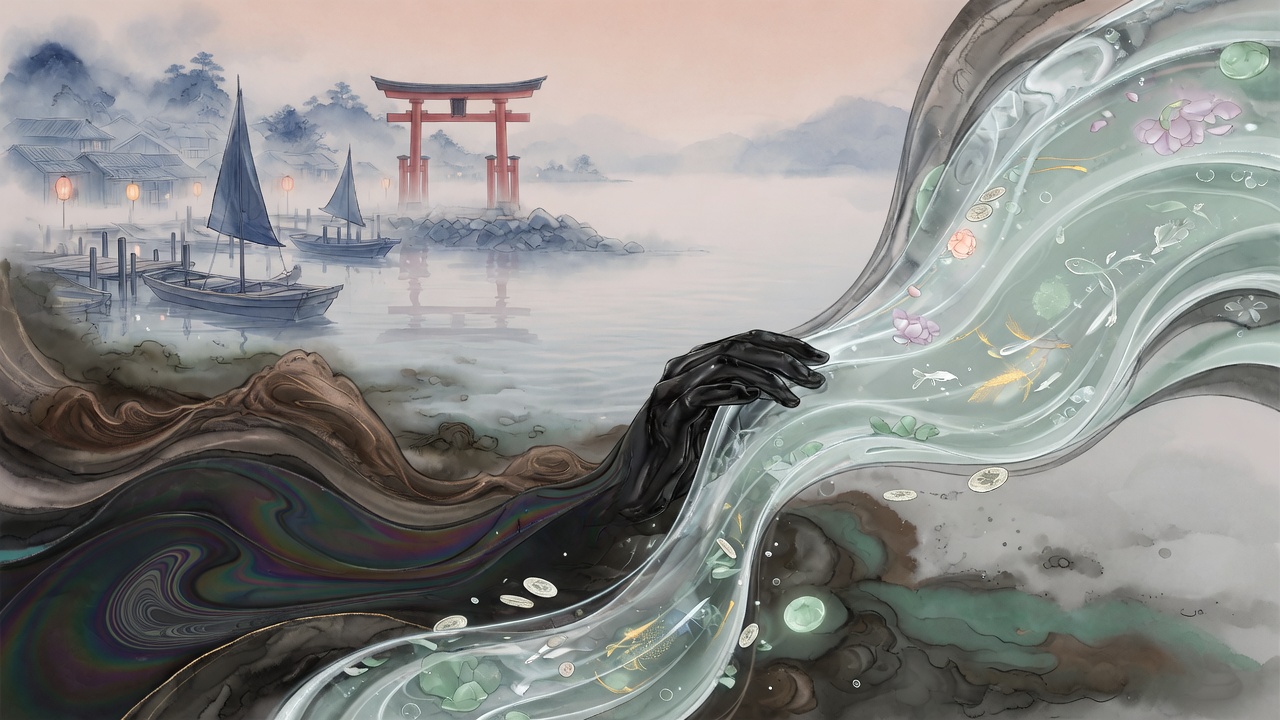
The heavy oil spill at Shiogama Port covered the sea surface with large amounts of viscous oil, rendering the water turbid and foul. In the Five Elements symbolic system, clean seawater is strong Water, while heavy oil, with its thick, sticky, and polluting nature, can be classified as turbid Earth. Turbid Earth entering Water is precisely the pattern of mixing of Water and Earth.
A Ba Zi proverb states: 'Where Water and Earth are mixed, foolishness and dullness often follow.' Originally referring to a personal chart where Water is weak and Earth is heavy, leading to mental confusion, when scaled up to the environmental level, mixing of Water and Earth signifies the suppression of the entire ecosystem's wisdom and wealth. Oil smothering marine life and closing fishing grounds is a real-life portrayal of the Wealth Star being trapped by turbid Earth.
The *San Ming Tong Hui* discusses Water: 'Water that is clear and moist governs wisdom; Water that is turbid and foul governs ignorance.' In ancient agrarian societies, soil erosion impoverished farmland, and poor water management led to droughts and floods. Modern industrial pollution is simply another form of turbid Earth invading the virtue of Water. The minister's declaration of fishing ground safety implies that through scientific cleanup, the mixing of Water and Earth has been alleviated, and the clarity of Water has been restored.
From the perspective of the generating and overcoming cycles, Earth can overcome Water, but if Earth is too heavy, it muddies Water, becoming a merciless overcoming. If the 'turbid Earth' produced by human activities (such as industrial discharge, oil spills) is not controlled, the nourishing function of Water will be lost, ultimately backfiring on humanity itself. This aligns with the principle of rebellious overcoming in the Five Elements: Earth originally overcomes Water, but when Water is too turbid, Earth collapses—ecological imbalance ensues.
- Turbid Earth Traps Water, Wealth Star is Restricted: Oil slick covering the sea surface blocks the exchange of yin and yang, and the aquatic life (Wealth Star) cannot survive—this is the image of the 'Wealth Star being combined and overcome' in destiny analysis.
- Water and Earth in Conflict, Both Sides Lose: In the Five Elements, when Water and Earth battle without Wood to mediate, Water becomes turbid and Earth flows away. Environmental pollution is the result of such adverse generating and overcoming, ultimately harming humanity itself.
- The Distinction between Clear and Turbid: The ancients placed great importance on the clarity of Water in chart analysis, believing that 'the clear are noble, the turbid are base.' Extended to nature, this concept translates into the pursuit of clean water sources and a healthy ecology.
3. Traditional Environmental Wisdom: Reverence for Nature and Unity of Heaven and Humanity
Chinese traditional culture has always emphasized the unity of Heaven and humanity. The *I Ching* states, 'The great virtue of Heaven and Earth is life.' The Five Elements theory is precisely the manifestation of this philosophy of life. Water, as one of the Five Elements, not only nourishes all things but also requires humanity to treat it with virtue. The ancients’ practices of not draining ponds to fish and not burning forests to hunt were precisely expressions of reverence for and protection of the virtue of Water.
In Ba Zi, the strength, weakness, clarity, and turbidity of Water not only affect personal destiny but are also linked to the broader qi dynamics of a region. Where water is clear and sweet, the land produces outstanding people and wealth flows in; where water is turbid and foul, livelihoods decline and diseases proliferate. This macro-level Five Elements perspective led the ancients to develop a set of simple yet effective environmental principles.
In the Japanese Shinto tradition, water is regarded as a sacred purifying agent, with rituals such as *Minazuki-barae*. However, the deeper cultural roots are shared with the East Asian view of Five Elements generating and overcoming: Water must maintain its purity to fulfill its functions of wealth and wisdom. After the oil spill, the authorities immediately tested and declared safety, which, behind the scientific standards, also resonates with the public's psychological need for clear water.
Ancient environmental wisdom is not esoteric but grounded in real survival experience. For example, viewing Water as a public wealth source, strictly prohibiting private monopolization, and instituting closed fishing seasons to allow aquatic life to regenerate—this corresponds to the Five Elements principle that 'Water should be still and store up.' Overfishing is like Water overflowing without restraint, eventually leading to depletion; proper rest periods are a process of recovery where Metal generates Water, with Metal representing contraction, allowing Water to be replenished.
These concepts, from the perspective of modern environmental science, equate to principles of staying within ecological carrying capacity, maintaining biodiversity, and preventing pollution. The ancients simply expressed them in the language of Five Elements balance, with the core being awe and alignment with natural forces.
- Revere Water as Deity: Ancient rituals offering sacrifices to river gods and sea gods, praying for favorable weather, were essentially acts of revering the power of nature, avoiding the destruction of Water's ecology through greed.
- Moderation in Use: Ba Zi's annual luck cycles emphasize following the momentum. The use of environmental resources should also follow the patterns of strength, weakness, rest, and imprisonment—do not overfish when Water is strong; allow time for rest and rejuvenation.
- Nourish Earth to Clear Water: In the Five Elements, Earth needs vegetation to stabilize it, preventing turbid Earth from entering Water. The ancients planted trees and protected wetlands precisely to maintain the clarity of Water.
- Heaven-Human Resonance: The ancients believed that deteriorating water quality was a warning from Heaven, prompting self-reflection and remedial actions. This is essentially a form of ecological ethics based on self-restraint.
Pitfall Guide: Rationally Viewing the Five Elements and Environmental Protection
Points to Note
When applying traditional Five Elements culture to interpret modern environmental events, it is essential to remain rational and avoid falling into superstition or over-interpretation. Here are some aspects to be mindful of.
- Do not over-interpret: The Five Elements is a philosophical model, not a direct equivalent of environmental science. The detection of oil spills and the declaration of fishing ground safety rely on chemical analysis and ecological assessment. Five Elements generating and overcoming merely provides a cultural perspective and is by no means a predictive tool.
- Avoid superstitious associations: The minister's declaration of fishing ground safety was based on scientific data and cleanup effectiveness, not on the Five Elements 'clearing of Water.' Any claim that directly links official decisions to destiny studies is irresponsible. Cultural popularization aims to elucidate traditional wisdom, not to replace real-world judgment.
- Respect traditional wisdom: The analogy of 'Water governs wealth' in the Five Elements reminds us that protecting water sources is protecting the economic lifeline. This concept highly aligns with modern sustainable development and can be utilized as a cultural resource, but should not be mystified.
- Importance of water and soil conservation: From the Five Elements perspective, Earth can overcome Water, but excessive Earth muddies Water. The 'turbid Earth' produced by human activities (such as pollution, overdevelopment) must be strictly controlled, otherwise it will destroy aquatic ecology. This reveals that environmental protection requires balancing the various human interventions corresponding to Metal, Wood, Water, Fire, and Earth.
- Rational dissemination: When sharing such cultural interpretations, clearly distinguish between fact and symbolism. For example, one can say 'the oil slick made the seawater turbid, akin to the mixing of Water and Earth in the Five Elements,' but cannot say 'the Five Elements indicate this spill will inevitably lead to disaster in a certain place.' Avoid causing panic or misleading the public.
- Do not forget modern management: Traditional environmental wisdom focuses on philosophy, while modern environmental protection relies on law, technology, and monitoring. The two can complement each other, but must never replace science with the Five Elements. When encountering pollution, first seek help from professional institutions, not divination.
Summary and Reflection
The Shiogama Port oil spill incident reenacts, in a modern way, the ancient theme of mixing of Water and Earth. The clarity of Water not only concerns the ecology but also reflects the wisdom and wealth that Water represents in the traditional Five Elements. The ancients revered nature, emphasized balance between Water and Earth, and advocated moderate use. This environmental wisdom still holds enlightening significance today. In the age of technology, we must govern pollution with science and revere nature with culture, jointly safeguarding our shared virtue of Water.