Behind the MapleStory Summer Update Craze: How Bazi's 'Output' and 'Peer' Stars Quietly Influence Your Character Choice
In the summer of 2026, the classic Korean MMORPG MapleStory once again ignited buzz with a massive update, drawing hordes of players to new servers to choose from dozens of character classes. From a traditional destiny analysis perspective, these c
Opening Guide
In August 2026, the Korean server's summer update for *MapleStory*, themed 'Seoul's Total Shade,' launched alongside new classes and large-scale balance adjustments, reigniting the player community. Every version iteration brings a wave of players re-evaluating their class choices. Some are drawn to high-burst fire mages, others prefer the calm control of ice-lightning classes, and some stick exclusively to warrior-type characters.
These seemingly casual preferences actually have fascinating parallels in Bazi destiny analysis. The Output and Peer stars, two of the core 'Ten Gods,' perfectly mirror the desires for creative expression and competitive collaboration found in gaming. From a purely cultural perspective, this article explores the entertaining link between elemental classes and inherent chart traits.
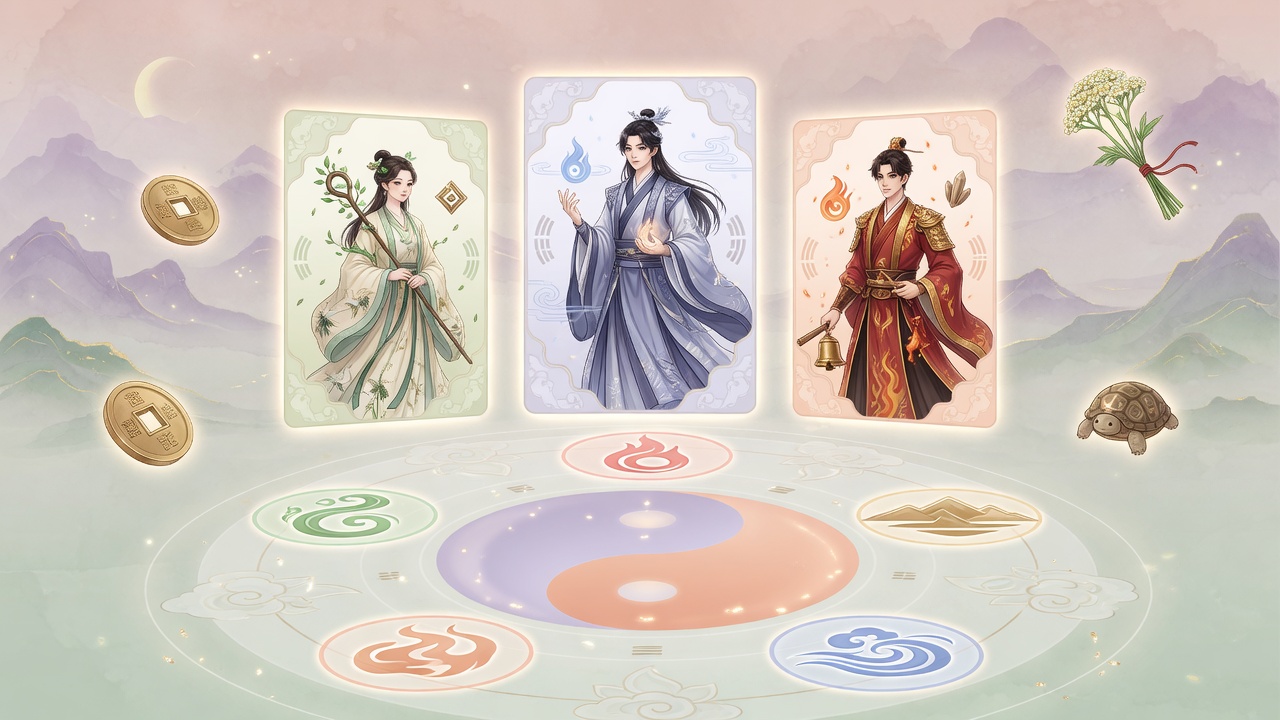
Basic Clarification: Destiny Analysis is Not a 'Class Predictor'
Common Misconceptions
The Ten Gods in Bazi are energy symbols derived from the relationships between the Day Master's Heavenly Stem and the other stems and branches. Output (a collective term for the 'Eating God' and 'Hurting Officer' stars) represents talent expression, creativity, enjoyment, and freedom. Peer (a collective term for 'Friend' and 'Rob Wealth') represents the self, competition, friends, and action. Together, they paint a picture of a person's behavioral baseline, not their specific choices.
- Misconception 1: Bazi can precisely calculate which class you should play in a game. In reality, the chart only reflects personality tendencies and energy preferences; class choices are also influenced by real-world factors like a version's power level and friend recommendations.
- Misconception 2: The Five Elements directly correspond to game classes. A Fire-element person won't necessarily love mages, and a Water-element person might enjoy melee combat. The Five Elements are just macro energy labels; specifics require a combination of the Ten Gods and chart structure.
- Misconception 3: Strong Output always means a love for DPS, and strong Peer always means a love for support. Destiny analysis emphasizes overall balance. An overly strong Output might manifest as a short attention span, while an unfavorable Peer star can actually cause stress in collaborative settings.
Core Insights: How Output and Peer Stars Map to Game Character Preferences
The Output Star: Creativity and Expressiveness in Gaming
In a Bazi chart, the Output star is what the Day Master produces, representing outward-releasing energy. People with a strong Output are typically imaginative, pursue a sense of technical control, and enjoy the satisfying feedback of skill combos. In *MapleStory*, these players often gravitate towards classes with high burst damage, high mobility, or intricate mechanics.
For example, classes like the Fire-Poison Mage, Marksman, or Dual Blade feature flashy skills and rich combos, perfectly satisfying an Output person's desire for 'expression' and 'showing off.' When choosing a character, they value the visual impact and skill ceiling of the animations more than pure survivability.
- The Eating God is gentle and meticulous, preferring classes with sustained, rhythmic damage, like the Bishop or Ice-Lightning Mage. They are used to supporting the entire team with consistent performance.
- The Hurting Officer pursues extremes and individuality, tending towards niche or high-difficulty classes like the Angelic Buster or Cadena, enjoying the unique feeling of 'having what others don't.'
- Five Element Mapping: An Output star associated with Fire or Earth often loves burst-type skills, while one associated with Metal or Water values the fluidity of control and combos.
The Peer Star: Competitive Instinct and a Sense of Team Belonging
The Peer star shares the Day Master's Five Element, symbolizing self-awareness, competitiveness, and fellowship. Players with a strong Peer star have an innate desire to 'fight side-by-side.' When choosing a class, they heavily weigh its team role, tankiness, and collaborative abilities. These players form the backbone of guild wars and party quests.
In *MapleStory*, warrior classes like the Paladin, Dark Knight, and Mihile, along with functional supports like the Beast Tamer and Mechanic, are often favored by those with a strong Peer star. They are happy to take on the role of protecting teammates and drawing enemy fire, deriving a sense of achievement from team victories.
- Favorable Peer: Actively seeks teamwork and enjoys fixed parties. Class choices lean towards tanks, supports, or characters with team-buffing skills.
- Unfavorable Peer: May frequently change classes due to excessive competition or easily clash with others in-game, yet they still cannot detach from social gameplay.
- Five Element Mapping: A Peer star associated with Wood or Fire often loves charging into battle, while one associated with Metal or Earth prefers defensive counterattacks and positional warfare.
How the Five Elements Quietly Influence Class Preferences
Beyond the Ten Gods, the relative strength of the Five Elements in a Bazi chart also subtly guides choices. A person lacking Wood might be drawn to high-mobility, multi-displacement classes to compensate for the 'expansive' feeling of Wood in their chart. Someone with strong Fire naturally feels an affinity for flame-based skills and might instinctively reject ice-type characters.
This preference is not absolute, but over long-term observation, players often find themselves gravitating towards a specific category of classes. For instance, those with a strong Water chart more easily accept control classes requiring calm calculation, while those with a strong Earth chart prefer the steady, methodical grinding style of a map-clearing character.
It's worth noting that the game's classes themselves carry elemental connotations. *MapleStory*'s mage classes are often associated with Fire, Ice, and Lightning; warriors with Metal and Earth; and thieves with Wood and Water. This design accidentally creates a cultural resonance with the Five Elements of destiny analysis.
- Wood: Represents growth and flexibility, corresponding to high attack-speed, multi-movement classes like Thieves and Archers.
- Fire: Represents passion and burst, corresponding to classes with instantaneous damage like the Fire-Poison Mage and Flame Wizard.
- Earth: Represents heaviness and endurance, corresponding to tanky warriors like the Paladin and Dark Knight.
- Metal: Represents sharpness and decisiveness, corresponding to classes emphasizing one-hit kills, like the Dawn Warrior and Hayato.
- Water: Represents wisdom and flow, corresponding to classes skilled in control and kiting, like the Ice-Lightning Mage and Shade.
Pitfall Guide: For Entertainment Only, Don't Take It Personally
Important Notes
- Reminder 1: Bazi destiny analysis is for entertainment reference only. Game class choices should still be based on personal preference, playstyle habits, and the actual power level of the current version.
- Reminder 2: Do not use destiny labels to limit yourself or others. Statements like 'Your Output star is weak, you can't play a DPS class' not only contradict the holistic view of destiny analysis but also ruin the gaming experience.
- Reminder 3: If you find yourself frequently changing classes and still feeling unsatisfied, this might reflect an excessively strong Peer or mixed Output in your chart. In such cases, try the game's versatile job-change system instead of forcing a single answer.
- Reminder 4: Five Element preferences can shift with your 10-year luck cycles or yearly influences. A strong Water year might suddenly make you fall in love with an ice-type class; this is just a short-term energy fluctuation and shouldn't be over-interpreted.
- Reminder 5: The correspondence between in-game class names and the Five Elements is merely a cultural association and has no strict basis in destiny analysis. Do not rigidly apply it to real-life personality or fate predictions.
Summary and Review
The wave of character choices sparked by the *MapleStory* summer update provides a fun window for observing our own personality tendencies. The creativity and expressiveness driven by the Output star, the competitive and collaborative instincts represented by the Peer star, and the subtle pull of Five Element energies together weave the fabric of a player's preferences in the virtual world.
Understanding these destiny symbols is not about prediction or limitation, but about using the game as a mirror to know ourselves more lightheartedly. Key Conclusion: The correspondence between Bazi and game classes is, at its core, an entertaining reflection of cultural psychology. Enjoying the process of choosing is far more important than fretting over right or wrong.