Manchester City Transfer Chain Reaction: Viewing Team Collaboration and Timing Through the Ten Gods
Recently, Manchester City's transfer market has seen a chain reaction: rumors involving Rodri, Tijjani, and Enzo Fernandez are interlocked, dubbed by fans as a 'domino effect.' From the perspective of BaZi destiny analysis, this kind of *
Opening Introduction
Recent transfer rumors surrounding Rodri, Tijjani, and Enzo Fernandez at Manchester City have formed a chain reaction, described by the media as a 'domino effect.'
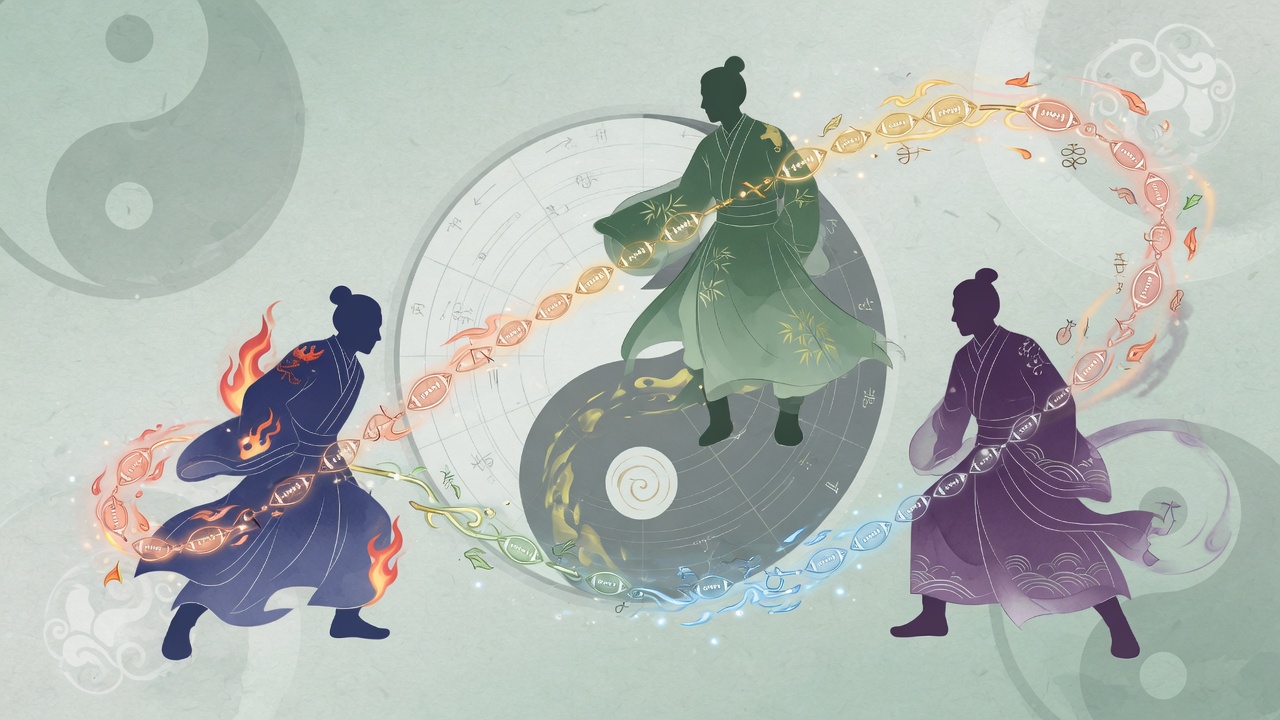
This interlocking team adjustment can be understood through the interaction of the Ten Gods in BaZi culture: each role is like a different Ten God, mutually generating and controlling each other to form a flow.
This article is purely a traditional cultural education piece. It does not predict any player performance or team results, nor does it involve personal privacy.
Basic Clarification
Many people new to destiny analysis easily mistake the Ten Gods for concrete real-life individuals, or think that a certain configuration can directly determine success or failure.
In reality, the Ten Gods are abstract relationships between the Day Master and other stems and branches, reflecting patterns of energy interaction, not specific persons or events.
Using the Ten Gods as an analogy for a team merely borrows their relational logic to help us understand role division and timing choices in collaboration.
Common Misconceptions
- Misconception 1: Equating 'Eating God/Hurting Officer' simply with a specific player's technical traits. Eating God and Hurting Officer are abstract attributes of output and expression, not concrete labels.
- Misconception 2: Thinking that 'Eating God/Hurting Officer producing Wealth' or 'Officer and Seal mutually generating' are fixed good configurations. Destiny analysis emphasizes dynamic balance; combination and timing are far more important than judging a single Deity in isolation.
- Misconception 3: Using BaZi to predict transfer outcomes or match scores. This article is purely cultural education and does not involve any real-world predictions or privacy inferences.
- Misconception 4: Believing that Ten God relationships can be judged independently of the Day Master. In fact, all Ten Gods must be positioned relative to the Day Master, otherwise they are meaningless.
Core Points
Ten Gods Basics: An Abstract Language for Understanding Team Roles
In BaZi, the Day Master represents oneself or the team core. The other seven characters form ten types of relationships with the Day Master, collectively known as the Ten Gods.
The Ten Gods include Peer, Rob Wealth, Eating God, Hurting Officer, Direct Wealth, Indirect Wealth, Direct Officer, Seven Killings, Direct Seal, and Indirect Seal — ten in total.
Among them, Eating God and Hurting Officer (the Output Stars) represent output, talent, and expression; Wealth Stars represent resources, goals, and results; Officer and Killings Stars represent rules, pressure, and management; Seal Stars represent learning, support, and backing.
Understanding the interaction of the Ten Gods allows us to interpret the functions and coordination of different roles within a team from a traditional perspective, avoiding attributing everything to individual ability.
In the context of transfers, different positions — midfield, forward, defense — can be analogized to different Ten God functions: some focus on output, some on defense, some on orchestration.
The mutual generation and control among the Ten Gods determine the direction and balance of energy. For example, Peer/Rob Wealth helping the body can strengthen the Day Master's power but may also bring competition.
The quality of a team combination depends on whether the Ten God configuration allows overall energy to flow smoothly, not on simply pursuing the quantity or strength of a single type of Deity.
A 'good configuration' in destiny analysis often arises because the Ten Gods form a smooth generating and controlling cycle, such as Output producing Wealth, Wealth producing Officer, Officer producing Seal, Seal producing the Self.
- Day Master: The team core or decision-maker, analogous to the tactical hub of a team.
- Output Stars (Eating God/Hurting Officer): Creative output, technical execution, analogous to offensive creativity.
- Wealth Stars: Resource integration, goal achievement, analogous to transfer budgets and final results.
- Officer/Killings Stars: Institutional constraints, competitive pressure, analogous to league rules and opponent strength.
- Seal Stars: Backstage support, experience transmission, analogous to the coaching team and youth academy system.
- Peer/Rob Wealth: Peer collaboration or internal competition, analogous to cooperation and positional rivalry among teammates.
- Generating and Controlling Principle: Generation represents energy transmission; control represents restriction and adjustment.
- Dynamic Perspective: Ten God combinations change with Luck Pillars and annual cycles; team configurations also need timely adjustment.
Output Producing Wealth: The Flow Logic from Creativity to Resources
Among the generating cycles of the Ten Gods, Output producing Wealth is one of the most fluid combinations. Output Stars represent talent, expression, and production; Wealth Stars represent results, gains, and disposable resources.
When Output energy smoothly transforms into Wealth, it symbolizes effective implementation of personal ability, where creativity and technology within a team can be converted into actual value — this is precisely the 'output-reward' cycle in collaboration.
The chain reaction in the transfer market often originates from a change in a key position, triggering a series of Output Stars (new signings, new tactics) to pursue Wealth Stars (squad reinforcement, resource reallocation).
But destiny analysis emphasizes moderation: if Output is too strong without Wealth to channel it, ideas may exist but struggle to materialize; if Wealth is too heavy without sufficient Output, there may be many goals but a lack of sustained production.
From a team perspective, the Output producing Wealth configuration suggests: both creative outputters and resource integrators are needed; one cannot function without the other.
Regarding individual timing choices, when one's own ability (Output) is mature and external resources (Wealth) can be connected, it is often easier to facilitate a positive flow.
Taking transfers as an example: if a creative midfielder (Output) joins, but there is no suitable striker or tactical system (Wealth) to receive it, their value is difficult to realize.
Conversely, if a team has ample budget and clear goals (strong Wealth) but lacks technically skilled players (weak Output), it may fall into the dilemma of 'having money but unable to spend it' or 'buying the wrong players.'
A healthy team ecosystem should have a relative balance between Output and Wealth, giving creativity an outlet and resources a source, forming a positive cycle.
In destiny analysis, Output producing Wealth also represents earning through skill, reminding us that continuously honing professional ability is the prerequisite for acquiring resources.
- Positive Flow: Talent → Results, Technique → Gains.
- Collaboration Insight: A team needs both 'output-side' and 'resource-side' roles simultaneously.
- Imbalance Risk: Excessive Output leads to idling; excessive Wealth leads to overextension.
- Timing Judgment: When ability and resources match, flow efficiency is highest.
- Real-world Mapping: The introduction of a 'creative midfielder' in transfers can be seen as strengthening Output to produce Wealth.
- Cultural Connotation: Output producing Wealth also symbolizes 'just rewards for effort,' aligning with traditional values.
- Dynamic Adjustment: When an Output surplus is detected, add Wealth Star roles; when a Wealth surplus occurs, enhance Output ability.
- Avoid Extremes: Do not blindly pursue the strength of a single Deity; focus on whether the generating and controlling chain is unobstructed.
Officer and Seal Mutual Generation: The Stable Structure of Institutional Support and Personal Growth
Unlike Output producing Wealth's 'output-gain' dynamic, Officer and Seal mutual generation focuses more on the coordination of rules and support.
Direct Officer represents norms, responsibility, and management; Direct Seal represents learning, protection, and experience. Officer generates Seal, and Seal protects the Self, forming a stable upward cycle.
In a team, Officer and Seal mutual generation is like the coaching staff (Seal) providing a tactical system, the players (Day Master) performing within the rules, and the management (Officer) maintaining order.
This combination symbolizes a sense of order and growth potential in collaboration: individuals receive support within an institutional framework, and the team progressively upgrades in stability.
However, if the Officer Star is too strong and the Seal Star cannot transform it, it may manifest as excessive pressure and constraint; conversely, if the Seal Star is too heavy and the Officer Star insufficient, it can easily lead to complacency and a lack of competitive awareness.
In a transfer chain, if a change in one link disrupts the original Officer-Seal balance, it may trigger a series of subsequent adjustments until a new steady state is formed.
Officer and Seal mutual generation also reminds us: an excellent team needs not only rule constraints but also cultural nourishment; pressure without support leads to member burnout.
From a personal development perspective, the Officer and Seal mutual generation configuration is suitable for accumulating qualifications in a stable environment and gradually taking on greater responsibilities, rather than frequent changes.
In reality, 'mid-career players' often possess characteristics of both Officer and Seal: they have match experience (Seal) and also bear locker-room discipline (Officer), acting as team glue.
If a team lacks such roles, problems like lax discipline or broken lineage may arise, affecting long-term competitiveness.
- Officer Star: Represents external rules and competitive pressure, like league rankings and transfer restrictions.
- Seal Star: Represents internal support, learning, and protection, like coaching philosophy and youth academy reserves.
- Destiny Insight: Good collaboration has both constraints and backing; balance between the two is needed for sustainability.
- Risk Warning: Strong Officer with weak Seal leads to anxiety; strong Seal with weak Officer leads to slackness.
- Team Application: Introducing experienced 'Officer Star' type players, or strengthening 'Seal Star' type coaching support, can adjust the team ecosystem.
- Cultural Connotation: Officer and Seal mutual generation symbolizes order and heritage, a stable structure esteemed in traditional society.
- Timing Choice: When a team needs to build systems and consolidate culture, Officer and Seal mutual generation is more suitable than Output producing Wealth.
- Long-term Perspective: A stable structure benefits talent pipeline construction, but must guard against excessive rigidity.
Pitfall Avoidance Guide
Important Notes
When using the Ten Gods as an analogy for real-world teams, always maintain the boundary of cultural education and avoid over-application or mystification.
- Note 1: Do not use Ten God configurations to 'judge' whether a certain player should transfer or will succeed; this falls into the realm of prediction, which this article does not cover.
- Note 2: The quality of a team combination depends on overall balance, not the strength of a single Deity; avoid one-sided interpretations.
- Note 3: Ten God interactions are dynamic; timing changes lead to configuration changes. There is no eternal 'best combination.'
- Note 4: Understanding 'Output producing Wealth' as creativity transforming into resources, and 'Officer and Seal mutual generation' as the coordination of rules and support, is the appropriate analogy.
- Note 5: Absolutely do not arbitrarily substitute a player's birth time into BaZi for calculation; this is both baseless and a violation of privacy.
- Note 6: Hot events can serve as a hook for education, but the main body must return to traditional culture itself, avoiding excessive trend-chasing.
- Note 7: Destiny analysis is one perspective for observing the world, not a scientific decision-making tool; team management still relies on real data and professional judgment.
- Note 8: When discussing in culturally diverse regions like Indonesia, pay attention to respecting local beliefs and customs, and avoid absolutizing destiny analysis.
- Note 9: Do not use 'Output producing Wealth' to encourage quick success and instant benefits; traditional destiny analysis equally emphasizes virtue and timing.
- Note 10: If you are not yet familiar with the concept of the Ten Gods, it is recommended to understand the basics first before applying them to complex scenarios, to avoid misinterpretation.
Summary and Recap
The Manchester City transfer chain reaction is merely a starting point; the core is understanding team collaboration and timing through the Ten Gods: Output producing Wealth symbolizes the flow from creativity to resources, and Officer and Seal mutual generation symbolizes the balance between rules and support.
Key Conclusion: Traditional destiny analysis does not predict specific events but provides a thinking framework for dynamic relationships — a good combination lies in proportion and timing, not the isolated strength of a single Deity.
No matter how the transfer market changes, the underlying logic of team building is always energy circulation and role complementarity, which coincides with the wisdom of Ten God generation and control.