From Malaysia’s Anti-Corruption Case to Bazi ‘Zheng Guan’ and ‘Qi Sha’: Rules, Boundaries, and the Cultural Wisdom of Integrity
In October 2026, the Malaysian Anti-Corruption Commission (SPRM) seized 15 luxury cars and detained two corporate executives, reigniting public reflection on the separation of public and private interests. In Eastern destiny systems, Bazi’s **Zhe
Opening Introduction
In October 2026, the Malaysian Anti-Corruption Commission (SPRM) seized 15 luxury cars and detained two corporate executives, reigniting public reflection on the separation of public and private interests.
In Eastern destiny systems, Bazi’s Zheng Guan and Qi Sha are precisely the core symbols for exploring the relationship between individuals, rules, and boundaries.
How did the ancients, through the force that “controls me,” understand integrity and self-restraint versus the boundaries of desire? This article unveils their way of thinking from a cultural interpretive perspective.
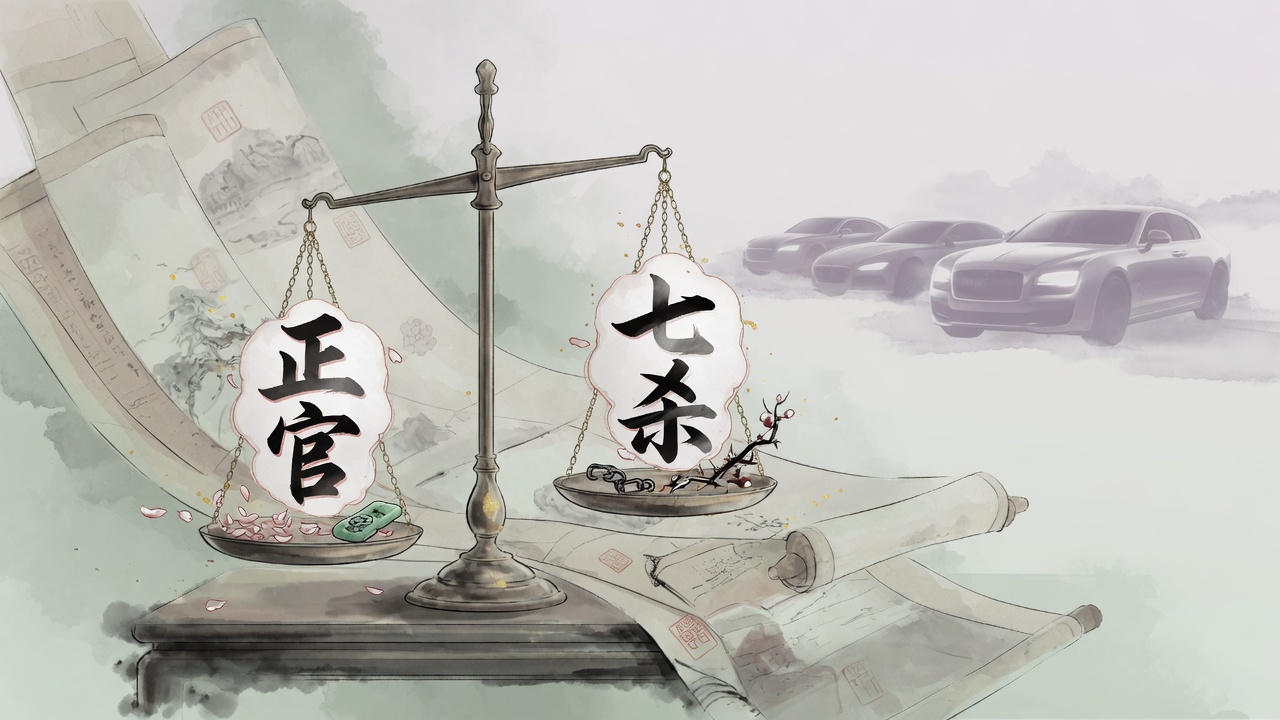
Basic Clarification: Dispelling Myths About Zheng Guan and Qi Sha
Common Misconceptions
- Misconception 1: Zheng Guan means being an official or civil servant. In reality, Zheng Guan is the element of the opposite polarity that controls the Day Master, representing all laws, discipline, rules, and a sense of responsibility — a person’s commitment to society and self-restraint.
- Misconception 2: Qi Sha is a malefic star representing disasters and villains. Although Qi Sha carries coercion and pressure, it also symbolizes boldness, authority, and the drive to break through boundaries. The key lies in whether it can be transformed.
- Misconception 3: Bazi can directly determine whether a person is corrupt. Destiny analysis reflects innate temperament and behavioral tendencies; postnatal education, environment, and free will are the decisive factors.
- Misconception 4: The stronger the Officer and Sha stars, the better. If Officer and Sha are too strong while the Day Master is weak, they become heavy pressure and shackles, potentially leading to rule evasion or reckless risk-taking. Balance is crucial.
Cultural Background: Officer and Sha Originate from Natural Generation and Control Cycles
The Ten Gods in Bazi stem from the relationships of the Five Elements’ generation and control. The one that controls the Day Master is called Officer and Sha: same-polarity control is Qi Sha, opposite-polarity control is Zheng Guan. The ancients used social relationships to analogize natural laws, forming a unique ethical perspective.
Under the influence of Confucianism, Zheng Guan was endowed with the connotation of “propriety,” representing the internalization of external norms; Qi Sha corresponds to “military” and “punishment,” emphasizing coercion and deterrence. Together, they constructed the ancient framework for understanding power and boundaries.
- Ethical Implications of Officer and Sha: Zheng Guan is Yang controlling Yin, symbolizing open and fair constraints; Qi Sha is Yin controlling Yin, symbolizing covert and coercive pressure. Together they form the dual dimensions of social control.
Core Points: Rules, Boundaries, and the Separation of Public-Private Interests in Zheng Guan and Qi Sha
Zheng Guan: The Guardian of Order and Integrity
Zheng Guan is the opposite-polarity controller of the Day Master, its force gentle yet persistent, like the soft constraint of social norms on the individual. It demands adherence to laws, morals, and professional ethics, forming a clear boundary between public and private.
When the ancients analyzed a chart, they first examined whether Zheng Guan was clear and unsullied. Those with a functional Zheng Guan are often upright, law-abiding, and responsible, able to consciously resist temptation and place public interest above personal desire. This “control” is not suppression but protection, preventing disasters caused by crossing boundaries.
From a cultural perspective on Malaysia’s anti-corruption case, those involved might have had Zheng Guan as an unfavorable element without remedy, manifesting as a weak awareness of rules or a lack of reverence for power boundaries. Conversely, those with a strong Zheng Guan can remain clear-headed in the face of interests, embodying the integrity and self-restraint the ancients revered.
Zheng Guan also represents reputation and prestige. The ancients said, “The Officer star reveals nobility,” referring not just to position but to the social respect earned through virtuous conduct. This respect in turn reinforces self-discipline, creating a virtuous cycle.
In chart combinations, Zheng Guan favors Wealth generating Officer, using resources to nourish responsibility; it even more favors Seal protecting Officer, using knowledge and cultivation to consolidate principles. If the Officer star is broken by Hurting Officer, one tends to disdain rules and challenge authority, blurring the line between public and private.
- Zheng Guan as Favorable: Acts with propriety, values reputation, clearly separates public and private, suitable for roles requiring high self-discipline such as supervision, judiciary, and auditing.
- Zheng Guan as Unfavorable: May feel heavily shackled, inwardly rebellious; if lacking Seal transformation, may easily go to the extreme of disregarding rules or collapse under pressure.
- Mixed Officer and Sha: When Zheng Guan and Qi Sha appear together, it represents an inner tug-of-war between rules and ambition. If not properly managed, one may waver between public and private, even becoming duplicitous.
- Officer Star Encountering Hurting Officer: Hurting Officer meeting Officer brings manifold troubles, most easily triggering a mindset of confronting rules, preferring shortcuts and loopholes, discarding the public-private boundary.
- Zheng Guan Sitting on Robust Root: The Officer star sits on its own strong root, such as Jia Wood encountering Xin You, representing deeply ingrained principles, able to hold the bottom line even under great temptation.
- Zheng Guan Cooperating with Wealth Star: Wealth can generate Officer, but if Wealth is overly strong while Officer is weak, one may easily lose integrity for wealth, breaking rules for money. At such times, the Seal star is urgently needed to restrain the mind and return to the right path.
Qi Sha: Challenging and Harnessing Boundaries
Qi Sha (Indirect Officer) is the same-polarity controller of the Day Master, its force fierce and direct, symbolizing competition, pressure, high risk, and unconventional means. Unlike the gentle and orderly Zheng Guan, it directly impacts personal desires and boundaries.
If Qi Sha is uncontrolled, a person may be impulsive, combative, and disregard rules, willing to cross boundaries to achieve goals. But if there is Eating God controlling Sha or Seal transforming Sha, this force can be converted into outstanding decisiveness and execution, becoming a general who expands frontiers within the rules.
From an anti-corruption perspective, those with overly strong and uncontrolled Qi Sha easily break the bottom line under the temptation of power and wealth, like a tiger out of its cage. Those with proper control and transformation can use Qi Sha’s boldness to uphold law and discipline, becoming iron-fisted pioneers in eradicating corruption.
The ancients emphasized, “When Qi Sha is controlled, it transforms into authority,” meaning the impulse to break boundaries must be tamed by morality and institutions (Eating God/Hurting Officer, Seal) to achieve success without harming public justice. This transformation is essentially using wisdom to subdue force, using virtue to govern authority.
Qi Sha also represents dignity and decisiveness. In a chart, if Qi Sha holds power and the Day Master is strong, one often becomes a strict, fearless leader who upholds the public-private boundary with near-rigid adherence. Conversely, if the body is weak and Sha is strong, one is easily devoured by desire.
- Eating God Controlling Sha: Uses wisdom and talent to dissolve aggression, channeling competitiveness into legal and rule-abiding paths, a typical case of “persuading through reason,” capable of turning hostility into harmony.
- Sha Generating Seal: Uses knowledge and cultivation (Seal star) to transform Qi Sha’s ferocity, forming a leadership style of authority with benevolence, valuing reputation and responsibility, advancing and retreating with propriety.
- Weak Body, Strong Sha: When the Day Master is weak and Qi Sha runs rampant, it is like a small boat on a raging sea, easily swallowed by desire. If activated by Luck Pillars or annual cycles, one may take desperate risks, ignoring laws.
- Sheep Blade Controlling Sha: When the Day Master is strong and uses Qi Sha, combined with Sheep Blade, one can use force to subdue force, use severity to subdue severity, achieving extraordinary results in special fields (e.g., military, police, anti-corruption), but must guard against excess leading to breakage.
- Removing Mixed Officer and Sha: When Zheng Guan and Qi Sha are mixed, one must be removed. If removing Guan and keeping Sha, one chooses to act with authority; if removing Sha and keeping Guan, one returns to the proper path of rules — a destiny reflection of major life choices.
- Qi Sha and Rob Wealth: When Rob Wealth is strong and Qi Sha is weak, competitiveness is high but deterrence is lacking, easily leading to forming cliques and disregarding rules; if Qi Sha is functional, it can discipline peers, forming a strictly disciplined team.
Ancient Thinking on the Public-Private Boundary: Seeing Self-Discipline Through ‘Control’
The core of Bazi destiny analysis is balance and harmony. Zheng Guan and Qi Sha, as forces that “control me,” essentially depict the individual’s relationship with external rules. The ancients believed that the public-private boundary is not an externally imposed chain but a natural expression of inner virtue.
In classics like *Yuan Hai Zi Ping*, when discussing Officer and Sha, one must examine the Day Master’s strength, and whether Seal or Eating God is present. This aligns with the Confucian sequence of “cultivate oneself, regulate the family, govern the state, and bring peace to the world”: first, one must be strong oneself (Day Master with root), then nourished by benevolence (Seal star), and judged with wisdom (Eating God/Hurting Officer) to properly exercise power.
Therefore, when the ancients assessed whether a chart was noble and pure, they did not only look at the amount of Wealth and Officer, but emphasized whether the Officer star was clear and pure, and whether Qi Sha was tamed. This reflects a profound cultural psychology: integrity and self-restraint is not about suppressing desires, but about channeling desires into a reasonable track through cultivation, achieving a win-win for the individual and society.
“Control” in destiny analysis is not derogatory. The control of Zheng Guan is the control of rules; the control of Qi Sha is the control of tempering. As the *I Ching* says, “The superior person curbs anger and restrains desire.” This effort of restraint is the very source of the ancients’ wisdom on the public-private boundary.
In modern society, this thinking remains vivid. When we face conflicts of interest, the inner “Zheng Guan” reminds us to hold the bottom line, and the tamed “Qi Sha” gives us the courage to refuse temptation. Destiny analysis merely symbolizes this inner dialogue.
- Pure Officer Structure: The Officer star is clear and unsullied, unbroken by Hurting Officer, unmixed with Qi Sha, indicating a person of uprightness and integrity, able to hold the bottom line — the gentleman whom the ancients could “entrust an orphaned child to.”
- Turbid Officer Structure: Mixed Officer and Sha, or the Officer star being combined and transformed, easily leads to confusing public and private, wavering stances, losing principles in the face of temptation, even abusing power for personal gain.
- Self-Discipline Is Freedom: The ancients said “restrain oneself and return to propriety.” The “control” of Zheng Guan and Qi Sha is precisely the symbol of self-restraint. Restraint is not the goal; achieving a higher level of spiritual freedom and social harmony through restraint is the true meaning.
- Destiny Mapping of the Public-Private Boundary: Zheng Guan represents the public, Qi Sha the private (partial). When Qi Sha is uncontrolled, private desire overrides public justice; when Zheng Guan is strong, public-mindedness guides private actions. This relationship is the ancients’ model for understanding the collective and the individual.
- Transformation, Not Elimination: Destiny analysis never advocates eliminating Qi Sha, but controlling and transforming it. Similarly, desires are not to be eradicated but guided onto the right path. This is the full meaning of integrity and self-restraint.
- Officer, Sha, and Changing Times: Ancient times valued Zheng Guan; in modern pluralistic society, Qi Sha also has its uses. But no matter how times change, rules and boundaries remain the cornerstone of civilization. The wisdom of destiny analysis lies in reminding us to find that balance point.
Pitfall Avoidance Guide: Rationally Viewing the Connection Between Destiny and Reality
Points to Note
- Do not equate destiny analysis directly with moral judgment: Bazi shows innate tendencies; postnatal education, environment, and personal choices are more critical. One must never conclude that someone is immoral simply because their chart has mixed Officer and Sha.
- Avoid using a single Ten God to explain complex events: Anti-corruption cases involve multiple factors such as institutions, economics, and human nature. Destiny analysis provides only a cultural perspective; do not simplify cause and effect, nor should it replace legal and ethical judgments.
- Avoid the trap of “fatalism”: Even if Qi Sha is uncontrolled, through self-cultivation, studying law (Seal star), and developing talents (Eating God/Hurting Officer), one can still transform the mind and hold boundaries. Destiny is a map, not a verdict.
- Respect privacy and the law: Do not use public figures’ birth data for destiny analysis and public dissemination. This violates ethics and may break the law. This article is purely cultural education and does not involve any specific individual.
- Maintain propriety when linking current events: This article uses news to introduce traditional cultural discussion, without alluding to any specific person or predicting case outcomes. Maintaining rationality and reverence is the basic premise for discussing destiny analysis.
Summary and Review
Malaysia’s anti-corruption case once again sounds the alarm on rules and boundaries. In Bazi, Zheng Guan and Qi Sha are precisely the wisdom symbols through which the ancients internalized external constraints into mental cultivation. Integrity and self-restraint are not innate; they come from learning reverence, transformation, and self-discipline within the force that “controls me.” Understanding Officer and Sha is understanding our way of coexisting with the world, and it is cultural nourishment every modern person can draw upon.