Leung Yan's Long-Term Unhappiness Sparks Discussion: Emotional Health and Traditional Wisdom Through the Lens of Five Elements Balance
Former TVB actress Leung Yan recently shared a cascade of negative emotions, revealing long-term unhappiness and a sense of 'suffocation,' drawing public attention. Emotional distress is not an isolated case; in traditional Chinese metaphysics, the *
Introductory Reading Guide
According to Hong Kong media reports, former TVB actress Leung Yan is widely known for her role as 'Vanguard Pan Jinlian' in 'Come Home Love: Lo and Behold.' After leaving the network, her career development has been mediocre and her income unstable. She has repeatedly expressed negative emotions on social media, stating bluntly that she is 'perpetually unhappy' and filled with a sense of suffocation.
Her public confession has resonated with many and reignited discussions about emotional health.
From the perspective of traditional Bazi theory, a person's innate Five Elements configuration is linked to their temperament and emotional tendencies. Those with balanced Five Elements tend towards mental and physical harmony, while an imbalance may manifest as specific emotional distress. Of course, this is not fatalism but a kind of wisdom derived from ancient observations of the human body and nature.
This article uses Leung Yan's situation as a springboard to popularize the concept of Five Elements balance and see how tradition interprets emotional health.
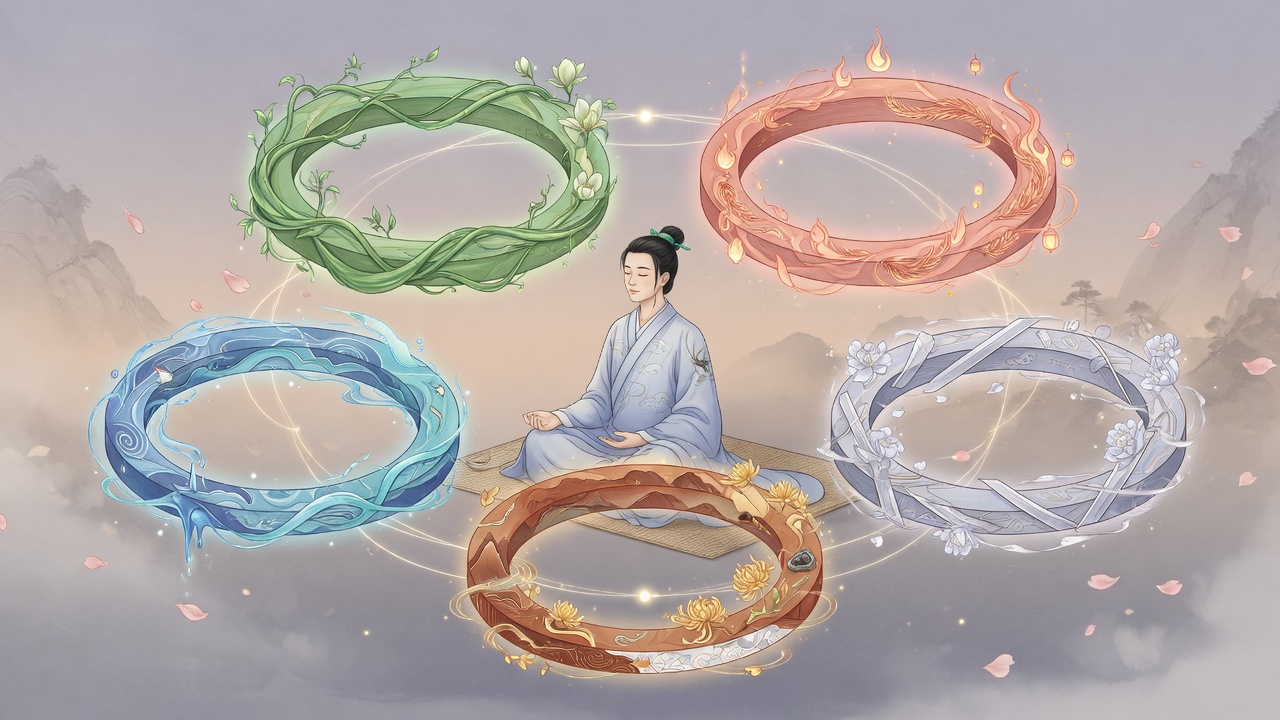
Basic Clarification: Bazi is Not a Fatalistic Label
Common Misconceptions
- Misconception 1: Bazi determines your fate, and you just need to supplement whatever element is missing. In reality, a Bazi chart reflects innate energy trends, but postnatal environment, education, and personal choices have a greater influence. Five Elements balance emphasizes the overall dynamic flow; both excess and deficiency require dialectical treatment, not simple 'supplementation.'
- Misconception 2: Emotional problems are solely determined by the Five Elements. Modern psychology and medicine confirm that emotions are influenced by physiology, cognition, social environment, and many other factors. The Five Elements is just one traditional observational dimension and cannot replace professional diagnosis and treatment.
- Misconception 3: Changing your name or wearing an accessory can quickly reverse your emotional state. Five Elements regulation is a systemic process involving lifestyle adjustments, environmental changes, and mental cultivation. Quick-fix luck claims are mostly commercial gimmicks lacking substantial evidence.
- Misconception 4: Five Elements balance means an equal distribution of the five elements. True balance is a dynamic 'neutralization,' like an ecosystem where orderly generation and restraint create stability. Sometimes a slightly stronger element is beneficial; the key lies in overall coordination.
- Misconception 5: Bazi can predict emotions with 100% accuracy. Destiny analysis provides a reference for tendencies, but a person's subjective initiative and postnatal growth can change many things. Never self-limit based on a deterministic reading of your chart.
The Correlation Logic of Five Elements and Emotions
In the Bazi and Traditional Chinese Medicine systems, the Five Elements (Metal, Wood, Water, Fire, Earth) correspond to the five major organs (Lungs, Liver, Kidneys, Heart, Spleen) and the five emotions (Grief, Anger, Fear, Joy, Anxiety). For example, Wood governs benevolence; when excessive, it can lead to irascibility. Fire governs propriety; when excessive, it can lead to agitation. Earth governs trustworthiness; when excessive, it can lead to overthinking. Metal governs righteousness; when excessive, it can lead to melancholy. Water governs wisdom; when excessive, it can lead to fear.
This correspondence originated from the ancient 'analogy and classification' way of thinking, emphasizing dynamic balance. When a particular element's energy deviates from the norm, it can trigger related emotions. However, this is not a mechanical formula; individual differences are vast, requiring comprehensive judgment.
Of course, the correspondence between the Five Elements and emotions is not absolute. Bazi destiny analysis also involves complex factors like the Ten Gods, chart structures, and Luck Pillars, requiring comprehensive consideration in actual practice. But as an introductory tool, the concept of Five Elements balance helps us establish a preliminary mind-body connection.
- Key Point: Five Elements balance pursues a state of 'neutralization,' not egalitarianism. Like a symphony, it sounds pleasant only when all sections coordinate; a slightly prominent instrument is not necessarily jarring.
Five Elements Balance: The Traditional Path to Mind-Body Harmony
Five Elements Basics: Understanding Your Energy Map
The Five Elements are not five material substances but five energy states: Wood represents growth and flexibility, like spring plants. Fire represents warmth and ascendance, like summer sunshine. Earth represents bearing and transformation, like the generous soil.
Metal represents contraction and purification, like autumn's solemnity. Water represents moistening and storing, like winter's cold water. Together, they form the basic driving forces of the world's operation.
The Five Elements maintain energy flow through the Generation Cycle (Wood generates Fire, Fire generates Earth, Earth generates Metal, Metal generates Water, Water generates Wood) and prevent excess through the Restraint Cycle (Wood restrains Earth, Earth restrains Water, Water restrains Fire, Fire restrains Metal, Metal restrains Wood). When generation and restraint are normal, the climate is moderate and the body is at ease; when abnormal, disasters arise and emotions become unbalanced.
A Bazi chart is the combination of Heavenly Stems and Earthly Branches for the year, month, day, and hour of birth, totaling eight characters. The Heavenly Stem of the day pillar represents the self, known as the Day Master. Analyzing the Five Elements interactions between the Day Master and other stems and branches reveals the innate energy pattern: whether the Day Master is strong or weak, the distribution of the Five Elements, and what is favorable or unfavorable.
For instance, if the Day Master is Wood and you are born in spring, Wood energy is abundant, requiring Metal to prune it and Earth to support its roots to achieve balance. Understanding your Five Elements tendencies is not for labeling but for reading an 'owner's manual' to comprehend innate traits, thereby cultivating mind and body more purposefully. However, remember that postnatal effort is always more important than innate configuration.
Furthermore, the Five Elements also correspond closely with directions, seasons, colors, and flavors: Wood corresponds to East, Spring, Cyan, and Sour; Fire to South, Summer, Red, and Bitter; Earth to Center, Late Summer, Yellow, and Sweet; Metal to West, Autumn, White, and Pungent; Water to North, Winter, Black, and Salty. Understanding these correspondences helps flexibly apply Five Elements regulation in daily life.
In Bazi analysis, beyond the Day Master's element, one must also consider the strength of the Month Branch (birth month). For example, a Wood Day Master born in the Yin or Mao month (spring) is in a commanding phase and is strong; born in the Shen or You month (autumn), it is restrained and weak. Different strengths lead to opposite likes and dislikes, which is the exquisite dialectical nature of the Five Elements.
- Core Concept: Balance is not static but a dynamic cycle. Normal generation and restraint lead to a peaceful body and mind; abnormal cycles lead to emotional distress. The essence of regulation is restoring flow, not suppressing an element.
Emotional Signals of Five Elements Imbalance
When the Five Elements' energy deviates from neutrality, the ancients observed certain emotional tendencies. The following descriptions are general patterns, not diagnostic criteria. Please do not apply them directly to yourself. Actual emotional issues require comprehensive assessment alongside real-life factors.
Wood Element Imbalance: Those with excessive Wood are prone to impatience, anger, and lack of patience, like trees growing out of control; they may lose their temper over minor issues. Those with weak Wood lack decisiveness, feel emotionally low, and are timid in action. In the workplace, this may manifest as frequent job-hopping or abandoning projects halfway.
Fire Element Imbalance: Those with excessive Fire are prone to over-excitement, anxiety, and insomnia, with hyperactive heart fire, possibly appearing as workaholics or overly social. Those with weak Fire lack enthusiasm, are apathetic and withdrawn, unable to muster interest in things. Entrepreneurs may easily fall into anxiety and sleeplessness.
Earth Element Imbalance: Those with excessive Earth overthink, are stubborn, and tend to get stuck in a rut, like heavy, stagnant soil, easily caught in repetitive indecision. Those with weak Earth lack a sense of security, are emotionally unstable, and often feel adrift and ungrounded. Homemakers might obsess over trivial chores.
Metal Element Imbalance: Those with excessive Metal are prone to autumnal melancholy, criticalness, and difficulty letting go, like a sharp blade that hurts the user; they may exhibit perfectionism or excessive criticism. Those with weak Metal lack principles, are indecisive, and tend to follow the crowd. Managers may become overly harsh.
Water Element Imbalance: Those with excessive Water are prone to fear, withdrawal, and depression, like a flood; they may escape social interaction and indulge in fantasies. Those with weak Water lack wisdom, are slow to react, and have reduced learning or adaptive abilities. Students may escape reality through gaming.
Understanding these tendencies is not for self-diagnosis but as a reminder: when emotions fluctuate, we can reflect on whether some energy is too biased and actively adjust our lifestyle. But ultimately, acceptance and action are the keys to improving emotional health.
- Note: These correspondences are the wisdom of ancient 'analogy and classification,' not scientific facts. Emotional problems should be assessed comprehensively; do not blindly apply these labels to yourself, and certainly do not use them for self-criticism.
Regulating the Five Elements: Cultivation Methods in Daily Life
Traditional culture provides a mind-body co-regulation approach to assist emotional balance through daily adjustments. The following methods should be viewed rationally as cultivation references and never as a replacement for medical advice.
Environmental Adjustment: Utilize the Five Elements attributes of colors, directions, and seasons. For example, if Wood is weak, spend more time with green plants, in the East direction, or during spring. If Fire is weak, moderately increase red colors, sunlight exposure, or summer activities. If Earth is weak, use more yellow, stay centered, or enjoy late summer.
If Metal is weak, wear more white, spend time in the West direction, or appreciate autumn. If Water is weak, use more black, face the North direction, or embrace winter. But avoid extremes and prioritize comfort.
Dietary Regulation: Based on the Five Elements' correspondence with the five flavors (Sour enters the Liver, belonging to Wood; Bitter enters the Heart, Fire; Sweet enters the Spleen, Earth; Pungent enters the Lungs, Metal; Salty enters the Kidneys, Water), maintain a balanced intake. When feeling emotionally low, avoid over-consuming any single flavor.
For example, those with excessive Wood should have less sour and more sweet foods; those with excessive Fire should have less bitter and more salty, and so on. A naturally diverse daily diet is inherently beneficial for the body and mind.
Behavioral Cultivation: Wood governs benevolence; practice calligraphy, gardening, or Tai Chi to cultivate patience. Fire governs propriety; engage in social activities, volunteer, and learn etiquette. Earth governs trustworthiness; organize the home, plant, and do grounded, practical tasks.
Metal governs righteousness; practice deep breathing, practice the art of letting go (simplifying possessions), or do calligraphy (as Metal also corresponds to contraction). Water governs wisdom; practice meditation, read, or listen to music. Choose activities that suit your temperament and pursue them consistently.
Emotional Counterbalance: The ancients used the Five Elements' Restraint Cycle to regulate emotions. For instance, 'Anger damages the Liver, Grief overcomes Anger' (Metal restrains Wood), meaning using sadness to dissolve rage; 'Joy damages the Heart, Fear overcomes Joy' (Water restrains Fire); 'Anxiety damages the Spleen, Anger overcomes Anxiety' (Wood restrains Earth), etc.
However, this method requires caution. It is not recommended to try it alone and should ideally be done under professional guidance to avoid emotional confusion.
Music and Scent: The five musical notes (Jue, Zhi, Gong, Shang, Yu) correspond to the Five Elements. Listen to corresponding music for regulation. For example, those with weak Wood could listen to Jue-tone music, and those with weak Fire could listen to Zhi-tone music.
Regarding scent, Wood likes sour/fragrant scents (like lemon), Fire likes bitter scents (like coffee), Earth likes sweet scents (like sandalwood), Metal likes pungent scents (like peppermint), and Water likes salty scents (like sea breeze). These methods are gentle and can serve as daily aids.
Routine Adjustment: Different hours of the day also have Five Elements attributes. For example, morning (Yin and Mao) belongs to Wood, suitable for waking and activity. Noon (Si and Wu) belongs to Fire, suitable for work and study. Afternoon (Chen, Xu, Chou, Wei) belongs to Earth, suitable for stable tasks.
Evening (Shen and You) belongs to Metal, suitable for reflection and summary. Night (Hai and Zi) belongs to Water, suitable for rest and quiet cultivation. Aligning with natural rhythms helps stabilize emotions.
Social Adjustment: The Five Elements also correspond to interpersonal dynamics. Wood-type people like cooperation, Fire-types like leadership, Earth-types like support, Metal-types like norms, and Water-types like contemplation. Understanding your own and others' elemental traits can reduce conflict and enhance understanding. For example, when an excessive Wood person cooperates with an excessive Metal person, careful attention to communication methods is needed to avoid head-on clashes.
- Crucial Point: All methods should be based on the premise of safety and moderation. For serious emotional problems, it is imperative to seek psychological counseling or medical help. Five Elements methods can be used as auxiliary cultivation but cannot replace professional treatment.
Pitfall Avoidance Guide: A Rational View on Five Elements and Emotions
Points of Caution
- Caution 1: Do not readily trust 'masters' who claim to change your fate. Services online claiming to 'adjust the Five Elements' through name changes, rituals, or selling lucky charms are often profit-driven and lack basis. Five Elements regulation is a long-term cultivation, not a quick fix, and certainly not achievable by purchasing goods.
- Caution 2: Do not arbitrarily supplement a Five Element on your own. Some people hear they are 'missing Fire' and start wearing red and eating spicy food, which may overcorrect the issue. An excess of an element is equally harmful. A comprehensive analysis is needed. It's best to consult a professional Bazi consultant, but you must also verify their credentials to avoid misinformation.
- Caution 3: Do not attribute emotional problems solely to destiny. Bazi or Five Elements tendencies are just one innate factor; postnatal environment, thinking patterns, and social support have a far greater influence. Blaming unhappiness entirely on a 'bad fate' can weaken the motivation to change and trap you in fatalism.
- Caution 4: Avoid over-interpreting negative emotions. Occasional emotional fluctuations are normal physiological phenomena. Do not forcibly link them to a 'Five Elements imbalance,' creating unnecessary anxiety. Emotions are like weather, with both cloudy and sunny days; accepting fluctuations is also a form of cultivation.
- Caution 5: Respect science and seek professional help. If you experience long-term low mood, loss of interest, or an impact on your daily life, prioritize seeking psychological counseling or a psychiatric diagnosis. Five Elements methods can serve as supportive cultivation but cannot replace professional treatment.
- Caution 6: Beware of the 'fatalism' trap. Bazi is a tool the ancients used for self-understanding, not a verdict. A person's subjective initiative, capacity to learn and grow, and social support are far more important than their Five Elements configuration. Never give up on effort because of a deterministic reading.
- Caution 7: Be cautious with online fortune-telling software. Many apps or websites offer free Bazi chart casting and Five Elements analysis, but their algorithms are crude and interpretations are often taken out of context, easily causing unnecessary anxiety. For deeper understanding, seek a professional and reputable Bazi consultant while maintaining critical thinking.
- Caution 8: Five Elements regulation requires long-term persistence. The effects of adjusting your environment, diet, and behavior are not immediate. View this as a healthy lifestyle rather than a utilitarian fix to gradually and subtly improve your physical and mental state.
- Caution 9: Share knowledge carefully. If you develop an interest in the Five Elements and want to share it with friends, avoid using assertive language like 'You are missing element X,' which may cause unease. Science popularization should emphasize possibilities, not certainties.
Summary and Recap
Leung Yan's candid emotional expression once again draws our attention to the emotional health of modern people. From the perspective of Five Elements balance in Bazi, the ancients emphasized a mind-body integrated wisdom of regulation: emotions are not isolated phenomena but reflections of an energy state.
By understanding the generation and restraint of the Five Elements, we can know ourselves more comprehensively, but we must avoid fatalistic thinking.
Key Conclusion: Five Elements balance is a dynamic cultivation, not a quick nutrient supplement. Emotional issues require a comprehensive view; rationally leverage traditional wisdom, and even more importantly, make good use of modern psychological resources.
Regardless of the birth chart, everyone has the ability to move towards inner harmony through awareness and action. May Leung Yan and all those troubled by emotions find their own path to balance.