From Leung Ka-ying’s “Beautiful Since Childhood” to the Five Elements: The Traditional Metaphysical View of “Physiognomy Born of Mind” and Temperament Cultivation
Recently, photos of Hong Kong double-prize Miss Hong Kong first runner-up Leung Ka-ying as a child were revealed, and netizens marveled that she has been “beautiful since childhood.” The excitement goes beyond aesthetic appreciation, sparking an
Opening Introduction
Recently, childhood photos of Hong Kong double-prize Miss Hong Kong first runner-up Leung Ka-ying surfaced online, and netizens praised her for being “beautiful since childhood,” stunning from an early age.
This trending topic not only shows the public’s love for natural beauty, but also raises an interesting question: in traditional metaphysical culture, what truly determines a person’s appearance and aura? How do the balance of BaZi Five Elements and the flow of facial qi and charm explain the ancient wisdom of “physiognomy born of mind”?
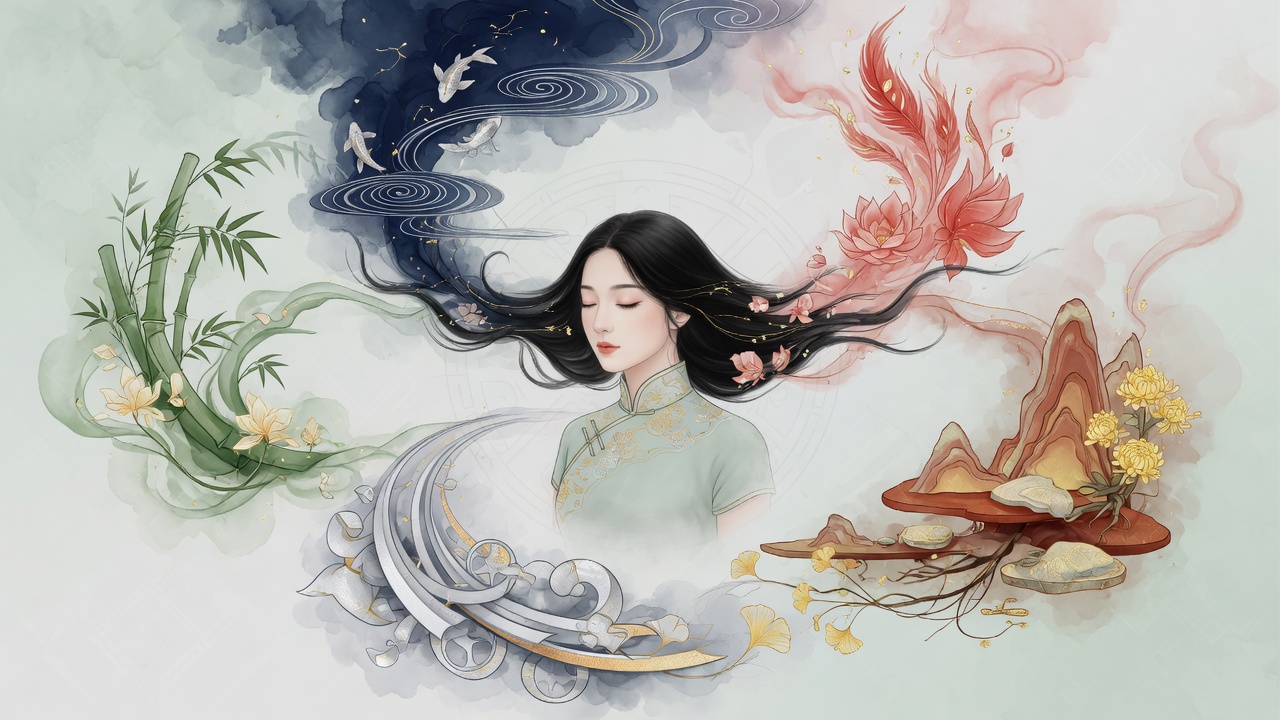
Basic Clarification: Metaphysics Is Not Fatalism, but a Framework of Observation
Common Misconceptions
- Misconception 1: Metaphysics dictates a fixed appearance. In reality, BaZi reflects innate tendencies, but environment, mindset, and cultivation constantly influence one’s complexion and spirit.
- Misconception 2: Only excellent BaZi charts produce beauties. In traditional metaphysics, beauty is not a single standard; it emphasizes Five Elements harmony and vivid qi — harmony itself is beauty.
- Misconception 3: Physiognomy can exist independently of cultivation. Traditional culture emphasizes “physiognomy born of mind”; a kind heart and broad-mindedness often make the face more relaxed and gentle.
- Misconception 4: Whatever element is missing, supplementing it will enhance beauty. This is a huge misunderstanding. Adjustment must follow the Favorable God (Useful God); blindly supplementing a missing element can backfire.
- Misconception 5: Ancient metaphysical texts can be directly applied to modern people. Times have changed and aesthetics are diverse, yet the core criteria of qi charm and spirit remain unchanged.
Core Interpretation: From Five Elements Balance to Temperament Cultivation
1. Five Elements Balance: The External Reflection of Innate Endowment
Of course, BaZi cannot directly determine the details of facial features; it shapes a person’s aura and spirit. Like Leung Ka-ying, whose childhood photos already show clear brows and eyes and well-proportioned contours, this might reflect a chart where Five Elements flow smoothly and a pure and noble qi is evident — but we lack specific details, so this is merely speculation from a cultural perspective.
- Metal-Water Mutual Generation: Metal governs righteousness, Water governs wisdom. The skin is fair and delicate, the eyes clear, and the temperament leans toward cool elegance, like the glow of an autumn moon.
- Wood-Fire Illumination: Wood governs benevolence, Fire governs propriety. The posture is upright, the gaze bright, brimming with warmth and infectious energy, like the beauty of spring wood.
- Earth-Metal Mutual Generation: Earth governs trust, Metal governs righteousness. A dignified and sincere appearance, full facial features, and a strong nasal bridge convey a sense of steadiness and reliability.
- Water-Wood Refinement: Water governs wisdom, Wood governs benevolence. A graceful figure, moist complexion, and an aura of delicate intelligence, like the fragrance of a secluded orchid.
- Fire-Earth Mutual Generation: Fire governs propriety, Earth governs trust. Distinct contours, rosy complexion, and a temperament that is both passionate and embracing, full of vitality.
- Imbalanced Five Elements: If one element is excessively strong without restraint, it may manifest as an extreme in appearance, such as being overly sharp or rigid — not necessarily conventional beauty, but a unique temperament, awaiting remedy through luck cycles.
- Pure Chart Pattern: When Direct Officer and Direct Seal are clear and untainted in the chart, the face is often dignified and the aura refined; when Eating God expresses talent, there is often artistic flair and lively eyes.
2. Vivid Qi: “Spirit” and “Complexion” in Physiognomy
Traditional physiognomy not only examines form (facial features, bone structure) but places greater emphasis on spirit (eye expression, vitality), qi (complexion, dynamic aura), and voice (sound). As the *Ma Yi Shen Xiang* states: “Form cannot surpass spirit; spirit cannot surpass qi.” Qi is dynamic and can change with cultivation.
A person’s complexion can shift with health, emotions, and self-cultivation. In BaZi, when a Favorable God gains strength during a luck cycle or year, it often manifests as a rosy complexion and bright eyes; conversely, when an Unfavorable God runs rampant, the face may appear dull and the spirit listless.
Ancient physiognomy categorizes spirit into many types: clear, upright, harmonious, refined, reserved, tranquil, etc. It believes that when spirit is clear, the form must be elegant; when spirit is harmonious, the qi must be gentle. This aligns with the principle of Five Elements neutralization in BaZi.
- Spirit: The eyes are the window to the entire body’s qi charm. Those with balanced Five Elements often have eyes that are steady and bright, not wandering. As the *Ren Lun Da Tong Fu* says: “Spirit is the one; the one runs through all.”
- Qi: Complexion is divided into green, yellow, red, white, and black, corresponding to the Five Elements and related to the five organs. A good complexion is subtle and restrained, like the luster of pearl and jade, not floating on the surface.
- Charm: This refers to dynamic bearing and demeanor, the manifestation of Five Elements inter-promotion and inter-restriction in movement. For example, Wood-type people walk like the wind, Water-type people move smoothly and fluidly, Metal-type people are dignified and poised.
- Voice: Voice also belongs to the category of qi charm. Metal voices are clear and resonant, Wood voices are high and far-reaching, Water voices are round and smooth, Fire voices are sharp and intense, Earth voices are deep and rich. Vocal harmony is also a sign of Five Elements balance.
- Mutual Rooting of Complexion and Spirit: Spirit is the root of qi; complexion is the sprout of qi. When a person’s inner state is peaceful, the spirit is settled and the qi vibrant, and the complexion naturally brightens — this is the aspect that can be cultivated postnatally.
3. Physiognomy Born of Mind: The Postnatal Cultivation of Temperament
“Physiognomy born of mind” originates from Buddhism, was later absorbed by Daoism and Confucianism, and became the core of Chinese aesthetics. In the metaphysical system, mind-nature is the inner cause, and BaZi is the external condition; the two interact.
The *Liao Fan Si Xun* records how Yuan Liao-fan changed his destiny through accumulating virtue and performing good deeds, and his physiognomy transformed from early harshness to lenience. This shows that a shift in mindset directly affects complexion and facial appearance.
Those who consistently maintain compassion and forbearance will gradually develop a gentle and serene countenance, even if their original BaZi chart is not perfect. Conversely, chronic anxiety and harshness will leave lines of worry between the brows.
The ancients said: “If there is mind without physiognomy, physiognomy arises from the mind; if there is physiognomy without mind, physiognomy perishes with the mind.” This reveals the fundamental law of mind-physiognomy interaction, perfectly aligning with the neutralization way emphasized in BaZi and Five Elements.
- Cultivating Mind and Nature: Through reading, playing music, quiet sitting, and meditation, one can stabilize the mind-spirit, naturally harmonize the Five Elements qi, and the face will exude a scholarly air or refined elegance.
- Good Deeds and Virtue Accumulation: Tradition holds that good deeds attract harmonious qi, improving one’s personal aura — “the environment changes with the mind; physiognomy arises from the mind.” With sufficient inner foundation, one naturally radiates vitality.
- Internal Harmony, External Nourishment: Chinese medicine teaches that “the five organs correspond to the face”; the inner health brought by Five Elements harmony inevitably manifests as outward vibrancy and radiance, a direction worth striving for postnatally.
- Elevating One’s Life Pattern: When a person broadens their heart and does not fret over trivial matters, the brow loses some furrowed tension and gains more relaxation — this is genuine change in “physiognomy.”
- Emotional Management: Maintaining a long-term attitude of optimism and gratitude relaxes facial muscles, forming natural smile lines that are more lasting than any cosmetic technique.
- Consistency of Words and Deeds: “A person of good fortune naturally has a favorable physiognomy,” but the premise is that words and deeds align with the mind, inside and outside as one; this sincere aura is the most touching.
Pitfall Avoidance Guide: Rationally Viewing Metaphysics and Appearance
Points to Note
- Do not blindly believe in physiognomy determinism: There is no perfect physiognomy, only a harmonious whole. Do not feel anxious about a single feature; true beauty lies in vitality and harmony.
- Avoid simply supplementing according to missing elements: The Five Elements must be approached through the lens of Favorable and Unfavorable Gods. Supplementing Metal just because Metal is missing can harm the chart. For example, if the day master is weak and favors the Seal (Resource), strengthening the Seal is the key.
- Beauty is diverse: Metaphysical aesthetics emphasize vivid qi and charm, not a single standard. Over-pursuing an “internet celebrity face” may disrupt the original chart pattern and actually cause one to lose distinctiveness.
- Postnatal cultivation far outweighs the innate: BaZi is like a fine canvas, cultivation is the paintbrush; the final picture is drawn by oneself. The refinement of mind-nature can transform complexion and spirit.
- Do not spread personal privacy: Never use trending topics to fabricate someone’s birth chart or perform metaphysical calculations. This is disrespectful and violates the ethics of metaphysical study.
- Avoid over-interpreting celebrities: We can only discuss from a universal cultural perspective. Any metaphysical inference about specific individuals is irresponsible; please remain rational.
- Health is the foundation of beauty: Five Elements harmony first and foremost means physical health. When the five organs are at peace, the complexion naturally glows — this is the most fundamental “beauty treatment.”
- Respect science: Metaphysics is part of traditional culture; it cannot replace modern medicine or psychology. Issues regarding appearance should be viewed comprehensively.
Summary and Recap
From the buzz around Leung Ka-ying being “beautiful since childhood,” we glimpse the unique aesthetic of Five Elements balance and vivid qi in traditional metaphysical culture. True beauty is a symphony of innate endowment and postnatal cultivation.
Physiognomy born of mind reminds us that all outward ease and grace stem from inner steadiness and kindness. Regardless of one’s BaZi, everyone can cultivate mind, virtue, and qi to live out their most radiant self.