From Krungthai Peace of Mind Debit Card to Bazi: Life Rhythms and the Wisdom of Choice in an Aging Society
Recently, Thailand's Krungthai Bank launched the “Krungthai Peace of Mind Debit Card,” which includes built-in daily accident protection, precisely responding to the needs of an aging society. This news prompts deeper reflection: within t
Opening Introduction
Recently, Thailand's Krungthai Bank launched the “Krungthai Peace of Mind Debit Card,” which includes built-in daily accident protection, precisely responding to the needs of an aging society. This news prompts deeper reflection: within the Eastern system of destiny analysis, how does Bazi understand the flow of fortune, risk preference, and proactive choices at different life stages? From a purely traditional cultural perspective, this article explores the rhythm of the 10-year luck cycles, the characteristics of the Day Master, and the interaction with the times, without making any concrete predictions, offering readers an alternative lens for rationally understanding oneself and the era.
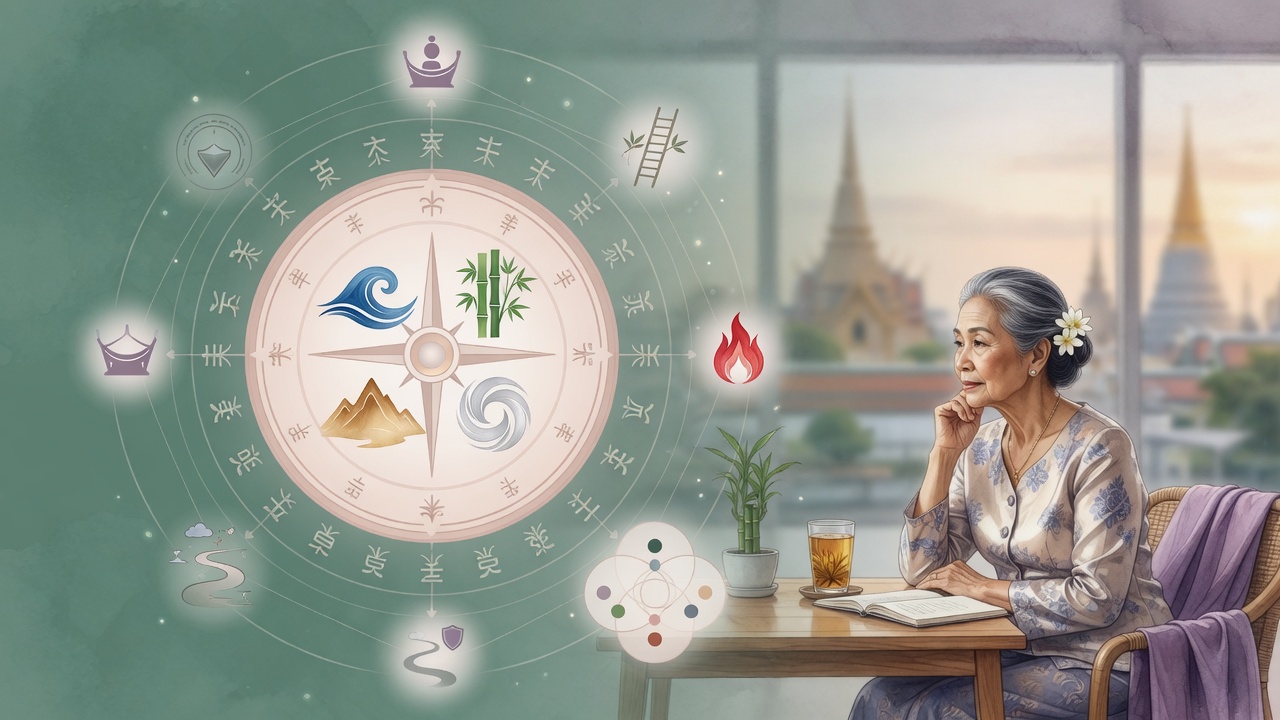
Basic Clarification: What Bazi Can and Cannot Do
Common Misconceptions
- Misconception 1: Bazi equals fatalism. Many people mistakenly believe that Bazi locks a person into a fixed path. In reality, Bazi analyzes innate endowments and acquired fortune trends, never negating personal choice and effort. It is more like an innate “energy map” rather than an unchangeable script.
- Misconception 2: Bazi can precisely predict accidents. Bazi indicates periods when certain types of risk are more likely, for example, a year with Hurting Officer confronting the Officer or Owl Spirit seizing the Food might suggest emotional fluctuations or health decline, but it will never specify “a car accident will happen on a certain day of a certain month.” The purpose of such hints is to make one alert in advance, not to create panic.
- Misconception 3: Bazi is only applicable to Chinese people. Bazi is derived from birth time and has nothing to do with regional culture. Thai friends can also understand their Five Elements structure and the ups and downs of luck cycles through Bazi; it is a universal symbolic system.
- Misconception 4: Poor fortune in old age means a bad destiny. The arrival of an aging society makes more people concerned about their later years, but the late-life luck cycle in Bazi is merely one stage of life. Ups and downs are natural; the key lies in how to adjust mindset and actions according to the characteristics of the luck cycle. This parallels the wisdom of purchasing accident insurance or planning for retirement.
Core Points: Life Rhythms and the Logic of Choice in Bazi
The Flow of Luck Cycles: A Life Rhythm That Changes Every Decade
In Bazi destiny analysis, luck cycles change every ten years, representing the main theme of different life stages. Each person's luck cycle is arranged forward or backward from the Month Pillar, differing by gender, and the starting age also varies. Luck cycles are like seasonal changes — sprouting in spring, growing in summer, harvesting in autumn, and storing in winter — each having its appropriate activities.
- Youth luck cycles: Often dominated by Output and Wealth stars, corresponding to creativity, social interaction, and wealth accumulation, suitable for striving and trial-and-error.
- Middle-age luck cycles: Frequently feature Officer/Killing and Resource stars, representing responsibility, career, and stability, a critical period for personal achievement and social status.
- Late-life luck cycles: If the natal chart is weak and the luck cycle provides support, old age can be stable; if strong and the cycle reinforces strength, one must beware of exhaustion from excess energy. Regardless, late-life luck cycles emphasize internal conservation and harmony, much like the Peace of Mind card launched by Krungthai — proactively transferring risk is precisely the wisdom of aligning with the times.
- Transition between luck cycles: Around the shift of cycles, fortune is often turbid, and one may easily feel confused or experience fluctuations. Major decisions should be avoided during this time; instead, one should observe quietly. This is not superstition, but respect for life's rhythms.
Day Master Strength and Risk Preference
The Day Master in Bazi represents the self, and its strength or weakness determines a person's innate ability to withstand risk and behavioral tendencies. This is remarkably similar to risk ratings in modern finance, except Bazi analyzes it from the perspective of Five Elements balance.
- People with a strong Day Master: Typically energetic, highly proactive, and able to bear greater pressure, suitable for pioneering life paths. However, excessive strength can lead to impulsiveness; they need restraint from the Officer or Killing star or release through the Output star, otherwise they may fall into risk due to overconfidence.
- People with a weak Day Master: Naturally sensitive and thoughtful, suited to conservative paths. If the luck cycle brings support from Resource or Companion stars, they can also shoulder heavy responsibilities; if the cycle further drains or attacks, they need to actively use external safeguards (such as insurance, annuities) to stabilize life.
- Five Element nature of the Day Stem: For example, Jia Wood people like to grow upward but need Geng Metal pruning to become useful timber; Gui Water people are flexible and adaptable but need Wu Earth embankments to store their potential. These characteristics determine one's instinctive response when facing accidents and changes; understanding them allows one to enhance strengths and avoid weaknesses.
- The way of balance: Bazi values harmony. Whether strong or weak, luck cycles bring dynamic adjustments. Individuals in an aging society can fully convert the potential instability brought by luck cycles into proactively arranged safeguards through advance planning, which is exactly the rational choice reflected by the Krungthai debit card.
Annual Cycle and Choice: The Wisdom of Seizing the Moment
The annual cycle is the energy symbol of each year, interacting with the luck cycle and the natal chart to produce the specific theme of the year. Bazi does not believe that life is predestined; rather, it emphasizes that those who understand the times are wise — discern the broader environment of each year, and then make choices based on personal circumstances.
- Grand Duke Jupiter and the conjunction of annual and luck cycle: Traditionally, years of offending the Grand Duke are believed to be prone to changes. In essence, this means the year's energy strongly resonates with the natal chart, potentially bringing both opportunities and challenges, requiring extra caution.
- The way of resolution: “Resolution” in Bazi is not a superstitious ritual but behavioral adjustment. For instance, if the Wealth star is clashed in a certain year, indicating financial volatility, one can proactively reduce high-risk investments; if the Resource star is harmed, it is wise to slow down the pace of study or work and pay more attention to health.
- Collective annual cycles in an aging society: Against the backdrop of Thailand entering an aging society, many people may be at the starting point of late-life luck cycles. If the annual cycle encounters a strong Officer or Killing star, changes in social systems and policies will profoundly affect individuals. At such times, aligning with the times — such as purchasing financial products with accident protection — embodies the ancient wisdom of overcoming movement with stillness.
- The power of non-action: In Bazi, the Resource star represents protection, stability, and also symbolizes elders and wisdom. As society as a whole trends toward aging, the energy tends more toward the attributes of the Resource star, and people naturally place more importance on safety, security, and inheritance. This phenomenon is not a coincidence, but brought about by the times.
Pitfall Avoidance Guide: Applying Bazi Rationally and Staying Clear of Misconceptions
Points to Note
- Do not use Bazi to directly predict specific accidents or illnesses: Bazi only indicates periods when energy flow is obstructed, not specific disasters. Over-interpretation only adds unnecessary anxiety.
- Reject “resolution” sales pitches: Those who truly understand Bazi will not ask you to buy expensive “ritual objects” to change your luck. Proactive planning and advance safeguarding are the most effective forms of “resolution.”
- Bazi cannot replace professional financial and insurance planning: It can serve as a reference for self-understanding, but specific pension and insurance allocations still require consultation with professionals.
- Avoid single-pillar destiny analysis: Drawing conclusions based only on your zodiac sign or Day Pillar easily leads to overgeneralization. A complete Bazi analysis requires a holistic view of all Four Pillars, combined with the luck cycle and annual cycle.
- Be mindful of cultural differences: Thai culture also has traditions of birth-time astrology, but the Bazi system is independent; do not confuse the two. If you need consultation, seek a professional Bazi practitioner, not a generic “fortune teller.”
- Applying Bazi in an aging society: Interpreting late-life luck cycles should focus more on psychological adjustment and life rhythm, rather than attempting to “reverse heaven and change destiny.” Learning to coexist with your own luck cycle is the true wisdom.
Summary and Review
The launch of the Krungthai Peace of Mind Debit Card, seemingly a financial product innovation, actually resonates with the demands of the times — in an aging society, people increasingly desire predictable security. Bazi destiny analysis is not a tool of fatalism, but a discipline that helps individuals understand the interaction between life rhythms, personality traits, and luck cycles and annual cycles. Key conclusion: Every stage of life has its suitable choices. Going with the flow and planning proactively are far more valuable than passive waiting or blind panic. In the wave of aging, we can use modern financial tools to transfer risk, and at the same time use traditional wisdom to settle body and mind — the two run in parallel, not in conflict.