Bazi on Investing: Korean Stocks' Heavy Bets on Samsung and SK Hynix, and the Balance Between Personality Extremes and Timing
In October 2026, South Korea's stock market fluctuated as AI sentiment cooled, with reports pointing to "disproportionately heavy bets on Samsung and SK Hynix" as a drag on the market. This phenomenon mirrors a recurring warning in Bazi: over-concent
Introduction
A recent report on South Korea's stock market has drawn attention: as the AI boom cools, some investors' disproportionately heavy bets on Samsung and SK Hynix have instead put enormous selling pressure on the index. This "putting all eggs in one basket" decision often corresponds in Bazi to a personality code of excessive Ten Gods or elemental imbalance.
This article does not aim to predict market movements. Instead, it uses this moment as a lens to explore how traditional Bazi culture views the relationship between extreme choices and balance with the times, offering a mindset for self-awareness.
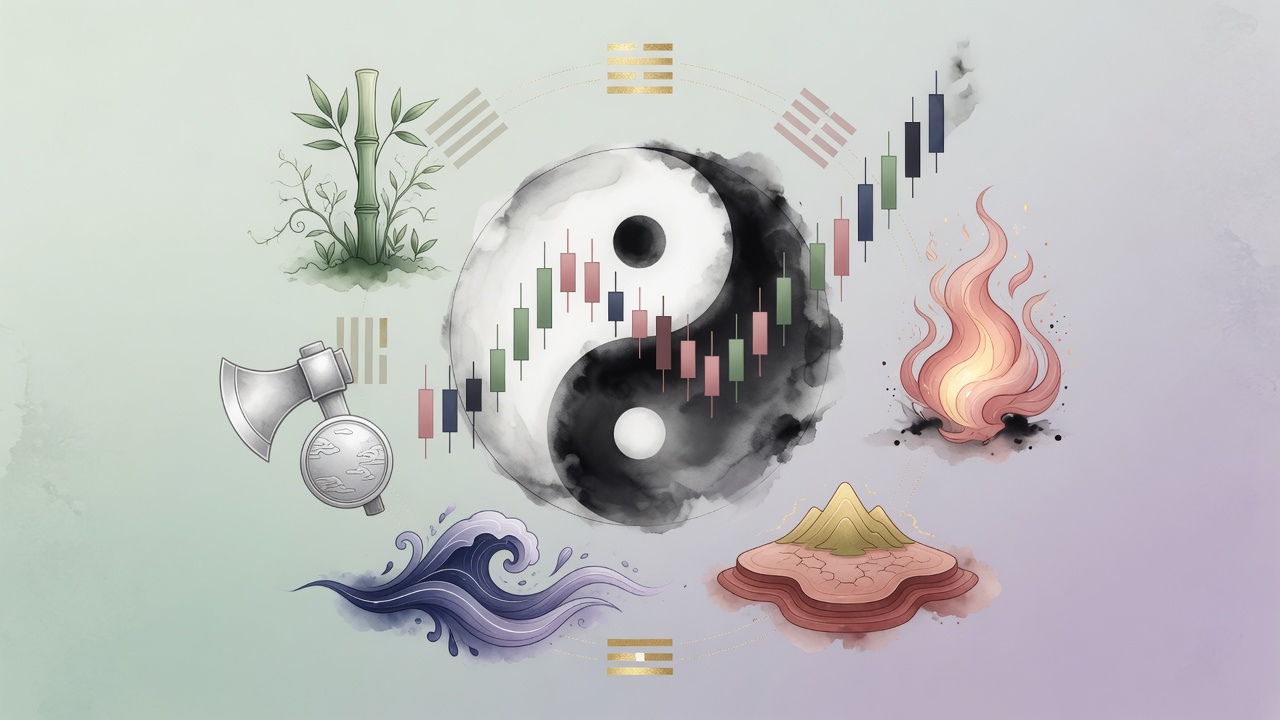
Clarification: Bazi Is Not a Prediction Tool, but a Lens on Personality
Common Misconceptions
- Misconception 1: Bazi can predict stock ups and downs. Metaphysics does not make precise predictions for non-living entities or collective markets; it analyzes a person's innate disposition and behavioral tendencies, not financial product trends.
- Misconception 2: Heavy concentration is always bad. Bazi values pure chart structure, which can sometimes achieve great things, but the key is whether it is "timely and well-placed." Without supportive Major Luck and Annual Fortune, over-concentration is like a boat without water.
- Misconception 3: The South Korean stock slump is entirely due to Bazi. Market fluctuations result from multiple overlapping factors. The Bazi perspective merely offers an analogical way of thinking to help understand the deep link between "obsession" and "risk" in human nature.
Core Insights: From Ten Gods and Five Elements to Major Luck, Deconstructing the Bazi Metaphor of "Heavy Concentration"
1. The "Bi Jie" Personality in the Ten Gods: A Double-Edged Sword of Following the Crowd
In Bazi, the elements that share the same Five Element as the Day Master are called Bi Jian (Companion) and Jie Cai (Rob Wealth), collectively known as "Bi Jie." People with strong Bi Jie are usually loyal and action-oriented, but they are also prone to herd mentality and competitive blind spots.
When the market is universally bullish on AI and Samsung and SK Hynix become national favorites, investors with a Bi Jie personality are especially likely to rush in all at once, amplifying the virtue of "brothers united" into the risk of "over-concentration."
- Bi Jie too strong without control: If the chart lacks Officer Star restraint, one tends to act on impulse, ignore the importance of diversified allocation, and fall into the cycle of "I buy because others buy."
- Group identity overrides independent judgment: People with heavy Bi Jie fear being left out. When everyone around them is heavily concentrated in specific sectors, stepping away requires great courage—this is the Bazi portrait of the "disproportionate" phenomenon in the Korean stock market.
- The remedy: Introduce the Officer Star mindset—set discipline and rules for yourself, such as enforcing a maximum single-stock holding limit, using the rationality of "Direct Officer" to restrain the blindness of "Bi Jie."
2. Five Elements Imbalance: When "Metal" and "Water" Become Excessively One-Sided
Samsung and SK Hynix are essentially Metal (precision manufacturing, semiconductors) and Water (data flow, AI computing). If a person's Bazi already has excessively strong Metal and Water elements, heavily investing in such assets creates a resonance of Five Elements imbalance.
Bazi emphasizes the circulation of the Five Elements. When one or two elements dominate without any mediating element, it is like an ecosystem with only a single species—once the climate changes (Major Luck and Annual Fortune shift), the whole system easily falls out of balance.
- Too much Metal without Fire: When Metal is strong but lacks Fire to refine it, it symbolizes hoarding hardware without flexibility (Fire represents innovation and marketing). When AI application demand falls short of expectations, one falls into the "cold Metal, icy Water" impasse.
- Too much Water floats Wood away: When Water is excessively strong without Wood (Wood represents growth and diversification), it means capital flows like a flood into only a few channels, without taking root in other industries. Any slight disturbance then creates huge waves.
- Climate Adjustment Useful God: Bazi climate adjustment emphasizes "warming the chart" or "moistening the chart." In investing, this means holding assets of different natures to balance the overall portfolio—for example, adding Fire attributes (software, content) or Earth attributes (infrastructure, stable income) to mediate the flow.
3. Major Luck and Annual Fortune: Timing Outweighs Individuals; The Real Skill Is Going with the Flow
The Bazi classic *Di Tian Sui* says: "A person may have soaring ambition, but without the right luck, they cannot rise." Even if one's chart strongly favors concentrated investing, if Major Luck and Annual Fortune move into an unfavorable god luck, heavy bets will instead accelerate the drain of vitality.
The 2026 Bing Wu annual pillar brings fierce Fire energy. For South Korea's semiconductor duopoly, dominated by Metal and Water, this is a year of Fire clashing with Metal. If one still adds positions against the trend at this time, it is like the Bazi pattern of "weak Day Master encountering wealth"—you can see it but cannot grasp it, and instead get crushed by wealth.
- Major Luck turning points: The Major Luck, which changes every ten years, determines whether a person should be "aggressive" or "conservative." During a Bi Jie luck cycle, one can benefit from group collaboration; during a Wealth luck cycle, it is better to diversify and seek stability. Insisting on going against the luck cycle means fighting natural rhythms.
- Annual Fortune timing: In a year of strong Fire like 2026, it is actually a test for those whose Bazi favors Metal and Water. At such times, one should reduce the proportion of Metal-Water assets and shift toward bright Wood and Fire sectors. This is not superstition but ancient wisdom for aligning with energetic rhythms.
- Know fate and use fate: Bazi does not advocate fatalism but emphasizes knowing when to advance or retreat. Understanding your own Major Luck trajectory—being not greedy when you should be conservative, and not timid when you should be active—is the right way to apply Bazi to modern life.
Pitfall Avoidance Guide: Use Bazi Thinking to Calibrate Your Investing Personality
Important Notes
- Identify your dominant Ten God: Through professional chart analysis, understand whether your Bi Jie, Output, or Wealth and Officer stars are strong. If Bi Jie is strong, be sure to set up a "forced diversification" mechanism to avoid unconsciously following the crowd into heavy concentration.
- Regularly review Five Elements allocation: Classify your investment portfolio by Five Elements (e.g., tech stocks as Metal-Water, consumer stocks as Wood-Fire, real estate as Earth), check for severe imbalance, and use the "mediating Useful God" to supplement weak areas.
- Do not ignore Major Luck reminders: Around each Major Luck change (usually near years ending in 0 or 5), reassess your risk tolerance. Reduce leverage when appropriate, and do not let "Annual Fortune triggering" become the last straw that breaks the camel's back.
- Avoid the "Follower Structure" myth: Bazi has a special structure called "Follower Strength," which may seem to justify riding momentum with heavy bets, but true Follower structures require strict conditions. Most people are merely ordinary strong types; misjudging the structure and going all in often leaves deep scars.
- Manage with the "Wealth, Officer, and Seal" mindset: Replace speculation with the steady accumulation of Direct Wealth, restrain impulses with the discipline of Direct Officer, and absorb diverse knowledge through the learning of Direct Seal. When the three are balanced, you naturally stay away from the trap of heavy concentration.
- Do not treat Bazi as a market timing tool: Bazi should not be twisted into entry and exit signals. It is a mirror that helps you see the situations in which you are prone to mistakes. Real decisions must still return to fundamentals and risk management.
Summary and Review
The phenomenon of "heavy concentration in a few AI stocks" in South Korea's stock market is a classic Bazi case of excessive Bi Jie, Five Elements imbalance, and going against the luck cycle. Traditional Bazi reminds us: Lonely Yin cannot grow; solitary Yang cannot thrive. Any extreme allocation hides vulnerability.
Rather than asking whether the year will rise or fall, it is better to return to the calibration of your own personality and the times—recognize your Ten God tendencies, balance Five Elements attributes, and align with Major Luck rhythms. This is the most practical risk wisdom that Bazi culture offers to contemporary investors.