The Frenzy and Controversy of Kishiwada Danjiri Matsuri: Understanding the Collective Energy of Folk Festivals through BaZi 'Bi Jie' and 'Shi Shang'
In October 2026, the Kishiwada Danjiri Matsuri in Japan once again sparked heated discussions, from 'corpses with brains spilling out' to 'NHK-style persistent donation requests,' this town 'dominated' by danjiri exhibits extreme collective revelry a
Introduction
The Kishiwada Danjiri Matsuri has a history of over 300 years. Giant wooden danjiri floats race at high speed through narrow streets, with hundreds of people pulling and shouting, creating a stunning spectacle. However, in recent years controversies have continued: forced donations, accidents and casualties, and a sense of community coercion have made the word 'tradition' feel heavy.
From the perspective of BaZi, any large-scale folk activity is a concentrated release of spatiotemporal energy. Among these, Bi Jie represents the collective strength of standing shoulder to shoulder, while Shi Shang corresponds to the festive joy, catharsis, and creativity. Understanding these two energies can help us view the modern significance of traditional festivals more clearly.
Basic Clarification: BaZi is not superstition, but a relational energy system
The Essence of Bi Jie and Shi Shang
BaZi uses the Ten Gods to describe a person's relationship with the outside world. Bi Jie are stars with the same elemental type as the Day Master and the same yin-yang polarity, representing siblings, friends, colleagues, competitors, with the core being 'the power of unity'.
Shi Shang are things generated by the Day Master, representing talent, expression, entertainment, catharsis, and enjoyment—the blossoming of life force. The Eating God is gentle, the Hurting Officer is intense, and both govern 'the output of happiness'.
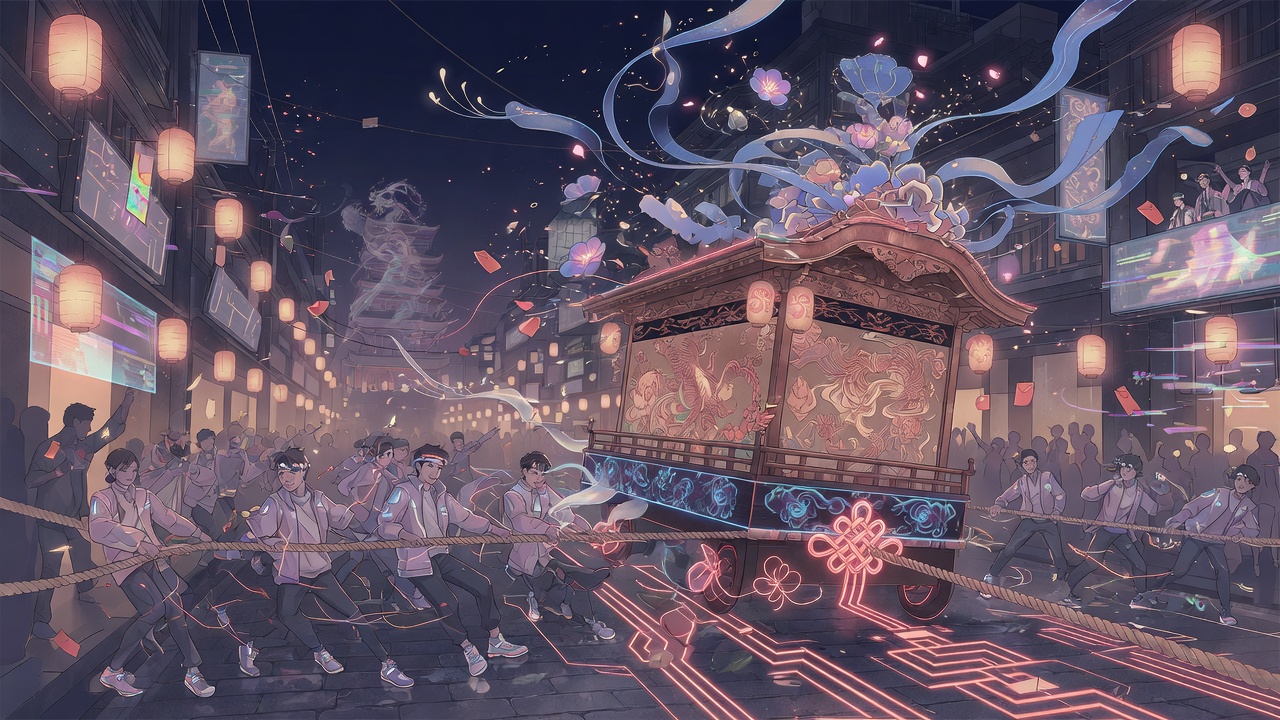
- Bi Jie: Like the hundreds of people pulling ropes shoulder to shoulder in the danjiri festival, moving in unison to form an unstoppable collective kinetic energy.
- Shi Shang: Like the shouts, taiko drums, colorful decorations, and celebratory banquets in the festival—release valves for repressed daily life.
- Misconception 1: Having more Bi Jie is not necessarily good. In BaZi, if Bi Jie is excessively strong without control, it can lead to stubbornness, competition, and financial loss, corresponding to shadows like excessive donations and community coercion in festivals.
- Misconception 2: Shi Shang is not mere fun and games. Excessive Shi Shang drains oneself; the emptiness and fatigue after revelry are manifestations of Shi Shang draining the body.
Core Points: Analyzing the Energy of Danjiri Matsuri from a BaZi Perspective
1. The Collective Cohesion of Bi Jie — The Invisible Skeleton of Danjiri Operation
The core of the Danjiri Matsuri is hundreds of people pulling a wooden cart weighing up to 4 tons, relying on synchronized effort from all to safely navigate sharp turns. This mechanism of 'one person's mistake, the whole cart topples' perfectly illustrates the positive qualities of Bi Jie: When brothers are of one mind, their sharpness can cut through metal.
In BaZi, when Bi Jie is an unfavorable god, it can turn into stubbornness, cliques, and forced contributions. The complaints of Kishiwada residents—'being ostracized if not participating' and 'donations as persistent as NHK fee collectors'—are manifestations of Bi Jie being too strong without the restraint of Guan Sha (Officer and Seven Killings).
Healthy Bi Jie needs Shi Shang to flow and smooth it. Shi Shang can transform the brute force of Bi Jie into celebratory joy, giving collective strength an outlet rather than internalizing it as community oppression.
- Positive aspects of Bi Jie: cohesion, team rapport, sense of belonging, mutual aid in emergencies.
- Negative aspects of Bi Jie: exclusivity, moral coercion, compulsion, submergence of individual will.
- Way to resolve: People with strong Bi Jie in their charts who participate in such activities should set personal boundaries in advance, and wear metal accessories (such as silver) that belong to Guan Sha to enhance rationality.
2. The Festive Joy of Shi Shang — Catharsis and Creativity in the Festival
The ornate carvings, colorful curtains, lanterns, chants, and taiko rhythms of the Danjiri Matsuri are all manifestations of Shi Shang. Shi Shang represents the outward display of inner energy—an outlet for art, performance, and emotion.
People with strong Shi Shang in their charts naturally enjoy performing and easily become active members in festivals. However, Shi Shang also represents draining. Consecutive days of revelry, drinking, and shouting can greatly deplete qi and blood, leading to post-festival 'festival syndrome'.
From a BaZi perspective, Shi Shang needs Yin Xing (Resource Star) to balance it. Yin Xing represents rest, introspection, and nourishment. The moments of silent ritual and prayer interspersed in traditional festivals reflect the wisdom of Yin Xing—returning to stillness after release.
- Positive aspects of Shi Shang: happiness, creativity, stress relief, cultural heritage of the community.
- Negative aspects of Shi Shang: over-consumption, emotional loss of control, accident risk (excessive Shi Shang overcomes Guan Sha, which represents rules and safety).
- Balancing advice: During the festival, sit quietly for a moment every two hours, hydrate, and silently recite a Yin Xing mantra (such as the word 'jing' meaning stillness) to prevent energy depletion.
3. Traditional Date Selection and Community Energy Field — Why is Danjiri Matsuri held in October?
Kishiwada Danjiri Matsuri originally took place in the ninth lunar month, corresponding to October in the solar calendar. Traditional date selection emphasizes favorable heavenly timing, earthly advantage, and human harmony. October is strong in Metal, and Metal represents Guan Sha, which can restrain the laxity of Bi Jie, and also generates Water (Yin Xing) to nourish Shi Shang. It is a spatiotemporal window of 'controlled revelry'.
BaZi date selection avoids days that are Sui Po (year breaker), Yue Po (month breaker), or days that clash or punish the participants' own charts. If a large-scale folk activity is held on a day that is unfavorable for most community members' charts, conflicts and accidents are likely. The fixed schedule of Danjiri Matsuri may not be customized for individuals, but being fixed in a particular month over time inadvertently forms a collective energy field.
From the perspective of community energy, the streets traversed by the danjiri are seen as undergoing energy cleansing. The rolling wheels and collective shouts are akin to a large-scale 'ground breaking' and 'sound sha', which can dispel accumulated yin energy, but may also disturb the earth veins, requiring post-event stabilization.
- Date selection principles: Choose days when Bi Jie and Shi Shang are prosperous and controlled, such as days with earthly branch three harmonies or six harmonies, avoiding clashes and punishments.
- Community energy field: A festival is a 'ventilation' of collective fortune, similar to a BaZi major luck transition, where some benefit and some suffer.
- Personal response: Check whether your own day chart clashes or punishes with the festival date. If there is a clash, wear He Shen (harmonizing god) accessories or temporarily avoid high-risk segments.
Avoidance Guide: Using BaZi Wisdom to Safely Participate in Folk Activities
BaZi Advice for Participants
- Clarify your personal BaZi favorable and unfavorable elements: If Bi Jie is unfavorable, avoid taking on organizer roles to prevent moral coercion; if Shi Shang is unfavorable, control the intensity of drinking and shouting to prevent post-event exhaustion.
- Choose timing for participation: If the festival lasts multiple days, choose days that are beneficial for you. For example, if your Day Master is Wood, participating on a Water day (Yin Xing) can bring more nourishment.
- Wear protective accessories: Those with weak Guan Sha and prone to injury can wear metal accessories (to strengthen Guan Sha) or obsidian (to strengthen Yin Xing) to stabilize the energy field.
- Psychological boundary: Before entering a dense crowd, silently recite your core needs, such as 'I am here only to experience the culture, I refuse forced donations,' using the clear expression of Shi Shang to replace the blind obedience of Bi Jie.
- Post-event energy recovery: On the night after participation, soak your feet in salt water, sit quietly for 15 minutes to reclaim scattered energy, which is equivalent to the Yin Xing returning to its place in BaZi.
- Respect but do not blindly follow: Understand the value of traditional energy fields, but if you feel strong discomfort, allow yourself to withdraw midway. BaZi teaches 'pursue good fortune and avoid misfortune', not to force yourself to endure.
- Children and those with weak Day Masters: The Danjiri Matsuri has strong sound and light, which can be quite impactful for children and people with weak Day Masters. It is advisable to watch from a distance to avoid being harmed by Qi Sha (sudden shock).
Summary and Review
The frenzy and controversies of Kishiwada Danjiri Matsuri are essentially the natural collision of Bi Jie collective strength and Shi Shang cathartic energy under the absence of modern management mechanisms. BaZi offers not mystical prophecy but a symbolic system for understanding group behavior and individual temperament.
Key conclusion: Traditional festivals are the 'collective breath' of community energy fields. When participating, if you can be aware of your own Bi Jie and Shi Shang energies, set boundaries, choose the right timing, and recover your energy afterward, you can preserve cultural heritage while maintaining physical and mental balance.