From the 20th Anniversary of 'Kabuto' to the Heavenly Stems of Ba Zi: Jia Wood Breaking the Shell and the Philosophy of Transformation in the Sixty-Year Cycle
In 2026, Kamen Rider Kabuto marks its 20th anniversary and returns with the new work Those Who Inherit the Heavens, reuniting the original cast; actor Yuki Sato, who played 'Gatack', confidently states 'This is Kabuto.' As the classic bet
Introduction
When the phrase 'Walking the path of heaven, ruling over all' resounds once more, Kamen Rider Kabuto returns after 20 years with the new work *Those Who Inherit the Heavens*. This is not merely a celebration for tokusatsu fans, but a cultural metaphor for time cycles and breaking out of the shell.
In Ba Zi fate analysis, the core code of time is precisely the cyclic combination of the Ten Heavenly Stems and Twelve Earthly Branches, forming the great cycle of sixty years (one Jia Zi) and the personal rhythm of ten-year luck cycles. Kabuto's beetle transformation, like a Jia Wood seed cracking its shell and stretching toward the sky, perfectly mirrors the Eastern philosophy of growth, breakthrough, and return.
Basic Clarification: Ba Zi is not 'fortune-telling' but a model of time rhythms
Dispelling Common Misconceptions
- Misconception 1: Ba Zi can predict specific events with precision. In reality, Ba Zi uses Heavenly Stems and Earthly Branches to map the distribution of the Five Elements at a person's birth moment, describing innate tendencies and the 'climate' changes during the life cycle, not an ironclad fatalistic decree.
- Misconception 2: It only concerns good or bad fortune. Ba Zi emphasizes the interpretation of 'xiang' (symbolic imagery). Just as Kabuto's beetle form symbolizes leadership and breakthrough, Jia Wood—which in the heavens is thunder and on earth is a tall tree—represents leadership, breakthrough, and upright character. This imagery helps us understand our mental state and challenges at certain time nodes.
- Misconception 3: Treating cycles as rigid formulas. Both ten-year luck cycles and annual luck are dynamically superimposed. Just as a classic work returns after 20 years bearing both the marks of its era and a new interpretation, fate analysis is a comprehensive judgment combining imagery, numbers, and principles.
Core Interpretation: Jia Wood's Metamorphosis and the Cyclic Clock of Heavenly Stems and Earthly Branches
Kabuto's Beetle Transformation and the Image of 'Jia Wood'
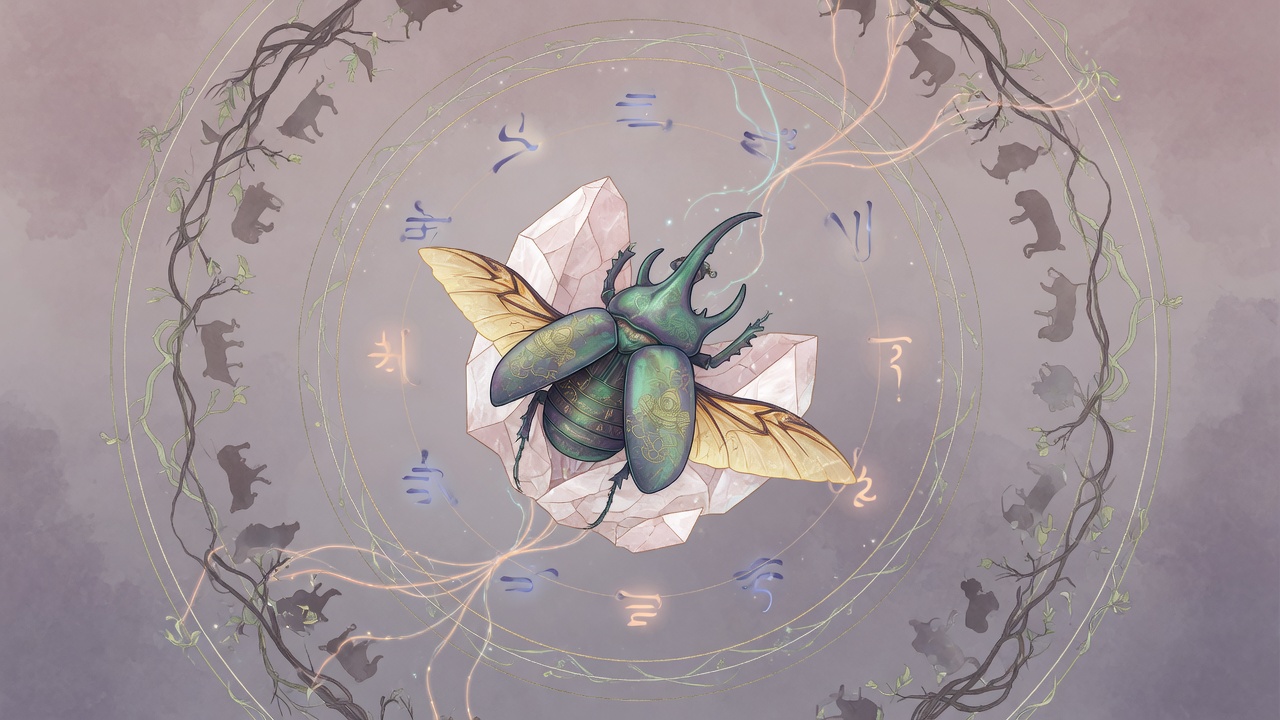
The core image of *Kamen Rider Kabuto* is the rhinoceros beetle, an insect that undergoes a complete metamorphosis from egg to larva to pupa to adult, especially the explosive moment of breaking out of the pupa. This perfectly coincides with the characteristics of Jia Wood in Ba Zi.
Jia Wood is the first of the Heavenly Stems, corresponding to the east and spring; its nature is yang wood, like a towering tree, and even more like the force of a seed pushing through the soil upward. People with Jia Wood as the Day Master have an innate drive to break through constraints and lead, but they often have to undergo a 'latent period' before success, much like the Rider's heavily armored form before Cast Off.
The switch between Kabuto's Masked Form and Rider Form can be seen as Jia Wood's process from 'buried' to 'emerging'. When the Heavenly Stem Jia Wood appears and gains root energy, it is like the Rider shouting 'Henshin' and entering Clock Up, fully releasing its power. This also explains why many classic IPs evoke a stronger resonance when they return after many years—timing is another form of 'Jia Wood breaking through the earth'.
- Nature of Jia Wood: towering, upright, responsible, indomitable, yet possibly overly rigid and inflexible.
- Shell-breaking imagery: In Ba Zi, if Jia Wood is the Day Master and is carved by Geng Metal, it represents refinement through adversity, just as Kabuto continuously grows through Clock Up in combat.
- Cultural connection: The rhinoceros beetle symbolizes 'victory' and 'tenacity' in Japanese culture, while Jia Wood in Eastern philosophy also represents vitality and championship imagery—both are spiritually aligned.
Ten-Year Luck Cycles and the Sixty-Year Jia Zi: Life's Transformation Cycles
Ba Zi fate analysis relies on a precise periodic system: the Ten Heavenly Stems (Jia, Yi, Bing, Ding, Wu, Ji, Geng, Xin, Ren, Gui) and the Twelve Earthly Branches (Zi, Chou, Yin, Mao, Chen, Si, Wu, Wei, Shen, You, Xu, Hai) pair sequentially to form the basic cycle of sixty Jia Zi. For example, Jia Zi, Yi Chou... up to Gui Hai, exactly sixty years, then repeat.
Against this backdrop, everyone enters the flow of luck cycles (Da Yun) starting from birth. Da Yun is calculated in ten-year units, derived from the month pillar and ordered based on gender and the yin-yang polarity of the year stem. Every ten years the Da Yun stem-branch changes, meaning life enters a new 'climate zone.' This is like how the *Kamen Rider* series is rebooted or new works are launched every several years; each generation of audiences experiences different luck cycle markers on the clock of destiny.
Specifically, the heavenly stem of a ten-year luck cycle governs the first five years, the earthly branch the last five years, but in practice stem and branch must be viewed together. If a certain luck cycle happens to be rich in Jia Wood, such as Jia Yin or Jia Chen, it often brings identity shifts, entrepreneurship, and opportunities to step into the spotlight. The span of twenty years is exactly one complete alternation of Da Yun combined with some matching annual lucks. It is no wonder that the return of *Kabuto* after twenty years becomes a resonant movement for both the creative team and fans in terms of 'luck cycles.'
- Jia Zi cycle: 60 years is a complete cycle, symbolizing a closed loop from beginning to fulfillment, like a person from birth to the age of sixty.
- Ten-year step luck: Each ten-year luck change brings noticeable shifts in living environment and mental state, similar to how the tokusatsu series produces milestone works every decade.
- Year Luck coinciding with Da Yun: When the annual luck stem-branch matches the Da Yun, like overlapping old and new Kabuto forms, both good and bad forces are magnified—a node of life transformation.
- Twenty-year return: When the annual stem-branch resonates with the original broadcast year, traditional culture sees it as a 'reconnection of qi,' making the work's return easily trigger collective nostalgia and renewed fervent response.
Rationally Viewing Time Rhythms: From Classic Revival to Personal Transition
Ba Zi emphasizes not only the cycle itself but also the rational grasp of 'timing' and 'positioning.' The Heavenly Stems and Earthly Branches calendar is like a cosmic clock, constantly reminding us that all things have rhythmic rises and falls. Kabuto's theme, 'the path of heaven,' can be understood in fate study as reverence for the movement of Five Element Qi.
A work regains vitality after 20 years not because time flows backward, but because the annual qi resonates with the 'birth energy' of the original. Similarly, if a person feels lost or breaks through during a Da Yun transition, it is essentially a restructuring of the Five Elements aura. The most rational approach is not panic or blind action, but like Kabuto, examine one's 'shell' and 'base.'
For those in a luck transition period, traditional fate study often advises: first observe the imagery calmly, then act in accord with the trend. For example, when entering a Jia Wood Da Yun, one can accumulate learning and expand networks, waiting for an annual luck that reveals Jia Wood or gives strong Yin/Mao roots before exerting force. Classic revivals remind us that every ending is the start of a new cycle, and every molting is only to better accelerate forward.
- Heavenly Stems and Earthly Branches are a statistical model: They record energy bands under the laws of Earth and celestial movements, not mysterious forces.
- Luck change does not equal disaster: A ten-year luck change is like switching scenes; though there is an adaptation period, it may be the prelude to a major opportunity.
- Jia Wood's tenacity: If the Day Master is Jia Wood and meets a Geng Metal Seven Killings Da Yun, it appears suppressive but actually forges one into a vessel, just as Kabuto evolves into Hyper Form when facing formidable foes.
- Times create heroes: The 'timing' in Ba Zi is precisely the energy window that allows heroes to emerge. After 20 years of accumulation, the classic met its time.
Avoidance Guide: Stay Clear-Headed When Using Cyclic Wisdom
Rational Application of Fate Cycle Knowedge
- Do not equate the sixty-year Jia Zi with reincarnation fate. The cycles in fate study are spiraling upward; every return carries new foundations and higher dimensions, just as a new work is not a simple remake but an inherited development.
- Avoid blindly waiting for the 'Jia Wood breaking through' good luck. Although Jia Wood represents breakthrough, without root energy and moisture, it becomes rootless wood. One must actively learn and accumulate, waiting for the luck to arrive before riding the wind.
- Avoid using Ba Zi cycles to label others or events. Especially do not interpret the personal fortune of *Kamen Rider Kabuto* actors, as that crosses the boundary of cultural education. We only discuss symbolism and philosophy.
- The 20th anniversary is only a cultural concept. In fate study, everyone's starting point of Da Yun differs; one cannot directly apply a work's Gregorian anniversary to match personal rhythms without rigorous chart erection.
- Cast Off is not a one-time transformation. Kabuto upgrades multiple times in the show, corresponding to how each Heavenly Stem emergence or clash/combinaton can bring a form shift in Ba Zi. Life is not achieved in one stroke but through continuous growth and iteration.
- Guard against excessive worship of 'Jia Wood.' While Jia Wood is excellent, if out of balance, excessive yang wood leads to impulsiveness and stubbornness. True strength, like water and earth, knows how to combine hardness and softness—this is the wisdom of Five Element balance.
Summary and Recap
The 20th-anniversary new work of *Kamen Rider Kabuto* lets us see how a classic is reborn through the cyclic philosophy of Heavenly Stems and Earthly Branches. The Jia Wood breaking out of its shell, the alternation of ten-year luck cycles, and the sixty-year Jia Zi cycle all tell us: Metamorphosis is not a betrayal of the past, but the greatest respect for the rhythm of time.
When the Rider dons armor again and life's luck cycle turns once more, why not use Jia Wood's courage to break the old shell, and Geng Metal's carving to refine oneself, seizing your own moment of 'Clock Up.' Remember, fate study is not a shackle, but an ancient wisdom tool that synchronizes life with the cosmos.